
Reference Edition · Version 1.0, August 2026 · 77 pages, 31 sections, 5 appendices
The structure is designed in weeks or months. The economics are read for years. The Durable Law-Firm MSO is Guardian Tax Consultants®' reference on what a law-firm management services organization has to do, document, and prove — every year — so that its operating substance, intercompany economics, governance, and contemporaneous record hold up when a professional-responsibility regulator, a taxing authority, or a buyer or lender opens the file. It is written for owners who may never transact, for the counsel who own every legal conclusion in the structure, and for the buyers and lenders who eventually price the record. This page is the Reference Edition's canonical public surface: it states the framework, maps the questions the paper answers, and routes each to the technical brief in this library that owns it. The full paper is available here as an ungated PDF.
Download the 77-Page Reference Edition (PDF)
Ungated · Version 1.0, August 2026 · 802 KB, no email required
Canonical Answer
What is a durable law-firm MSO?
A durable law-firm MSO is a separate company that provides a practice's nonlegal services — administration, finance, technology, marketing, facilities — under a management services agreement, priced at arm's length, and that is built to operate as a real business rather than solely for a transaction: performing identifiable nonlegal functions, using its own personnel and assets, bearing appropriate risks, maintaining defensible intercompany economics, and producing a contemporaneous record over time. It does not practice law, own the practice, share in legal fees, or direct legal judgment. A signed set of formation documents establishes entities and contracts; it does not by itself establish that the parties operated according to those documents afterward, or that the management fee reflects services actually performed. Durability reframes the question from "was an MSO formed?" to "can the structure be explained and supported from what actually happened, year after year?" That is the governing thesis of The Durable Law-Firm MSO — Reference Edition (Guardian Tax Consultants®, Version 1.0, August 2026).
Operating doctrine: one structure, one contemporaneous record, three later readers.
Why the Durability Question Comes Before the Transaction Question
Most writing on law-firm MSOs treats the structure as a transaction device — separating the licensed practice from the services company, satisfying Rule 5.4, papering the management services agreement, admitting a sponsor. That work is essential, and the Reference Edition does not compete with transaction counsel on it. But standing up the structure is half the problem, and often the smaller half. Many firms building these platforms are not in a process and may never be. What moves them is the form itself.
The traditional practice — a partnership or professional entity owned entirely by its licensed practitioners, distributing substantially all of its income each year — was designed to preserve professional independence, and it does that well. It was never designed to do what every comparable operating business does as a matter of course: admit outside capital, build transferable enterprise value, grant ownership to the operators who build it, and invest across more than one budget cycle. The Reference Edition names four constraints (Section 02): outside capital is structurally constrained under Rule 5.4; a typical buy-in is more accurately described as a claim on future draws than as the purchase of an appreciating asset, so the wealth a firm creates every year is hard to carry out at the end; the retention tools other industries rely on are generally unavailable, because operators cannot hold equity in the practice outside those same carve-out jurisdictions, and covenants restricting a departing lawyer's right to practice are barred by Rule 5.6(a) and its state analogues, outside the rule's retirement-benefit exception and state variations; and multi-year investment competes with current distribution, sharpened by the fact that partners are taxed on retained income whether or not it moves. Where built value cannot be captured, the incentive to build it goes with it.
A management services organization can address each constraint structurally — but only if the platform is actually operating. Whether it does, in any given firm, depends on the professional rules of Part Two and the operating substance of Part Three being satisfied in fact, not on the org chart. And the Reference Edition is explicit that these constraints are hypotheses to test: feasibility begins with the non-tax operating objective the firm is trying to solve, and a structure sized to a desired tax result rather than to the business actually conducted is outside the durability framework described here.
Three Owners, One Operating Discipline
The same discipline serves three different owners (Section 03). They are not three service models; what changes between them is timing, and whether a buyer's diligence ever joins the list of readers.
- The owner who holds. A legitimate, well-governed operating platform for the long term — operating separation that holds, a fee that reflects real work, governance a lender or regulator reads without alarm, support for accumulating capital inside the platform, and reduced dependence on a future sale as the thing that finally justifies the structure. In Guardian's experience the largest group, and the least written-for. Guardian's own law-firm platforms, built since 2022, were formed to operate, not to sell; in its practice the non-transactional platform is the base case.
- The owner who raises capital. Outside capital, debt financing, investment in technology at a scale a partnership is poorly built to fund out of current earnings, acquisitions, and talent retention through equity-like participation in the services entity — without an immediate transaction.
- The owner approaching a transaction. Operating-history presentation, quality-of-earnings readiness, the contemporaneous transfer-pricing file a buyer's team will open, and continued administration after closing, because the platform still has to run once the deal is done.
For what Guardian Tax Consultants® does for each of these owners — feasibility, design, build, and administration — see For Law Firms.
The Three Continuing Reviews — and the Fourth Reader
The Reference Edition's central device is that a law-firm MSO is tested not by a counterparty at the table but by three reviewers who reopen the same record later, each for a different purpose (Section 05).
- A professional-responsibility or regulatory reviewer asks whether the arrangement still honors the profession's limits on nonlawyer ownership and fee-splitting — under Rule 5.4, its state analogues, and the statutes Illinois and Colorado enacted in 2026 — and reads operating reality across years, not a formation deck frozen at closing.
- A taxing authority asks whether the management fee, the accumulation of capital, and any claimed gain exclusion reflect economic substance — under §482, §269A, §531, and §1202 — on the record built while the platform operated.
- A buyer, lender, or recapitalization committee asks whether the platform owns real value and whether the intercompany economics have been administered consistently enough to underwrite. The first two reviews test whether a position holds. The third prices what it finds — in the currency of the transaction: a lower multiple, a larger escrow, an indemnity holdback, a delayed close.
There is a fourth reader, in a different category. The owner's continuing adviser team — counsel, the CPA, the economist, the benefits and estate advisers — renders no external verdict, and each decides real questions inside a separate lane. What none of them is engaged to do is read the whole. The fourth function is administrative: reading the record across the lanes every year, noticing while the facts are still fresh that the documents, the economics, the books, the governance, the filings, and the estate plan still describe the same business, and routing each discrepancy to the professional responsible for resolving it. That is administration of alignment — never custody of privileged communications, client files, or professional judgment, which stay where the rules put them. Three verdicts, one administrator. The three reviewers test whether the record held; the administrator is why it does.
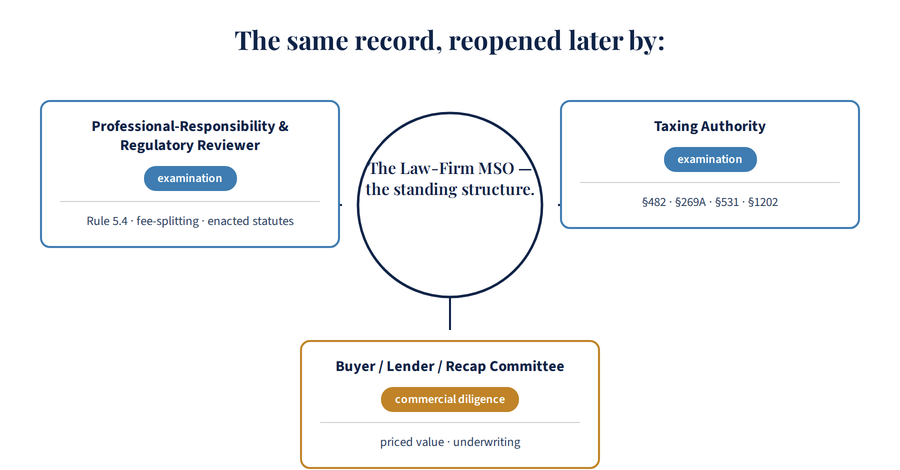
Three reviewers reopen the same record — two examinations and one commercial diligence. The third arrives only if the owner chooses a transaction; the first two can arrive whether or not the owner chooses anything.
Deeper treatment: The Three Continuing Reviews of a Law-Firm MSO.
What the Reference Edition Answers — and Where Each Answer Lives
The paper runs to 31 sections in four parts, with five reference appendices. The map below names the question each part answers and routes it to the brief in this library that owns it in depth. This page states the framework; the briefs carry the detail; the PDF carries everything.
Part One — The Practice and the Business (Sections 01–10)
- What is a law-firm MSO, in an institutional sense? — What Is a Law Firm MSO?
- What can the traditional practice structure not do, and what problems does the platform exist to solve? (Sections 02, 04) — the diagnosis above; the debt is personal, the income stops, the contingency practice runs hot and cold, the operators cannot own and the producers can leave, retained dollars are taxed and then re-argued. For the contingency practice specifically: Law-Firm MSOs for Personal Injury Firms: What Changes?
- Which entity shape? (Section 04) — Three illustrative shapes recur: a pass-through platform (Variant I, where the §199A analysis lives); a pass-through platform with a companion C-corporation engaged under its own services agreement for defined functions, retaining capital and financing deferred compensation, with no cross-ownership between the two (Variant II); and a C-corporation platform holding the operations, systems, and company-owned intellectual property inside it (Variant III, where the §1202 analysis attaches). The paper recommends none; the operating facts, with counsel and the CPA, select the entity, and the entity is never selected to manufacture a result. — Law Firm MSO Setup: How the Structure Is Built and Reviewed
- Who reviews the structure, and when? (Sections 05–06) — The Three Continuing Reviews
- How much operating history is enough before a process? (Section 07) — The paper declines to invent a number: no authority establishes a safe harbor at four months, a year, or any other line. What exists is an evidentiary continuum — formation documents, then several operating cycles, then one full year with a filed return and a fee refresh, then multiple years with trend evidence and a method re-selected as facts changed — and each point on it is read differently. — Law-Firm MSO Transaction Readiness: Why the Platform Must Operate Before a Sale
- What does a transaction actually transfer, and what does it not? (Section 08) — The investor acquires interests in a holding entity over the management company; the owners roll equity and keep a stake; the licensed practice does not change hands at all; and in the companion-corporation pattern the corporation sits outside the purchase while its platform-facing fee is commonly terminated or re-scoped, because a related-party fee flowing to the sellers' retained corporation is leakage from the stream being priced. — How Outside Capital Enters a Law-Firm MSO. For the deal-side record on this site: Law-Firm MSOs for Private Equity: A Sponsor-Side Guide, Law Firm M&A in 2026, Regulatory Puts and Cure Mechanics, The Law-Firm MSO Transaction Pipeline, and A Seven-Partner Illustrative Structure.
- When is the answer no? (Section 09) — When the Answer Is No: Six Conditions Under Which a Law-Firm MSO Should Not Be Built. A framework that cannot describe its own boundary is a sales document.
- Where does Guardian fit? (Sections 10, 31) — For Law Firms.
Part Two — The Rules and the Reviewers (Sections 11–15)
- How does Rule 5.4 constrain a law-firm MSO? (Section 11) — Rule 5.4 and the Law-Firm MSO. All four subsections of the rule, not only (a) and (b); why the fee's measurement basis is load-bearing; what Texas Ethics Opinion 706 held and — as importantly — what it did not; and the design lines for confidentiality under Rules 1.6 and 5.3, client funds under Rule 1.15, marketing under Rules 7.1–7.3, and the partner's own conflict under Rule 1.7(a)(2).
- What did Illinois enact? (Section 11) — Public Act 104-0801, approved August 7, 2026, effective on approval. Illinois Law-Firm MSO Requirements.
- What do Colorado's 2026 statutes require? (Section 12) — HB26-1421 (effective August 12, 2026; repeals September 1, 2029 absent further action) and SB26-174 (lead-generation marketing for legal services, defined as paying a third party for information about a potential client, designated a deceptive trade practice). Colorado HB26-1421 and SB26-174.
- How should a multi-state firm design for the jurisdictional patchwork? (Section 12) — Most jurisdictions have said nothing, and silence is not permission; Rule 8.5 makes which state's rules apply a question in itself; the permissive regimes — Arizona's ABS code, Utah's closing sandbox, Washington's applicant-specific pilot, the District of Columbia's Rule 5.4(b), Puerto Rico's conditioned 49% allowance — are carve-outs that do not travel. The durable posture is to design to the most restrictive regime the firm is meaningfully exposed to. ABS, the Utah Sandbox, and the MSO · Jurisdictional Design for MSOs
- How do independence and economic separation reinforce each other? (Section 13) — An investor's economic participation is confined to the platform's own enterprise value and earnings, determined by a fee set independently of the practice's revenue, profit, and matter outcomes. The paper names the tension rather than assuming it away: decoupling the fee's measurement does not decouple its source.
- What does the tax examiner test, and what does the buyer price? (Sections 14–15) — The Three Continuing Reviews; buy-side diligence adds coverage architecture and retention design as diligence surfaces of their own.
Part Three — The Economics That Survive Review (Sections 16–23)
- What transfers from MSO durability in other professions and industries, and what does not? (Section 16) — The durability spine, the after-formation enforcement pattern, and the control-in-substance analysis transfer; the doctrine does not. Corporate-practice-of-medicine outcomes are analogy for a law-firm platform, never authority.
- What has to be real? (Section 17) — Six things, documented and contemporaneous: real people, real agreements, real books, real governance, real deliverables, real insurance. Where substance is thin, no documentation cures it. — Law Firm MSO Agreement
- How is the management fee set and defended under §482? (Section 18) — Law Firm MSO Management Fees: Beyond the Fee Formula for the law-firm application, and How MSO Management Fees Are Calculated for the method generally. The Reference Edition's position is the one this site applies throughout: the fee is set on a documented method fixed in advance and benchmarked under §482 among the seven method categories of Treas. Reg. §1.482-9 — it is never a percentage of legal fees, revenue, or profit, and any later true-up applies the pre-existing method to actual costs or operating data rather than resizing the charge to a target margin or tax result. The fee discipline ordinarily confines the platform to an arm's-length return for the nonlegal functions, assets, and risks it actually owns and performs; a nonroutine return requires nonroutine substance of the platform's own; the practice's legal-services residual stays with the practice. See also management-fee ethics commentary.
- How does a durable MSO differ from an arrangement that gets unwound? (Section 19) — Aspro read for what it held, H.W. Johnson read for what it did not, §269A's personal-service-corporation threshold, and the material-advisor and promoter provisions the paper turns on its own author.
- What must a corporate platform document about retained capital? (Section 20) — MSO Cash Uses and §531 Accumulated Earnings. For the law-firm application: Law-Firm MSO Retained Capital: Growth, Retention and Succession.
- Does §1202 apply, and where are its limits? (Section 21) — Only where the management entity is a C corporation holding the operating business and company-owned IP; analyzed, not promised; and best supported by an annual record of why the business did not disqualify itself. Section 1202 QSBS MSO Strategy · The §1202 Active-Asset Test
- The asset-location conflict. (Section 22) — A corporation that retains capital under §531 and holds stock positioned under §1202 answers to both regimes at once, and the natural response to the personal-holding-company income test can impair the §1202 position. Because one exposure is curable annually and the other is not, the one that is not curable is decided first — at formation.
- The qualified business income question. (Section 23) — §199A is claimed owner by owner, so a fee costs nothing in §199A terms for partners already phased out and reduces a live deduction for those who are not; the "crack and pack" objection is answered by reading Treas. Reg. §1.199A-5(c)(2), which allocates SSTB character to a commonly owned supplier for §199A purposes only and settles nothing under §1202. The classification is the CPA's, made early and documented.
Part Four — The Record Over Time (Sections 24–31)
- What does the annual substantiation cycle require, and what belongs in the annual evidence file? (Sections 24–26) — The Annual Substantiation Cycle for a Law-Firm MSO, with the Law Firm MSO Governance Checklist as the working companion.
- What separates a durable record from a thin one? (Section 27) — Two platforms identical at closing, diverging only in the record built afterward — invoice by invoice, minute by minute.
- What happens when a partner leaves, retires, or dies? (Section 28) — Four questions answered at formation: who may hold platform equity, how the interest is valued, how the transfer is funded, and what happens to the fee. — Law-Firm MSO Succession and Equity: Building Transferable Value
- What does the corporation do after a transaction? (Section 29) — The companion corporation's change of job, the personal-holding-company clock, and the paths available on appropriate facts.
- What can be repaired in a structure someone else built? (Section 30) — A documentation problem is largely remediable going forward; a substance problem is not remediable by documentation; and backdating is not a remediation technique.
- Who administers the record, and what does the work consist of? (Section 31) — For Law Firms.
Appendices A–E cover what each reviewer expects to see and what the record administrator keeps aligned annually; a reference set of frequently asked questions; a glossary; cited authorities classified by weight; and transaction readiness by category. They are in the PDF and are not reproduced on this site in Version 1.0.
Download the 77-Page Reference Edition (PDF)
Ungated · Version 1.0, August 2026 · the complete paper, with all 31 sections and 5 appendices
Governance: What the Record Has to Contain
The Reference Edition's operating claim is that durability is administered, not declared. The record it describes — kept every year, never reconstructed — is a controlled information architecture of ten moving parts held in alignment as each changes: the management services agreement; the current service scope as actually delivered; the economic study supporting the fee; the intercompany invoices; the cost allocations behind them; the governance decisions of record; the documented business purpose for capital retained; the financial reporting; the tax positions as filed; and the transaction diligence materials, if a process ever comes. The cycle terminates in a signed Annual Governance Certification rather than a memo, and it is built to be produced: where the §6662 documentation rules apply, penalty protection is conditional on contemporaneous transfer-pricing documentation in existence when the return is filed and produced within thirty days of a request (Treas. Reg. §1.6662-6(d)), with no retroactive cure, and asserting privilege over the substantiation itself is worse: the documentation was created to be shown, withholding it forfeits the protection it was meant to earn, and a privilege claim over a taxpayer’s own transfer-pricing file reads to a reviewer as an answer about the position rather than about the document. Counsel owns every legal conclusion in that file. Independent economists own the fee study. The firm's own CPA owns the returns. Guardian Tax Consultants® owns the accuracy and completeness of the record it administers and the transition it executes — and nothing that constitutes the practice of law.
An Illustrative Engagement
A litigation and consulting practice with net income swinging between roughly $2 million and $5 million on settlement timing, living four of the paper's problems at once — liquidity pressure in lean years against continuous costs, strong years landing at top personal rates just as the next docket had to be funded, property and practice interests commingled, no succession framework, and no retention structure for the attorneys most likely to leave. A corporate management platform in Variant III's shape, with the fee set on a method and benchmarked under §482 in every year, high-settlement and lean alike; the retained capital, built from the platform's own earned service revenue, funded vesting retirement benefits for the at-risk attorneys who also held documented management roles at the platform, key-person coverage, a documented settlement-cycle liquidity reserve, intercompany credit serviced as genuine debt, and a funded buy-sell. The Reference Edition's Section 04 illustration is an anonymized composite that draws on this and other engagements; the business purposes came first, on the record, in the year they were adopted. Read the case study. Results are neither typical nor promised.
Get the Reference Edition
Download The Durable Law-Firm MSO — Reference Edition (PDF, 77 pages)
Publication: The Durable Law-Firm MSO — Operating substance, annual substantiation, and the architecture that holds up, whether the firm is held, financed, or eventually sold
Edition: Reference Edition · Version: 1.0 · Published: August 2026
Length: 77 pages · 31 sections in four parts · Appendices A–E
Publisher: Guardian Tax Consultants® · MSO Platform™ (founded 2011; MSO-focused since 2018; law-firm MSO practice since 2022)
Canonical web location: https://msoplatform.com/insights/durable-law-firm-mso/
Authorities current through: September 2, 2026 (per Section 11 and Appendix B)
Suggested citation: Guardian Tax Consultants®, The Durable Law-Firm MSO — Reference Edition, v1.0 (Aug. 2026), msoplatform.com/insights/durable-law-firm-mso/
Version history: v1.0 — initial public edition. Later editions will be listed here; prior versions are not overwritten.
Written for owners, for counsel, and for buyers — and for the three reviewers who will read the record later. Questions specific to a firm's own facts belong in a feasibility review, not in the paper: request a feasibility review, request a counsel briefing, or inquire about a platform review.
Related Insights
- The Three Continuing Reviews of a Law-Firm MSO
- The Annual Substantiation Cycle for a Law-Firm MSO
- When the Answer Is No
- Rule 5.4 and the Law-Firm MSO
- Law Firm MSO Management Fees: Beyond the Fee Formula
- Law Firm MSO Case Study: Settlement-Driven Income and a Succession Platform
Frequently Asked Questions
What is a durable law-firm MSO?
A management-services structure built to operate as a real business rather than solely for a transaction, whose legal relationships, actual operations, intercompany economics, governance, and documentation remain coherent and supportable over time. See the Canonical Answer above.
Why do firms build this with no transaction in view?
Because the traditional form creates real wealth annually but little a partner can carry out at the end, and a form in which built value cannot be captured weakens the incentive to build it. The platform is the part of the enterprise where transferable value can exist and compound — toward succession, operator equity, retention, and multi-year investment — whether or not any outside party ever appears.
Can the MSO fee be a percentage of firm revenue?
That is a jurisdiction-specific legal question for the firm's own counsel, and Guardian does not answer it. As background: Texas Ethics Opinion 706 (2025), an advisory opinion that binds no one, concludes that a lawyer may not pay a nonlawyer-owned support-services company a fee measured as a percentage of the lawyer's or firm's revenues; it does not address flat or cost-plus fees and approves no alternative structure. Illinois Public Act 104-0801 now reaches fees keyed directly or indirectly to a firm's fees, revenues, or profits. The design the Reference Edition applies is a fee set on a method fixed in advance and decoupled in its measurement from firm revenue, profit, and matter outcomes.
What is the annual substantiation cycle?
A fixed-calendar discipline under which the fee's method and support are refreshed on current facts each year, minutes record the business purpose for retained capital as decisions are made, services are invoiced on a real cadence, and independence is documented as an operating fact — closing in a signed Annual Governance Certification. A record produced only when someone asks for it is produced in the year someone asks, reliably not the year a reviewer arrives.
Is there a court case approving law-firm MSOs?
Research through September 2, 2026 identified no adjudicated holding approving or invalidating the modern law-firm MSO structure as a whole. Durability rests on Rule 5.4, enacted state statutes, ethics opinions, and analogical non-law-firm tax authority, classified by weight in Appendix D.
Disclaimer
Informational only. Applicability depends on the specific facts, structure, and advisory environment of each engagement. Guardian Tax Consultants® provides MSO strategy, modeling, documentation coordination, governance support, fee-methodology coordination, and advisor-integrated implementation support. GTC™ does not provide legal opinions, prepare tax returns, or replace the client's independent CPA, legal counsel, investment advisor, insurance advisor, or family office. Tax and legal advice, tax-return positions, legal conclusions, filings, and opinions are provided by the client's independent legal and tax advisors. Guardian Tax Consultants® is not a law firm, does not practice law, and expresses no view on whether any arrangement satisfies any jurisdiction's rule. Case illustrations are anonymized composites; results are neither typical nor promised. No outcome promises. No pre-packaged structures.