
A law firm MSO agreement, the management services agreement connecting the two entities, is where the structure holds together or quietly comes apart. Here is what counsel, lenders, economists, and buyers each read first.
In short: A law firm MSO agreement is the management services agreement (MSA) under which a management services organization provides defined nonlegal services to a licensed law practice. Advisors read it clause family by clause family: fee formula, control and staffing, records, term and termination, cure and wind-down, governance and transfer.
Educational only. It is not a template, form, drafting guide, or negotiation checklist. Drafting, negotiation, and any legal conclusion about a specific arrangement belong to counsel licensed in the relevant jurisdiction.
A law firm MSO is explained through its entities: the lawyer-owned practice on one side, the separately owned services company on the other. The entities are the easy part. A management services agreement for a law firm — the MSA connecting them — carries many of the operating boundaries between them, and recent statutes, bills, ethics authority and practitioner commentary now reach several of those boundaries directly. Sidley Austin puts it directly: “The MSA is the fulcrum of the MSO structure” (Sidley Austin, Private Equity Investment in U.S. Law Firms (Part II), March 25, 2026). Who decides what, who employs whom, who touches the client file, and what happens when the relationship fails are answered there or not at all.
One argument organizes what follows, and every clause family tests it. An MSO agreement is a description of a business. Whether the business still matches the description is answered by operations, not by the document. The question a reviewer asks in year three is whether the minutes, the invoices, and the system logs still describe the relationship that was signed.
From the Reference Edition
This topic is addressed in The Durable Law-Firm MSO — Reference Edition, Version 1.1, September 2026.
Relevant sections: Sections 13, 17 and 18.
What Does a Law Firm MSO Agreement Actually Do?
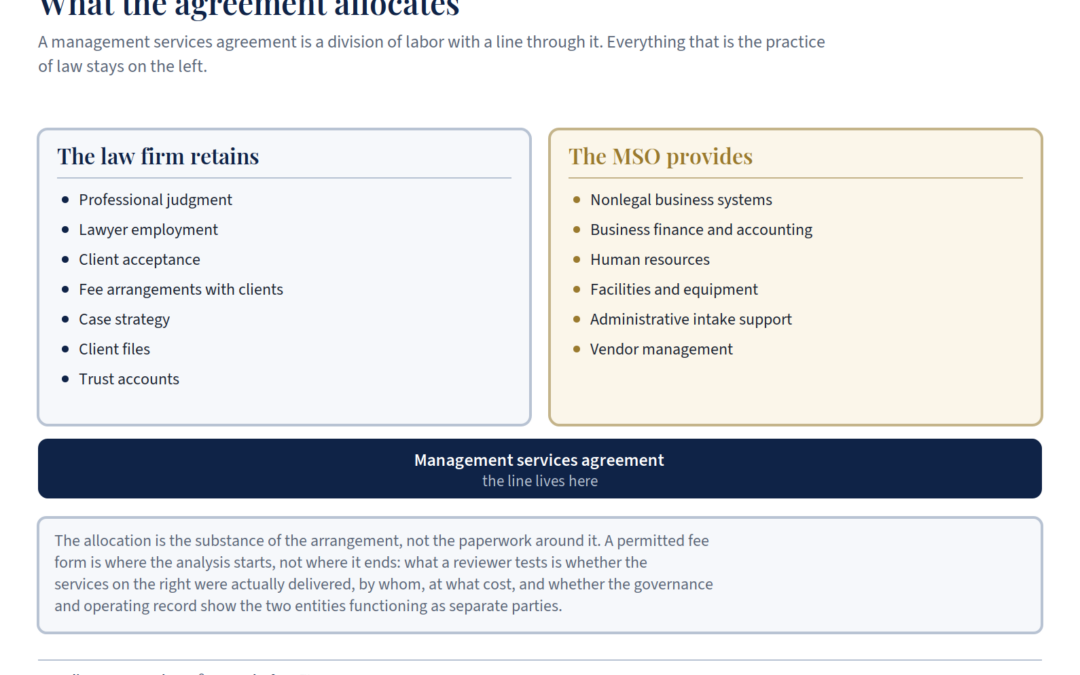
It divides one business into two, then reconnects the halves on stated terms. The firm keeps professional judgment, lawyer employment, client acceptance, fee structures, and case strategy. The MSO takes the nonlegal platform: technology, accounting, human resources, facilities, nonlegal intake, and vendors. Where an asset transfer accompanies the arrangement, Holland & Knight describes the MSO acquiring “substantially all of a law firm’s assets” while excluding those a law firm must own itself: “client records, engagement letters and offer letters, or employment agreements with lawyers” (Holland & Knight, Restructuring Law Firms Through Management Service Organizations, July 10, 2025). That short exclusion list is load-bearing.
Definitions and anatomy: what a law firm MSO is and the general management services organization definition. Standing the entities up: the law firm MSO structure guide. How sponsors underwrite these platforms: private equity-backed MSOs for law firms.
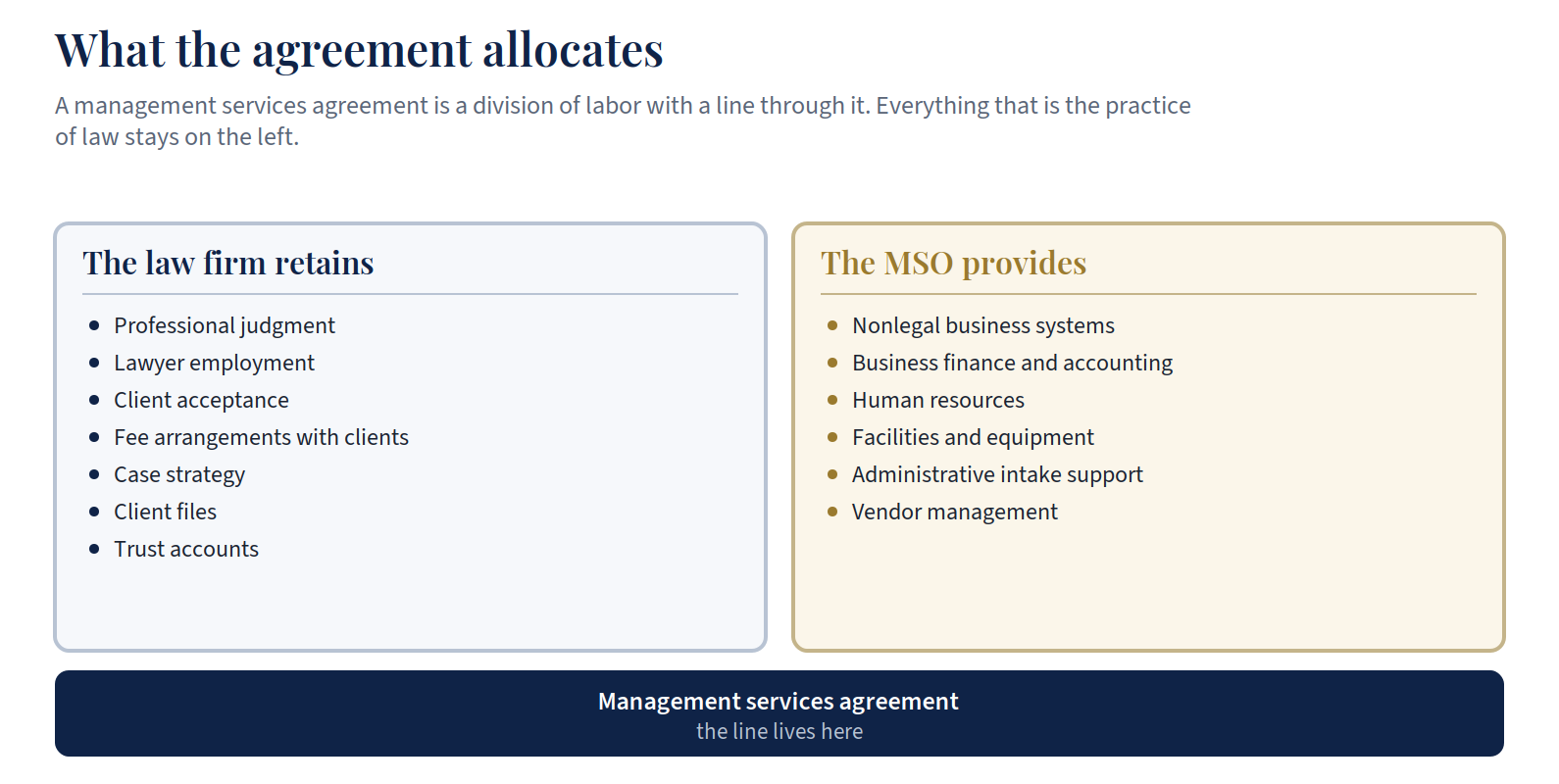
The allocation is the substance of the arrangement, not the paperwork around it. A permitted fee form is where the analysis starts, not where it ends: what a reviewer tests is whether the services on the right were actually delivered, by whom, at what cost, and whether the governance and operating record show the two entities functioning as separate parties.
Which Management Services Agreement Terms Do Advisors Read First?
Different reviewers open the same MSA to different pages. The table maps clause families to the question each brings.
| Clause family | What the reviewer looks for | Source |
|---|---|---|
| Fee formula | Payment for defined nonlegal services, structured to comply with applicable jurisdiction-specific fee-sharing restrictions | ABA Model Rule 5.4; Tex. Op. 706 (Feb. 2025) |
| Control and staffing | Judgment, strategy, and lawyer employment with the firm in substance | Ill. HB 5487 (Public Act 104-0801, approved August 7, 2026) |
| Service standards and change control | Whether the defined services are still being delivered, and how changes in scope, systems, personnel, or responsibilities are documented | No primary source; see the operating-record discussion below |
| Records, confidentiality, trust | Access limited and defined; trust funds outside MSO cash flows | Tex. Op. 706 (Feb. 2025) |
| Term and renewal | Term matched to the capital structure and succession horizon | No primary source; published commentary only (Clio, May 25, 2026) |
| Termination and independence exit | Whether the firm can exit for interference, and afford to | L.E.K., June 22, 2026; Breydo, April 30, 2026 |
| Restrictive covenants | Whether protective terms read as restrictions on practice | ABA Model Rule 5.6; Hunton, May 27, 2026 |
| Governance, transfer, collateral | Board composition, transfer rights, MSA as lender collateral | Sidley, March 25, 2026; L.E.K., June 22, 2026 |
| Client disclosure | Whether the agreement and its material terms are disclosed to clients | Ill. HB 5487 (Public Act 104-0801, approved August 7, 2026), as read by Dykema, June 10, 2026 |
Fee formula
What the reviewer looks for
Control and staffing
What the reviewer looks for
Source
Service standards and change control
What the reviewer looks for
Source
Records, confidentiality, trust
What the reviewer looks for
Source
Term and renewal
What the reviewer looks for
Source
Termination and independence exit
What the reviewer looks for
Restrictive covenants
What the reviewer looks for
Governance, transfer, collateral
What the reviewer looks for
Source
Client disclosure
What the reviewer looks for
Source
It is a reading order, not a form. What any clause should say is for counsel. The same families read against an illustrative structure: a seven-partner law firm MSO example.
How Is the Fee Clause Reviewed?
Texas Committee on Professional Ethics, Opinion 706 (February 2025) concluded that “a lawyer that engages a nonlawyer-owned company to provide a platform of support services may not pay or promise to pay fees to the company based on a percentage of the revenues of the lawyer or the lawyer’s firm” (opinion text). The rule it applied is Texas Disciplinary Rule 5.04(a): “A lawyer or law firm shall not share or promise to share legal fees with a non-lawyer, except that,” followed by enumerated exceptions. The opinion did not establish that another fee form is automatically permissible or economically supportable: it does not approve flat or fixed periodic fees, it does not mention cost-plus, and it enumerates no permissible fee forms.
Sidley treats formulas that “resemble a direct percentage of legal fees, gross receipts, or case recoveries” as higher risk, particularly in contingency-fee practices, and fixed fees for defined services, cost-plus arrangements, and fair-market-value pricing supported by third-party benchmarking as lower risk (Sidley, Part II). That is one firm’s risk gradient, not a holding, and it does not address whether a given amount is economically supportable. How the amount is built and documented: how MSO management fees are calculated.
Deficit funding: Hunton describes a “deficit funding” provision that “allows the law firm to operate at a deficit to meet its salary obligations to lawyers while satisfying its fee obligations to the MSO” (Hunton Andrews Kurth, May 27, 2026), a dependency term as much as an economic one. The reset mechanic: functions, personnel, costs, and risk allocation all move after signing, so reviewers look for whether the agreement contemplates revisiting the fee when they do, on what trigger, on whose evidence, and at whose cost.
Hunton frames the economic test plainly: “MSO fees need to be defensible in terms of the price charged for the service versus the value of the service provided” (Hunton, May 27, 2026). The agreement names the method; it does not substantiate it.
Who Controls Hiring, Staffing, and Professional Judgment?
Holland & Knight states the constraint this way: “The MSO cannot hire, fire, evaluate, discipline or control lawyers in ways that infringe on independent professional judgment,” and “[d]ecisions about client representation – including intake, conflicts, staffing, strategy and settlement – must remain with the firm’s lawyers” (Holland & Knight, Everything Old Is New Again, December 1, 2025). The qualifier matters: the constraint is framed around professional judgment, not every personnel decision. ABA Model Rule 5.4 supplies the independence baseline the commentary is reading against. Hunton cautions that protections can become “overly burdensome” and “be interpreted as quasi-non-competes” (Hunton, May 27, 2026).
The harder issue is whether approval authority means anything. Commentary published by Clio makes the operational version of the point directly: “When someone else controls the systems, budgets, and workflows surrounding a staffing decision, they exercise substantial functional control over that decision regardless of what the contract provides” (Clio, May 25, 2026). A firm can hold every decision right and still choose from a menu someone else wrote. Lev Breydo makes the governance version, describing arrangements that “started with clean governance and independent practice boards” and “drifted toward de facto investor control over professional decisions” (CLS Blue Sky Blog, April 30, 2026). Advisors need not accept that conclusion to take the discipline it implies: a control clause that cannot be traced into the operating record is a clause about intentions.
What Happens to Client Records, Confidentiality, and Trust Accounts?
Texas Opinion 706 matters here beyond its fee holding, because the facts presented to the committee read as a records specification. In the facts the committee was asked about, revenue data given to the services company was pooled and anonymized, no client lists were shared, no confidential client information was transferred, and the lawyers oversaw use of the platform (Texas Committee on Professional Ethics, Opinion 706 (February 2025)). The opinion approved no set of facts; it rejected percentage-of-revenue compensation, and those facts are the ones presented to it. Illinois goes further. HB 5487 bars MSO access to client records and attorney-client communications outright; it was approved by the Governor on August 7, 2026 and is now Public Act 104-0801, effective on approval (Illinois General Assembly, HB 5487, official bill status record). Clio states the benchmark in agreement terms: “The MSO should not be permitted to control client records, select or terminate attorneys or legal staff, or set competency or productivity parameters for legal professionals” (Clio, May 25, 2026), which suggests agreements state it rather than rely on general confidentiality language. See Illinois HB 5487.
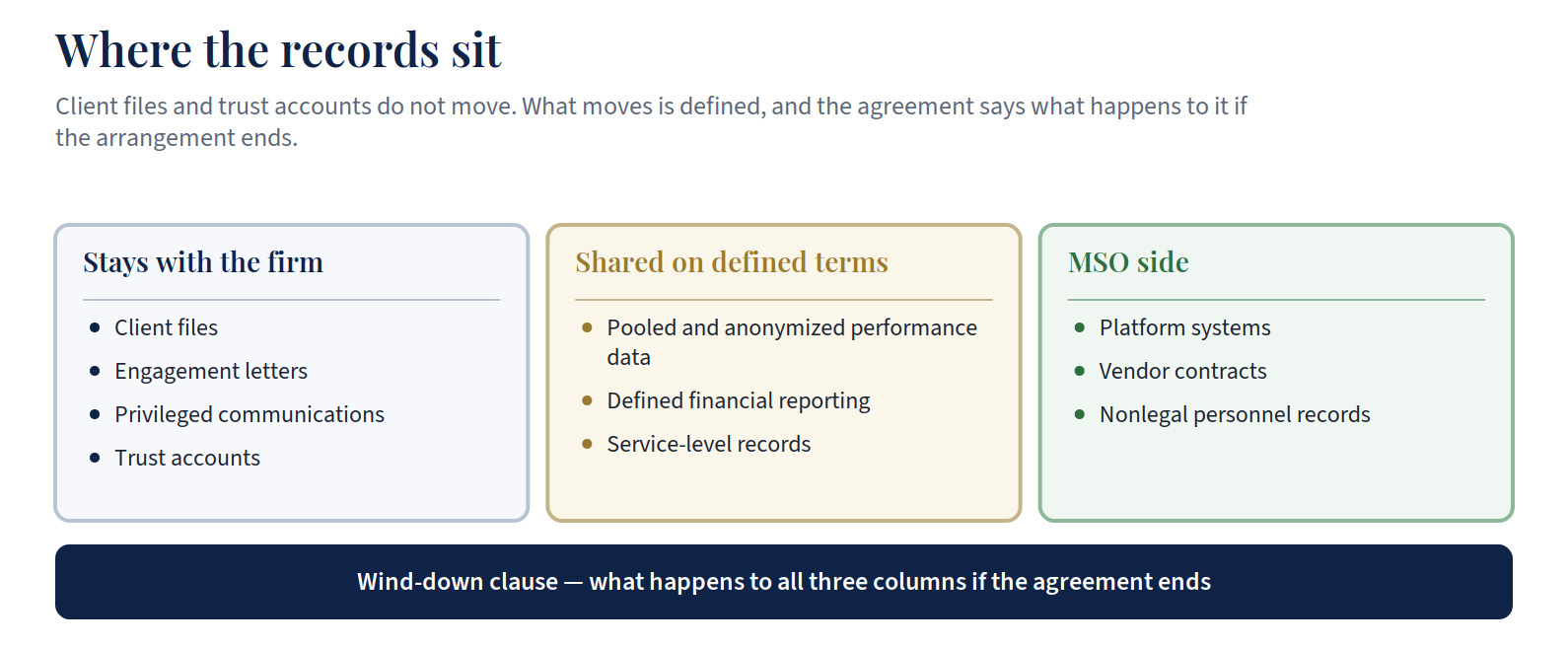
The wind-down clause is the term owners read last and reviewers read first. An arrangement that cannot be unwound without disrupting client files or trust accounts has a problem that no fee analysis will fix.
How Long Do MSO Agreements Last, and What Are the Termination Rights?
Three published sources address the exit right in similar terms. L.E.K. states that the MSA “must allow the law firm to exit without financial penalty if the MSO interferes with attorney independence or professional judgment” (L.E.K. Consulting, June 22, 2026). Breydo treats a real termination right where independence is compromised as a governance requirement (Breydo, April 30, 2026). Clio adds the practical qualifier: the right must be “financially feasible to exercise, meaning no prohibitive make-whole fees or restrictive covenants that render the right illusory” (Clio, May 25, 2026). The reviewed question is the same across all three: can the firm leave, and can it afford to. An exit made impractical by make-whole obligations, transition costs, or systems dependence is not one.
Deal-side economics of an unwind: the regulatory put.
What Do Lenders and Investors Add: Governance, Transfer, and Collateral?
The agreement is rarely negotiated by two parties alone. Sidley reports that “[l]enders commonly require security interests in, and collateral assignments, of the management services agreement” (Sidley, Part II, March 25, 2026). Termination or amendment may then require lender consent, and on a default the firm’s counterparty can change without the firm having chosen the replacement. An independence-exit right that needs a third party’s permission is a different right. Collateral and cure interaction: the regulatory put. Market context for the capital arriving on these terms: law firm M&A in 2026.
Sponsors bring their own governance terms, and the two published positions point opposite ways. The left column draws on Hunton Andrews Kurth, May 27, 2026; the right on L.E.K. Consulting, June 22, 2026.
| What the sponsor wants | What L.E.K.’s recommended architecture restricts |
|---|---|
| An exit unrestricted in the MSO’s organizational documents | No sponsor transfer of the MSO interest “without written law firm consent” |
| Board influence proportionate to capital at risk | Separate boards, MSO investors off the law firm board, and “at least one independent director with deep ethics and professional responsibility experience” |
| Performance oversight through the platform | A chief compliance officer reporting to the ethics committee, plus “annual independent ethics audit[s]” |
An exit unrestricted in the MSO’s organizational documents
What L.E.K.’s recommended architecture restricts
Board influence proportionate to capital at risk
What L.E.K.’s recommended architecture restricts
Performance oversight through the platform
What L.E.K.’s recommended architecture restricts
The right column is one consultancy’s recommended design rather than observed practice, and it sits in visible tension with the left.
How Are 2026 State-Law Developments Changing Law Firm MSO Agreements?
Between February 2025 and mid-2026, the four measures below address issues that can affect law firm MSO arrangements — three of them enacted or issued, one of them still a bill with no legal effect. The definitional sibling covers the same instruments from the entity side: what a law firm MSO is.
Texas
Instrument and status
What it reaches in the agreement
California
Instrument and status
What it reaches in the agreement
Colorado
Instrument and status
What it reaches in the agreement
Illinois
Instrument and status
What it reaches in the agreement
Whether a particular structure is reached in a given state is a legal question for counsel.
Which Advisor Reviews Which Term?
The mapping below is Guardian’s review framework keyed to clause families, not a professional consensus, and it does not reallocate anyone’s professional responsibility. The stage-by-stage version sits in the law firm MSO structure guide.
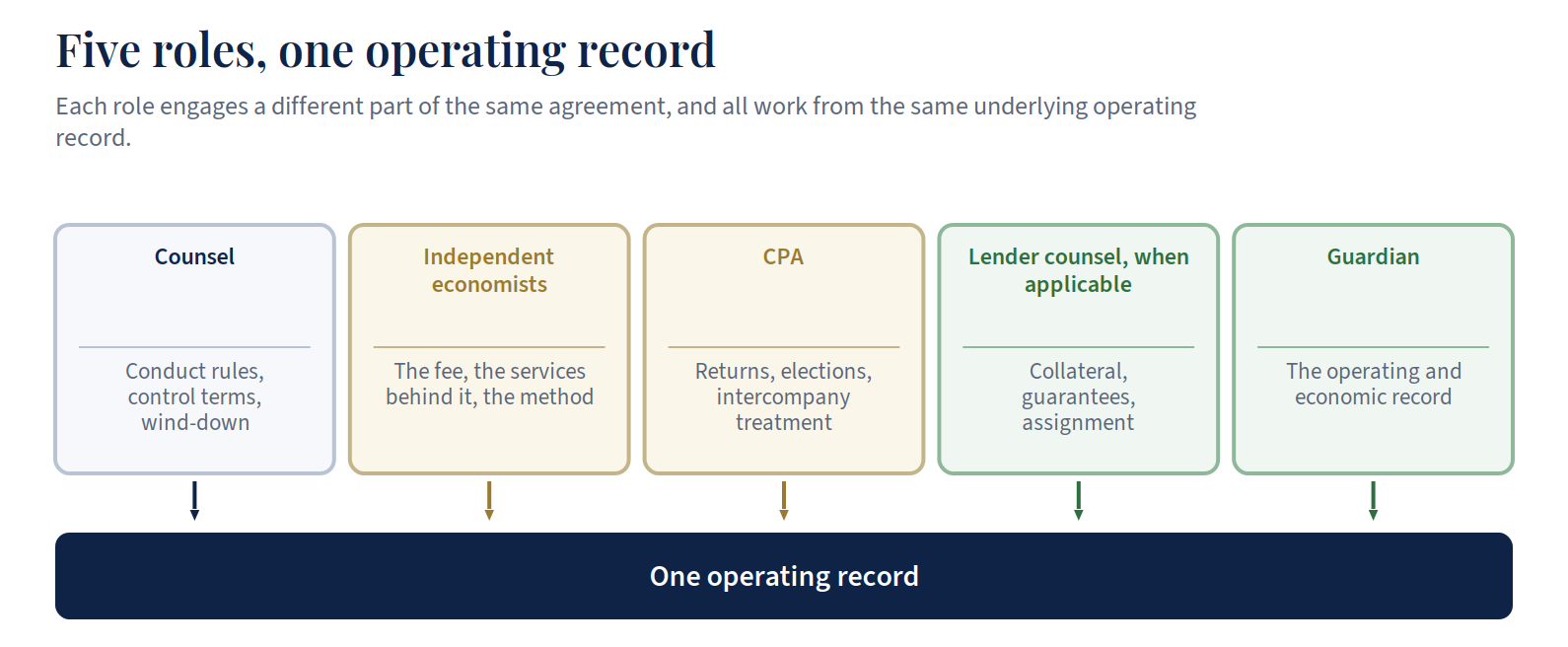
Each professional lane owns different conclusions, and any of them may read material outside the conclusion it owns. The distinction that matters is ownership, not access. Guardian's lane is administrative: to keep the operating and economic record coherent across those lanes without replacing their conclusions.
| Term under review | Who owns the conclusion | What the record has to show |
|---|---|---|
| Fee formula and permitted structures | Professional-responsibility and transaction counsel | Services delivered, priced by a stated method, invoiced consistently |
| Fee amount and economic support | Independent economists or valuation professionals | Functions, personnel, assets, risks, and a method selected on the facts |
| Tax reporting and return positions | The client’s CPA of record | Books and intercompany billing that reconcile to the agreement |
| Control, staffing, and records clauses | Counsel, with the firm’s ethics committee | Minutes, approval trails, and system-access records showing who decided |
| Term, termination, cure, wind-down | Counsel, with lender counsel | Transition provisions and a consent trail matched to any amendment |
| Whether the record still matches the document | Guardian Tax Consultants® | One operating and economic record all of the above can read |
Fee formula and permitted structures
Who owns the conclusion
What the record has to show
Fee amount and economic support
Who owns the conclusion
What the record has to show
Tax reporting and return positions
Who owns the conclusion
What the record has to show
Control, staffing, and records clauses
Who owns the conclusion
What the record has to show
Term, termination, cure, wind-down
Who owns the conclusion
What the record has to show
Whether the record still matches the document
Who owns the conclusion
What the record has to show
Why Does the Agreement Stop Describing the Business?
Because businesses move and documents do not.
The mechanisms are ordinary, and they need not involve a decision anyone records. A function can migrate across the line without an amendment. A service named in the schedule can stop being delivered while the invoice for it continues. An approval right can stay in the document while the budget process feeding it moves to the platform. That is drift, and it is legible only if someone keeps the record in a form all lanes can read at once.
How Are Changes to Services, Governance, or Economics Recorded?
Change is ordinary. Unrecorded change is the problem. Four questions organise the review, and none of them is answered by drafting language.
Does the change reach the document? A change in which services are actually delivered, in who decides, in the personnel and systems standing behind an approval right, or in how costs and risks are allocated reaches the terms that were signed. A change that leaves all four where the agreement put them does not.
Is an amendment needed, a consent, or both? Where the change alters the services, the economics, or the governance the agreement describes, what a reviewer looks for is the record named in the advisor table above: transition provisions and a consent trail matched to any amendment, kept as the change is made rather than reconstructed later.
Is a third party’s permission implicated? Where lenders hold security interests in and collateral assignments of the management services agreement, amendment or termination may require lender consent, so a change the two parties agree on is not necessarily a change they can make alone. On the equity side, L.E.K.’s recommended architecture would put a sponsor’s transfer of the MSO interest behind written law firm consent — a recommended design position rather than observed practice.
Does the fee analysis have to be refreshed? When functions, personnel, costs, or risk allocation move, the basis on which the fee was priced moves with them. That is the reset question the fee section describes: on what trigger, on whose evidence, and at whose cost. The conclusion stays where the advisor table puts it — the fee amount and its economic support with independent economists or valuation professionals, the fee form with counsel.
None of this is drafting. It is the question of whether the change left a trail a reviewer can follow.
The decision worth making early is narrow: name who keeps the operating record aligned with the agreement.
Where Guardian Tax Consultants® Fits
Guardian designs and administers the operating and economic record beneath an MSO structure: intercompany billing, financial reporting, the governance record, and the documentation a regulator, lender, or buyer eventually reads. The lanes stay clear.
Guardian keeps the record readable, so the answer to “does the business still match the description” is a document rather than an argument, which is what the law firm MSO case study walks through end to end. The economic report supports the operating company; it does not replace one.
Frequently Asked Questions
Is there a standard law firm MSO agreement template?
No, and a downloadable sample would be the wrong instrument. A law firm MSO agreement has to resolve scope, control, fee methodology, records, termination, and jurisdiction-specific professional-responsibility questions on the firm’s own facts — and since August 2026 it has to meet enacted state law in Illinois and Colorado that reaches fee design, client-contract disclosure, and administrative-staff compensation directly. A generic template cannot make those choices; counsel makes them on the facts, the economist supports the fee, and the agreement records what was decided. The sections above describe what the terms have to do; they are not a form.
What should a law firm MSO agreement cover?
It should cover the clause families a reviewer opens it to read: the fee formula; control and staffing; service standards and change control; records, confidentiality, and trust accounts; term and renewal; termination and the independence exit; restrictive covenants; governance, transfer, and collateral; and client disclosure. This article maps what each reviewer looks for in each family. It supplies no language for any of them, and what a clause should say in a particular structure is for counsel licensed in the relevant jurisdiction.
Is an MSO management fee the same as fee-splitting?
That depends on the fee form, the jurisdiction, and facts counsel has to assess. Texas Opinion 706 concluded that a lawyer engaging a nonlawyer-owned services company may not pay fees based on a percentage of the revenues of the lawyer or the lawyer’s firm, treating that as prohibited fee-sharing under Texas Disciplinary Rule 5.04(a). The opinion did not establish that another fee form is automatically permissible or economically supportable, and it enumerates no permissible fee forms. The management fee reference covers how the amount is built and documented.
Who controls legal decisions under a law firm MSO agreement?
The law firm’s lawyers. The firm keeps professional judgment, lawyer employment, client acceptance, fee structures, and case strategy; Holland & Knight places decisions about client representation — intake, conflicts, staffing, strategy, and settlement — with the firm’s lawyers, and states that the MSO cannot hire, fire, evaluate, discipline, or control lawyers in ways that infringe on independent professional judgment. The harder question is operational rather than textual. A firm can hold every decision right and still choose from a menu someone else wrote, which is why reviewers trace control clauses into minutes, approval trails, and system-access records showing who decided.
Can a law firm terminate an MSO agreement if professional independence is threatened?
Published commentary recommends that the agreement preserve a practical exit right if professional independence is threatened. The legal effect of any specific provision belongs to counsel. L.E.K. states that the MSA “must allow the law firm to exit without financial penalty if the MSO interferes with attorney independence or professional judgment”; Breydo treats a real termination right where independence is compromised as a governance requirement; and Clio adds that the right must be “financially feasible to exercise, meaning no prohibitive make-whole fees or restrictive covenants that render the right illusory.” Those are recommended design positions in published commentary, not holdings. Two practical limits follow: an exit made impractical by make-whole obligations, transition costs, or systems dependence is not one, and where the agreement has been collaterally assigned, termination may require lender consent.
What does Illinois HB 5487 do, and is it law yet?
Yes. It passed both houses on May 31, 2026, went to the Governor on June 26, 2026, and was approved by the Governor on August 7, 2026; it is now Illinois Public Act 104-0801, effective on approval (Illinois General Assembly, HB 5487, official bill status record). Under Illinois Constitution, article IV, section 9(b), a bill not returned by the Governor within 60 calendar days after presentment becomes law. That timeline is now moot: the Governor approved the bill on August 7, 2026, well within the period. Its coverage test is disjunctive: attorneys and firms with annual global revenue from the provision of legal services below three hundred million dollars, or attorneys deriving more than 50 percent of revenue from contingent fee arrangements in each of the prior three years. See the Illinois spoke.
What happens to client files if the MSO fails?
The wind-down clause governs, which is why it is read before it is needed. Client records and engagement letters sit on the firm’s side of the line: Holland & Knight lists them among the things a law firm must own itself and that are excluded from what an MSO acquires. The deal-side economics of an unwind are covered separately in the regulatory put.
Can a nonlawyer own part of a law firm through an MSO?
That depends on the state, and the rule in any given state is for counsel. See ABS, the Utah sandbox, and law firm capital.
Authorities and Further Reading
- Texas Committee on Professional Ethics, Opinion 706 (February 2025); opinion text (PDF). Texas Disciplinary Rule of Professional Conduct 5.04.
- ABA Model Rule of Professional Conduct 5.4, Professional Independence of a Lawyer and ABA Model Rule 5.6, Restrictions on Rights to Practice.
- Colorado General Assembly, HB26-1421, official bill record; signed June 4, 2026, takes effect August 12, 2026, repealed September 1, 2029.
- Illinois General Assembly, HB 5487, official ILGA status record; passed both houses May 31, 2026, sent to the Governor June 26, 2026, approved by the Governor August 7, 2026; now Public Act 104-0801, effective on approval. Illinois Constitution, article IV, section 9(b) supplies the sixty-calendar-day computation behind the August 25, 2026 outer date, which assumes June 26, 2026 is the presentment date.
- California AB 931 (2025), signed October 10, 2025, codified at Cal. Bus. & Prof. Code § 6156 — https://leginfo.legislature.ca.gov/faces/billNavClient.xhtml?bill_id=202520260AB931
Related Reading
- How MSO Management Fees Are Calculated
- What Is a Law Firm MSO?
- Law Firm MSO Structure
- Private Equity-Backed MSOs for Law Firms
- The Regulatory Put in Law Firm MSO Deals
- Law Firm MSO Case Study
Does Your Record Still Match Your Agreement?
If your law firm MSO agreement was signed more than a year ago, the question is not whether it was well drafted. It is whether the invoices, the minutes, the system entitlements, and the intercompany books still describe the arrangement the document describes, and whether anyone has looked at all four together.
Guardian works with law firm ownership groups, their counsel, their CPAs, and their capital partners on that record, and is available for an educational conversation with your advisors.
Ask us about the record beneath your MSO agreement
Alex Jones, Founder and Chief Executive Officer, Guardian Tax Consultants · Last reviewed August 22, 2026
Part of the MSO Platform™ Insights library. Statutory descriptions are current as of August 22, 2026 and requirements change over time. Independent counsel provides legal opinions, independent economists perform management-fee and valuation analyses, and the client’s CPA determines tax-return positions.