
Alex Jones, EA, CFP®, CLU®, ChFC®, CEPA
Founder & Chief Executive Officer, Guardian Tax Consultants®
Last reviewed: September 5, 2026
A management fee may be written at formation, but its durability is determined through years of operations, governance, documentation, and financial performance.
A law firm MSO management fee may eventually be read by three different reviewers, each asking a different question.
A professional-responsibility or regulatory reviewer may ask whether the payment represents compensation for legitimate business services or an impermissible sharing of legal fees. A taxing authority may ask whether the amount reflects an arm’s-length charge for services actually performed. A buyer, lender, or recapitalization committee may ask whether the platform’s economics are sufficiently established and durable to underwrite.
These are not three unrelated inquiries. They are three readings of the same economic relationship and, frequently, the same operating record.
A law firm MSO management fee is the amount a management services organization charges a law practice for defined nonlegal services under a management services agreement. Its supportability generally depends less on the name of the fee formula than on the services performed, personnel and assets deployed, risks borne, governance maintained, and operating history developed by the MSO.
The market has largely moved beyond the threshold question of whether law firms can use management services organizations. The more consequential question is what makes the economics of an MSO durable over time.
The structure may facilitate formation or closing. The operating platform determines long-term durability.
In short: A law firm MSO management fee is what a management services organization charges a law practice, under a management services agreement, for defined nonlegal business services. Its durability depends less on the fee formula than on the services actually performed, the personnel and assets deployed, the risks borne, and the operating record built over time — the same record later read by a regulator, a taxing authority, and a buyer.
From the Reference Edition
This topic is addressed in The Durable Law-Firm MSO — Reference Edition, Version 1.1, September 2026.
Relevant sections: Sections 07, 13 and 18.
One Management Fee, Three Review Disciplines
A law firm management services agreement may be negotiated at a single point in time, but the management fee can be evaluated repeatedly throughout the life of the structure.
The three principal review disciplines read the same operating record and ask different questions:
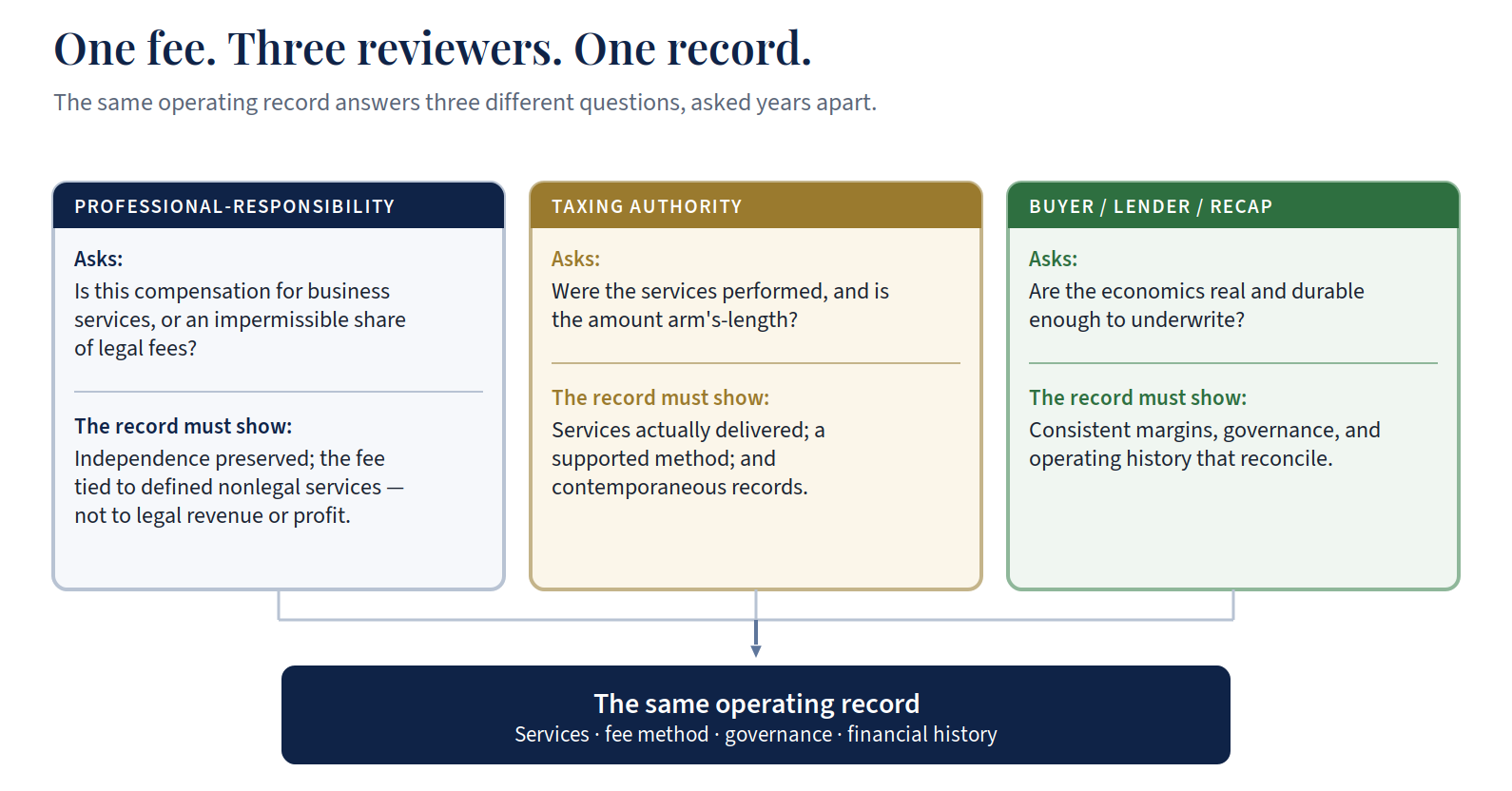
A structure designed for only one of these audiences may carry weaknesses that do not emerge until the organization is under review or approaching a transaction.
The more durable posture is a coherent record that can be understood by all three.
Where Guardian Fits
Counsel owns the legal conclusions. Independent economists own the management-fee analysis. The client’s CPA owns the returns. Guardian administers the operating and economic architecture that keeps the underlying services, invoices, governance, reporting, and advisor work aligned over time.
This article explains the principles, reviewer questions, and evidence categories associated with a durable law-firm MSO. It does not disclose Guardian’s proprietary control framework, workflow architecture, testing procedures, implementation protocols, workpapers, or client-specific methods.
What Is Included in a Law Firm MSO Management Fee?
In a law firm MSO structure, the management services organization performs defined nonlegal business functions for the licensed law practice. The law firm retains responsibility for the practice of law, professional judgment, client representation, legal fees, and other functions reserved to licensed attorneys.
Depending on the operating model, the MSO’s services may include:
- Technology infrastructure and information systems
- Human resources and benefits administration
- Accounting, finance, and financial reporting
- Recruiting and workforce support
- Marketing and nonlegal intake operations
- Facilities and real estate administration
- Vendor contracting and procurement
- Administrative personnel
- Business analytics
- Shared operational infrastructure
The list of services, however, does not by itself establish the value of the management fee.
This reframes the whole inquiry. The question is not, in the first instance, what the fee should be. It is whether the MSO operates as a real business. The MSO should perform identifiable business functions, employ or direct the personnel necessary to perform them, utilize operating assets, bear appropriate business risks, and maintain governance and financial records consistent with those activities. A supportable management fee is the economic consequence of that operating reality — the output of the business, not the subject of it.
The fee is the economic expression of that substance.
A management fee is therefore not simply a pricing mechanism. It is the observable evidence of a durable operating platform — the economic signal that connects the services the MSO performs to the value the platform is designed to create.
When the operating substance is present and documented, the fee may be evaluated as compensation for an actual service relationship. When the operating substance is thin, selecting a familiar formula does not resolve the underlying weakness.
How Are Law Firm MSO Management Fees Calculated?
There is no universal law firm MSO management fee formula. There is also no general assumption that a particular calculation method produces a supportable result.
Common approaches include:
| Fee structure | General description | Potential application |
|---|---|---|
| Fixed fee | A recurring amount for a defined scope of services | Service arrangements with relatively stable scope and operating requirements |
| Cost-plus | An identified cost base plus a stated margin | Service functions whose costs can be reliably identified and allocated |
| Per-lawyer or per-FTE fee | A unit-based charge tied to timekeepers or personnel | Platforms whose service burden closely tracks headcount |
| Hybrid fee | A combination of fixed, cost-based, or unit-based charges | Operating models with multiple service categories and cost drivers |
The appropriate method depends on the facts.
The selection of a fixed fee does not establish that the amount is reasonable. A per-FTE fee does not establish that staffing is the correct economic driver. A cost-plus method does not establish that all included costs are properly allocable or that the markup reflects an arm’s-length result.
Most importantly, cost-plus should not be treated as a safe harbor.
For a controlled services transaction subject to Section 482, the arm’s-length charge must be determined using an appropriate method under the regulations. The regulations provide multiple methods and apply a best-method analysis based on the facts and available data. The use of a cost base and markup does not, by itself, make the resulting fee arm’s-length.
A cost-plus analysis may still require consideration of:
- Which costs relate to the covered services
- Whether direct and indirect costs are allocated consistently
- Whether shareholder or duplicative activities are excluded where appropriate
- What functions the MSO actually performs
- What assets and personnel support those functions
- What risks the MSO bears
- Whether the selected margin is economically supportable
- Whether the result remains appropriate as operations change
The formula is the beginning of the inquiry, not the conclusion. For the full cost-plus floor-and-ceiling methodology and the four-pillar fee-substantiation framework — which applies across MSO models, not only law firms — see Guardian’s companion reference, How MSO Management Fees Are Calculated. This article focuses on what that framework must additionally satisfy when the operating company sits beneath a law practice.
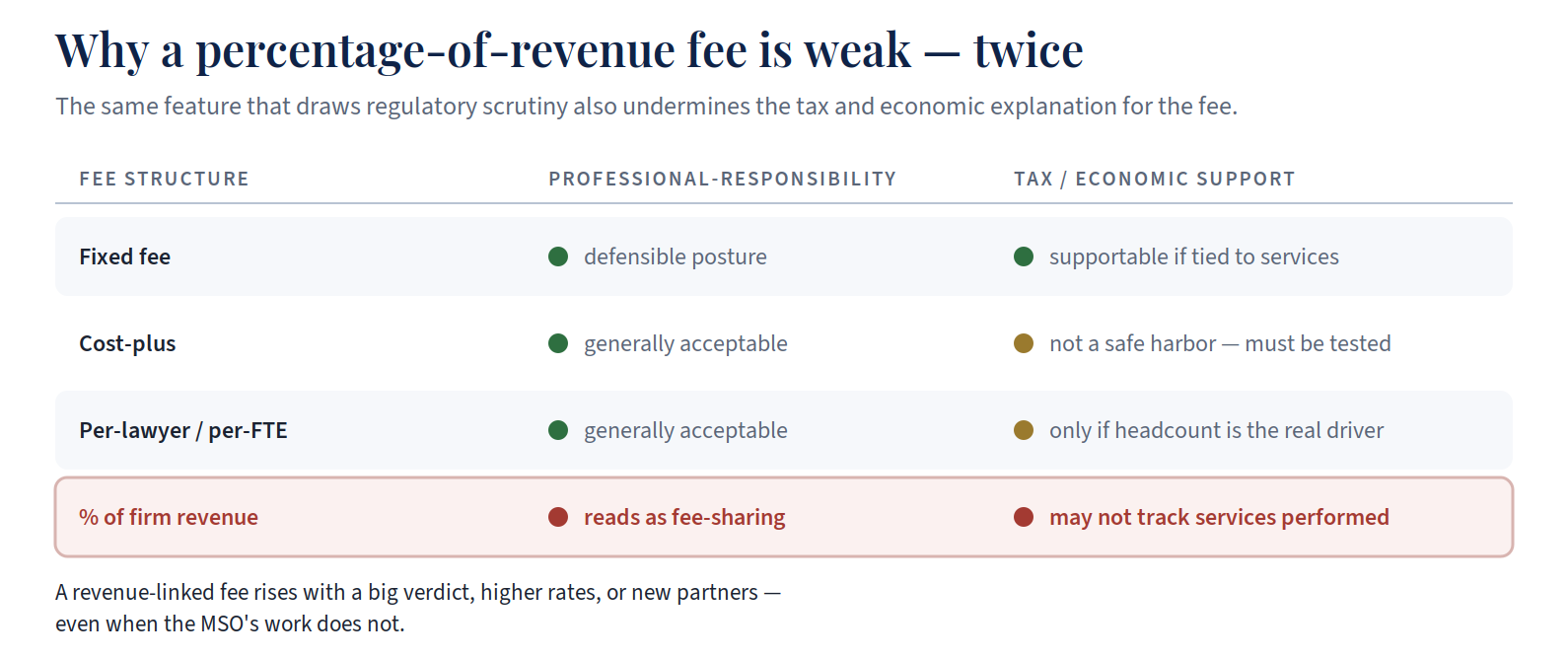
Why a Percentage-of-Revenue Fee May Be Weak Under More Than One Standard
Percentage-of-revenue management fees often receive attention because of professional-responsibility and fee-sharing concerns. That is not the only potential weakness.
From a tax and economic perspective, a revenue percentage may also be difficult to support where the resulting payment does not correspond to the value of the services actually delivered.
A law firm’s revenue can rise because of changes that have little relationship to the MSO’s functions, including:
- A significant litigation result
- An increase in matter values
- Higher attorney billing rates
- Changes in case mix
- Expansion of contingency-fee recoveries
- The addition of highly productive partners
- Market conditions affecting legal demand
If the management fee automatically increases with legal revenue while the MSO’s services, costs, personnel, assets, and risks remain substantially unchanged, the resulting charge may become increasingly difficult to explain as compensation for services.
The central tax question is not whether a percentage formula is mathematically consistent. It is whether the resulting payment reflects the economic relationship between the service provider and the service recipient.
A revenue-linked formula may therefore create two distinct issues:
- Professional-responsibility risk, because the payment may resemble a share of legal fees, revenues, or profits.
- Tax and economic supportability risk, because the payment may not track the functions performed, resources deployed, or value of the services.
The same characteristic that attracts regulatory scrutiny may also weaken the economic explanation for the fee.
Can a Law Firm MSO Management Fee Be Based on Revenue?
The answer depends on the jurisdiction, the parties, and the specific arrangement. It is a legal question for qualified professional-responsibility counsel.
Recent developments illustrate the scrutiny applied to revenue-based arrangements.
Texas Ethics Opinion 706 concluded that a lawyer engaging a nonlawyer-owned company to provide a platform of support services may not pay that company a fee based on a percentage of the revenues of the lawyer or law firm. The opinion treated the revenue-based payment as prohibited fee-sharing under the Texas rules.
Illinois House Bill 5487 — approved by the Governor on August 7, 2026, and now Illinois Public Act 104-0801, effective on approval — prohibits certain nonlawyer-owned, operated, or controlled entities involved with a law firm from charging fees directly or indirectly based on the attorney’s or firm’s fees, revenues, or profits. The Act applies to a firm with annual global legal-services revenue below $300 million or to a firm regularly handling contingency-fee matters and deriving more than 50% of its revenue from those arrangements during each of the preceding three calendar years. The precise interaction of those coverage provisions should be analyzed by Illinois counsel.
These authorities should not be generalized into a nationwide conclusion. Professional-conduct requirements vary by jurisdiction, and the language, scope, exceptions, and application of individual rules can differ materially.
The broader operating principle is more durable: a management fee tied to defined services and supported by operating facts may be easier to distinguish from a participation in the law firm’s legal fees or financial results.
Decoupling the fee from revenue does not, however, complete the analysis. A fixed fee or cost-plus fee must still be economically supportable.
Fair Market Value Is Not Created by an Economic Report
Fair market value is often discussed as though it begins with an economist’s report. In practice, the opposite is generally true: fair market value is not something you buy. It is something you build.
The report evaluates an operating company that already exists. Personnel have been hired. Systems have been implemented. Services have been delivered. Costs have been incurred. Governance has been maintained. Financial records have accumulated. The economic analysis supports that operating reality. It does not create it.
An independent economic or transfer-pricing report can therefore be important, but it does not substitute for an operating company. It should analyze an economic reality that already exists or is being implemented: a separately managed services organization with identifiable functions, personnel, systems, expenses, assets, governance, responsibilities, and financial records. Fair market value is not created merely because a report assigns a number to an agreement.
The report may evaluate and support the value of services performed by the MSO, but the strength of that analysis depends on the quality of the facts beneath it.
Those facts may include:
- The services the MSO actually delivers
- The personnel responsible for delivering them
- The time, systems, and resources required
- The operating assets used
- The contractual responsibilities of each party
- The risks allocated to and borne by the MSO
- The cost structure of the services company
- The consistency of intercompany billing
- The financial results developed over time
An economic conclusion that assumes a robust operating platform may become less persuasive if the operating record shows limited staffing, inconsistent services, weak cost allocation, or decision-making that remains inside the law practice.
The economic report supports the operating company. It does not replace one.
Does Section 482 Apply to a Law Firm MSO Management Fee?
Section 482 authorizes the allocation of income and deductions among organizations under common ownership or control to prevent tax evasion or clearly reflect income.
Where the law firm and MSO are under common control, a controlled services transaction may be analyzed under the Section 482 regulations. The arm’s-length amount must be determined under an appropriate method, selected under the best-method rule based on the facts, comparability, quality of data, and reliability of assumptions.
Common control is a fact-specific concept and should not be assumed merely because the entities have a contractual relationship.
For example, a private-equity-backed MSO and a law practice may or may not be treated as commonly controlled depending on the ownership, contractual rights, practical influence, governance, and other relevant facts. Section 482 may therefore apply differently—or may not be the governing framework—in different MSO arrangements.
Even where Section 482 does not apply, the fee may still be evaluated under other tax authorities addressing deductibility, reasonableness, substance, characterization, and whether services were actually rendered.
The relevant tax analysis belongs to the parties’ tax advisors. The operating point is that no calculation method should be treated as self-validating.
Are Law Firm MSO Management Fees Tax Deductible?
A management fee is not deductible merely because it appears in a contract or is labeled a service payment.
Deductibility depends on the applicable tax rules and the facts. Among other matters, a reviewer may examine whether:
- Services were actually rendered
- The expenditure was ordinary and necessary
- The amount was reasonable
- The payment represented compensation rather than a distribution
- The expense was properly characterized
- The parties followed the stated arrangement
- The supporting records were contemporaneous
The Eighth Circuit’s decision in Aspro, Inc. v. Commissioner provides a useful, although not directly controlling, illustration. The case involved an asphalt-paving corporation that deducted purported management fees paid to shareholders. The courts sustained the denial of the deductions, concluding that the payments were disguised distributions rather than compensation for services.
Aspro did not involve a law firm MSO. It should therefore be used as an analogy rather than as a rule specific to law firm structures.
Nevertheless, the case illustrates two foundational questions:
- Were identifiable services actually performed?
- Was the amount reasonable in relation to those services?
Those questions travel well beyond the facts of Aspro. They reflect the basic distinction between an operating service relationship and a payment whose label is stronger than its substance.
What Documentation Supports a Law Firm MSO Management Fee?
A supportable record should allow a reviewer to understand the relationship without relying entirely on explanations developed years later.
The record may include:
- A management services agreement defining the covered services
- Clear allocation of legal and nonlegal responsibilities
- Documentation of personnel and resources used by the MSO
- Consistent cost-allocation records
- Periodic invoices describing the relevant services
- Financial statements for the MSO and law practice
- Governance records reflecting material operating decisions
- Independent economic or transfer-pricing support where appropriate
- Documentation of changes in service scope
- Periodic consideration of whether the fee method remains appropriate
- Evidence that payments followed the agreement and methodology
Documentation should not be understood as a collection of paper created solely for review.
It should be the natural record of running the MSO as a legitimate, separate operating company.
That distinction matters. Records reconstructed after a question arises may describe what the parties intended. Contemporaneous financial and operating records are more capable of showing what the parties actually did.
The objective is not volume. It is consistency among the agreement, the services, the invoices, the governance, the financial reporting, and the tax treatment.
The Operating History Is Part of the Economic Support
A newly formed MSO necessarily begins with assumptions, budgets, personnel plans, and anticipated service requirements.
Over time, those assumptions should be replaced or refined by operating evidence.
The platform begins to develop:
- Actual service-delivery costs
- Historical margins
- Staffing patterns
- Technology expenditures
- Vendor relationships
- Cost-allocation experience
- Recurring financial reporting
- Variance data
- Billing history
- Evidence of how the platform performs through growth and change
This operating history can strengthen the basis for evaluating whether the management fee continues to reflect the business.
It may also become important in a later transaction.
At the deal table, a buyer, lender, or investor generally prefers financial information based on demonstrated operations rather than a model developed shortly before a sale process. A meaningful operating history may allow quality-of-earnings work to evaluate actual revenue, costs, margins, allocations, service delivery, and management-fee performance.
The difference is consequential.
A theoretical platform must be underwritten largely through assumptions. An operating platform can be evaluated through results.
The operating history reflects the gradual institutionalization of nonlegal business functions into a separately managed operating platform — the point at which a set of arrangements becomes, in fact, a business.
Quality of Earnings Begins Years Before the Deal
Quality-of-earnings analysis is the reason operating history matters. When a platform has operated for a meaningful period, diligence can be performed on demonstrated results — historical management-fee revenue, service costs, margins, staffing, allocations, and how the fee tracked the business through change — rather than on a model assembled in anticipation of a sale. The sufficiency of that history depends on the platform, the transaction, and the quality of the data; the principle does not. Demonstrated performance is more informative than projection, and the record that supports a quality-of-earnings review is the same operating record the regulator and the taxing authority read. The discipline of a durable platform is to have built that record long before anyone asks for it.
How Management Fees Should Evolve with the MSO
A management fee is not a set-and-forget entry.
Law firm operating platforms change. They may add employees, centralize functions, invest in artificial intelligence, replace technology systems, enter new markets, open offices, acquire service capabilities, expand recruiting, or assume responsibilities previously performed by the law firm.
Each material change can affect the MSO’s functions, personnel, cost base, assets, risks, service capacity, and economic contribution.
The fee methodology should be capable of responding to those changes. For a fixed-fee arrangement, that may involve a defined adjustment mechanism or periodic reconsideration of whether the amount still reflects the service scope. For a cost-plus method, it may involve testing whether the cost pool, allocation approach, and markup continue to fit the operating model. For a per-FTE arrangement, it may involve assessing whether headcount remains the appropriate value driver.
Periodic review is not simply a matter of increasing the number. The result could be an increase, decrease, restructuring, or confirmation that the existing methodology remains appropriate. The discipline is to ensure that the fee continues to describe the business that actually exists.
Why Separate Operations Matter
An MSO should not be viewed merely as a contractual payment channel. Its longer-term value may depend on whether it operates as a distinct business organization with its own identity, responsibilities, systems, personnel, financial information, and governance.
Depending on the structure, indicators of separate operations may include defined nonlegal management functions; personnel employed by or assigned to the MSO; separate books and financial records; documented intercompany transactions; independent bank and accounting activity; consistent governance procedures; contracts with vendors and service providers; ownership or use of operating assets; and financial reporting capable of showing platform performance.
These factors should not be treated as a generic checklist or as substitutes for advice from counsel, economists, and tax advisors. Their significance is broader: the value and supportability of the management fee arise from the operating platform, not solely from the agreement that describes it.
Formation is only the first step. Governance is an ongoing discipline. The operating record becomes increasingly important after closing.
How an MSO May Create Value Before a Transaction
The strategic value of an MSO is not limited to facilitating an immediate private-equity investment or sale. A founder, ownership group, or pre-transaction law firm may begin building economic value in the management platform before deciding whether to pursue outside capital.
By separating and institutionalizing appropriate nonlegal functions, the organization may develop more consistent financial reporting, centralized operating capabilities, scalable technology infrastructure, repeatable recruiting and administrative systems, greater visibility into costs and margins, an established management team, a history of service delivery, a more developed governance record, and better preparation for lender or investor diligence.
The law practice remains responsible for legal services and professional independence. The MSO may develop value through the nonlegal operating platform that supports the practice.
Building the platform before a transaction may allow owners to approach the market when they determine the timing is appropriate, rather than attempting to create transaction readiness after a buyer has already arrived. A transaction should not be the first moment at which the organization attempts to demonstrate that the MSO is real. The operating history should precede the transaction.
How Buyers and Lenders Evaluate Law Firm MSO Management Fees
Institutional buyers rarely underwrite documents alone. They underwrite operating businesses. They examine recurring financial performance, management reporting, governance discipline, service delivery, cost structure, and quality of earnings. The management fee is one component of that broader operating record — read, once again, as evidence of whether a real business exists.
Commercial diligence may examine whether the MSO performs the services identified in the agreement; whether the fee follows a defined methodology; whether historical invoices are consistent with that methodology; whether the MSO’s costs and margins can be reconciled; whether changes in the business were reflected in the fee; whether professional-responsibility concerns have been addressed by counsel; whether tax positions are supported by appropriate advisors; whether financial reporting separates the platform’s economics; whether the fee is sustainable after the proposed transaction; and whether the relationship depends excessively on individual founders.
A weakly supported fee may affect normalized earnings, quality-of-earnings adjustments, valuation, debt capacity, escrows, indemnities, closing conditions, and post-closing governance — even if it has never been challenged by a regulator or taxing authority.
A well-established operating history does not guarantee a particular transaction result. It does, however, provide more reliable information for underwriting than a fee supported primarily by theory.
Capital follows operating architecture.
The Working-Capital Question
A management fee should also be considered in relation to the law practice’s ability to operate. A fee that consistently leaves the law firm without adequate capital to meet payroll, fund matters, satisfy professional obligations, or respond to normal volatility may raise economic and governance questions.
The point is not that a particular working-capital threshold applies universally. It does not. The question is whether an independent service recipient would rationally accept the arrangement while remaining capable of conducting its business.
A management fee that appears designed primarily to remove nearly all available economics from the law practice may be difficult to reconcile with arm’s-length behavior, the value of the services provided, the practice’s ongoing responsibilities, professional independence, and long-term platform sustainability. The economic relationship should support the operating platform without impairing the licensed practice’s ability to perform its obligations.
The Seam Between the Advisors
Most components of a law firm MSO have a natural professional owner. Transaction counsel advises on the legal structure and professional-responsibility requirements. Independent economists may analyze the management fee. The CPA advises on reporting positions and prepares the applicable returns. Financial advisors and diligence providers evaluate transaction performance.
Each engagement is important. The challenge is that long-term durability exists in the seam between them. Over time, the agreement may no longer match the service scope; the economic analysis may assume facts that have changed; governance records may describe the relationship differently from the invoices; financial reporting may use allocations that do not reflect operations; tax reporting may become disconnected from the economic record; and a material business change may not reach every advisor.
No single formation document can prevent that drift. Someone must remain accountable for administering the operating and economic record so that the legal structure, management-fee support, governance, financial reporting, and tax planning continue to tell a coherent story.
Guardian Tax Consultants® and the Operating Record
Guardian Tax Consultants® helps design the operating and economic architecture of the MSO, coordinates the independent economic support for the management fee, and keeps the system running over time — the intercompany invoicing, the financial reporting, the governance record, and the supporting documentation — so the platform stays operationally prepared for tax examination, regulatory review, and buyer or lender diligence.
The lanes stay clear. Independent counsel provides legal opinions and advises on professional-responsibility requirements. Independent economists perform the management-fee, valuation, or transfer-pricing analyses. The client’s CPA determines return positions and prepares the tax filings. Guardian builds and maintains the operating and economic record that connects those disciplines — and keeps it coherent across all three reviewers over the life of the structure.
For law firm owners, managing partners, investors, and advisors evaluating an MSO, the question is not only whether the structure can be formed. It is whether the platform is being run so that its governance, financial reporting, operating substance, and history remain supportable through regulatory review, tax review, and commercial diligence — long after formation.
The transaction is the beginning—not the destination.
For Firms Evaluating an MSO
Evaluating a law firm MSO? The durability of the structure depends less on the fee formula than on whether the operating record can be administered and defended over time. Guardian Tax Consultants® works alongside your counsel, economists, and CPA on the operating and economic architecture.
Reference Edition
A longer treatment of the same material, organized for counsel, CPAs, and ownership groups.
Frequently Asked Questions
What is a law firm MSO management fee?
A law firm MSO management fee is the amount a management services organization charges a law practice for defined nonlegal business services under a management services agreement. The fee may cover technology, personnel, finance, recruiting, facilities, marketing support, and administration. It should correspond to the services and economic activity of the MSO.
How is a law firm MSO management fee calculated?
Common approaches include fixed fees, cost-plus methods, per-lawyer or per-FTE charges, and hybrid arrangements. No method is automatically supportable. The appropriate approach depends on the services performed, cost structure, personnel, assets, risks, available comparables, and the relationship between the parties.
Is cost-plus a safe harbor for a law firm MSO management fee?
No general cost-plus safe harbor should be assumed. A cost-plus method may be appropriate, but the cost base, allocations, markup, functions, and resulting fee must still be supportable under the applicable facts and tax authorities. Selecting cost-plus does not eliminate the need for economic analysis.
Can a law firm MSO management fee be a percentage of revenue?
Revenue-based fees may raise professional-responsibility concerns, particularly where they resemble a sharing of legal fees or profits with nonlawyers. They may also raise tax and economic concerns if the resulting charge does not track the services, personnel, costs, assets, and risks of the MSO. Qualified counsel should analyze the rule in each jurisdiction.
Does Section 482 apply to a law firm MSO?
Section 482 may apply where the MSO and law practice are under common ownership or control. Whether common control exists is fact-specific. Where it applies, the fee may be evaluated under the controlled-services regulations and best-method rule. Other tax authorities may apply even where Section 482 does not.
Are law firm MSO management fees tax deductible?
Potential deductibility depends on the applicable tax rules and facts, including whether services were performed, whether the amount was reasonable, and whether the payment was properly characterized. The client’s CPA should determine the reporting position. A contractual label alone does not establish deductibility.
Is an economic report enough to support the fee?
No. An economic report can analyze and support a management fee, but it should be based on an operating reality. The MSO should have demonstrable functions, personnel, assets, expenses, risks, governance, and financial records. The report supports the operating company; it does not substitute for one.
Is there a typical or reasonable law firm MSO management fee percentage?
There is no reliable “market” percentage, and a headline number is the wrong anchor. A supportable fee is built from the MSO’s actual functions, personnel, assets, costs, and risks — then tested against reference points — rather than set from a range. A fee chosen because it is “typical” is often the first item a taxing authority or a buyer’s diligence team questions.
Is a law firm MSO the same as an alternative business structure (ABS)?
No. An ABS is an ownership model — permitted in states such as Arizona and Utah — that allows nonlawyers to hold equity in the law practice itself. An MSO is a separate services company that contracts with the practice and can be used in most states without changing who owns the firm. The management-fee question arises in both, but the ownership and professional-responsibility analysis differs.
Authorities and Further Reading
The sources below are the primary authorities referenced in this article. They are provided for reference and do not constitute legal or tax advice. Application depends on facts, jurisdiction, and the current state of the law.
Professional Responsibility
- Texas Committee on Professional Ethics, Opinion 706 (February 2025) — whether a lawyer may pay a nonlawyer-owned support-services company a fee based on a percentage of the lawyer’s or firm’s revenues.
- Illinois General Assembly, HB 5487 (104th General Assembly) — official bill status and full text — including the Senate floor amendment establishing the coverage provisions described above. Sent to the Governor June 26, 2026; approved August 7, 2026; now Public Act 104-0801, effective on approval.
Tax and Transfer Pricing
- 26 U.S.C. § 482 — Allocation of income and deductions among taxpayers
- Treas. Reg. § 1.482-1 — Allocation of income and deductions among taxpayers — the arm’s-length standard and the best-method rule.
- Treas. Reg. § 1.482-9 — Methods to determine taxable income in connection with a controlled services transaction
- 26 U.S.C. § 162 — Trade or business expenses — the ordinary, necessary, and reasonable requirements for deductibility.
- Aspro, Inc. v. Commissioner, No. 21-1996 (8th Cir. Apr. 26, 2022) — management-fee deductions disallowed where the operating record did not support the amounts paid. Cited here as analogical, not as controlling authority for law firm MSOs.
Related Reading
- How MSO Management Fees Are Calculated: An Institutional Framework — the cross-industry companion.
- The Seven-Figure Ethics Question — the professional-responsibility and fee-sharing dimension in depth.
Conclusion
A law firm MSO management fee is more than a line in a management services agreement. It is one of the defining economic relationships in the operating structure.
Its durability is not established solely by selecting a fixed fee, a cost-plus method, or another formula. No formula can substitute for operating substance. The fee should reflect the services performed, personnel and assets deployed, risks borne, and economic responsibilities assumed by the MSO. An independent economic report may help analyze that relationship. It cannot create the underlying business.
Over time, the MSO’s operating history may become as important as its formation documents. That history can provide the financial and operational basis for periodic fee review, governance, consolidated reporting, quality-of-earnings work, financing, recapitalization, and a later strategic transaction.
For founders and ownership groups, this is part of the broader value of the MSO model. Transaction readiness does not have to begin when a buyer appears. The organization may begin developing the platform, financial discipline, governance, and operating record earlier — while retaining the flexibility to determine whether and when a transaction is appropriate.
Formation answers whether an MSO can exist. Operations answer whether it deserves to continue existing. Formation creates the platform; operations create the enterprise.
The operating platform does not require a transaction thesis. It may support long-term ownership, access to capital, investment in infrastructure, future recapitalization, or an eventual sale. Transaction readiness is one potential consequence of durable operations—not the sole reason to build them.
Durable economics follow durable operations.
Guardian Tax Consultants® coordinates tax planning and the economic architecture supporting Management Services Organizations. Guardian does not provide legal advice or prepare tax returns. Independent counsel provides legal opinions, independent economists perform management-fee or transfer-pricing analyses where appropriate, and the client’s CPA determines tax-return positions. This article is educational and does not constitute legal, tax, accounting, valuation, or investment advice. Requirements vary by jurisdiction and may change over time.
About the Author
Alex Jones, EA, CFP®, CLU®, ChFC®, CEPA is the Founder and Chief Executive Officer of Guardian Tax Consultants®, where he leads the firm’s work on the operating and economic architecture of Management Services Organizations. An Enrolled Agent admitted to practice before the Internal Revenue Service, he holds the CERTIFIED FINANCIAL PLANNER™, Chartered Life Underwriter®, Chartered Financial Consultant®, and Certified Exit Planning Advisor designations.
His work focuses on how professional-services platforms are administered over time — the intercompany services record, governance, financial reporting, and economic support that determine whether a structure remains defensible through tax examination, regulatory review, and buyer or lender diligence.