
MARKET INSIGHTS · LAW-FIRM CAPITAL
How law firms, investors, and M&A counsel can choose between direct ownership, regulated authorization, contractual separation, and state-specific hybrid structures.
By Alex Jones, Founder & CEO, Guardian Tax Consultants® · July 18, 2026 · Updated September 7, 2026 · 14 min read
Last reviewed September 7, 2026
Executive summary
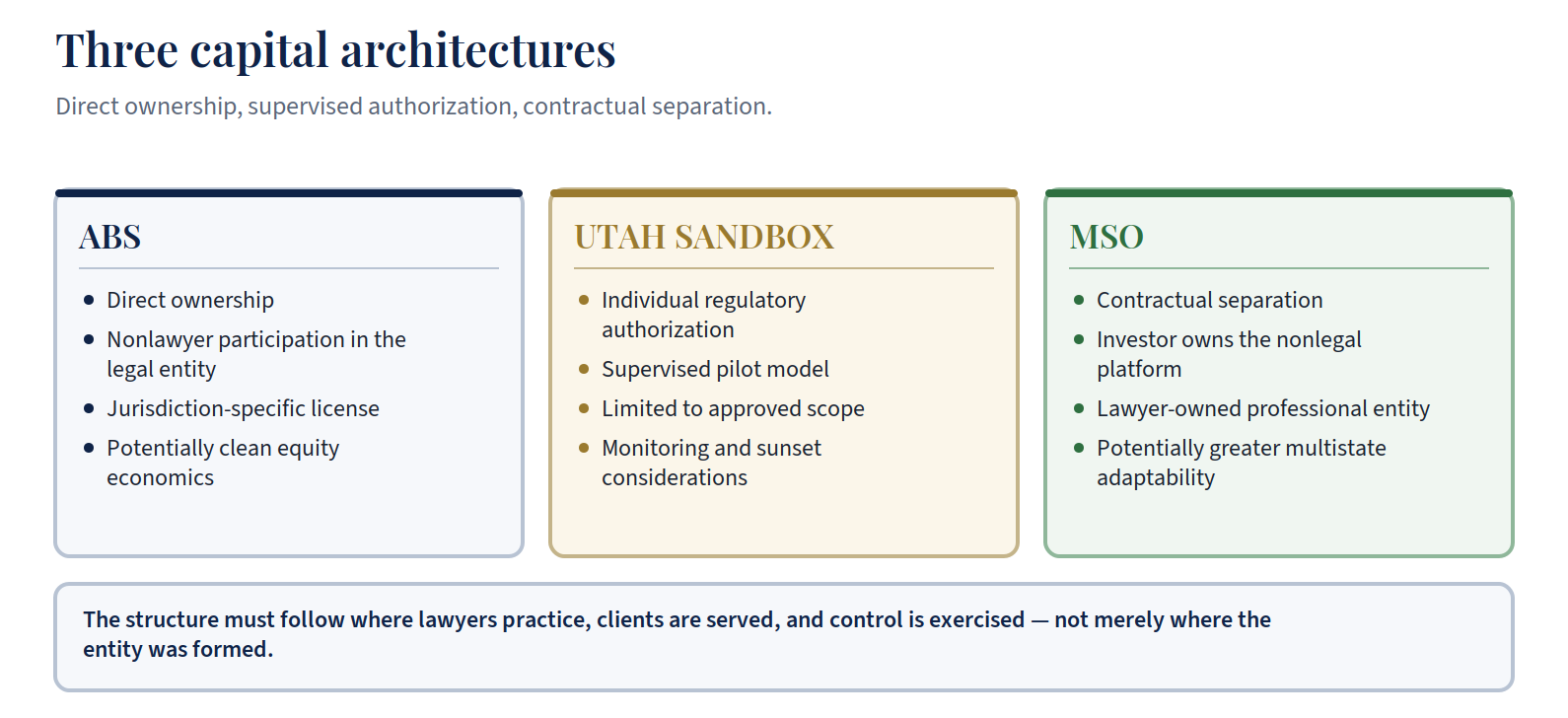
Outside capital can enter the business of legal services through more than one architecture, but the available structures do not provide the same ownership rights, economics, geographic reach, or regulatory durability.
An alternative business structure permits authorized nonlawyer participation directly in the entity delivering legal services. Arizona has established a formal ABS licensing regime. Puerto Rico permits qualifying nonlawyer ownership subject to defined limitations. Washington, D.C. permits a narrower form of participation by active nonlawyer professionals rather than unrestricted passive investment.
Utah’s regulatory sandbox is different. It is a supervised pilot under which approved entities may operate within the scope of individual regulatory authorization. The sandbox is closed to new applications and is currently scheduled to sunset on August 14, 2027.
An MSO uses contractual rather than direct ownership. The lawyers continue to own and control the legal practice, while a separately owned management company provides defined nonlegal infrastructure and services under a management-services agreement.
The right question is not simply which model is “best.” The transaction team should determine where the lawyers will practice and clients will be served; whether the investor requires direct ownership of the legal entity or can own the nonlegal platform; which functions, assets, and employees belong in each entity; how the management company will be compensated; which decisions must remain exclusively with licensed lawyers; whether the structure must expand across multiple states; and how a future regulatory restriction would affect valuation, financing, and exit.
For a single-jurisdiction business in an ABS-authorizing state, direct ownership may provide the cleanest equity architecture. For a multistate platform, an MSO may provide a more adaptable starting point because the professional practice remains lawyer-owned. In some transactions, the most workable answer may be a state-specific hybrid rather than one structure imposed across the entire platform.
None of these approaches is a nationwide safe harbor. The governing rules follow the lawyers, clients, services, fees, and actual allocation of control, not merely the state in which an entity was formed.
What this brief does not say
- It does not say an ABS license authorizes practice or ownership outside the issuing jurisdiction.
- It does not say Utah’s sandbox is a permanent ownership regime.
- It does not say Washington, D.C. permits passive private-equity ownership of law firms.
- It does not say every MSO is lawful in every state.
- It does not say a fixed, cost-plus, or fair-market-value fee is automatically permissible without reviewing the applicable rules and facts.
- It does not say any hybrid architecture described below is lawful in a given jurisdiction.
- It does not provide an opinion on any identified structure.
The narrower point is that these models solve different components of the same capital problem and must be diligenced against the jurisdictions in which the lawyers practice and the clients are served.
The capital decision tree
Question 1 — Does the investor need direct ownership of the legal entity?
If yes, the parties first examine whether the relevant jurisdiction affirmatively permits it. Arizona operates a licensed ABS model. Puerto Rico permits qualifying minority nonlawyer ownership under specified conditions. D.C. permits active professional participation rather than unrestricted passive investment under the current rule. Utah permits ownership only within the scope of an existing sandbox authorization.
Arizona’s framework recognizes ABS entities in which nonlawyers hold an economic interest or decision-making authority, but the entity must be licensed and regulated under Arizona’s regime.
Question 2 — Does the platform need multistate portability?
If yes, direct-ownership authorization in one state may not travel. Five different questions are often collapsed into one and should be separated:
- Entity authorization — where the entity may be owned.
- Professional licensure — where the lawyers may practice.
- Disciplinary jurisdiction — which rules govern the conduct.
- Client location — where legal services have their effect.
- Economic relationship — how the investor receives a return.
Forming an Arizona ABS does not automatically authorize the same ownership or fee model for lawyers operating elsewhere. Formation in an ABS-authorizing jurisdiction does not by itself resolve the rules applicable to lawyers serving clients or handling matters in other states. Disciplinary authority, choice of law, client location, tribunal admission, and the jurisdiction in which conduct has its predominant effect must be analyzed separately, including under Rule 8.5 or its state analogue.
Question 3 — What does the investor actually need to own?
This is the question most often skipped, and it converts an abstract comparison into a transaction-design exercise.
| Asset or function | Potential law-firm location | Potential MSO location |
|---|---|---|
| Client relationships and legal matters | Professional entity | Generally not the MSO |
| Legal fees and trust funds | Professional entity | Generally not the MSO |
| Legal judgment and supervision | Licensed lawyers | Not delegated |
| Technology platform | Depends on structure | Frequently MSO |
| Nonlegal brand assets | Depends on ethics and trademark analysis | Potentially MSO |
| Facilities and equipment | Either, subject to contract | Frequently MSO |
| Administrative employees | Depends on roles and state law | Potentially MSO |
| Marketing systems | Shared or contractual | Potentially MSO |
| Finance and reporting infrastructure | Subject to confidentiality controls | Potentially MSO |
| Acquisition capital | Structure dependent | Frequently raised at MSO level |
The jurisdictions, as evidence
Arizona: direct nonlawyer ownership where licensed
Arizona abolished its categorical Rule 5.4 ownership restriction effective January 1, 2021 and created a licensing regime for alternative business structures. The Arizona Supreme Court supervises the program, and licensed entities must satisfy ownership, character-and-fitness, compliance-lawyer, audit, and reporting requirements.
2026 update. By Administrative Order 2026-31 (March 18, 2026), the Arizona Supreme Court amended ACJA § 7-209 to add an in-state nexus to the code’s regulatory objectives and to require that ABS-affiliated lawyers actually provide legal services, curbing use of an Arizona ABS license as a purely out-of-state platform. For a multistate investor, the amendment reinforces the point made throughout this brief: an Arizona license is an Arizona authorization, not a national one.
Stanford Law School’s five-year study reports that authorized Arizona ABS entities increased from 19 in 2022 to 136 as of April 30, 2025, that 134 of those 136 entities had lawyers directly providing legal services, and that the market remained heavily oriented toward individual consumers.
Puerto Rico: up to 49% nonlawyer ownership under conditions
Puerto Rico’s Rules of Professional Conduct became effective January 1, 2026. Rule 5.4(b) permits nonlawyer ownership up to 49% when specified conditions are satisfied. Those conditions materially distinguish Puerto Rico from an unrestricted passive-capital model: the firm must be operated by Puerto Rico-licensed counsel; the rule includes professional-independence, confidentiality, disclosure, annual-reporting, and pro bono requirements; and the nonlawyer’s contribution is limited to money rather than services.
Washington, D.C.: active professional participation, not passive investment
D.C. Rule 5.4 permits an individual nonlawyer who performs professional services assisting the delivery of legal services to hold a financial interest or managerial authority in a qualifying organization. The organization’s sole purpose must be providing legal services, the nonlawyer must agree to the professional rules, the lawyers must accept responsibility for the nonlawyer participants, and the safeguards must be written. The rule’s comments expressly state that it does not permit an investor, corporation, or investment-banking firm to acquire an ownership interest for investment purposes.
Pending D.C. development. Proposed amendments to D.C. Rule 5.4(b) and its Comments would permit lawyers to share fees with nonlawyers in a firm whose principal rather than sole purpose is providing legal services, where other services are law-related. The proposal would also require disclosure to prospective and existing clients where there are nonlawyer owners, lawyer supervision of nonlawyer owners, reaffirmed protections of professional independence, and registration with the D.C. Bar. The proposal would not convert D.C. into a general passive-capital ABS jurisdiction. The comment period has been extended; its current status should be confirmed with the D.C. Court of Appeals before reliance. Monitor this development; do not treat it as current law.
Utah: a supervised experiment with a scheduled sunset
Utah’s legal regulatory sandbox is a pilot project established by the Utah Supreme Court. The official program site states that the sandbox is closed to new applications, with its ABS-only portion closed at the end of 2024, and is scheduled to sunset on August 14, 2027, after which the court will consider recommendations on permanent reform. The Office of Legal Services Innovation’s published program timeline describes the sandbox as in its final phase.
The Stanford five-year study reports that the number of authorized Utah entities fell from 39 in 2022 to 11 as of April 30, 2025. For an investor underwriting a long-duration platform, the principal limitations are the program’s Utah-specific scope, monitoring conditions, and scheduled sunset.
The law-firm MSO: contractual separation rather than direct ownership
In an MSO structure, the lawyers retain ownership and control of the professional practice. A separate management company may own or operate nonlegal infrastructure such as technology, finance, HR administration, facilities, marketing systems, and vendor management. The practice pays the MSO under a management-services agreement.
Related: the Rule 5.4 analysis that governs the MSO side of this comparison — all four subsections, Texas Opinion 706, and the Illinois and Colorado statutes of August 2026 — is developed in Rule 5.4 and the Law-Firm MSO: Ownership, Fee-Sharing, and Independence in Fact.
The MSO is often the more structurally portable starting point for private equity and law-firm capital because it does not require a jurisdiction to authorize direct nonlawyer ownership of the law firm. But the portability comes from preserving the existing professional boundary, not from an exemption from it.
The MSA must describe real nonlegal services, preserve the lawyers’ professional judgment and client duties, protect confidential and privileged information, allocate staffing and data rights carefully, and use compensation that is permissible under the controlling jurisdiction. A structure that transfers legal-fee economics or practical control to the MSO can fail even when the entities are formally separate. The timing and substantiation discipline that supports the fee is addressed in MSO management-fee timing under §267 and the 12-month rule, and the investor’s ownership of the nonlegal platform is where §1202 QSBS diligence for MSO structures becomes relevant.
State-law examples that narrow the MSO analysis
Texas Ethics Opinion 706 considered a nonlawyer-owned support-services company charging a periodic fee based on a percentage of the subscribing law firm’s revenue. The committee concluded the proposed payment would constitute impermissible fee sharing because it was not based on the amount or cost of services. The opinion does not create a universal fixed-fee, cost-plus, or fair-market-value safe harbor; it establishes a clear negative proposition on the facts presented.
California AB 931, enacted in 2025, limits specified fee sharing between California lawyers and out-of-state ABS lawyers. It also preserves specified contracts with entities owned in part by nonlawyers when, among other conditions, the payment is a specific dollar amount, does not include payment for referrals or lead generation, and is not contingent on the amount recovered. The statute is commonly summarized as permitting a “flat fee,” but the enrolled language should control the diligence.
Illinois HB 5487 passed both chambers, was sent to Governor JB Pritzker on June 26, 2026, and was approved on August 7, 2026; it is now Illinois Public Act 104-0801, effective on approval. As enacted, it restricts revenue- or profit-based fees, specified control rights, client-contract terms, and other conduct for covered Illinois firms and nonlawyer entities. See Illinois HB 5487 law-firm MSO requirements. The bill illustrates why “MSO” is not itself the legal conclusion: the exact fee, governance, records, staffing, contract, and disclosure mechanics matter.
The structure does not have to be identical in every state
This may be the most useful insight for a multistate platform. Architectures for counsel to evaluate include:
National MSO with lawyer-owned local practices. The investor owns the management platform. State-specific professional entities contract for approved services while maintaining lawyer ownership and professional authority.
Direct ABS ownership where authorized, MSO separation elsewhere. A platform might use direct ownership in an authorizing jurisdiction while maintaining lawyer-owned professional entities where it is prohibited. The legal, tax, and financing challenge is preventing the direct-ownership economics from being replicated improperly through MSO contracts elsewhere.
State-specific service schedules. Rather than one national MSA, the parties can use a master services framework with state-specific schedules, different fee methodologies, different data-access rules, different employment allocations, and state-specific reserved-powers matrices.
Geographic or service-line carve-outs. A restrictive state or practice area can be excluded from certain services, economics, or governance rights without requiring the entire platform to adopt the most restrictive model.
Sequenced expansion. A buyer may begin with an MSO platform, develop documented operating substance, and enter additional jurisdictions only after professional-responsibility review.
None of these is automatically lawful. Their value is in framing the architecture questions counsel should ask.
What the buyer is really buying
The buyer may believe it is acquiring a law-firm platform. Legally, it may be acquiring technology, administrative infrastructure, marketing systems, a nonlegal workforce, vendor contracts, facilities, brand assets, data rights subject to professional restrictions, management contracts, and a contractual income stream.
The quality of an MSO investment therefore depends not only on EBITDA, but on whether the MSO owns transferable operating assets, performs substantial services, controls lawful nonlegal functions, and holds contracts that remain enforceable without crossing the professional boundary.
Who cares about what
| Stakeholder | Primary concern | Structure question |
|---|---|---|
| Law-firm owners | Professional control and rollover value | What remains in the professional entity? |
| PE buyer | Durable economics and governance | Can the buyer protect its investment without controlling legal practice? |
| Investment banker | Valuation and marketability | Which earnings are transferable and repeatable? |
| Lender | Collateral and cash-flow access | Which entity owns the assets and receives the cash? |
| Ethics counsel | Independence and fee sharing | Do the documents and actual operations preserve the professional boundary? |
| Transaction counsel | Closing and enforcement | Are the rights lawful in every relevant jurisdiction? |
| Tax counsel | Entity and payment characterization | Are returns derived from equity, services, debt, or another arrangement? |
ABS vs. sandbox vs. MSO: side-by-side comparison
| Feature | Arizona / Puerto Rico ABS | Utah Sandbox | MSO Separation |
|---|---|---|---|
| Ownership of legal practice | Nonlawyer participation permitted under local rules and conditions | Permitted only to the extent authorized for the approved entity | Legal practice remains lawyer-owned where required |
| Regulatory status | Licensed or authorized regime | Supervised pilot; sunset scheduled August 14, 2027 | No single national approval; analyzed under each state’s existing rules |
| Geographic reach | Primarily tied to authorizing jurisdiction and multijurisdictional-practice rules | Tied to Utah authorization and scope | Potentially broader, but state-specific |
| Economics | Investor may participate in legal-entity equity subject to local rules | Depends on authorization | Investor owns nonlegal platform; compensation flows through MSA |
| Professional control | Must remain protected under authorizing rules | Monitored under sandbox conditions | Must remain with lawyers under applicable law |
| Principal diligence issue | License conditions and cross-border practice | Scope, monitoring, sunset, and revocability | Fee design, service substance, governance, data, staffing, and state law |
Which law-firm capital model is most portable?
For a single-jurisdiction firm operating principally in Arizona, a licensed ABS may offer the cleanest direct ownership and profit-participation architecture. Puerto Rico offers a distinct minority-ownership regime with substantial conditions. D.C. supports active multidisciplinary participation but excludes passive investment. Utah offers supervised experimentation through a pilot scheduled to end in 2027 unless the court adopts a successor framework.
For a multistate firm, an MSO is often the more structurally portable starting point because it separates nonlegal operations and capital from ownership of the law practice. That portability is conditional. It depends on state-specific fee-sharing, control, UPL, professional-entity, choice-of-law, and disciplinary rules, and it is a supported transactional judgment rather than a settled legal rule.
An ABS determines who may own the legal-services entity. An MSO determines how nonlegal capital, infrastructure, and services can be positioned outside it. For a law firm operating across multiple jurisdictions, the most durable structure may not be a single entity form. It may be a modular platform that changes at the professional boundary without changing the investment thesis. Where a protective deal term is negotiated on top of whichever structure is chosen, its durability depends on the same discipline, as discussed in regulatory put risk in MSO deals.
Frequently asked questions
Can private equity directly own a U.S. law firm?
Usually not. Arizona permits licensed ABS entities, Puerto Rico permits limited nonlawyer ownership under conditions, Utah authorizes approved sandbox entities, and D.C. permits limited active nonlawyer professional participation. These authorizations do not automatically travel across states.
What is the difference between an ABS and an MSO?
An ABS permits authorized nonlawyer ownership or managerial participation in the legal-services entity. An MSO is a separate nonlegal company that provides business services to a lawyer-owned practice under contract.
Is Utah’s legal sandbox permanent?
No. Utah’s legal sandbox is a supervised pilot program, closed to new applications, with a scheduled sunset of August 14, 2027, subject to future court action.
Why is the MSO model more portable than an ABS?
An MSO can be more portable because the investor does not directly own the law firm. The structure still requires state-specific review of fees, governance, staffing, data access, marketing, confidentiality, and professional control.
What makes a law-firm MSO risky?
A law-firm MSO becomes risky if the nonlawyer entity controls legal judgment, shares in legal fees, owns or reveals protected client records, controls attorney staffing, or uses compensation tied to law-firm revenue or profits.
Related from the GTC Insights Library
- Rule 5.4 and the Law-Firm MSO: Ownership, Fee-Sharing, and Independence in Fact
- The Regulatory Put in Law-Firm MSO Deals: A Negotiation Framework for Cure, Repricing, and Unwind
- Illinois HB 5487 and Law-Firm MSOs: A Contract and Compliance Readiness Guide
- The Seven-Figure Ethics Question: Reading Sidley Austin on MSO Management-Fee Architecture
- §1202 QSBS Through an MSO: OBBBA 2025 and Diligence
- MSO Management-Fee Timing: The 12-Month Rule, §267(f), and Controlled-Group Service Payments
From the Reference Edition
This brief is read alongside The Durable Law-Firm MSO — Reference Edition, Version 1.1, September 2026, which carries the current jurisdictional and authority record.
Related section: Section 12 — ABS, the Utah Sandbox, and the MSO; Jurisdictional Design for MSOs.
Selected public authorities
- ABA Model Rule of Professional Conduct 5.4 and state analogues.
- Arizona Code of Judicial Administration § 7-209, as amended by Arizona Supreme Court Administrative Order 2026-31 (March 18, 2026), and Arizona ABS program materials.
- Stanford Law School, Legal Innovation After Reform: Five Years of Data on Regulatory Change (June 2025).
- Utah Supreme Court Standing Order No. 15, as amended; Utah Office of Legal Services Innovation, sandbox status and sunset materials.
- D.C. Rule of Professional Conduct 5.4, and proposed amendments to Rule 5.4(b) published for public comment (status to be confirmed with the D.C. Court of Appeals).
- Puerto Rico Rule of Professional Conduct 5.4(b), effective January 1, 2026.
- Texas Professional Ethics Committee Opinion 706 (February 2025).
- California AB 931 (2025).
- Illinois HB 5487 (Public Act 104-0801), enacted text and official bill status.
Law and status verified through July 18, 2026; Arizona Administrative Order 2026-31, Utah sandbox status, and Illinois Public Act 104-0801 updated September 7, 2026. Pending rule amendments, sandbox authorizations, bills, and professional-conduct rules may change after publication.
Disclosures
This brief is general information for professional and institutional audiences. It is not legal, tax, accounting, regulatory, securities, or investment advice. Professional-conduct rules are adopted and enforced by jurisdiction-specific authorities, and their application depends on the lawyers, clients, offices, services, contracts, compensation, ownership, and operating facts involved. The architectures described are framing tools for counsel, not recommended structures. No statement in this brief should be treated as approval of a particular ABS, sandbox entity, MSO, fee methodology, or multijurisdictional practice arrangement. Qualified professional-responsibility and transaction counsel should review each jurisdiction before formation, investment, expansion, or closing.
NEXT STEP
Working through a related fact pattern?
For law firms, PE deal teams, investment bankers, and M&A counsel evaluating the business architecture around a licensed practice, Guardian Tax Consultants® coordinates management-fee methodology, operating documentation, and pre-transaction MSO design alongside the client’s professional-responsibility and transaction counsel.