
MARKET INSIGHTS · DEAL ARCHITECTURE
How buyers, sellers, investment bankers, and counsel can allocate regulatory risk without creating an unfunded or unfinanceable repurchase obligation.
By Alex Jones, Founder & CEO, Guardian Tax Consultants® · July 18, 2026 · Status-sensitive analysis
Last reviewed August 22, 2026
Executive summary
A private equity buyer investing in a law-firm management services organization has a legitimate concern: what happens if a later statute, ethics opinion, court decision, or regulatory action materially limits the management-fee structure, governance rights, continuity arrangements, or other economics underwritten at closing?
A regulatory put, requiring the seller, MSO, practice, or another obligor to repurchase the buyer’s interest, can appear to answer that question. But a broad cash repurchase obligation may create a second transaction risk. The same regulatory event that triggers the put may impair the cash flow, collateral, valuation methodology, financing capacity, or transfer rights needed to perform it.
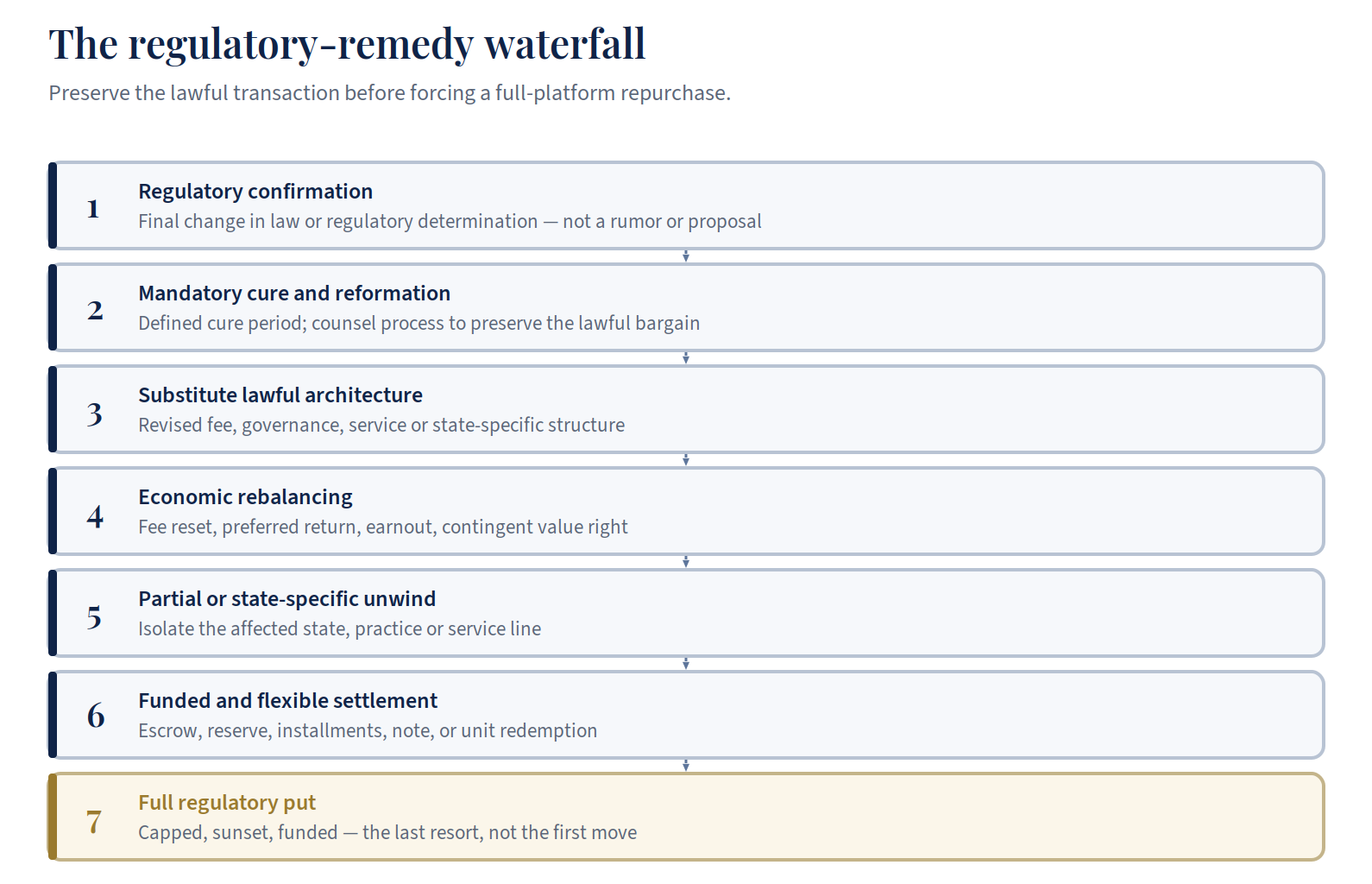
The negotiating choice should therefore not be reduced to “put or no put.” A more workable approach is a regulatory-remedy waterfall that gives the parties a defined sequence of alternatives: confirm that a qualifying regulatory event has actually occurred; provide a period to cure or reform the affected documents; substitute lawful economic, governance, or service arrangements; reprice or restructure only the affected portion; use partial unwind, escrow, seller-note, or equity-settlement mechanics; and exercise a capped, funded repurchase right only when the less destructive remedies cannot preserve the lawful transaction.
This framework can give buyers meaningful downside protection while helping sellers, lenders, and investment bankers avoid an obligation that is unlimited, unfunded, or impossible to execute when it matters most. The objective is not to eliminate regulatory risk. It is to allocate that risk through a remedy that remains lawful, financeable, and operational under the conditions that activate it.
The term “regulatory put” is used here as transaction shorthand; terminology and trigger formulations vary among agreements.
What this article does not say
- It does not say every regulatory put is invalid or unenforceable.
- It does not say a buyer should give up regulatory-change protection.
- It does not say a seller may transfer assets to avoid an existing or foreseeable obligation.
- It does not say an irrevocable trust is automatically beyond the reach of creditors or available to satisfy a put.
- It does not say healthcare corporate-practice developments control law-firm MSO structures.
- It does not say any level of the waterfall below is lawful or appropriate in a given transaction.
- It does not provide a legal conclusion about any identified agreement or pending matter.
Each mechanism described requires transaction-specific legal, tax, securities, lender, fiduciary, creditor-rights, and professional-regulation review before use.
Why the buyer’s concern is legitimate
A law-firm MSO transaction separates the licensed practice from the nonprofessional operating platform. The licensed owners retain the regulated practice and professional judgment. The MSO may own or operate technology, finance, HR, marketing, real estate, administrative systems, and other nonprofessional infrastructure under a management-services agreement.
A later change in law can affect the management-fee methodology, governance and reserved powers, information and banking access, continuity and succession mechanisms, ownership or transfer rights, professional independence, and the value originally attributed to the MSO.
Recent healthcare developments illustrate the direction of travel, although they do not decide the legal-services analysis. California SB 351, effective January 1, 2026, restricts specified private-equity and hedge-fund interference with clinical decision-making and enumerated practice functions. Oregon SB 951, with subsequent implementing legislation, imposes additional ownership and governance restrictions on certain healthcare MSO-professional-entity arrangements. In Art Center Holdings, Inc. v. WCE, a California appellate matter pending as of July 18, 2026, the Attorney General has argued that specified continuity rights may violate the corporate-practice-of-medicine doctrine; other amici have urged a more fact-specific analysis.
The legal-services market has its own authorities. Texas Ethics Opinion 706 rejects, on the facts presented, a support-services fee calculated as a percentage of law-firm revenue. California AB 931 conditions specified MSO arrangements. Illinois HB 5487 and law-firm MSO requirements, now enacted as Illinois Public Act 104-0801 (approved August 7, 2026, effective on approval), directly restricts revenue- or profit-based fees, specified control rights, and other contractual provisions for covered Illinois firms. How outside capital reaches a practice at all is compared across law-firm capital models.
The private equity buyer is therefore not inventing the risk. The drafting question is whether the proposed remedy remains usable when that risk materializes.
Why a traditional regulatory put may create a second risk
A regulatory put should be modeled as a closing that occurs under stress. Five questions carry most of the weight.
Who owes the money? A right against an individual seller, the professional practice, the MSO, a holding company, or a special-purpose entity produces different credit and regulatory outcomes. The party with legal liability may not be the party holding cash or transferable assets when the right is exercised.
Where does the money come from? The agreement should identify not only the payment method but the expected source of funds, financing conditions, payment priority, and consequences if financing is unavailable.
What collateral remains valuable? If the note is supported by cash flow derived from a management-services agreement, and the triggering event limits that agreement, the collateral package may become less valuable or harder to enforce. Counsel and the credit team should test severability, lien scope, excluded assets, professional-practice restrictions, intercreditor rights, and the residual value of the nonprofessional platform under the assumed scenario.
How is the price calculated? A repurchase price tied to management-fee EBITDA, legal-practice revenue, or an affected governance right may become disputed or unusable after the trigger. A durable clause needs a lawful fallback methodology, a valuation date, a dispute process, and an answer to whether the regulatory event itself changes the valuation premise.
Can the required transfer legally occur? Each step must remain permissible under professional-conduct rules, securities law, tax law, lender covenants, organizational documents, and any order then in effect.
This liquidity concern is documented in the public record. BrainsWay Ltd. addressed it directly in its Form 20-F filed April 20, 2026, in a risk factor stating that put rights connected to MSO investments may not protect the company if the MSOs or other obligated parties lack sufficient liquidity to repurchase its interests, and that exercise generally requires available cash, financing access, or other liquidity. That disclosure does not establish that any particular law-firm MSO put will fail. It establishes the institutional point: a put right is a credit instrument as well as a contractual remedy.
A related caution applies to enforcement rights themselves. A remedy cannot be evaluated solely for economic effectiveness. Step-in, succession, proxy, equity-transfer, hiring, banking, and operational-control rights must themselves be tested under applicable professional-ownership, fee-sharing, and corporate-practice restrictions, because an aggressive enforcement mechanism can create the very regulatory problem it was meant to solve.
The regulatory-remedy waterfall
The following sequence is a negotiation framework, not a form. Each level requires counsel review against the governing law and deal facts.
Level 1 — Regulatory confirmation
A press release, regulator inquiry, proposed bill, or preliminary decision should not automatically trigger a catastrophic obligation. Possible trigger standards include a final change in applicable law; a final, nonappealable order; a written determination from the applicable professional regulator; a formal opinion from mutually approved regulatory counsel; material illegality or unenforceability rather than mere economic inconvenience; and a defined materiality threshold. The parties can separately address whether interim measures are needed while an appeal or regulatory process remains unresolved.
Level 2 — Mandatory cure and reformation
Before any put becomes exercisable, require the parties to attempt to preserve the lawful transaction. The process can include a defined cure period, joint engagement of professional-responsibility or regulatory counsel, required cooperation and document access, a defined decision process, cost allocation, emergency temporary amendments, and a neutral process if the parties disagree over whether the cure is adequate. Transaction agreements commonly use good-faith modification language intended to preserve the parties’ original economic or legal substance when a provision becomes unlawful or unenforceable.
Level 3 — Substitute lawful architecture
Depending on the actual restriction and the advice of counsel, the parties might consider replacing a revenue-based management fee with a fixed or otherwise permissible service-based methodology; cost-plus compensation; separately priced service schedules; fair-market-value fees for technology, personnel, facilities, marketing, or administrative services; revised governance or approval rights; enhanced reporting instead of operational control; a licensing or services arrangement replacing an affected economic right; a state-specific operating structure; a modified professional-entity relationship; or a third-party service arrangement for functions the MSO can no longer perform.
None of these is automatically lawful. The point is that the contract should create a process for evaluating substitutes before destroying the transaction.
Level 4 — Economic rebalancing
A regulatory event may reduce value without making the investment worthless. Possible responses include adjusting the management fee, modifying the preferred return, repricing seller rollover, reducing or extending a seller note, converting a portion of consideration into an earnout, creating a contingent value right, adjusting future distributions, suspending a payment while a cure is implemented, or applying a predefined valuation adjustment to the affected economics. This level matters to bankers because it converts a binary legal remedy into something that can be modeled.
Level 5 — Partial rather than platform-wide unwind
A regulatory change may affect one state, one practice area, one service, one fee methodology, one governance provision, or one professional entity. The remedy should ask whether the parties can isolate and unwind the affected portion without forcing a repurchase of the entire platform. Mechanics can include state-level carve-outs, service-line exclusions, removal of affected practices from the MSA, transfer of nonregulated assets, replacement of affected agreements, and a proportionate purchase-price adjustment. A state-specific rule should not automatically become a nationwide exit right unless the change truly impairs the platform as a whole.
Level 6 — Funded and flexible settlement
When payment is necessary, the parties can negotiate among cash escrow, a funded reserve or sinking fund, installment payments, a secured seller note, a buyer note surrendered or reduced, return of rollover equity, redemption of only the affected units, transfer to an approved replacement investor, a combination of cash and equity, or payment contingent on available cash subject to minimum annual amounts. Each alternative requires its own tax, securities, lender, fiduciary, solvency, and professional-regulation analysis.
Level 7 — Full regulatory put
Only after the earlier levels fail should the analysis reach a full repurchase right. A negotiated put should address maximum liability; duration or sunset; reduction for prior distributions; treatment of debt; valuation date; whether the regulatory event affects valuation; payment timing; permitted installment terms; security and priority; solvency and lawful-distribution limitations; lender consent; dispute resolution; and a prohibition against double recovery.
A contractual waterfall also remains subject to applicable organizational-law distribution restrictions, senior-creditor rights, fraudulent-transfer law, bankruptcy priorities, and the enforceability and perfection of any supporting security interest.
How the waterfall serves each side
| Commercial concern | Buyer protection | Seller protection | Banker benefit |
|---|---|---|---|
| Regulatory uncertainty | Defined trigger and counsel process | No trigger from rumors or proposed laws | Greater closing certainty |
| Affected contract provision | Mandatory cure and reformation | Opportunity to preserve the deal | Lower execution risk |
| Reduced economics | Fee reset or price adjustment | No automatic full unwind | Modelable valuation impact |
| State-specific restriction | State or service-line carve-out | Platform remains intact | Preserves transaction value |
| Repurchase liquidity | Escrow, reserve, note, or installments | Avoids immediate catastrophic cash demand | More financeable obligation |
| Buyer downside | Capped last-resort put | Cap, sunset, and no double recovery | Quantifiable contingent liability |
| Enforcement risk | Collateral and dispute process | Solvency and lender limitations | Cleaner financing diligence |
What the investment banker should resolve before indications of interest
The banker and deal team should determine whether regulatory risk is reflected in price, structure, or both; whether the buyer is seeking protection against actual illegality or against underperformance; what part of enterprise value depends on the disputed right; whether the affected value can be isolated by state, practice, or service; whether the requested put is financeable under both capital structures; whether the put creates a contingent liability that affects debt capacity or closing proceeds; whether part of the risk belongs in escrow, rollover, earnout, or a purchase-price adjustment; and what operating history and substantiation can narrow the buyer’s perceived risk before bids are submitted.
Illustrative negotiation
Buyer’s initial request. The seller must repurchase the buyer’s entire investment in cash at the original purchase price plus a preferred return if any regulatory change materially affects the MSO structure.
Negotiated structure. The trigger requires a final change in applicable law or a final regulatory determination. The change must materially impair the buyer’s economic benefit from the affected arrangement. The parties receive a defined cure period. They must first consider revised fees, substitute services, and replacement governance protections. A state-specific problem is isolated to that state where commercially and legally feasible. If value remains impaired, an independent valuation determines the reduction attributable to the regulatory event. The buyer may receive a combination of escrowed cash, note cancellation, and installment payments. The seller’s aggregate liability is capped. Prior distributions reduce the repurchase amount. The right sunsets after a defined operating period. A full-platform cash repurchase applies only if the change materially impairs the platform as a whole and no lawful alternative is available.
The buyer retains meaningful protection, but the remedy no longer assumes that every regulatory problem requires an immediate cash unwind of the entire transaction.
Why operating history matters in law-firm MSO deals
A buyer is more likely to demand broad regulatory protection when the MSO exists principally in transaction documents: no operating history, no tested invoice cadence, no service logs, no independent fee analysis, and governance that has not operated outside the seller’s informal control.
Related: the professional-responsibility boundary the put is designed to protect — ownership, fee-sharing, and independence in fact under Rule 5.4 — is set out in Rule 5.4 and the Law-Firm MSO: Ownership, Fee-Sharing, and Independence in Fact.
A preexisting MSO with documented services, state-specific legal review, an arm’s-length fee methodology, contemporaneous invoices, clean information boundaries, and functioning governance does not eliminate regulatory risk. It gives the parties a stronger factual record for pricing that risk and narrowing the remedy. The same discipline governs deduction timing under MSO management-fee timing under §267 and the 12-month rule.
The institutional read is therefore not that early structuring makes a regulatory put unnecessary. It is that operating evidence can reduce the amount of uncertainty the put is being asked to cover.
Estate planning and creditor-rights coordination
A seller may undertake legitimate estate planning after a transaction, including gifts to irrevocable trusts. That planning can reduce the seller’s personal liquidity and may separate transferred assets from the seller’s direct control. It does not create a universal rule that the seller is unable to perform, or that a trust can or cannot satisfy the obligation.
The analysis depends on when the obligation arose, whether it was known or reasonably foreseeable, the seller’s solvency, fraudulent-transfer law, the governing instruments, trustee powers and duties, beneficiary interests, tax consequences, and applicable creditor protections. The institutional planning point is coordination: material contingent obligations should be identified before proceeds are transferred, and transaction, estate-planning, tax, and creditor-rights counsel should determine what reserve or liquidity posture is appropriate. Exit-value planning through the structure is addressed in §1202 QSBS diligence for MSO structures.
A transaction should not rely on post-closing asset transfers to defeat a known obligation. Nor should an estate plan assume that a personal put can be honored without preserving a lawful source of liquidity.
Frequently asked questions
What is a regulatory put in a law-firm MSO deal?
A regulatory put is a contractual repurchase right. It may require a seller, practice, MSO, or other obligor to repurchase an investor’s interest if a legal or regulatory change impairs the MSO structure.
Why do private equity buyers ask for regulatory puts?
Private equity buyers ask for regulatory puts because law-firm MSO deals depend on professional-independence boundaries, management-fee design, governance rights, and continuity mechanics. If those terms are later restricted, the buyer wants a remedy.
Why can a regulatory put fail?
A regulatory put can fail because the triggering event may also weaken the liquidity, collateral, cash flow, pricing formula, or transfer mechanics needed to complete the repurchase.
What can replace a broad cash regulatory put?
Possible components include cure covenants, further-assurances provisions, funded escrows, caps, sunsets, entity-level recourse, MSO-unit settlement, revised notes, and partial or state-specific unwind. None is automatically appropriate.
Does MSO operating history eliminate regulatory-put risk?
No. Operating history does not eliminate regulatory risk, but it can improve the factual record for pricing, narrowing, or supplementing the remedy.
Related from the GTC Insights Library
- Rule 5.4 and the Law-Firm MSO: Ownership, Fee-Sharing, and Independence in Fact
- ABS vs. MSO for Law Firms: A Capital-Architecture Framework for Private Equity
- Illinois HB 5487 and Law-Firm MSOs: A Contract and Compliance Readiness Guide
- The Seven-Figure Ethics Question: Reading Sidley Austin on MSO Management-Fee Architecture
- §1202 QSBS Through an MSO: OBBBA 2025 and Diligence
- MSO Management-Fee Timing: The 12-Month Rule, §267(f), and Controlled-Group Service Payments
From the Reference Edition
This brief is read alongside The Durable Law-Firm MSO — Reference Edition, Version 1.1, September 2026, which carries the current jurisdictional and authority record.
Related section: Section 08 — How Outside Capital Enters a Law-Firm MSO.
Selected public authorities
- BrainsWay Ltd., Form 20-F for the year ended December 31, 2025, filed April 20, 2026, SEC accession no. 0001171843-26-002568.
- California SB 351, 2025–2026 Regular Session.
- Oregon SB 951 (2025) and subsequent implementing legislation.
- Art Center Holdings, Inc. v. WCE, California Court of Appeal, Second Appellate District, No. B338625 (appeal pending as of July 18, 2026).
- Texas Professional Ethics Committee Opinion 706 (February 2025).
- California AB 931 (2025).
- Illinois HB 5487 (Public Act 104-0801), enacted text and official bill status.
Law and status verified through July 18, 2026. Pending bills, court proceedings, and professional-conduct rules may change after publication.
Disclosures
This article is general information for institutional and professional audiences. It is not legal, tax, accounting, securities, creditor-rights, estate-planning, or investment advice. The remedy framework described is a negotiation aid, not a form or a recommended structure. Contract enforceability, regulatory triggers, collateral rights, fraudulent-transfer analysis, trust administration, tax consequences, and professional-conduct obligations depend on governing law and transaction-specific facts. Healthcare corporate-practice authorities are discussed as market analogies and do not determine the legality of law-firm MSO structures. Readers should engage qualified transaction counsel, professional-responsibility counsel, tax counsel, estate-planning counsel, and lender counsel before adopting any mechanism described.
NEXT STEP
Working through a related fact pattern?
For PE deal teams, investment bankers, and M&A counsel evaluating MSO structure before transaction documents are signed, Guardian Tax Consultants® coordinates the management-fee substantiation file, pre-transaction operating record, and post-close governance framework alongside the client’s legal and tax advisors.