
Status update — August 22, 2026: HB 5487 was approved by the Governor on August 7, 2026, and is now Illinois Public Act 104-0801, effective on approval. It is current law. Contracts entered into on or after the effective date fall within its prospective-application rule; how renewals, amendments, extensions, restatements, assignments, and addenda to existing agreements interact with that rule is a question for Illinois counsel now, not at the next annual review.
TECHNICAL BRIEF · LAW-FIRM REGULATION
What law firms, MSOs, private-equity buyers, and transaction counsel should test in management agreements, client contracts, data systems, and employment authority.
By Alex Jones, Founder & CEO, Guardian Tax Consultants® · July 18, 2026 · Updated September 7, 2026
Last reviewed September 7, 2026
LEGISLATIVE STATUS — VERIFIED SEPTEMBER 5, 2026
HB 5487 passed both chambers on May 31, 2026, was sent to Governor JB Pritzker on June 26, 2026, and was approved by the Governor on August 7, 2026. It is Illinois Public Act 104-0801, effective on approval, and is current law. The discussion below reflects the statute as enacted. Confirm current status before relying on this brief.
From the Reference Edition
This topic is addressed in The Durable Law-Firm MSO — Reference Edition, Version 1.1, September 2026.
Relevant sections: Section 12.
Executive summary
Illinois HB 5487 should not be read merely as a prohibition on percentage-based management fees. As enacted, it reaches the broader operating architecture between certain Illinois law firms and nonlawyer-owned entities.
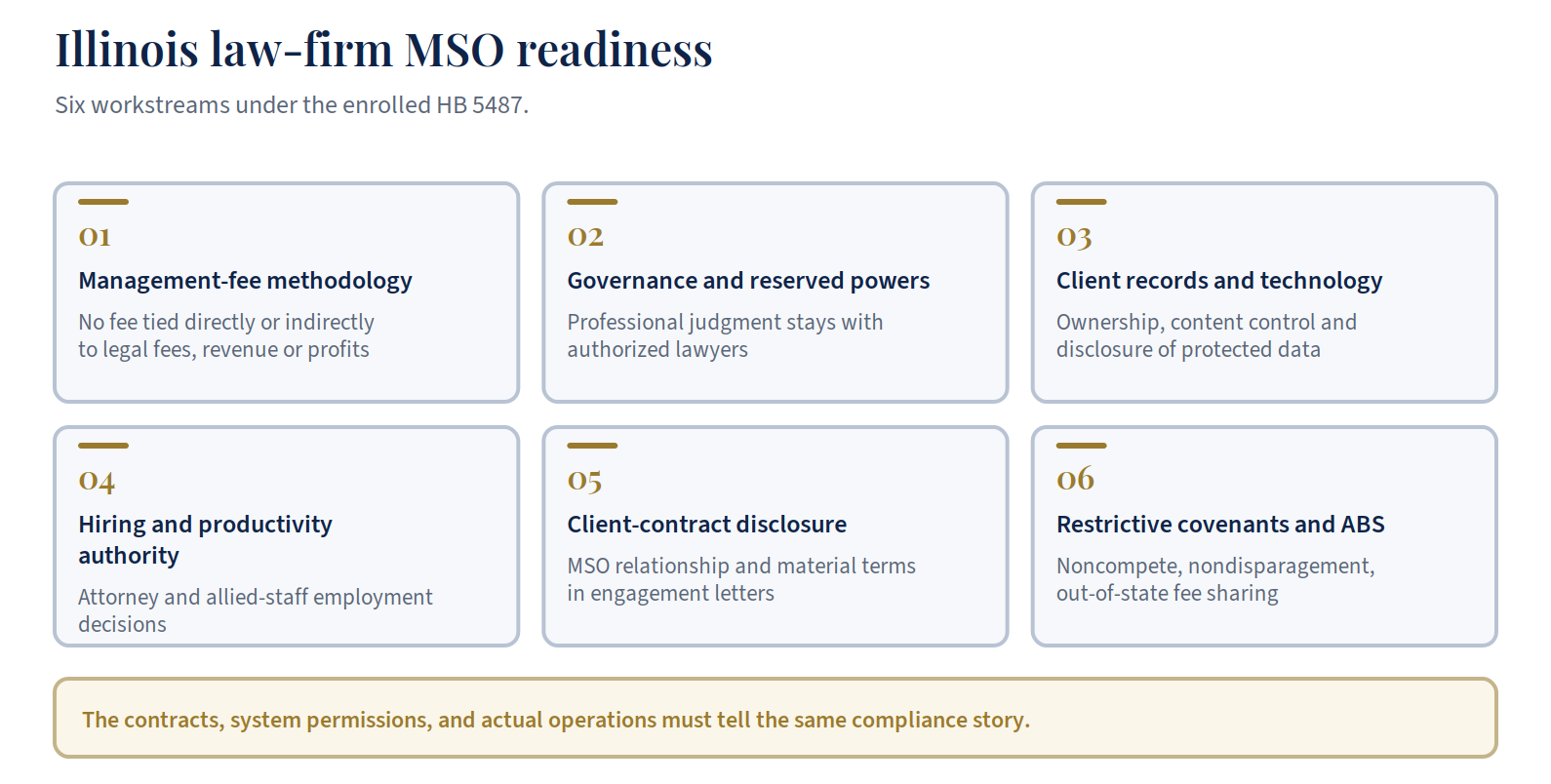
Now enacted, the statute reaches at least six separate workstreams — no longer readiness planning, but the compliance surface of current law: the formula used to compensate an MSO; the disclosure of the MSO relationship in attorney-client contracts; ownership, access, and control over client records and communications; authority over attorney and allied-legal-staff hiring, termination, and performance standards; restrictive covenants and specified nondisparagement provisions; and fee-sharing relationships with out-of-state alternative business structures.
The immediate task for law firms and MSOs is therefore not simply to replace a percentage-of-revenue fee with a fixed number. The parties must test whether the agreement, governance documents, technology permissions, staffing workflows, client contracts, and actual operating practices tell the same compliance story.
The enacted text also presents material interpretive questions. Its applicability language and its remedy provisions both raise issues that may require Illinois counsel's construction, corrective legislation, or judicial interpretation.
For transaction purposes, HB 5487 should be treated as a diligence and allocation issue. A buyer should determine which contracts would require amendment, whether the management-fee economics remain viable, whether data and employment rights must be reallocated, and whether the resulting changes affect valuation, financing, or closing conditions.
A disciplined response has three stages: determine whether the law applies; map each statutory restriction to the relevant agreement, system, and decision-maker; and redesign only the provisions that create exposure while preserving lawful nonlegal services and investment value. The objective should not be to defend an MSO label. It should be to establish that the management company performs real nonlegal services, receives compensation through a supportable methodology, and does not exercise authority reserved to licensed lawyers.
What this brief does not say
- It does not say the Act's application to any particular firm or arrangement is settled.
- It does not say HB 5487 bans MSOs.
- It does not say every vendor relationship is covered or prohibited.
- It does not say a fixed or fair-market-value fee automatically satisfies every provision.
- It does not say an existing MSO is compliant merely because lawyers retain professional judgment.
- It does not offer a view on the Act's constitutional validity, and it does not predict that a challenge will be filed or succeed.
- It does not provide an Illinois legal opinion or a contract-specific compliance conclusion.
- The workstreams, matrices, and review categories below are diligence prompts for counsel, not compliance determinations.
Applicability: an open construction question
The Act defines an MSO as an entity providing management and administrative support services in exchange for ownership of a law firm's assets or payments, and defines an ABS as an entity that provides legal services and allows nonlawyers to have ownership or decision-making authority, excluding nonprofit organizations.
Two thresholds appear in the applicability provision: an Illinois attorney or law firm with annual global revenue from legal services below $300 million, calculated using publicly available information and including affiliated firms; and an attorney or firm that regularly represents clients on a contingent-fee basis and derived more than 50% of gross global revenue from contingent-fee arrangements in each of the preceding three calendar years.
The enacted text states the two thresholds in the alternative. The official legislative synopsis of Senate Floor Amendment No. 2 describes them that way, using "(i) … or (ii)," and the operative text as enacted follows it. Read as written, the revenue prong alone reaches all but the largest global practices — the $300 million figure operates as a carve-out for firms above it, not as a threshold narrowing the Act. Any argument for a narrower conjunctive construction now runs against the enacted text, and Illinois counsel owns that construction and its application to any particular firm.
On that text, satisfying either prong can bring an arrangement within the provision, subject to the Act's definitions and scope provisions and to Illinois counsel's application to the particular facts; this brief does not state categorically how the provision applies to any firm. Covered firms and MSOs should obtain Illinois counsel's interpretation of the final enacted language and any corrective or implementing guidance before concluding they are inside or outside the statute. The Act also permits a firm, upon request of the ARDC, another enforcing authority, or court order, to provide a sworn self-certification addressing the relevant revenue and contingent-fee thresholds.
The six compliance workstreams
Workstream 1 — Management-fee redesign
The Act prohibits fees charged directly or indirectly based on the attorney's or firm's fees, revenue, or profits, with an exception for repayment of a loan or extension of credit where the obligation is not contingent on or calculated by reference to attorney fees, revenue, profits, or other financial performance.
Fee methodologies for counsel to evaluate include a fixed annual fee; a fixed monthly service fee; cost reimbursement; a cost-plus methodology; service-line pricing; per-employee or per-location administrative pricing; a technology licensing fee; a facilities or equipment charge; independently benchmarked fair-market-value pricing; and separate schedules for distinct nonlegal services.
Structures that would warrant particular scrutiny include a fixed fee that automatically rises with firm revenue; a bonus tied to profits; a true-up that recreates a percentage fee; debt repayment indexed to collections; referral or lead fees characterized as management compensation; service charges unsupported by actual operations; and a fee amount determined solely to transfer the firm's residual earnings.
Changing the label does not cure the economics. A fixed fee can remain exposed if its adjustment mechanism indirectly tracks legal revenue or profits. The substantiation and timing discipline behind a defensible fee is addressed in MSO management-fee timing under §267 and the 12-month rule.
A reviewable fee file would ordinarily identify the services performed, service recipients, cost base, allocation keys, pricing method, invoice cadence, deliverables, and state-specific legal review. That file may support the analysis. It does not replace it.
Workstream 2 — Governance and reserved powers
The Act restricts a nonlawyer-owned or controlled entity from interfering with attorneys' professional judgment and from exercising control over, or being delegated power over, specified law-firm functions.
| Decision | MSO may support | Final authority |
|---|---|---|
| Budgeting | Prepare data and recommendations | Lawyer-controlled governing body |
| Attorney hiring | Recruiting administration | Authorized lawyers |
| Attorney termination | HR process support | Authorized lawyers |
| Legal staffing | Operational analytics | Supervising lawyers |
| Case strategy | None beyond administrative support | Responsible lawyer |
| Settlement | No decisional authority | Client and lawyer |
| Professional competency | Administrative records only | Authorized lawyers |
| Vendor selection | Potential MSO authority for nonlegal vendors | Depends on function |
| Technology | Operate system subject to controls | Professional entity controls protected content |
Workstream 3 — Client records and technology
The records provision is broader than a general instruction not to practice law. It addresses whether the nonlawyer entity can reveal, own, or determine the content of client records, or reveal attorney-client communications.
A data-governance response would identify every system containing client-level data; assign ownership of the legal file to the professional entity; separate administrative data from privileged content where possible; establish role-based permissions; prohibit unauthorized secondary use for underwriting, marketing, or investor reporting; establish lawyer-controlled retention and litigation-hold policies; document incident-response authority; and test vendor and subcontractor access.
The MSA cannot reserve client control to the lawyers while the software permissions give the MSO unrestricted practical control over the file. The agreement and the technology permissions should tell the same story.
Workstream 4 — Hiring, productivity, and compensation
The distinction that matters is between administrative support and professional-employment authority.
Administrative support may include recruiting logistics, payroll processing, benefits administration, interview scheduling, background-check coordination, workforce reporting, and preparing operational dashboards.
Authority that would warrant scrutiny includes selecting the attorney; vetoing the hire; requiring termination; setting competency standards; establishing professional-quality metrics; imposing attorney productivity requirements; and conditioning management compensation on legal-output targets.
The compliance file should distinguish these categories and test actual decision pathways, not only job descriptions.
Workstream 5 — Client-contract disclosure
A covered attorney or law firm that is party to an MSO agreement must disclose in attorney-client contracts that the agreement exists and disclose its material terms. This is not a back-office filing requirement; it places the MSO relationship in the client engagement document.
Rather than a model clause, the development process should address: identifying the existence and role of the MSO; describing the categories of nonlegal services; stating that professional judgment remains with the attorneys; addressing access to administrative or client-related information; explaining any material financial relationship to the extent counsel determines is required; preserving confidentiality of proprietary terms not required to be disclosed; coordinating the disclosure with privacy notices and engagement-letter language; and establishing version control and implementation responsibility.
No model disclosure should be treated as universally compliant. What "material terms" requires, and how the disclosure interacts with confidentiality and proprietary transaction terms, are questions for Illinois counsel.
Workstream 6 — Restrictive covenants and out-of-state ABS relationships
The Act prohibits a management contract with a nonlawyer-owned or controlled entity from limiting an attorney or allied legal staff member from competing after termination or resignation, and restricts specified provisions limiting disparagement or comment on quality of services, ethical or professional challenges, or revenue-increasing strategies used by the nonlawyer entity.
Alternatives counsel can evaluate include confidentiality obligations; trade-secret protection; data-return and deletion requirements; client-file transition duties; property-return obligations; security and access termination; noninterference with active matters; professional-responsibility transition requirements; and carefully reviewed nonsolicitation provisions where otherwise permissible.
Separately, an Illinois lawyer may not share legal fees directly or indirectly with an out-of-state ABS unless the lawyer is also licensed in the ABS jurisdiction, the fees compensate legal services in that state, and that state's law controls under Illinois Rule 8.5 or a successor rule. How outside capital reaches a practice across jurisdictions is compared in ABS, Utah sandbox, and MSO law-firm capital models.
Illinois transaction matrix
| Deal document | HB 5487 issue | Potential response |
|---|---|---|
| MSA | Revenue- or profit-based fee | Redesign pricing methodology |
| Purchase agreement | Regulatory risk allocation | Condition, covenant, escrow, or price adjustment |
| Governance agreement | Nonlawyer control | Expand attorney-only reserved powers |
| Employment documents | Hiring and productivity authority | Reallocate final decisions |
| Client engagement letters | MSO disclosure | Develop approved disclosure language |
| Data-use agreement | Records and communications | Restrict ownership, content control, and disclosure |
| Credit documents | Financial-performance repayment | Remove prohibited contingencies |
| Restrictive-covenant package | Competition and commentary | Replace with narrower lawful protections |
| Out-of-state ABS agreements | Fee sharing and Rule 8.5 | State-by-state analysis |
| Amendment or renewal | Prospective application | Determine whether a new contract is created |
A triage view
These categories indicate where review effort is likely to concentrate. They are not compliance determinations, and none of them substitutes for Illinois counsel's review of the actual documents and operations.
Likely to require redesign if the section applies: percentage of legal revenue; percentage of profits; MSO veto over attorney hiring; MSO authority to terminate attorneys; MSO-owned client files; unrestricted access to attorney-client communications; MSO-set attorney competency or productivity requirements; broad post-employment noncompete.
Facts and drafting determine exposure: fixed fees with annual adjustments; bonuses or true-ups; cost-plus methodologies; shared CRM access; centralized recruiting; performance dashboards; debt covenants; brand ownership; nonsolicitation provisions; contract renewals or extensions.
Lower apparent exposure, subject to counsel review: lawyer-controlled professional decisions; service-specific compensation; documented nonlegal services; role-based data access; attorney-controlled hiring and termination; independent fee support; separate governance records. This category does not describe a safe harbor.
M&A implications
Before signing, a buyer should determine whether the target is covered; which contracts could become prohibited; whether the fee model survives; whether management EBITDA must be recalculated; whether client contracts require modification; whether operating control must move back to the lawyers; whether changes affect debt capacity; whether the seller must complete remediation before closing; and whether a price-adjustment or regulatory-remedy mechanism is needed.
In diligence, request all MSAs and amendments; management-fee calculations; cost-allocation studies; client engagement templates; data maps and access permissions; attorney hiring and termination workflows; productivity dashboards; employment and separation agreements; financing documents; out-of-state ABS arrangements; and board minutes showing actual decision authority.
In the purchase agreement, counsel may consider regulatory-compliance representations; disclosure of state-specific arrangements; pre-closing remediation covenants; conditions precedent; special indemnities; escrow; purchase-price adjustment; state-specific carve-outs; cure obligations; and a sequenced remedy framework rather than an automatic full unwind, as discussed in regulatory put risk in MSO deals. Exit-value planning through the structure is addressed in §1202 QSBS diligence for MSO structures.
Remedies and prospective application
A violation may constitute grounds for ARDC discipline and could subject the attorney, MSO, and ABS to statutory damages of $10,000 per violation or three times actual client damages, whichever is greater, plus attorney's fees and costs, and injunctive or declaratory relief.
The Act specifies damages, fees, costs, and equitable relief, but the enforcement vehicle, eligible claimants, standing, calculation of violations, and interaction with existing disciplinary and judicial remedies may require judicial construction. This brief does not assert that any particular person has an established private cause of action.
The Act applies only to contracts entered into on or after its effective date, August 7, 2026. Counsel should determine how renewals, amendments, extensions, restatements, assignments, addenda, and new client contracts affect that prospective-application rule.
The Illinois separation-of-powers question
Illinois courts have long recognized the Illinois Supreme Court's authority over core aspects of regulating the legal profession, including admission and discipline. The Supreme Court exercises statewide supervisory authority and administers attorney discipline through the ARDC.
Holland & Knight has argued that HB 5487 infringes that judicial authority and has identified constitutional infirmities that may affect enforcement. Enactment does not resolve the constitutional question; it makes it justiciable. This brief offers no view on validity. That is an attributed legal position, not a decided outcome.
A future challenge could raise questions about whether the statute regulates the practice of law, creates civil remedies around commercial conduct affecting law firms, supplements professional rules, or intrudes on judicial authority. Standing, ripeness, severability, the identity of the plaintiff, and the provision challenged would all matter. As of the initial July 18, 2026 review, no reported merits decision addressed the bill. Enactment on August 7, 2026 makes the constitutional question justiciable rather than resolving it; current litigation status should be confirmed with Illinois counsel.
This brief reports the positions commentators have taken and takes no position on the constitutional question. Whether or not a challenge is ultimately raised, it does not eliminate the need to review the enacted text and to comply with it now.
Frequently asked questions
Is Illinois HB 5487 law?
Yes. HB 5487 was approved by the Governor on August 7, 2026, and is now Illinois Public Act 104-0801, effective on approval. Its application to any particular arrangement is a question for Illinois counsel.
What happened to Illinois SB 3812?
SB 3812 was the identical Senate companion to HB 5487, filed the same day, February 6, 2026, by Sen. Michael Hastings. It was assigned to the Senate Judiciary Committee, amended once, and re-referred to Assignments on March 27, 2026, where it did not advance. HB 5487 is the bill that became law. Anyone tracking “HB 5487 / SB 3812” should read the enacted text of Public Act 104-0801; SB 3812 has no independent legal effect.
Does Illinois HB 5487 ban law-firm MSOs?
No. The Act does not ban MSOs as entities. It regulates specified conduct, disclosures, fees, control rights, restrictive covenants, remedies, and relationships involving covered Illinois firms and nonlawyer-owned or controlled entities.
What MSO fee structure does HB 5487 restrict?
HB 5487 prohibits fees charged directly or indirectly based on a law firm's fees, revenue, or profits. Percentage-of-revenue management fees are the clearest pressure point.
Would a fixed management fee automatically comply?
No. A fixed fee may avoid the most obvious percentage-of-revenue formula, but counsel still needs to review service substance, indirect performance ties, control rights, disclosure, records, staffing, and other provisions.
Which Illinois firms does the Act cover?
The Act states two tests in the alternative: an Illinois attorney or firm with annual global legal-services revenue below $300 million, or one that regularly represents clients on a contingent-fee basis and derived more than 50% of gross global revenue from contingent fees in each of the preceding three years. Read as written, the revenue prong alone reaches all but the largest practices. Illinois counsel should confirm application to any particular firm.
Could HB 5487 face a constitutional challenge?
The question is unresolved. Holland & Knight has argued that the Act intrudes on the Illinois Supreme Court's authority over law-practice regulation. This brief does not offer a view on the Act's validity and does not predict whether a challenge will be filed or succeed.
Related from the GTC Insights Library
- ABS vs. MSO for Law Firms: A Capital-Architecture Framework for Private Equity
- The Regulatory Put in Law-Firm MSO Deals: A Negotiation Framework for Cure, Repricing, and Unwind
- The Seven-Figure Ethics Question: Reading Sidley Austin on MSO Management-Fee Architecture
- §1202 QSBS Through an MSO: OBBBA 2025 and Diligence
- MSO Management-Fee Timing: The 12-Month Rule, §267(f), and Controlled-Group Service Payments
Selected public authorities
- Illinois General Assembly, HB 5487 official bill status and enacted text (Public Act 104-0801).
- People ex rel. Brazen v. Finley, 119 Ill. 2d 485 (1988), and related Illinois authority concerning judicial regulation of the legal profession.
- Holland & Knight, "HB 5487 Passes, Ushering in New Regulation of MSOs, ABS Models and Law Firm Operations" (June 1, 2026).
- Illinois Rules of Professional Conduct, including Rule 8.5.
Law and status verified through September 5, 2026. Pending bills, court proceedings, and professional-conduct rules may change after publication.
Disclosures
This brief is general information for institutional and professional audiences. It is not Illinois legal advice, a constitutional opinion, a professional-responsibility opinion, or a contract-specific compliance determination. The workstreams, matrices, and triage categories are diligence prompts for counsel and do not establish compliance or non-compliance. HB 5487 was approved by the Governor on August 7, 2026, and is Public Act 104-0801, effective on approval. The enacted text, implementing guidance, judicial decisions, and professional rules in effect at the relevant time will control. Law firms, MSOs, investors, vendors, and advisors should consult Illinois professional-responsibility and litigation counsel before entering, amending, renewing, or relying on any covered arrangement.
NEXT STEP
Working through an Illinois-touching fact pattern?
For law firms, PE deal teams, and M&A counsel evaluating MSO architecture, Guardian Tax Consultants® coordinates the service, fee-methodology, and operating-documentation workstream alongside the client's Illinois professional-responsibility and transaction counsel.
Related development: Colorado enacted its own legal-practice statutes in the same window — HB26-1421 (fee-sharing and MSO/ABS restrictions, signed June 4, 2026) and SB26-174 (designating paid lead-generation marketing for legal services a deceptive trade practice, signed June 3, 2026), both effective August 12, 2026. Illinois is no longer the only enacted statute in this area.