
A multi-partner law firm MSO example: how partners reach liquidity, who governs what after outside capital arrives, and what makes the platform readable to a buyer years later.
In short: In a law firm MSO structure, the firm stays lawyer-owned and keeps professional judgment while a separate services company holds the nonlegal operations. Liquidity, governance, and exit readiness are decided in how that second company is designed and run, not in the fee attached to it.
This is an illustrative example drawn from recurring law-firm MSO planning issues. It is anonymized and does not describe a named client, transaction, or completed private-equity-backed law-firm MSO deal.
On this page: assumptions · jurisdiction · structure · liquidity · governance · the fee · exit readiness · tax · state law · failure modes · the payoff · where Guardian fits · FAQ
From the Reference Edition
This topic is addressed in The Durable Law-Firm MSO — Reference Edition, Version 1.1, September 2026.
Relevant sections: Sections 03 and 27.
What does this law firm MSO example assume?
The facts below are inputs to an illustration: proportions and structural quantities. They are not prices, and no valuation, benchmark, multiple, or fee level should be inferred.
Assume a plaintiffs-side litigation practice in a single state: seven equity partners, two within five years of retirement, two originating a disproportionate share of new matters, three mid-career. Roughly 45 lawyers and 90 nonlawyer employees. Marketing, intake, technology, finance, HR, and facilities run inside the firm. No funded retirement obligation, and no market for a departing partner’s interest.
That last point is the pressure.
Two senior partners want a defined exit. Three mid-career partners want the practice to exist in fifteen years. None wants a stranger deciding which cases the firm takes. Those objectives are the test, and the payoff below returns to them.
Is a law firm MSO available in the firm’s state?
This is the gating question, and it belongs to counsel rather than to an illustration.
The map moved considerably across 2025 and 2026. Specifics sit under state law below, with fuller treatments at Illinois HB 5487 requirements and ABS, the Utah sandbox, and MSO capital. Definitions are at what a law firm MSO is and the model generally.
What does the structure look like in this example?
A separate management services organization holds the nonlegal assets, employs the nonlegal staff, and provides services under a management services agreement for a recurring fee. It is treated at length in the MSO structure article.
In the illustration, the seven partners form the services company themselves, move substantially all nonlegal assets into it, and run it for a full year before an investor is approached. That year is what later distinguishes a platform from a diagram.
| Stays with the law firm | Moves to the MSO |
|---|---|
| Client acceptance, declination, termination | Brand, trade name, nonlegal IP |
| Fee structures, case strategy, settlement | Technology, data, marketing, intake |
| Lawyer employment and supervision | Finance, HR, recruiting, benefits |
| Professional judgment, ethics, trust accounts | Facilities, vendors, nonlawyer staff |
How do law firm partners get liquidity from an MSO?
Before a transaction a retiring partner recovers the capital account and little else, and internal succession asks the next generation to fund a buyout from earnings — the problem taken up at succession without a sale. Assume an investor acquires a minority interest in the MSO.
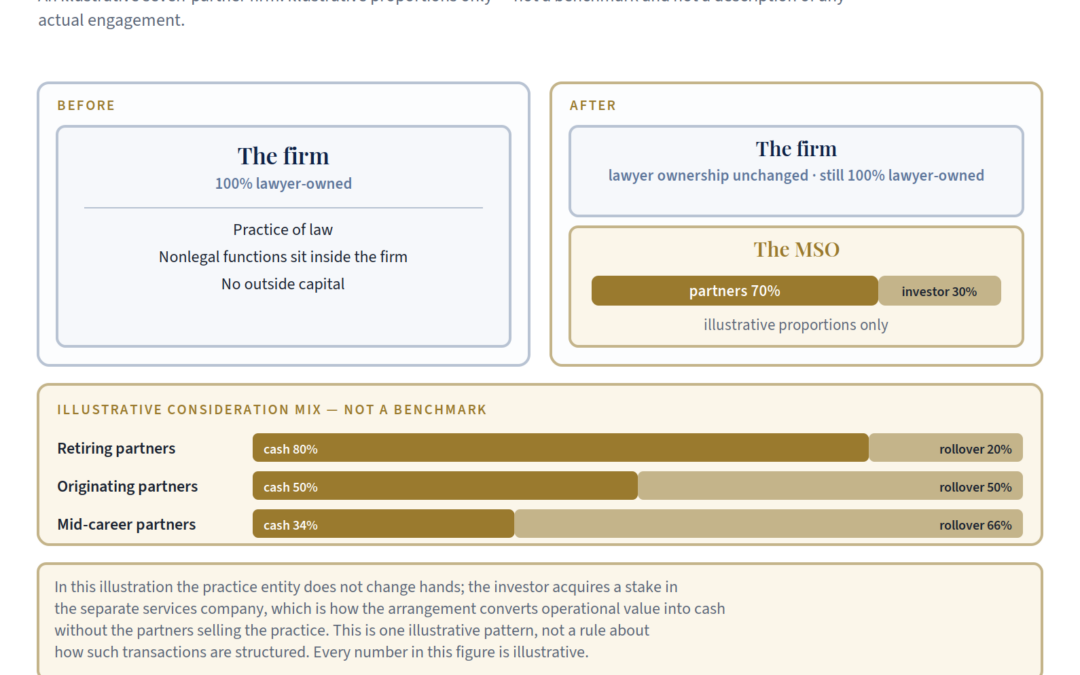
The illustrative ownership stack. The investor takes 30 percent of the MSO. The seven partners retain 70 percent, tracking their firm interests at formation. The law firm remains 100 percent lawyer-owned. The proportions make the mechanics legible; they do not signal a market split.
The illustrative consideration mix. What each partner receives at closing is where three competing positions resolve.
| Partner group | Cash at closing | Rollover equity | Why the mix is shaped this way |
|---|---|---|---|
| Two retiring partners | Roughly 80 percent | Roughly 20 percent | Shortest horizon; cash is the outcome |
| Two originating partners | Roughly half | Roughly half | Cash for what they built, rollover for what follows |
| Three mid-career partners | Roughly one third | Roughly two thirds | Their interest is what the platform becomes |
All seven keep MSO equity and share in the services company’s results separately from what they earn practicing law. Four hold platform management roles, compensated for nonlegal services rendered to the services company and not tied to the firm’s legal revenue, recoveries, or profits. What those roles pay is a question for independent economists.
The illustration treats retention as economic rather than contractual, which is why the two originating partners take half their consideration in rollover.
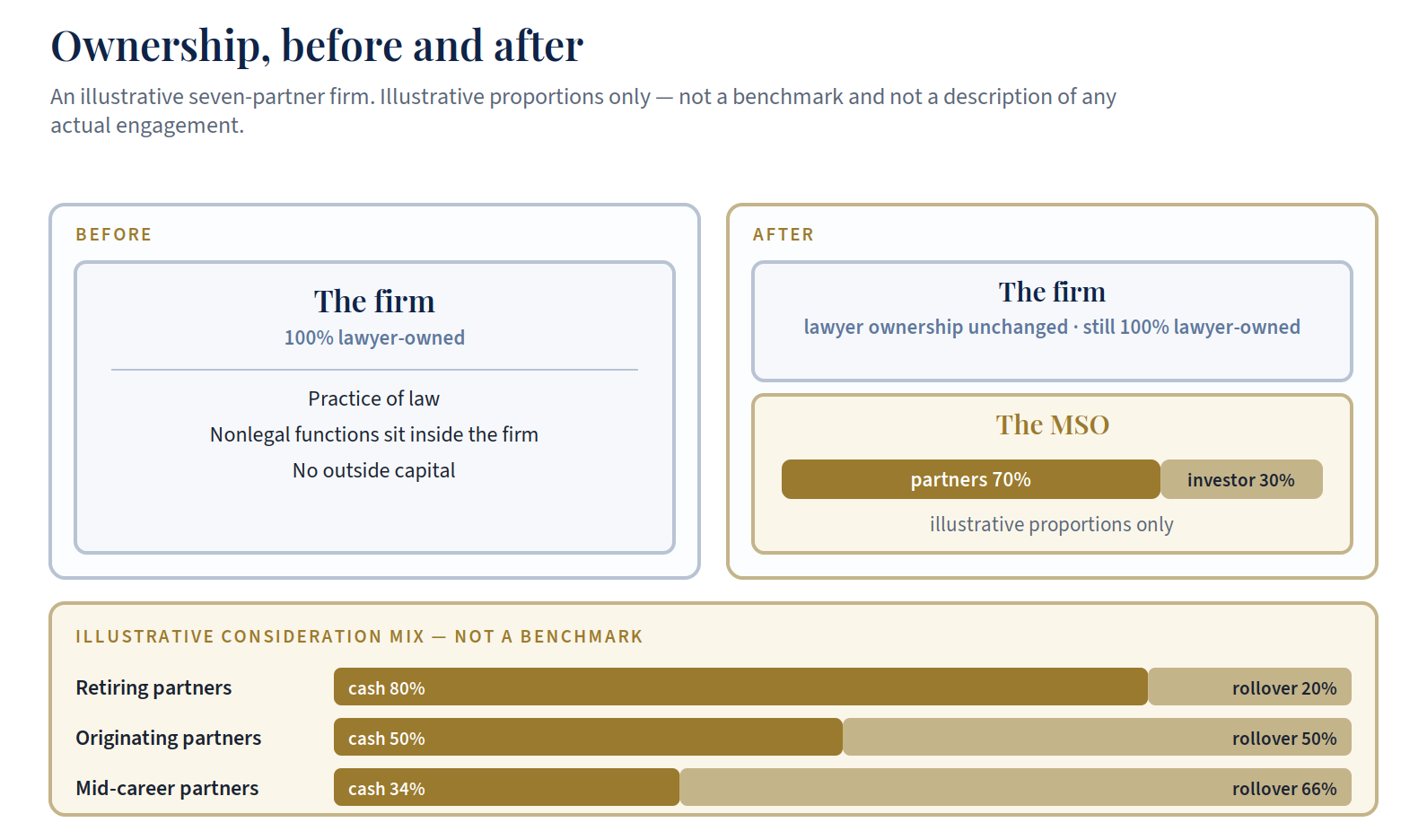
In this illustration the practice entity does not change hands; the investor acquires a stake in the separate services company, which is how the arrangement converts operational value into cash without the partners selling the practice. This is one illustrative pattern, not a rule about how such transactions are structured. Every number in this figure is illustrative.
Who controls the law firm after an MSO investment?
Liquidity is why owners look at the model. Governance is why it survives after the money arrives.
For each decision touching professional judgment: does a named person own it, is it written down, and does the reporting line survive contact with the sponsor? That test is this section’s contribution.
Run that test:
- Board composition, stated rather than implied. The MSO board seats five: three designated by the partner holders, one by the investor, one independent director agreed by both. The partners, holding 70 percent, control the platform board. Board seats and management roles are separate assignments, which is why three partners sit on the board and four hold management roles. The investor takes no seat or information right at the law firm.
- The ethics committee is chaired at the firm, and the compliance officer reports to it. One originating partner calls the independent director’s seat overhead, which is the reason it exists.
These allocations live in the management services agreement, treated in law firm MSO agreement key terms.
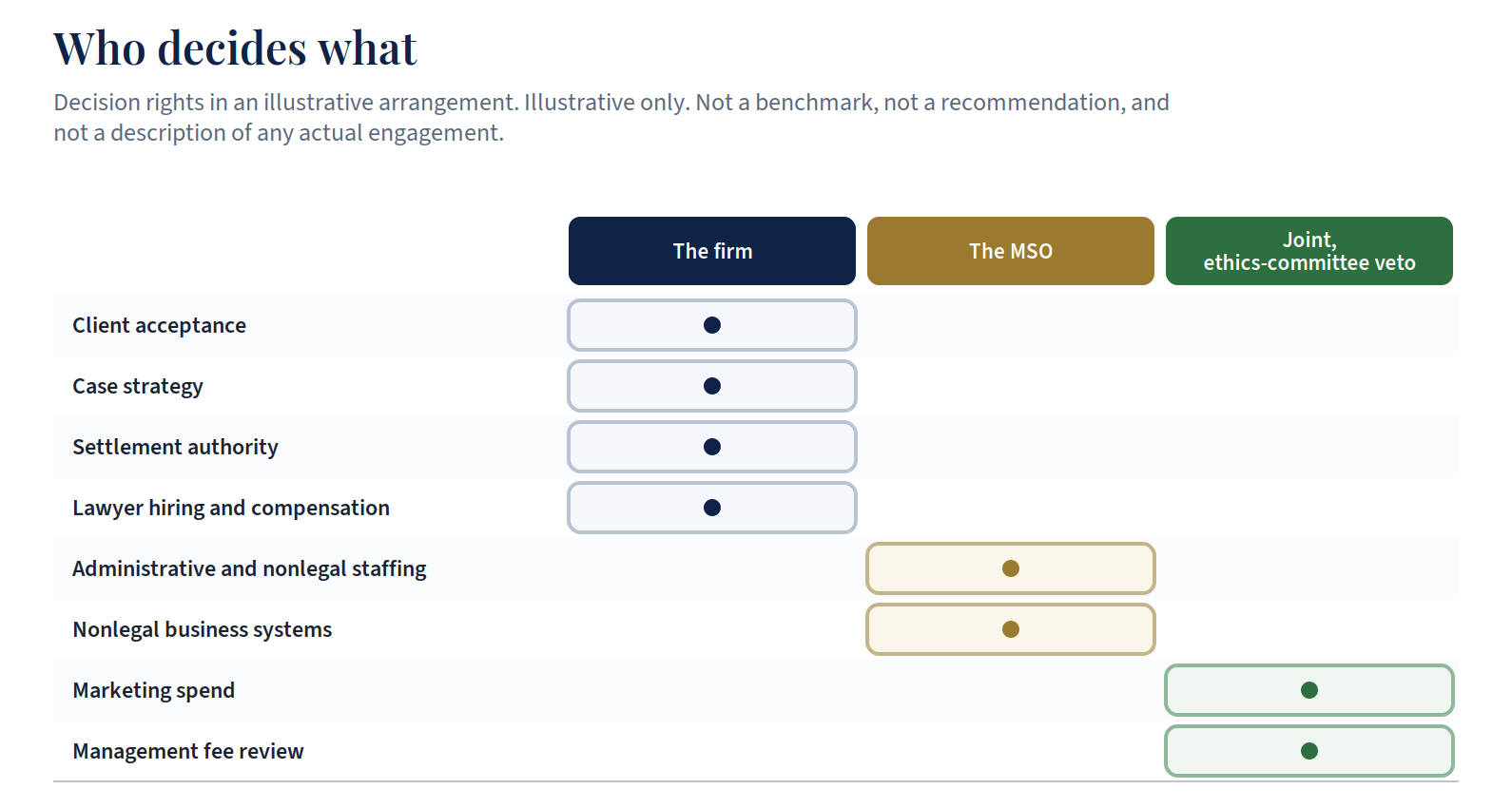
Illustrative only. The allocation a given firm adopts is a matter for professional responsibility counsel in the relevant state. Governance approval of the management fee does not replace independent legal or economic review of it. What matters more than the grid is whether the minutes show the rights being exercised the way the agreement says they are.
What can the MSO charge, and why is the fee not the whole story here?
Texas Ethics Opinion 706, issued in February 2025, addresses the question directly (Texas Committee on Professional Ethics, Opinion 706, February 2025, reproduced in the Texas Bar Journal, https://lsc-pagepro.mydigitalpublication.com/article/Ethics+Opinion+706/4947717/843020/article.html).
Texas Opinion 706 rejected percentage-of-revenue compensation. It did not establish that another fee form is automatically permissible, and it does not reach whether a given amount is economically supportable — a point the cornerstone works through.
In the illustration, the MSO charges a fixed monthly fee, reviewed on a defined annual cadence, supported by an independent economic analysis, and documented through ordinary invoicing and management reporting. How such a fee is built and tested is the cornerstone’s subject: how MSO fees are calculated.
The fee is reviewed on its own terms — this section is that review — and it is also evidence of something behind it. Where the operating company is thin, no formula repairs it.
What makes a law firm MSO platform exit-ready?
Exit readiness is not a document produced before a sale. It is institutionalization: the point at which the business runs on documented processes and named owners rather than on the memory of two or three people.
| Exit-readiness signal | What a buyer or lender looks for | Where it comes from here |
|---|---|---|
| Revenue concentration | Matters not dependent on one or two lawyers | Marketing and intake as a platform function |
| Leadership depth | Management that survives a founder’s exit | MSO roles held by four of seven partners |
| Financial clarity | Statements that reconcile without narration | Separate books and invoicing from the start |
| Governance record | Decisions documented as they were made | Board minutes, ethics records, annual fee review |
A meaningful operating history may allow quality-of-earnings work to evaluate demonstrated results rather than assumptions, and how much history suffices depends on the platform and the data. Durable economics follow durable operations.
Deal flow in the wider market is covered at law firm consolidation and MSO adoption; how sponsors underwrite these platforms is the hub’s subject: private equity-backed MSOs.
What tax and economic questions do the partners’ advisors carry?
These belong to the client’s CPA and to tax counsel, and they get decided before a transaction.
First, what the MSO holds. A services company that will hold interests in other pass-through entities raises qualified small business stock questions that look different from one holding only its own operations, and the answer shapes entity choice at formation. That lands hardest on the three mid-career partners. See Section 1202 QSBS and MSO strategy.
Second, character and timing. Cash at closing, rollover equity, distributions, and leadership compensation are four different questions, and the retiring two carry a different version of them than the mid-career three.
Third, the record behind the fee. It is read for whether services were actually performed and priced consistent with arm’s-length methodology. That is an evidentiary observation, not a conclusion.
How does state law change this law firm MSO example?
Colorado. HB26-1421 was signed June 4, 2026, takes effect August 12, 2026, and repealed September 1, 2029 (Colorado General Assembly, HB26-1421, https://leg.colorado.gov/bills/hb26-1421). The act was signed on June 4, 2026 and took effect on August 12, 2026; it is now in effect. Its prohibitions run to a lawyer or law firm “in connection with providing legal services concerning a legal right arising in whole or in part in Colorado,” and reach fee sharing with nonlawyers and alternative business structures. The compensation rule is the one that matters to a services company: the act prohibits “compensating a person that provides administrative or nonlegal business services to a lawyer or law firm unless the compensation is not contingent upon a percentage of legal fees or revenues and not determined by reference to recoveries, settlements, or other case outcomes.” Legal fees or revenues — a revenue-linked management fee sits inside that prohibition, not outside it, and the second half reaches recoveries and settlements, which is the operative half for a contingency practice. The act regulates “a person that provides administrative or nonlegal business services,” not an entity it calls an MSO.
Illinois. HB 5487 passed both houses on May 31, 2026, was sent to the Governor on June 26, 2026, and was approved by the Governor on August 7, 2026. It is now Illinois Public Act 104-0801, effective on approval, and is current law (Illinois General Assembly, HB 5487 bill status, 104th General Assembly, https://www.ilga.gov/ftp/legislation/104/BillStatus/HTML/10400HB5487.html). Its coverage test, as enacted, is disjunctive. The Act applies to a licensed attorney or law firm with “annual global revenue from that licensed attorney’s or law firm’s provision of legal services that is less than $300,000,000,” or to a licensed attorney or law firm that regularly represents clients on a contingent fee basis where contingent fees comprised “more than 50% of the attorney’s or law firm’s revenues from the contingent fee arrangements in each of the preceding 3 calendar years” (Illinois General Assembly, HB 5487, full text as passed, https://www.ilga.gov/Legislation/BillStatus/FullText?GAID=18&DocNum=5487&DocTypeID=HB&LegID=&SessionID=114&GA=104). The illustrative firm is a contingency practice, so it sits inside coverage on the second prong under the Act as enacted.
California. AB 931 was chaptered October 10, 2025 and is repealed January 1, 2030; it added section 6156 to the Business and Professions Code (California Legislature, AB 931 (2025), chaptered text, https://leginfo.legislature.ca.gov/faces/billNavClient.xhtml?bill_id=202520260AB931). Subdivision (g) is an applicability rule, not a general operative date: “This section shall only apply to contracts entered into on or after January 1, 2026.” An arrangement papered before that date sits outside the section.
The restricted counterparty is an entity, not a person. Subdivision (a): “No attorney licensed or otherwise authorized to practice in this state shall share legal fees directly or indirectly with an out-of-state alternative business structure unless all of the following apply:” — the attorney is also licensed in the approving state, the fees compensate legal services in that state, and that state’s law controls under Rule 8.5. Subdivision (c) defines an alternative business structure as “any entity that provides legal services while allowing nonattorney ownership or decisionmaking authority.”
That “unless all of the following apply” is subdivision (a)’s own internal exception. Subdivision (e) is a separate and additional exclusion: “This section shall not apply to a contract in which all of the following are satisfied: (1) The contract outlines a specific dollar amount for services rendered. (2) No payment is related to the referral of legal services or purchase of a lead for a potential client or case. (3) No payment is contingent on the amount recovered in a specific case.” The statute does not use the term “MSO” or “management services organization.” Reading a conforming management arrangement into the (e) exclusion is an inference drawn here, not a permission granted by the statute.
What would make this illustrative structure fail?
- The structure that exists only on paper. Nonlegal staff still report to partners, the invoice arrives without services behind it, the ethics committee never meets, and a diligence team finds paperwork where an operating business was promised.
- The fee that tracks legal revenue. Texas Opinion 706 and Colorado HB26-1421 both reach it, and the Colorado prohibition names “a percentage of legal fees or revenues” alongside compensation “determined by reference to recoveries, settlements, or other case outcomes” (both cited under state law and the fee section above). It is also weak as economics, because firm revenue moves for reasons unrelated to the services company.
- Dependence on people who can walk. Retention here is economic, not contractual. If an originating partner leaves in year two, the concentration problem becomes everyone’s.
- The generational-equity problem. The payoff section below gives the design answer, and it has to be built rather than asserted.
- Building the record after the buyer arrives. A failure that is difficult to reverse. Years of operating history cannot be manufactured in ninety days.
Did the seven partners get what they wanted?
Three objectives were posed at the top.
The defined exit. The two retiring partners take roughly 80 percent in cash, and that cash is the outcome.
Fifteen years. The generational-equity objection above is the sharp form of the doubt: if the current partners monetize the platform, what is left for the lawyers who follow? The answer is that the platform is the thing that can be left. Marketing, intake, technology, and management belonging to an institution rather than to two founders are what a next generation inherits without funding a buyout from earnings. Whether they inherit anything is a design decision, made in how much equity stays with the firm’s lawyers and how new partners are admitted.
No stranger picking cases. Answered by the governance section, in reporting lines rather than in assurances.
Where does Guardian Tax Consultants® fit?
The lanes stay separate, and they should. Independent counsel owns the legal and professional-responsibility analysis. Independent economists own the fee and valuation conclusions. The client’s CPA owns return positions and filings. Guardian Tax Consultants® (GTC™) designs and administers the operating and economic record beneath all three, so the governance file, the invoicing, and the management reporting keep describing the same business over time.
The economic report supports the operating company. It does not replace one.
If you are working through these questions
Whether you are evaluating a platform for your practice or reviewing one that exists, bring your counsel and your CPA into it. Guardian’s part is the operating and economic record.
Firm owners, counsel, and CPAs: start an educational conversation about a law firm MSO platform and describe the liquidity, governance, or exit-readiness question you are working on.
Educational discussion only. No engagement is created by an inquiry, and no advice is given through this page.
Frequently asked questions
Is this a real law firm MSO transaction?
No. This is an illustrative example drawn from recurring law-firm MSO planning issues. It is anonymized and does not describe a named client, transaction, or completed private-equity-backed law-firm MSO deal. The figures in it are proportions and structural quantities, not prices, and no valuation, benchmark, multiple, or fee level should be inferred from them.
Is there a real law firm MSO case study with actual numbers?
Not on this page. Guardian’s separate law firm MSO case study works a single-principal practice. The seven-partner structure here is illustrative, and what it publishes is proportions and structural quantities rather than prices.
What does a law firm MSO example look like in practice?
A partner group forms a services company, moves nonlegal operations into it, runs it as a business, and later sells a minority interest. The example here uses seven partners, a 70/30 partner-investor split of the MSO, and consideration weighted to cash for retiring partners and rollover for mid-career ones.
How can law firm partners receive liquidity without selling the law firm?
Through the services company rather than through the firm. In this illustration an investor acquires a minority interest in the MSO — 30 percent, with the seven partners retaining 70 percent — while the law firm remains 100 percent lawyer-owned. Partners take their consideration as cash at closing and rollover equity in the MSO, weighted toward cash for the two retiring partners and toward rollover for the three mid-career partners, and all seven keep MSO equity and share in the services company’s results separately from what they earn practicing law. Whether the model is available at all is a jurisdictional question for counsel, not one this illustration answers.
Who controls the law firm after outside investment in the MSO?
The lawyers do, in this illustration. The law firm remains 100 percent lawyer-owned, and client acceptance, declination and termination, fee structures, case strategy and settlement, lawyer employment and supervision, and professional judgment stay with the firm. The investor takes no seat or information right at the law firm. Its single seat is on the five-member MSO board, where the partner holders designate three and both sides agree one independent director, and the ethics committee is chaired at the firm with the compliance officer reporting to it. Those allocations live in the management services agreement.
Does a law firm MSO example require private equity?
No. In this illustration the seven partners form the services company themselves, move substantially all nonlegal assets into it, and run it for a full year before an investor is approached. Outside investment enters as an assumption in the liquidity section, not as a precondition of the structure described here — and that operating year is what later distinguishes a platform from a diagram.
Authorities and further reading
- Texas Ethics Opinion 706 (February 2025, as reproduced in the Texas Bar Journal)
- Illinois HB 5487: bill status · full text (approved August 7, 2026; now Public Act 104-0801, effective on approval)
- Colorado HB26-1421 · California AB 931, chaptered text
- L.E.K. Consulting: design principles
- Lenfestey, Attorney at Law Magazine · LawFuel
Related reading
Management fees · what is an MSO · what is a law firm MSO · MSO structure · private equity-backed MSOs · Illinois HB 5487 · ABS and the Utah sandbox · regulatory puts · agreement terms · single-principal case study
Guardian Tax Consultants® designs and administers the operating and economic architecture supporting Management Services Organizations, including the MSO Platform™ approach described across this library. Guardian does not provide legal advice, does not prepare or file tax returns, and does not render valuation or fee-study conclusions. Independent counsel provides legal opinions, independent economists perform management-fee and valuation analyses, and the client’s CPA determines tax-return positions. This article is educational and is not legal, tax, accounting, valuation, or investment advice. Statuses stated here are current as of August 22, 2026.
Alex Jones, Founder and Chief Executive Officer, Guardian Tax Consultants · Last reviewed August 22, 2026