
Technical Brief · Private Equity · Sponsor-Side
Technical Brief · Draws on The Durable Law-Firm MSO — Reference Edition, Sections 05, 07, 08, 11, 12, 13, 15, 20 and 21. First published June 4, 2026; substantially revised and re-verified September 7, 2026.
A law-firm management services organization is a separately owned nonlegal company that employs the firm's business functions and charges the practice a fee for them under a documented method; what it is and how outside capital enters it are covered elsewhere in this library. This brief is written for the other side of the table: the private equity sponsor, family office, or institutional investor evaluating a law-firm services platform, and the deal team — banker, transaction counsel, quality-of-earnings accountants — advising them. It describes what a sponsor actually acquires, where the professional-independence perimeter sits, how the management fee has to be set for the platform's earnings to survive later review, what the enacted state statutes of 2026 changed, and what buy-side diligence reads. It does not describe a valuation method and it does not assume one.
Canonical Answer
What does a private equity sponsor actually buy in a law-firm MSO?
In the law-firm MSO architecture addressed here, the sponsor acquires permitted interests in the nonlegal services platform — ordinarily through a holding entity that owns the management company — rather than the law practice. In that architecture the licensed practice stays attorney-owned before and after closing, holding the clients, the engagement letters, the legal fees, and the trust accounts. What the investor's capital buys is the services business: its executed agreements, systems, workforce, company-owned intellectual property, and above all its operating history. What that capital prices is the record. The platform's only revenue is a management fee that must follow a documented method fixed in advance, never a percentage of the firm's fees, revenue, or profit, and never resized to produce a target result; fixed and cost-plus methods are the design posture, not a safe harbor. After closing, the fee remains subject to annual substantiation and fact-specific §482 analysis; the applicable professional-responsibility rules and state statutes — now including enacted law in Illinois and Colorado — constrain what any investor right may reach. No valuation effect is assumed or promised: buyer underwriting depends on operating substance, governance, pricing support, regulatory risk, financial performance, and the transaction facts.
From the Reference Edition
This topic is addressed in The Durable Law-Firm MSO — Reference Edition, Version 1.1, September 2026.
Relevant sections: Section 05 (“The Three Continuing Reviews”); Section 07 (“Before the Process: Operating History and Transfer Pricing”); Section 08 (“What a Transaction Actually Transfers — and What It Does Not”); Sections 11–13 (professional responsibility, the jurisdictional patchwork, economic separation); Section 15 (“Buyer, Lender, and Recapitalization Diligence”).
What the sponsor owns, and what it does not
Owners contemplating a first transaction generally know the licensed practice is not what is sold. What is less familiar, on both sides of the table, is what the transaction actually looks like: what is bought, what is rolled, what stays outside the perimeter, and what ends at closing. In the nonlawyer-capital architecture the Reference Edition illustrates, the investor purchases interests in a holding entity, commonly a partnership, that owns the management company. The founding owners do not simply cash out: they roll a portion of their equity into the same holding entity, taking a retained stake on the same capitalization table as the investor. The Reference Edition's summary of what the capital acquires is the sentence a deal team should carry into every meeting: “What the investor's capital actually buys is interests in the services business: its executed agreements, systems, workforce, company-owned intellectual property, and above all its operating history. What that capital prices is the record.”
The licensed practice does not change hands. In the paper's words, it is “attorney-owned before closing and attorney-owned after, holding the clients, the engagement letters, the legal fees, and the trust accounts throughout. The day after closing, the practice's ownership page reads as it did the day before. What changed is the capitalization table of the holding entity, not the ownership of the practice.” Rule 5.4 does not merely constrain this transaction; the paper's phrase is that it “draws its perimeter,” and a structure built correctly makes that boundary legible in the documents rather than asserted in a side letter. A sale of a practice to another lawyer or firm under Model Rule 1.17, or a transaction inside a permissive alternative-business-structure regime, is a different transaction governed by its own rules; the ABS and MSO structures brief compares them.
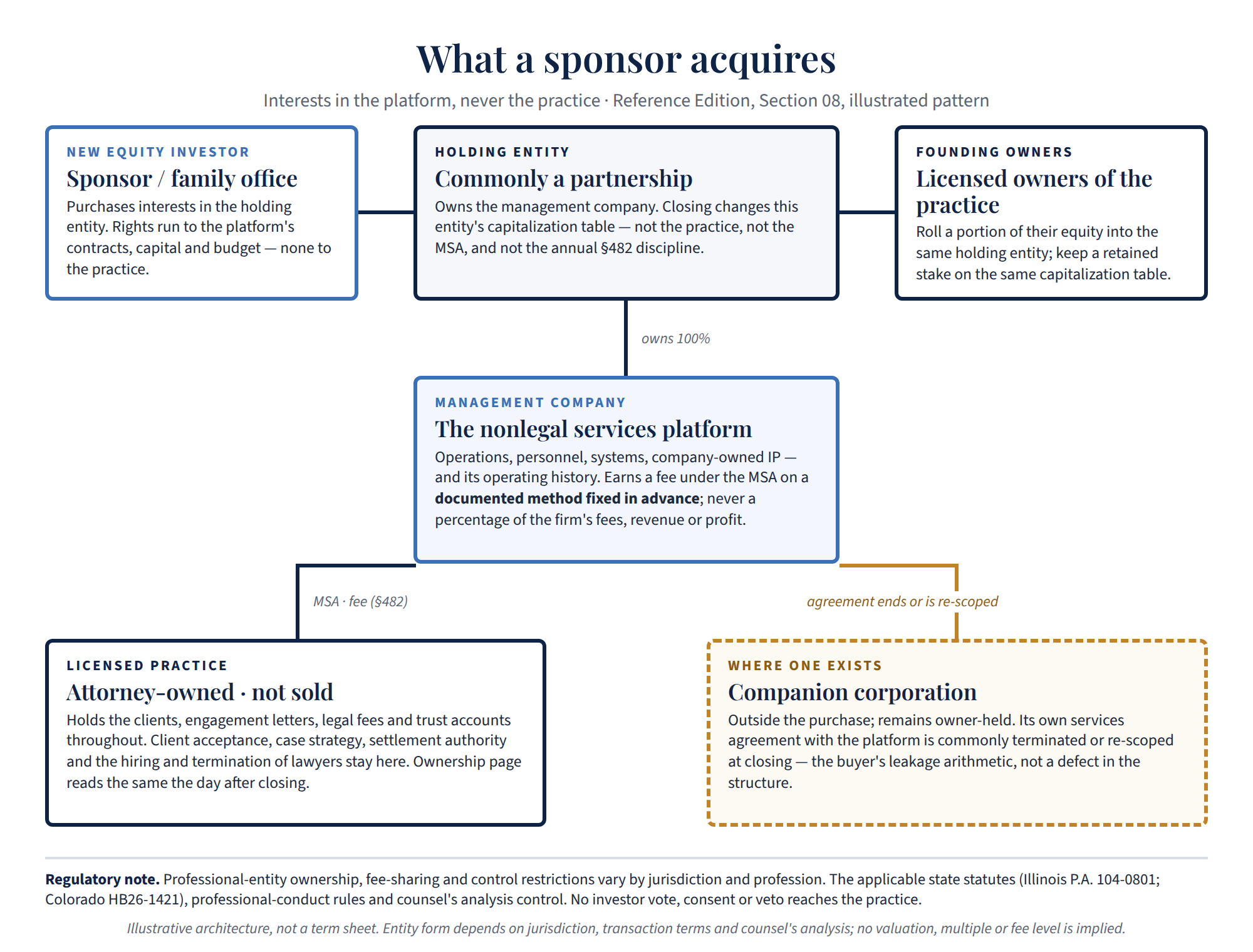
Two consequences of that anatomy matter to sponsor diligence. First, the parties' post-closing rights under the services agreement depend on the agreement and applicable law; in the pattern the paper illustrates the master services agreement between the practice and the management company continues, commonly amended and restated in the buyer's form at closing, and, in the paper's words, “that agreement is the spine of what was underwritten.” Second, where the owners also hold a companion corporation with its own services agreement to the platform, the buyer should diligence whether that agreement continues, is terminated, or is re-scoped at closing. The Reference Edition explains the buyer's arithmetic: “a related-party fee flowing out of those earnings to the sellers' retained corporation is leakage from the very stream being priced, so that agreement is commonly terminated, or re-scoped to whatever the buyer actually wants to keep, in connection with the closing.” What survives is whatever portion of the agreement the buyer concludes it is actually paying for.
The professional-independence perimeter
The threshold constraint on any law-firm MSO is ABA Model Rule 5.4 and its state analogues, and it is broader than the shorthand usually given for it. The Reference Edition sets out the rule's four operative parts, and a sponsor-side design has to answer all four. Subsection (a) bars a lawyer from sharing legal fees with a nonlawyer, subject to enumerated exceptions. Subsection (b) bars a partnership with a nonlawyer where any of the activities consists of the practice of law. Subsection (c) — the one the paper describes as reaching a services arrangement most directly and most often omitted — bars a lawyer from permitting a person who recommends, employs, or pays the lawyer to render legal services for another to direct or regulate the lawyer's professional judgment. Subsection (d) bars a lawyer from practicing with or in a for-profit entity authorized to practice law if a nonlawyer owns an interest in it, serves as its director or officer, or holds the right to direct or control a lawyer's professional judgment. In the paper's assessment, “a design that satisfies only (a) and (b) has answered half the rule.”
The design answers are structural rather than contractual. Nonlawyer ownership of the practice is addressed by confining the investor's interest to the entity above the management company. Interference with professional judgment is addressed by governance carve-outs under which no investor vote, consent, or veto reaches client acceptance, case strategy, settlement authority, or the hiring and termination of lawyers — termination included deliberately, because Illinois Public Act 104-0801 reaches control over both, and a carve-out drafted narrower than the strictest enacted statute is one that will have to be redrafted. Client confidentiality under Rule 1.6 protects all information relating to the representation, far broader than privilege; aggregate financial reporting still discloses matter mix, practice-area revenue, settlement timing, and client concentration, so what data may be shared, in what form, and on what client consent is counsel's determination. Client funds are held by the licensed practice under Rule 1.15 and the applicable trust-accounting rules; a services entity should not receive, hold, or disburse client or trust funds.
The Reference Edition's illustrative composite shows how minority-investor rights can be structured within that perimeter, subject to transaction-specific counsel review. The composite — a single-state plaintiffs-side practice, seven equity partners, a platform that operated for a full year before an investor was in the room, a thirty-percent minority check — carries a negotiated information-rights schedule of recurring, non-privileged financial reporting on the metrics that drive the platform's fee base; protective consent rights over major platform decisions such as new debt, new equity, related-party agreements, annual budgets, and executive hires; transfer mechanics on the partners' interests; and a defined path to liquidity. Each of those rights runs to the platform's own contracts, capital, and budget; none reaches the practice, and each is tested by counsel against the control line before it is granted. The paper's sentence is the design rule: “The professional-responsibility line constrains what those rights may reach, not whether an investor is informed or protected” — and the paper adds that an illustration omitting them would be underselling what a real minority investor negotiates. That illustration is a composite and a sketch, not a named client or a completed transaction, and no valuation, multiple, or fee level should be inferred from it. The Rule 5.4 brief treats ownership, fee-sharing, and independence in fact in full.
The management fee: a method, not a margin
Because only the licensed practice may earn legal fees, an outside investor's economic participation is confined to the platform's own enterprise value and earnings — a function, in the Reference Edition's words, “of the nonlegal services the platform performs, the assets it owns, and the risks it bears, determined by a fee set independently of the practice's revenue, profit, and matter outcomes.” In the paper's words, “it is why that method is the position most likely to be tested” — and its supporting record is part of sponsor diligence.
The fee doctrine that governs every page of this library applies with particular force on the sponsor side, because the temptation to let the fee follow the model runs the other way. The management fee is consideration for nonlegal services actually provided by the platform. It follows a documented method fixed in advance. It is never a percentage of the firm's fees, revenue, or profit, never resized to the year, and never set to produce a target EBITDA. Fixed and cost-plus methods are the design posture the paper describes, not a safe harbor: no fee form is universally approved. Jurisdiction-specific counsel evaluates the legal and professional-responsibility perimeter of the whole arrangement — scope, control rights, and the form of the fee — while the independent economist owns the management-fee analysis within that perimeter; counsel drafts and opines on the legal structure; the firm's CPA owns the returns. Any later true-up applies the pre-existing method to actual costs or operating data; it never resizes the charge retroactively to a target margin, profit allocation, or tax result.
The paper names the tension honestly rather than assuming it away. The services fee is the platform's only revenue and it is funded out of the practice's receipts. Decoupling the fee's measurement from firm results does not decouple its source; the discipline claims only that the fee is set independently of legal revenue, profit, and outcomes — “not that the platform's fortunes are independent of the firm's.” What a buyer prices on that narrower claim is “a contracted, renewing stream of arm's-length service revenue whose durability rests on the operating substance behind it — not a share of legal economics, and not a margin.” A fee set high enough to capture the practice's entrepreneurial residual invites being read as fee-sharing in substance however it is denominated, and Illinois Public Act 104-0801 now reaches fees keyed to firm revenue indirectly as well as directly. The professional-responsibility rules do not delete any method from the Treasury Regulations, but they can make certain methods, profit-level indicators, or resulting fee arrangements unusable on the facts — a limitation that narrows the best-method field before the economic analysis begins, and whose boundary is counsel's to set rather than the economist's.
Two further rules follow for a sponsor. A financing need is not a pricing method: where the platform borrows against its own balance sheet to fund a recapitalization, it services the debt from fee revenue earned on the same method as before the borrowing, and the fee is never resized to meet debt service. And a lender's request that the licensed practice guarantee the platform's debt reverses the direction of credit support the structure exists to maintain; the paper's instruction is that counsel evaluate it “with the same rigor as an investor's request for control, because the two requests raise the same question in different clothes.” The management-fee brief and the agreement brief carry the method and documentation detail.
Operating history before the process
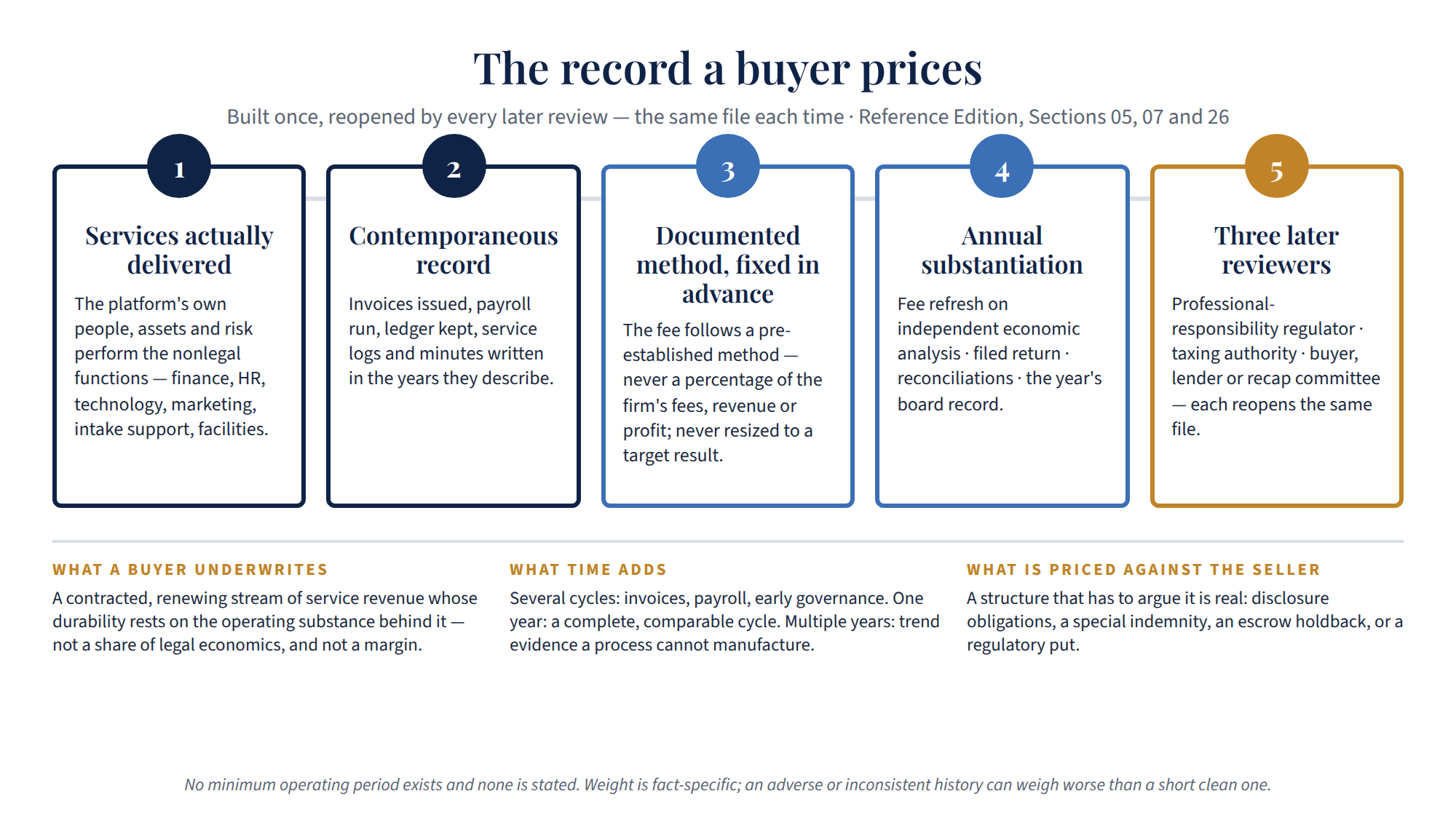
The record built for durability is the record that performs in diligence, and a sponsor should want the platform it is buying to have one. The Reference Edition's Section 07 is blunt about the alternative: “A services company created in the weeks around a transaction has no operating history, no contemporaneous transfer-pricing record, and no demonstrated substance. A quality-of-earnings team reads the absence immediately.” In the paper's words, a management fee that first appears on the eve of a sale “can contribute to a record resembling the concerns the Eighth Circuit described in Aspro” where actual services, documentation, and economic rationale are also thin, and a platform assembled at the table may invite repricing, additional escrow or indemnity protection, a delayed closing, or may “simply die at the letter of intent.”
How much history is enough has no legal answer, and the paper invents none: no authority establishes a safe harbor at four months, a year, or any other line. What exists is an evidentiary continuum. A structure formed at or after the letter of intent offers documents and forecasts and is read as a new diligence item carrying its own purpose questions. Several operating cycles produce actual invoices, payroll, books, and early governance. One full year produces evidence of a different kind — annual statements, a filed return, a fee refresh, a board record, reconciliations — a complete cycle that can be compared against the formation thesis. Multiple years produce trend evidence and a method selected and re-selected as facts changed, “a record that visibly was not manufactured under transaction pressure.” The weight any reviewer gives each point is fact-specific, and an adverse or inconsistent history can weigh worse than a short clean one. The companion brief on transaction readiness develops this for the seller; for the buyer, the practical rule is that diligence begins when the seller created the first fact the buyer will later test, not when the data room opens.
The state-specific overlay: statutes now sit on top of the rules
The earlier version of this brief said that most jurisdictions follow the Model Rule template and that the discipline is the same in every jurisdiction. Neither sentence survives 2026. The Reference Edition's Section 12 states the current landscape: the authorities available on law-firm MSOs — ethics opinions, supervised pilots, permissive regimes, and “enacted statutes now in Illinois and Colorado” — are “a thin layer over a large silence”; silence is neither permission nor prohibition but the absence of an authority to rely on. A sponsor underwriting a multi-state practice must identify the professional-responsibility rules and statutes that apply to the practice, its lawyers, and the relevant conduct; the paper's description of the result is that “the structure has to satisfy all of them simultaneously, and they are not converging.”
The table summarizes the instruments as the Reference Edition records them in Sections 11 and 12 (authorities verified through September 2, 2026), together with the Illinois and Colorado enactments verified against the legislative record on September 5–7, 2026. Each entry is a planning summary; the primary instrument and counsel's construction control.
| Jurisdiction | Instrument | What it does to a sponsor-side design |
|---|---|---|
| Illinois | Public Act 104-0801 (HB 5487), approved and effective August 7, 2026 | Directly addresses private-equity, hedge-fund, and MSO involvement with law firms; reaches control over the hiring and termination of lawyers and fees keyed to firm revenue indirectly as well as directly; requires disclosure of the covered arrangement in covered client contracts, moving the compliance surface into the firm's engagement documents. |
| Colorado | HB26-1421, signed June 4, 2026, effective August 12, 2026 (repeals September 1, 2029 absent further action); SB26-174, signed June 3, effective August 12, 2026 | Bars fee and revenue sharing with nonlawyers or nonlawyer-controlled organizations participating in legal services, bars financial arrangements with alternative business structures, prohibits administrative-staff compensation contingent on a percentage of legal fees or revenues or on case outcomes, and creates private rights of action, including for competing firms. SB26-174 makes covered lead-generation legal marketing a deceptive trade practice. |
| Arizona | ACJA §7-209 (ABS licensing effective January 1, 2021); Administrative Order 2026-31 (March 18, 2026) | Licenses alternative business structures under ACJA §7-209. As the Reference Edition records, Administrative Order 2026-31 added an in-state nexus to the code's regulatory objectives and requires ABS-affiliated lawyers to actually provide legal services, curbing use of an Arizona license as a purely out-of-state platform. |
| Utah | Utah Supreme Court Standing Order No. 15, as amended | As the Reference Edition records from the Office of Legal Services Innovation's published program timeline, the sandbox is in its final phase, closed to new applications, with its ABS-only portion closed at the end of 2024 and the program on track to sunset August 14, 2027. |
| Washington | Supreme Court Order No. 25700-B-721 (December 5, 2024) | As the Reference Edition records, an entity-regulation pilot granting applicant-specific, supervised authorization, with each participant advancing a defined regulatory-reform hypothesis under continuing reporting; no general repeal of the state's nonlawyer-ownership restrictions. |
| District of Columbia | D.C. Rule 5.4(b) | The oldest of the carve-outs: as the Reference Edition records, it admits individual nonlawyers who work in the firm assisting its delivery of legal services, and it is specific to the District. |
| Texas | Professional Ethics Committee Opinion 706 (2025) | As the Reference Edition records, the opinion concludes that a lawyer may not pay a nonlawyer-owned support-services company a fee measured as a percentage of the lawyer's or firm's revenues; it does not approve any alternative fee structure and does not address flat or cost-plus fees, and it is persuasive rather than binding. |
| All others | The state's Rule 5.4 analogue and general principles; Rule 8.5 choice of law | Analysis runs from the text of the state's rule rather than from anything on point. Which jurisdiction's rules govern is itself a Rule 8.5 question: as the paper summarizes it, Rule 8.5(a) subjects a lawyer to the disciplinary authority of every jurisdiction of admission regardless of where the conduct occurs, and Rule 8.5(b)(2) supplies the choice of law for conduct not before a tribunal, with the jurisdiction of the conduct the default and predominant effect the displacing exception. In the paper's words, “Authorization in a permissive jurisdiction does not cure exposure under a restrictive one.” |
The design consequence is to identify the most restrictive applicable regime and design within it. In the paper's words: “The durable posture is to design to the most restrictive regime the firm is meaningfully exposed to, which in practice means designing to traditional Rule 5.4: the fixed, flat, or cost-plus fee decoupled from firm revenue, profit, and matter outcome that Section 11 describes.” That posture is a design rule rather than a safe harbor: the method remains fixed in advance, decoupled from firm fees, revenue, profit, and matter outcomes, and subject to independent economic analysis and jurisdiction-specific counsel review. “A structure designed to the strictest applicable rule generally travels; one designed to the most permissive does not — though what the design buys is reduced redesign risk, not a compliance conclusion in any particular jurisdiction.” State tax treatment is a separate diligence question, and the paper notes it is frequently discovered late: “A number of states require related-member expense add-backs — most aimed at intangible expenses and interest, some reaching management fees — disallowing the deduction for amounts paid to an affiliate unless a statutory exception is met”; the exceptions are analyzed under the law of each applicable state on the transaction's facts. The jurisdictional-design brief and the Rule 5.4 brief take each of these further.
What buyer, lender, and recapitalization diligence tests
The Reference Edition calls the commercial reviewer “the one whose verdict is priced.” In the paper's words: “Weak intercompany economics do not merely create tax exposure. They are read as a quality-of-earnings problem, and they are settled in the currency of the transaction: a lower multiple, a larger escrow, an indemnity holdback, a delayed close.” When the platform is refinanced or sold, counsel and the quality-of-earnings team revisit the taxing authority's questions: is the management fee sustainable and supported; does the nonlegal platform own or operate meaningful business value; have the intercompany economics been administered consistently; does any claimed tax posture still rest on the historical facts. A newly formed platform gives that team little independent historical platform performance to normalize.
Three diligence surfaces are specific to a services business and belong in the buyer's file rather than behind the model. Coverage architecture: which policy responds when a nonlegal function performed at the platform fails — a wire, a filing, a payroll run — is a design question asked with a closing date attached; platform coverage does not replace the practice's professional-liability program. Retention: the earnings stream a buyer is underwriting is concentrated in the attorneys, teams, and client relationships that can simply leave; in the paper's words, “Rollover equity addresses part of that risk; vesting, clawbacks, and contribution schedules address the part equity alone does not,” and clients' choice of counsel remains a diligence fact rather than a risk those mechanisms eliminate. The regulatory put: a structure assembled at the letter of intent has to argue that it is real, and, in the paper's words, “an argument is what a buyer's counsel converts into disclosure obligations, a special indemnity, an escrow holdback, or some form of regulatory put — each of which is priced, and priced against the seller.” The regulatory-put brief sets out the negotiation points: what counts as a regulatory event, whether appeals must be exhausted, whether one state's ruling affects the whole platform, how the put price is determined, and whether repayment is structured over time.
A live process layers instruments onto this record that neither this brief nor the paper reaches: valuation and multiple construction; purchase-price allocation and any §338(h)(10) or §336(e) election; what the paper describes as “the treatment of identified tax positions in representations-and-warranties insurance, which typically excludes known exposures and pushes the §482, §531, and §1202 positions this paper describes toward specific indemnity, escrow, or a separate tax policy”; transition-services and earnout negotiation; and the investor's own exit terms. Their availability and treatment depend on the transaction and the governing documents, and they belong to the deal team a process assembles. What the platform's owners can bring to that table is the record every one of those instruments is priced against.
The tax positions a sponsor inherits
Federal tax treatment is evaluated on the facts, and the earlier version of this brief stated several of these positions more confidently than the statutes do. Restated to the standard this library now uses:
- §162 and §482. IRC §162(a) generally addresses deductions for ordinary and necessary business expenses; it does not make a management fee deductible because it is called one. IRC §482 authorizes the Secretary to allocate income and deductions among commonly controlled taxpayers when necessary to prevent evasion of taxes or clearly to reflect income. The management fee can present a material §482 issue where the entities are commonly controlled. Separately, this library's fee doctrine requires a documented method fixed in advance, an independent economic analysis addressed to the client, contemporaneous records of the services and economics, and annual substantiation.
- §269A. The section authorizes allocation in the circumstances it specifies — where substantially all of a personal service corporation's services are performed for or on behalf of one other entity and the tax-avoidance purpose described in §269A(a)(2) is present. Documented non-tax business purposes are relevant facts; the section is evaluated under its own requirements on the particular structure, not answered by a business-purpose memorandum.
- §531. Where the platform, or a companion entity, is a C corporation, the accumulated-earnings-tax provisions may require analysis: §531 imposes a 20% tax on accumulated taxable income, as defined in §535, for corporations described in §532. Application of the provisions depends on the statutory framework, including the reasonable needs of the business and the computation of accumulated taxable income under §535; the analysis is fact-specific and should be documented contemporaneously, and no documentation practice is itself a safe harbor. The §531 brief and the retained-capital brief carry the framework.
- §1202. Where a C-corporation services entity is in the structure, potential qualified-small-business-stock treatment is evaluated as an overlay, never as the reason to form the platform. For qualifying stock subject to the post-July 4, 2025 rules, §1202 includes a per-issuer limitation based on the greater of the applicable $15 million dollar amount, subject to indexing beginning in 2027, or ten times basis; a $75 million gross-assets ceiling at issuance; and 50%, 75%, and 100% exclusion percentages at three, four, and five years. The §1202(e)(3) services-exclusion analysis runs on the issuer's own facts; qualification and state conformity are evaluated under the governing rules throughout the relevant period, and, as the Reference Edition records, California does not conform. The paper's point for a sponsor is that a stock purchase “is the moment the §1202 analysis of Section 21 is finally tested, on the facts as they accumulated across the holding period rather than as they are described at signing.” See the §1202 brief.
The governance file a sponsor should expect to find
Governance is itself a diligence surface. A platform that can produce the following without reconstruction is one whose economics a buyer is better positioned to underwrite:
- Management services agreement defining nonlegal services only, with the fee method stated and fixed in advance.
- Independent management-fee analysis, engagement running from the client to the economist, refreshed annually.
- Contemporaneous service logs, invoices, payroll, and intercompany ledger — written in the years they describe.
- Board minutes and a reserved-powers schedule showing that no investor right reaches client acceptance, case strategy, settlement authority, or the hiring and termination of lawyers.
- State-by-state professional-responsibility analysis by counsel, designed to the most restrictive applicable regime, including the Illinois client-contract disclosure where it applies.
- Confidentiality and data-access protocol and a trust-accounting boundary memo.
- Coverage architecture map: which policy responds to a failure of each nonlegal function.
- Retention design: rollover, vesting, clawback, and contribution schedules, in the file rather than assumed behind the model.
- Reasonable-business-needs file where a C corporation accumulates capital; §1202 continuity memo where the overlay is positioned.
- Annual substantiation record: filed returns, reconciliations, fee refresh, and the year's board record — the annual substantiation cycle.
The healthcare comparison, and its limits
MSO structures have an established history in physician-practice transactions, where corporate-practice-of-medicine doctrines in many states separate the professional entity from the management company that provides nonclinical infrastructure under a services agreement. That history is useful to a sponsor as a comparison for architecture and for the diligence questions a taxing authority asks. Its limits are equally useful: the governing rules and permissible arrangements remain jurisdiction- and profession-specific; the professional-responsibility overlay for lawyers — independence of judgment, confidentiality, trust accounting, and now enacted statutes with private enforcement — has no direct healthcare analogue; and the compliance framework changes by industry even where the structural pattern does not. Any discussion of particular federal or state enforcement, rulemaking, or legislative activity in healthcare should identify the authority and instrument at the point of claim, and this brief makes no such claim.
Where GTC™ fits
Guardian Tax Consultants® sequences and executes the nonlegal transition and administers the operating and economic record of a law-firm MSO: the schematic of which services, personnel, systems, and contracts move; the intercompany agreements and first invoice; the coordination of the independent fee analysis; the governance cadence; and the annual evidence file the three later reviewers reopen. GTC™ does not provide legal opinions, determine bar-rule compliance, prescribe the entity architecture, or replace transaction counsel, the independent economist, or the firm's CPA. For a sponsor, continuity of administration can reduce handoff risk across the lanes before, during, and after a process and can help preserve a consistent operating and economic record.
What this brief does not say
- It does not say that private equity can own a law firm in any jurisdiction where nonlawyer ownership is prohibited, or that an MSO may control legal judgment, client relationships, settlements, conflicts, confidentiality, or attorney supervision.
- It does not say that a management fee can be set to create a desired EBITDA outcome, or that a fixed or cost-plus fee is a safe harbor. Fee form is one element; counsel evaluates the applicable legal and professional-responsibility requirements, the independent economist owns the management-fee analysis, and the CPA owns the returns.
- It does not assert a valuation uplift, a multiple, or a “multiple arbitrage.” How a buyer underwrites a service platform depends on its operating substance, governance, pricing support, regulatory risk, financial performance, and transaction facts, and no outcome is typical or promised.
- It does not say that §1202 treatment, deductibility under §162, or partner liquidity is guaranteed, or that an MSO structure is permissible in every state.
- It does not offer tax, legal, or compliance advice for any specific transaction. It is an educational summary of a framework whose application belongs to the deal team and the firm's own counsel.
Related Insights
- The Durable Law-Firm MSO — Reference Edition
- How Outside Capital Enters a Law-Firm MSO
- Law-Firm MSO Transaction Readiness: Why the Platform Must Operate Before a Sale
- The Regulatory Put in Law-Firm MSO Deals
- Illinois Public Act 104-0801 and Law-Firm MSOs
- Colorado HB26-1421 and SB26-174
- Rule 5.4 and the Law-Firm MSO
- ABS vs. MSO for Law Firms
- Law Firm MSO Case Study
- Strategic Exit Paths for C-Corp MSOs
- The Law Firm MSO Governance Checklist
- Who We Serve — PE Deal Teams and M&A Counsel · For Law Firms
Frequently Asked Questions
What does a private equity sponsor actually own in a law-firm MSO?
Permitted interests in the nonlegal services platform, ordinarily through a holding entity that owns the management company. The licensed practice remains attorney-owned and is not part of the sale; its clients, legal fees, and trust accounts stay with it. What the capital buys is the services business and its operating history; what it prices is the record.
Is the MSO a tax structure or an operating structure?
An operating structure whose tax positions are evaluated and documented on their own facts. The platform exists to employ and deliver the firm's nonlegal functions under a documented fee method; the §482, §531, and §1202 positions are consequences evaluated on the facts each year, not the reason for the architecture. Treating it as a tax structure misreads both its role and its examination exposure.
How is the management fee set in a sponsor-backed law-firm MSO?
On a documented method fixed in advance, priced by an independent economist and evaluated by counsel — never as a percentage of the firm's fees, revenue, or profit, never resized to the year, and never set to produce a target EBITDA or to meet debt service. Fixed and cost-plus methods are the design posture; they are not a safe harbor, and no fee form is universally approved.
What did the Illinois and Colorado statutes change for sponsors?
Illinois Public Act 104-0801 (effective August 7, 2026) directly addresses private-equity and MSO involvement with law firms, reaches control over the hiring and termination of lawyers and fees keyed to firm revenue indirectly as well as directly, and requires client-contract disclosure. Colorado HB26-1421 (effective August 12, 2026) bars fee and revenue sharing with nonlawyer-controlled organizations participating in legal services, bars ABS financial arrangements, prohibits administrative-staff compensation contingent on legal fees or case outcomes, and creates private rights of action. Both require separate state-specific analysis by counsel.
How can MSO architecture affect exit underwriting?
A buyer may underwrite a nonlegal service platform differently from a professional practice, but valuation depends on the platform's operating substance, governance, pricing support, regulatory risk, financial performance, and transaction facts. No valuation uplift is assumed or promised, and this brief states no multiple.
How long should the platform have operated before a sponsor invests?
No legal minimum exists and none is stated here. A structure formed at the letter of intent offers documents and forecasts; several operating cycles produce invoices, payroll, and early governance; one full year produces a complete, comparable cycle; multiple years produce trend evidence. Each completed cycle gives a reviewer more probative evidence than formation documents alone, and an adverse or inconsistent history can weigh worse than a short clean one.
What is a regulatory put and why does it matter to the seller?
A provision under which the investor can require repurchase or another remedy if a bar authority, court, legislature, or regulator determines the structure is impermissible. It is one mechanism buyer's counsel may negotiate in response to identified regulatory risk — in the Reference Edition's words, one of the instruments that is “priced, and priced against the seller” — and its economic effect depends on the negotiated terms; the negotiation turns on what counts as a regulatory event, whether appeals must be exhausted, whether one state's ruling affects the whole platform, how the price is set, and whether payment is structured over time.
What documentation should accompany a sponsor-backed law-firm MSO platform?
A management services agreement defining nonlegal services only with the fee method fixed in advance; an independent annual fee analysis; contemporaneous service, invoice, payroll, and ledger records; board minutes with a reserved-powers schedule; current state-specific counsel analysis; confidentiality and trust-accounting boundary memoranda; a coverage-architecture map; retention documentation; and, where applicable, a reasonable-business-needs file and a §1202 continuity record, each maintained or refreshed as its subject requires.
Selected public authorities
- ABA Model Rules of Professional Conduct 1.6, 1.7, 1.15, 1.17, 5.3, 5.4, 8.5; state analogues as adopted.
- Illinois Public Act 104-0801 (HB 5487), approved and effective August 7, 2026, adding 705 ILCS 205/13. Colorado HB26-1421 (signed June 4, 2026; effective August 12, 2026) and SB26-174 (signed June 3, 2026; effective August 12, 2026).
- Arizona Code of Judicial Administration §7-209 and Administrative Order 2026-31 (March 18, 2026); Utah Supreme Court Standing Order No. 15, as amended; Washington Supreme Court Order No. 25700-B-721 (December 5, 2024); D.C. Rule of Professional Conduct 5.4(b); Texas Professional Ethics Committee Opinion 706 (2025).
- IRC §§162(a), 269A, 482, 531–535, 1202; Treas. Reg. §1.482-1(c) (best-method rule); Treas. Reg. §1.482-9 (controlled services).
- Aspro, Inc. v. Commissioner, 32 F.4th 673 (8th Cir. 2022).
- The Durable Law-Firm MSO — Reference Edition, Guardian Tax Consultants®, v1.1, September 2026, Sections 05, 07, 08, 11, 12, 13, 15, 20 and 21.
Disclaimer
Informational only. Applicability depends on the specific facts, structure, and advisory environment of each engagement. Guardian Tax Consultants® provides MSO strategy, modeling, documentation coordination, governance support, fee-methodology coordination, and advisor-integrated implementation support. GTC™ does not provide legal opinions, determine bar-rule compliance, prepare tax returns, or replace the client's independent CPA, legal counsel, transaction counsel, investment banker, or independent economist. Illustrations are labeled by type; the seven-partner illustration referenced above is an illustrative composite from the Reference Edition, not a named client or a completed transaction, and no valuation, multiple, or fee level should be inferred from it. Statutory and regulatory references are summarized for planning discussion, not as legal conclusions; they reflect the Reference Edition's authorities as verified through September 2, 2026 and the Illinois and Colorado enactments as verified against the legislative record on September 5–7, 2026, and each should be confirmed against its primary source before reliance. Last reviewed: September 7, 2026.