
At a glance
Situation: RIA running advisory and insurance through one LLC; concentrated E&O exposure; foreseeable but unfunded partner buyout.
Design: Entity separation per business line; two C-corporation MSOs with $3.2M documented fees; buy-sell funding LLC.
Outcome: ≈$646K net federal tax deferral plus ≈$185K annual §199A benefit while qualifying — separate categories.
Engagement Profile. Registered Investment Advisor in the Southeast; $2.5–3 million annual investment management fees plus approximately $1 million in insurance revenue, rising to $2–3 million in large-case years; two partners with a ten-year age gap.
The Situation
The firm ran both revenue lines — advisory and insurance — through a single LLC. That concentrated legal, regulatory, and E&O exposure in one entity: a compliance issue in either division put all revenue at risk. It also cost real money at the margin, because the combined entity’s characterization compromised eligibility for the qualified business income deduction under §199A. And the partners’ age gap meant a buyout was foreseeable but unfunded — a contingent liability with no corresponding asset.
The Structural Question
Could the firm’s two businesses be separated so that each was regulated, insured, and taxed on its own terms — and could the management layer above them generate the capital to fund the buyout the partners already knew was coming?
The Design
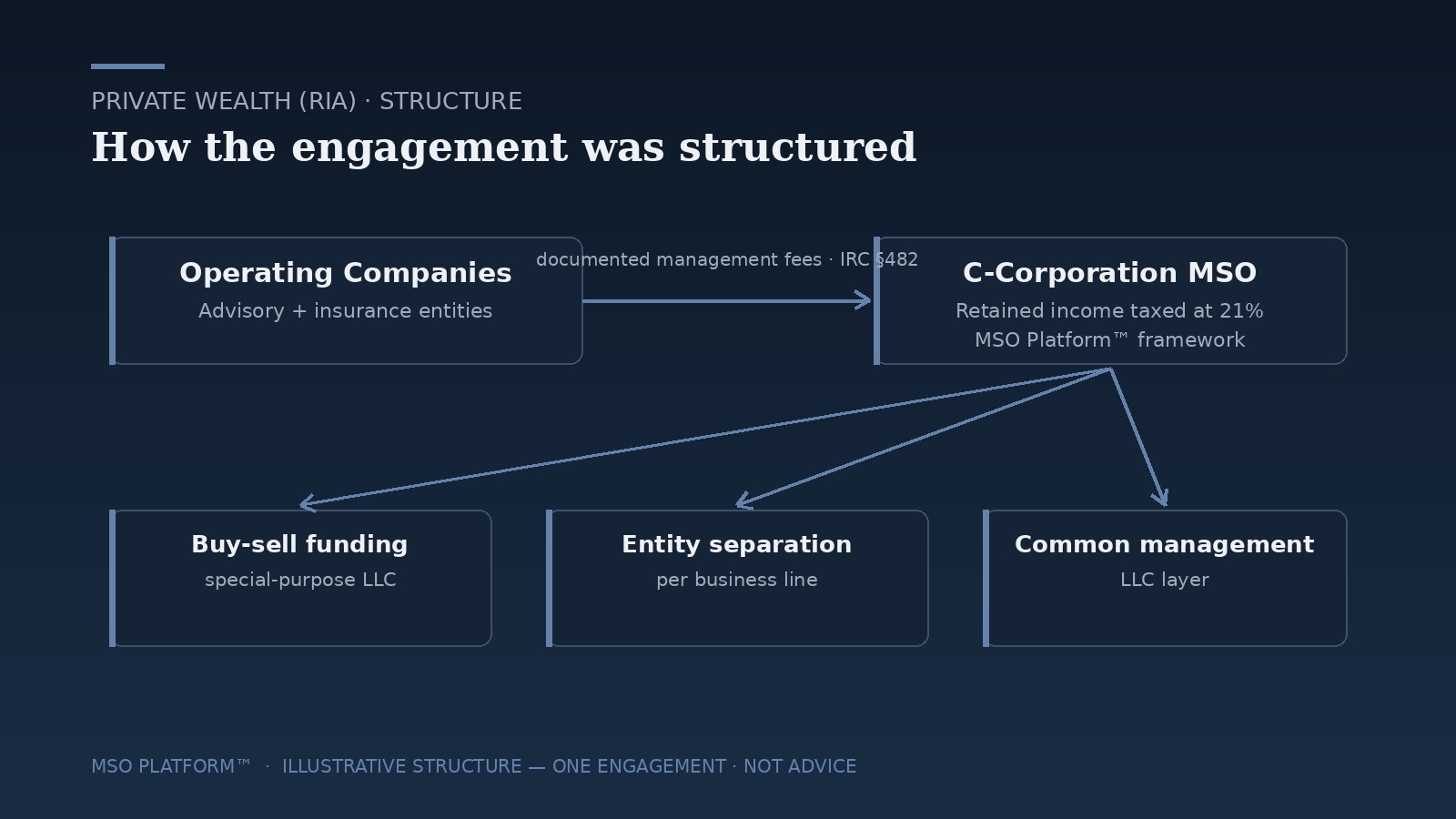
Guardian Tax Consultants® restructured the firm under the MSO Platform™ framework. The wealth management and insurance businesses were separated into distinct entities, each with coverage and compliance scoped to its own risk. The insurance entity, freestanding, qualified for the §199A qualified business income deduction on its own facts. Two C-corporation MSOs were established and paid a combined $3.2 million in documented management fees; a management LLC owned by the MSOs became the common operating layer, keeping employee roles intact while centralizing administration. A special-purpose LLC holds key person and buy-sell policies on both partners, designed to fund the eventual buyout, subject to policy performance, ownership documentation, and buy-sell terms.
Substantiation and Governance
Management fees are supported by contemporaneous functional analysis and benchmarking under the §482 arm’s-length standard, including the applicable Treasury regulations for controlled services transactions, coordinated with the CPA of record. Entity separation was documented with securities and insurance regulatory requirements in view, and reasonable owner compensation was established for each entity — a discipline that also cleaned up the firm’s own valuation picture.
Record reviewed: entity-separation documents, management-fee file, reasonable-compensation analysis, insurance and E&O records, buy-sell funding documents, and securities/insurance counsel coordination.
Measured Outcomes
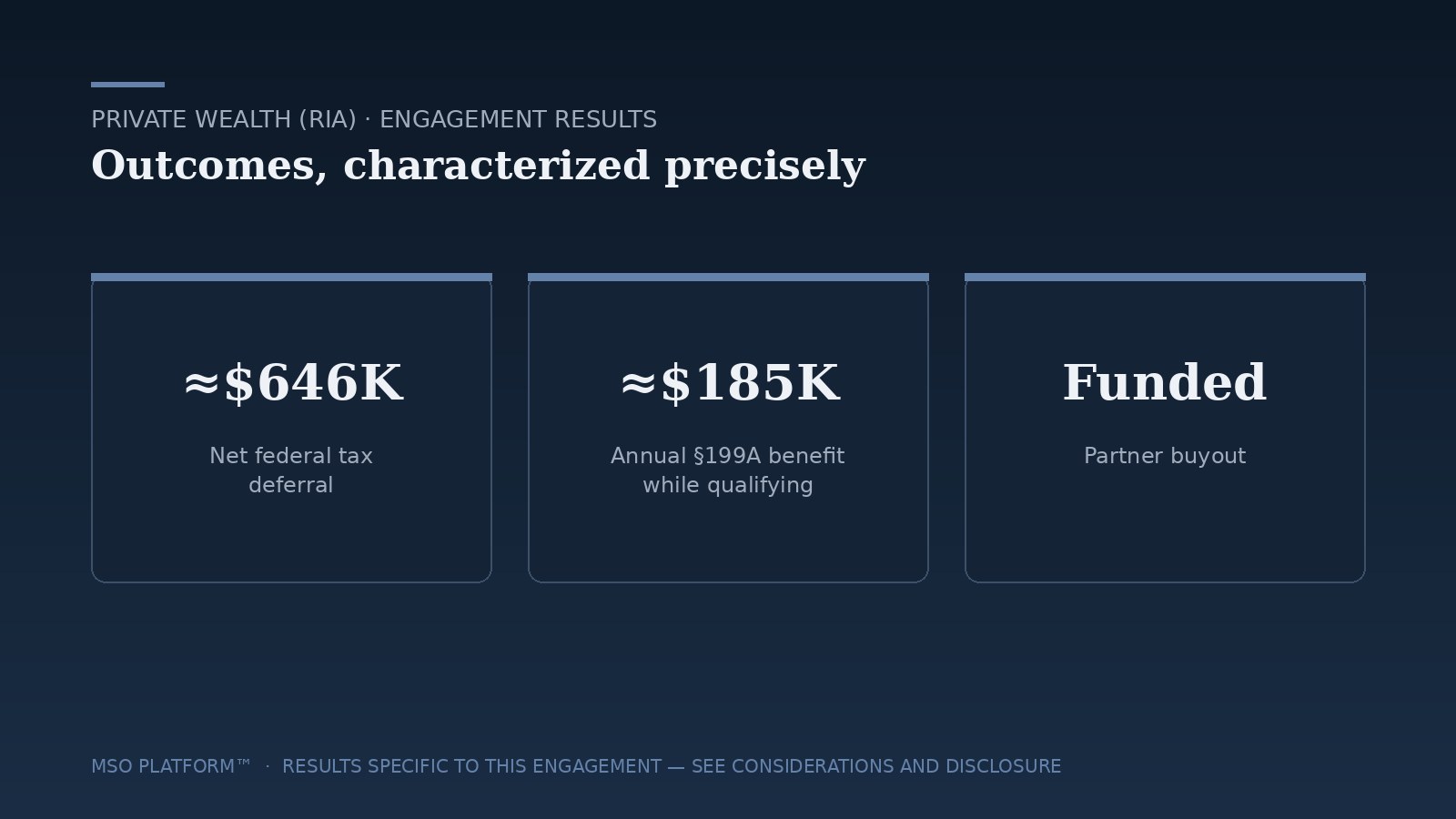
Results are specific to this engagement and depend on the facts, documentation, and implementation. The management fee structure produced a net federal tax deferral of approximately $646,000.
The §199A effect is a different benefit type and is stated separately: QBID qualification of the separated insurance entity produced approximately $185,000 in annual tax benefit while the entity qualifies — a rate benefit rather than a deferral, dependent on continued eligibility under the facts each year. Taken together, the first-year effect was approximately $831,000, redeployed into the business, including the buy-sell funding — though the two components should not be treated as one category. E&O costs declined with policies scoped per entity, and profit visibility by line improved the firm’s posture for any future sale.
A written feasibility review against your own facts is the first step of every engagement. The initial review is no-cost; the written analysis follows within six weeks of receiving the required materials. Inquire about partnership.
Related Reading
- MSO Case Studies: the full library
- How MSO Management Fees Are Calculated
- Avoiding Double Taxation in a C-Corp MSO
- Strategic Exit Paths for C-Corp MSOs
- MSO Private Equity Value Drivers
- Law Firm MSO Case Study: Settlement-Driven Income and a Succession Platform
- Medical Device MSO Case Study: Buy-Sell Funding and Retained Earnings Discipline
Frequently Asked Questions
How can an MSO support entity separation for an RIA?
By placing wealth management, insurance, and management functions in distinct entities, each regulated, insured, and taxed on its own terms, with a common management layer preserving day-to-day operations.
How can §199A QBID apply to an insurance entity separated from an RIA?
Eligibility depends on the entity’s activities, income type, and applicable wage and threshold limits each year; separation allowed the insurance business here to qualify on its own facts. The benefit continues only while the entity qualifies.
How can an MSO help fund a partner buyout?
Retained management income funded key person and buy-sell policies held through a special-purpose LLC, converting a foreseeable but unfunded buyout obligation into a funded one. Because the buyout was foreseeable rather than hypothetical — a ten-year age gap between partners — funding it early converted a contingent liability into a managed, insured obligation with defined economics.
What compliance issues matter in an RIA restructuring?
Securities regulation, insurance licensing, E&O scoping per entity, custodian and regulatory notice where applicable, and reasonable owner compensation for each entity.
Assumptions and Methodology
Facts are sanitized and figures rounded to preserve client confidentiality. Deferral figures represent the rate differential on documented management fees retained in the MSO — the owners’ marginal rate less the 21% corporate rate, applied to the fee for the period stated — and are not permanent savings; amounts later distributed bear shareholder-level tax. Here, the approximately $646,000 net deferral on $3.2 million of combined fees reflects an approximately 20-point spread net of entity-level effects; the §199A benefit is computed separately on the insurance entity’s qualified income and is not part of the deferral figure. The advisory income was specified-service income above the §199A thresholds, so no deduction offset applied to the fees it paid.
Rate assumptions reflect federal law in effect during the engagement period; figures are rounded.
Considerations
The deferral and the QBID benefit are different in kind and should not be aggregated casually: one reverses on distribution, the other is a current annual benefit only while the entity qualifies. §199A eligibility depends on continued facts. RIA restructurings require coordination with securities counsel and, where applicable, custodian and regulatory notice.
Separation does not change the advisory entity’s status as a specified service trade or business; the §199A benefit derives solely from the insurance entity’s own qualified income.
State income and franchise taxes vary by jurisdiction and can widen or narrow the modeled spread; figures tie to the assumptions stated above.
Entity separation should reflect real operational, regulatory, accounting, personnel, revenue, and risk separation; it should not rely on form alone to create §199A treatment. Shared management functions should be documented so they do not collapse the factual separation between the advisory and insurance businesses for regulatory, E&O, or §199A purposes.
The fee, retained-earnings position, intercompany balances, insurance funding, and business-purpose file should be reviewed annually with the CPA of record and counsel.
This case study describes one engagement and is provided for educational purposes only. It is not tax, legal, or investment advice, and results are not representative of every engagement. Outcomes depend on each client’s facts, the services actually performed, documentation quality, and applicable law. Any strategy should be reviewed with the client’s own tax and legal advisors. Guardian Tax Consultants® does not prepare or sign client income tax returns; management fee arrangements are documented and benchmarked to support the position taken by the CPA of record.
Evaluate this structure against your own facts
Every engagement begins with a written feasibility report, coordinated with your CPA of record and counsel. The initial review is no-cost; the written analysis follows within six weeks of receiving the required materials.