
Alex Jones, Founder and Chief Executive Officer, Guardian Tax Consultants · Last reviewed September 15, 2026
Law firm consolidation and law firm succession are usually covered as two stories. They are one: a graying profession restructuring itself, with several possible routes, two of which this article compares. This article is educational commentary on publicly reported market activity; the authorities discussed are considerations for a firm’s own advisors, not conclusions.
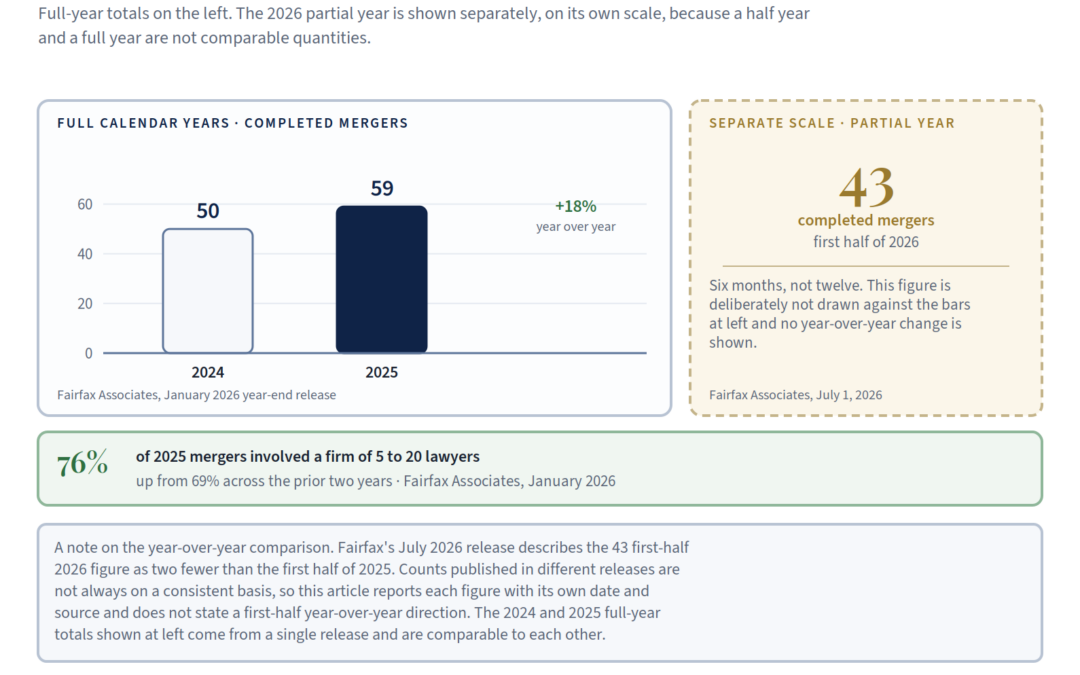
In short: Fairfax Associates reported 43 completed law firm mergers for the first half of 2026 (Fairfax Associates, Q2 2026 merger report, July 1, 2026, https://fairfaxassociates.com/merger-reports/q2-mergers-see-the-launch-of-two-new-global-firms-reports-fairfax-associates/). That is a half-year figure on its own basis, and it is not comparable to the full-year totals Fairfax reported for 2025 and 2024: 59 completed mergers in 2025 and 50 combinations in 2024, with 76 percent of the 2025 mergers involving a firm of 5 to 20 lawyers (Fairfax Associates, 2025 year-end merger report, January 5, 2026, https://fairfaxassociates.com/wp-content/uploads/2026/01/Fairfax-Associates-2025-Year-End-Mergers-PR.pdf). This article states no first-half year-over-year direction. The same succession pressure is opening a second door: outside capital arriving through management services organizations rather than firm ownership.
Two conversations run in the legal market at once, usually in different rooms. In one, the merger league tables. In the other, private equity, management services organizations, and the transactions built around them. Both describe the same demographic event: a generation of firm owners approaching the end of its practice life, with a successor bench thinner than the retirement schedule requires. A merger is one answer. A services-entity structure is another. This article covers the market side: what the deal data shows, what drives it, and why MSO structures draw attention from firms with no intention of selling.
From the Reference Edition
This topic is addressed in The Durable Law-Firm MSO — Reference Edition, Version 1.1, September 2026.
Relevant sections: Sections 08, 15 and 30.
What Happened in Law Firm M&A in 2025, and Where Does 2026 Stand?
Fairfax Associates reported 59 completed law firm mergers for full-year 2025, against 50 combinations in 2024 (Fairfax Associates, 2025 year-end merger report, January 5, 2026, https://fairfaxassociates.com/wp-content/uploads/2026/01/Fairfax-Associates-2025-Year-End-Mergers-PR.pdf). The composition matters more than the headline.
Table 1. Completed-merger figures as reported by Fairfax Associates in its 2025 year-end merger report (Fairfax Associates, January 5, 2026, https://fairfaxassociates.com/wp-content/uploads/2026/01/Fairfax-Associates-2025-Year-End-Mergers-PR.pdf). Each figure is Fairfax’s own, for the period Fairfax attaches to it.
| Measure (Fairfax Associates, 2025 year-end report, January 5, 2026) | Figure as reported |
|---|---|
| Completed law firm mergers, full-year 2025 | 59 |
| Combinations, full-year 2024 | 50 |
| Share of 2025 mergers involving a firm of 5 to 20 lawyers | 76%, up from the 69% Fairfax reports for the previous two years |
| Mergers effective in 2025 where both firms had at least 100 lawyers | 7, which Fairfax reports as the first occurrence since 2020 |
| Cross-border mergers | 10 in 2025; 3 in 2024 |
For the first half of 2026, Fairfax Associates reported 43 completed law firm mergers (Fairfax Associates, Q2 2026 merger report, July 1, 2026, https://fairfaxassociates.com/merger-reports/q2-mergers-see-the-launch-of-two-new-global-firms-reports-fairfax-associates/). That is a half-year figure on its own basis, not comparable to the full-year counts above, and this article states no first-half year-over-year direction.
The headline transactions of 2026 have been large. Hogan Lovells and Cadwalader combined effective July 1, 2026, at more than 3,200 lawyers across the Americas, EMEA and APAC; the firms’ own announcement described it as the largest law firm merger in history (Hogan Lovells and Cadwalader, joint announcement, PR Newswire, July 1, 2026, https://www.prnewswire.com/news-releases/largest-law-firm-merger-in-history-creates-hogan-lovells-cadwalader-302815253.html). Ashurst and Perkins Coie formally completed on June 29, 2026, with more than 950 partners and 3,500 fee earners across 52 offices (Global Legal Post, June 29, 2026, https://www.globallegalpost.com/news/ashurst-perkins-coie-complete-28bn-transatlantic-merger-2039988449; trade press reporting, cited as reporting rather than as a primary filing). Neither combination’s announcement disclosed revenue; the figures circulating in press coverage are estimates.
How the structure is reviewed before setup, what the governing agreement covers, and how a law firm MSO management fee is supported each have their own home in this library, alongside law firm MSO structure itself. None of it is re-derived here.
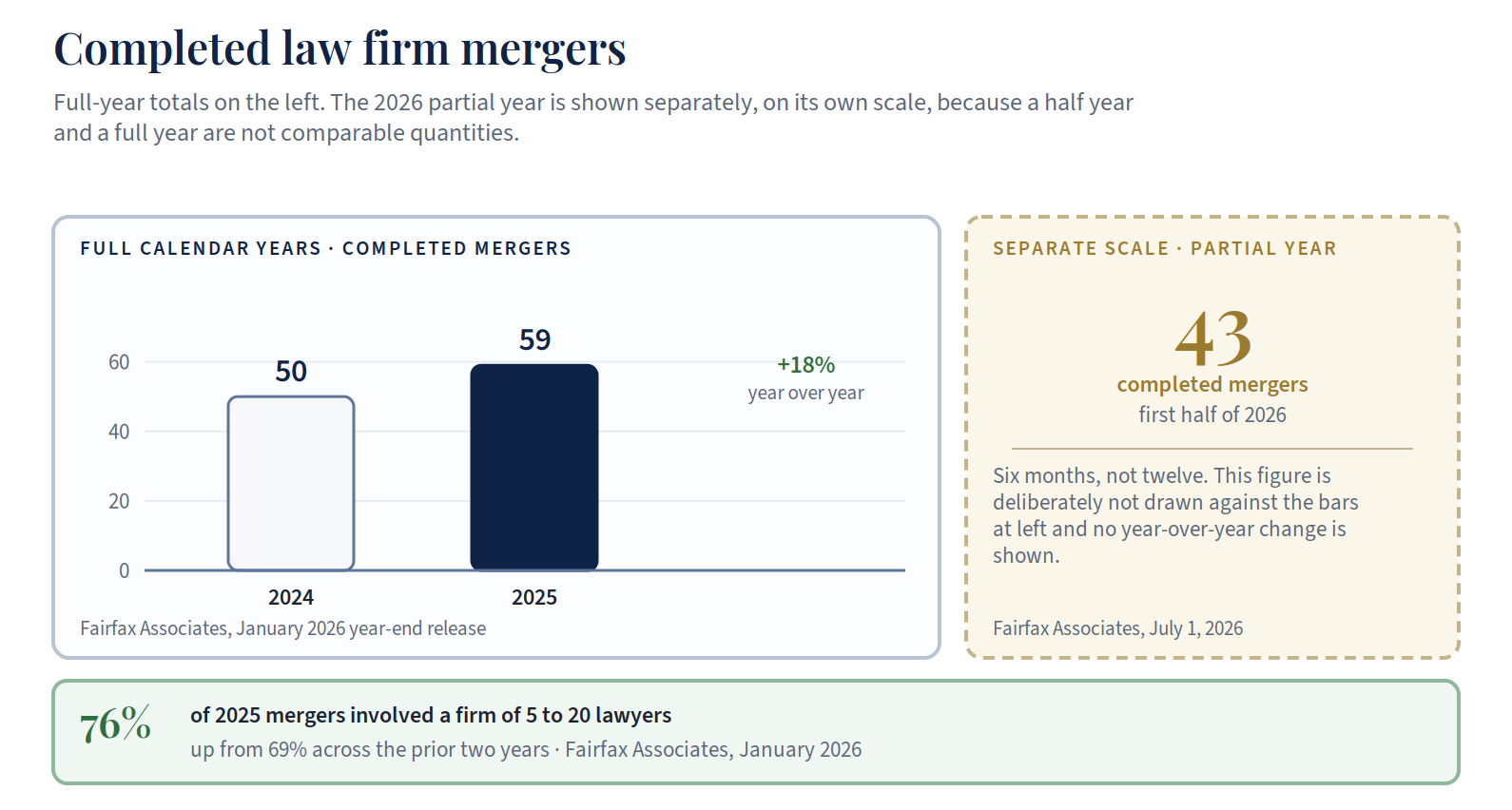
A note on the year-over-year comparison. Fairfax's July 2026 release describes the 43 first-half 2026 figure as two fewer than the first half of 2025. Counts published in different releases are not always on a consistent basis, so this article reports each figure with its own date and source and does not state a first-half year-over-year direction. The 2024 and 2025 full-year totals shown at left come from a single release and are comparable to each other.
Source: Fairfax Associates
Why Are So Many Law Firms Merging in 2026?
The answer is in the composition rather than the count. In 2025 the volume was not coming from mega-mergers; it was coming from small firms finding a home. Read as mergers and acquisitions data about law firms as businesses rather than as league-table news, a 2025 in which 76 percent of completed mergers involved a firm of 5 to 20 lawyers is a succession statistic wearing a merger statistic’s clothes.
For a founder, the traditional merger can carry a specific cost. Commonly the name goes away, the ownership goes away, and operating decisions move to a partnership the founder joined rather than built. That is a common consequence rather than an inevitable one; combinations vary in how much of a firm’s name and governance they preserve. Where it does apply, that cost is what makes the second track interesting.
What Happens to a Law Firm When the Founding Partner Retires?
Contingency-fee practice is where the pressure concentrates. A March 2026 white paper from Greenwich Capital Group, an M&A advisory firm and therefore an interested observer, stated that “the personal injury sector remains dominated by small and mid-sized regional firms, often founder-led and lacking succession planning” (Greenwich Capital Group, Private Equity & The Consolidation of Personal Injury Law, March 2026, https://greenwichgp.com/wp-content/uploads/2026/03/GCG-PE-and-the-Consolidation-of-Personal-Injury-Law.pdf).
When such a founder stops practicing, the options are few: an internal buy-in requiring successors with capital and appetite, a merger into a larger platform, a services-entity structure separating the business functions from the practice, or a wind-down. Law firm succession planning here is less a checklist than a question about what selling a law firm actually transfers, and what the firm is worth to anyone other than its founder.
What Economics Are Driving Law Firm Consolidation?
The Citi Hildebrandt 2026 Client Advisory, released December 11, 2025, reported that for the first nine months of 2025 law firm revenue grew 11.3 percent while demand grew 1.9 percent and expenses grew 9.1 percent (Citi and Hildebrandt Consulting, 2026 Client Advisory, released December 11, 2025, https://secure.businesswire.com/news/home/20251211402428/en/Citi-Hildebrandt-Client-Advisory-Reports-Expected-Strong-End-to-2025-and-Optimism-for-2026-for-Law-Firm-Industry). Growth is coming substantially from rate increases rather than volume, and the expense line sits close behind the revenue line. The advisory itself pointed toward broader market consolidation as an expected consequence.
That is the economic engine underneath the demographic one. A firm growing revenue through rate increases while expenses climb at a similar pace has limited capacity to fund what creates durable value: technology, centralized administration, recruiting, marketing systems. A larger platform can spread those costs across a wider base; a smaller firm may have less capacity to absorb large technology, recruiting and administrative investment. Consolidation, in that light, is less a growth strategy than an infrastructure strategy. That is also the argument for the MSO route, and why the two tracks compete for the same firms.
Why Is Big Law Exploring Private Capital Without Committing to It?
The market has split, and the split is worth stating precisely.
Large firms have largely held back from direct outside capital. Reporting through mid-2026 attributes that to the difficulty of getting hundreds of partners to approve, the fact that profitable firms do not need the money, concern about lawyers leaving with clients, and regulatory uncertainty (PitchBook, June 22, 2026, https://pitchbook.com/news/articles/why-us-big-law-hit-the-pause-button-on-private-equity; trade reporting, cited as reporting). The same reporting quotes Lucian Pera, a partner at Adams & Reese who advises firms on ownership structures, summarizing the sentiment: “They don’t want to be first, but they want to be second.”
The pause is not universal. The ABA Journal reported on February 10, 2026 that McDermott Will & Schulte, itself the product of a 2025 combination, was exploring a two-entity restructuring with private-equity funding on the services side and was “fielding inbound interest.” The firm stressed that talks were preliminary (ABA Journal, February 10, 2026, https://www.abajournal.com/web/article/mcdermott-will-schultes-private-equity-plan-could-test-longstanding-prohibitions-on-outside-funding-for-law-firms; trade reporting, cited as reporting).
The pool of firms looking has widened since. Financial Times reporting on August 6, 2026 described several prominent U.S. firms, including Paul Weiss, Quinn Emanuel, Proskauer, White & Case and McDermott Will & Schulte, as having explored or examined private capital and management services organization structures in different ways, while stating that no decision had been taken and no sale process had been launched (Financial Times, August 6, 2026, as reported; trade reporting, cited as reporting, not as confirmation of any transaction). The distinction still holds, but it is now a distinction of stage rather than of interest: publicly closed services-company transactions remain concentrated among founder-led and contingency-fee firms, while large firms are exploring without committing.
Publicly reported activity is further along among founder-led and contingency-fee firms, and through management services organizations rather than firm ownership. Holland & Knight partners Trisha Rich and Josh Porte report 17 to 18 such transactions closed so far in 2026 with roughly 100 more in progress (PitchBook, June 22, 2026, https://pitchbook.com/news/articles/why-us-big-law-hit-the-pause-button-on-private-equity; trade reporting carrying a law firm’s own count, not a public register); the pipeline detail and market-sizing estimates live in the MSO transaction pipeline piece.
The transactions themselves are on the public record.
- Uplift Investors closed its first fund with $670 million in capital commitments, announced July 16, 2026 (Forbes, July 16, 2026, https://www.forbes.com/sites/johnhyatt/2026/07/16/buyout-firm-uplift-investors-raises-670-million-to-invest-in-legal-and-other-services/; trade reporting, cited as reporting).
- Orion Legal, the MSO platform associated with Uplift, launched January 22, 2026 with Dudley DeBosier in Louisiana; the announcement stated that “Dudley DeBosier will remain 100% owned and controlled by its founding partners,” who “will continue to direct the law firm’s legal practice” (Businesswire, January 22, 2026, https://www.businesswire.com/news/home/20260122313960/en/Uplift-Investors-Launches-and-Closes-First-Investment-Forming-Orion-Legal-MSO-with-Dudley-DeBosier-Injury-Lawyers). Bottaro Injury Lawyers was announced July 22, 2026 (Businesswire, July 22, 2026, https://www.businesswire.com/news/home/20260722075888/en/Uplift-Investors-Orion-Legal-MSO-Forms-Partnership-with-Bottaro-Injury-Lawyers).
- Rafi Law Group in Phoenix is separating back-office services from its legal operation to receive $125 million from an outside investor (Bloomberg Law, April 6, 2026, https://news.bloomberglaw.com/business-and-practice/arizona-law-firm-severs-back-office-for-125-million-investment; trade reporting, cited as reporting).
- Morgan & Morgan was reported on June 5, 2026 to have hired JPMorgan to explore a minority stake sale that could pave the way for a public listing years from now (Reuters, June 5, 2026, “Law firm Morgan & Morgan explores stake sale, eyes long-term IPO, sources say,” https://www.tradingview.com/news/reuters.com,2026:newsml_L1N41J1L3:0-law-firm-morgan-morgan-explores-stake-sale-eyes-long-term-ipo-sources-say/). An exploration, not a transaction.
How Does an MSO Create M&A Optionality Without a Sale?
Here is a distinction worth drawing. A merger and an MSO transaction are not two versions of one event; they resolve different variables.
Table 2. Traditional combination compared with a management services organization route.
| Dimension | Traditional merger or combination | Management services organization route |
|---|---|---|
| Who owns the practice afterward | The combined partnership | The lawyers, in the deals on the public record |
| What is combined or sold | The practice: clients, name, governance | Nonlegal infrastructure, held separately |
| Where reported volume sits | Firms of 5 to 20 lawyers joining platforms: 76 percent of 2025 mergers involved a firm that size | Founder-led and contingency-fee practices |
| What the outside party underwrites | The combined book and lawyer retention | The operating platform: systems, intake, administration |
| The founder’s position | Identity and governance are absorbed | The practice continues under its own name and ownership |
| Principal constraints | Conflicts, culture, partnership votes | Conduct rules and a moving statutory landscape, addressed in the governing agreements |
The strategic point for a firm owner is optionality rather than exit. Separating and institutionalizing the nonlegal functions is useful whether or not a transaction occurs: better financial reporting, centralized administration, and an operating record a lender, investor, or buyer can evaluate on demonstrated results rather than on a model assembled during a sale process. A firm that builds the platform is not committed to selling it, only to being able to answer the question when someone asks.
Institutionalization is the word private equity readers recognize for this: converting functions that live in a founder’s head, or an office manager’s spreadsheet, into a separately managed platform with its own personnel, systems, records, and governance. It is also what private equity-backed MSOs for law firms are underwriting when they price one, and what an illustrative seven-partner law firm MSO example walks through at the level of partner liquidity, governance, and exit readiness. Where an MSO is organized as a C corporation, the exit paths open to it are a separate subject: strategic exit paths for C-corp MSOs.
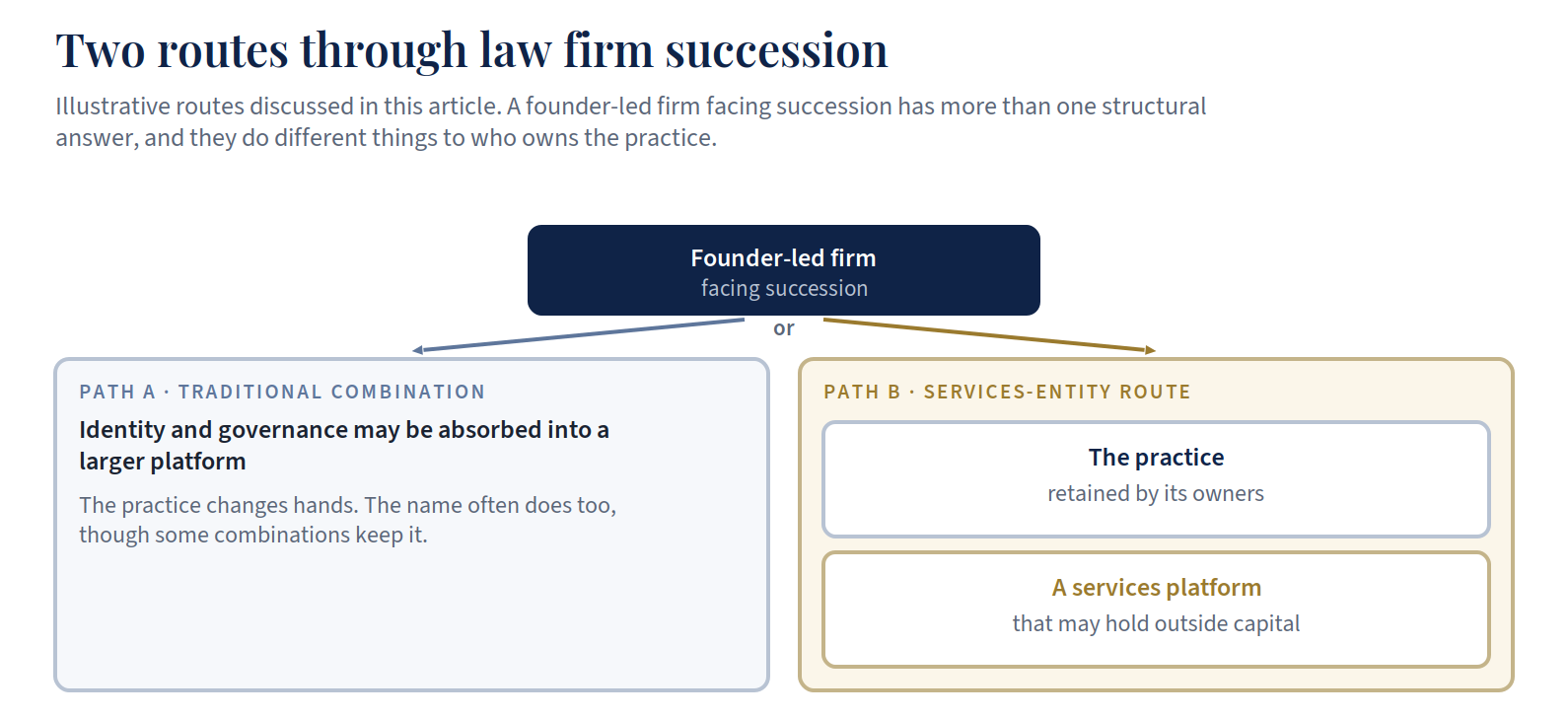
Neither path is a recommendation and neither is available everywhere. Whether a particular arrangement is permissible in a given state is a question for professional responsibility counsel, and the authorities are considerations rather than conclusions.
Capital follows operating architecture.
Where Does the Law Stand on Nonlawyer Capital in 2026?
This is a market article, not a regulatory one, and any summary is a snapshot dated to August 7, 2026. Three points matter for reading the deal data.
Some jurisdictions permit nonlawyer ownership directly. Arizona licenses alternative business structures. The Arizona Supreme Court’s ABS Committee reported a “total number of active licensed ABSs as of December 31, 2024” of 114 (Supreme Court of Arizona, ABS Committee Annual Report to the Supreme Court for 2024, https://www.azcourts.gov/Portals/0/26/ABS%20Committee%20Annual%20Report%20to%20Supreme%20Court%20for%202024%20(02_28_2025).pdf). That is a count of active licensed entities on a single date, not a growth rate, and not the same measure as cumulative licenses granted or as entries in a public directory. See ABS, the Utah sandbox, and law firm capital. Whether lawyer control survives in substance is contested rather than settled: writing on April 30, 2026, Lev Breydo argued that healthcare MSO arrangements that “started with clean governance and independent practice boards drifted toward de facto investor control over professional decisions,” and that no court “has adjudicated the boundary between permissible management services and impermissible control” (Lev E. Breydo, “Private Equity Is Coming for Law Firms and the Rules Aren’t Ready,” CLS Blue Sky Blog, April 30, 2026, https://clsbluesky.law.columbia.edu/2026/04/30/private-equity-is-coming-for-law-firms-and-the-rules-arent-ready/; academic commentary, not authority).
Where states have acted, the measures reach both how a services company is paid and whether the arrangement may be entered at all. Colorado HB26-1421 was signed June 4, 2026, takes effect August 12, 2026, and is repealed September 1, 2029. It bars “compensating a person that provides administrative or nonlegal business services to a lawyer or law firm unless the compensation is not contingent upon a percentage of legal fees or revenues and not determined by reference to recoveries, settlements, or other case outcomes.” Compensation tied to revenues is inside the act, not outside it, and the act does not name flat-fee or hourly compensation as permitted. It separately bars “entering into a financial or contractual arrangement with an alternative business structure, which arrangement relates to providing legal services.” Relief is “economic damages, injunctive relief, declaratory relief, and any other relief the circumstances may require,” with funds received or paid in violation disgorged to the state treasurer (Colorado General Assembly, HB26-1421, https://leg.colorado.gov/bills/HB26-1421).
Illinois HB 5487 passed both houses on May 31, 2026 and was sent to Governor Pritzker on June 26, 2026. The Governor approved it on August 7, 2026, and it is now Illinois Public Act 104-0801, effective on approval (Illinois General Assembly, HB 5487, bill status and amendment synopses, https://www.ilga.gov/Legislation/BillStatus?DocNum=5487&GAID=18&DocTypeID=HB&SessionID=114). It is current law; its application to any particular arrangement is a question for Illinois counsel. The statutory detail lives in Illinois HB 5487 and law firm MSO requirements.
California AB 931 restricts rather than permits. Business and Professions Code section 6156(a) provides that “no attorney licensed or otherwise authorized to practice in this state shall share legal fees directly or indirectly with an out-of-state alternative business structure unless all of the following apply,” and the conditions that follow are co-licensure in that state, fees compensating legal services in that state, and that state’s law controlling under Rule 8.5 of the California Rules of Professional Conduct. The counterparty is the alternative business structure itself, defined at subdivision (c) as an entity that provides legal services while allowing nonattorney ownership or decisionmaking authority, not attorneys associated with one. Subdivision (a) therefore carries its own internal exception, and subdivision (e) is a second and separate exclusion, for a contract that “outlines a specific dollar amount for services rendered,” where no payment relates to a referral or lead purchase and none is contingent on the amount recovered in a specific case. Subdivision (g) states that the section “shall only apply to contracts entered into on or after January 1, 2026,” an applicability rule keyed to contract date rather than a switch-on date for all conduct. The statute uses neither “MSO” nor “management services organization,” and it does not use “flat fee.” Reading a conforming management arrangement into subdivision (e) is an inference rather than a statement of the statute (Cal. Bus. & Prof. Code section 6156, added by AB 931 (2025), https://leginfo.legislature.ca.gov/faces/billNavClient.xhtml?bill_id=202520260AB931).
Texas Ethics Opinion 706, issued in February 2025, addressed compensation as a matter of professional responsibility rather than statute. It concluded that a lawyer may not pay a nonlawyer-owned services company a fee “based on a percentage of the revenues of the lawyer or the lawyer’s firm,” because in practical effect that is fee-sharing prohibited by Texas Disciplinary Rule of Professional Conduct 5.04(a). It did not establish that another fee form is automatically permissible or economically supportable, and it did not enumerate permissible fee forms (Texas Committee on Professional Ethics, Opinion 706, February 2025, https://www.legalethicstexas.com/resources/opinions/opinion-706/, reprinted in the Texas Bar Journal, April 2025, https://lsc-pagepro.mydigitalpublication.com/article/Ethics+Opinion+706/4947717/843020/article.html).
Across the measures examined here, compensation form is the common thread, and in Colorado the reach is wider than compensation. The Colorado act, the Illinois bill, and the Texas opinion each address whether a services company’s pay may be tied to the firm’s legal fees, revenues, or profits; the Colorado act separately bars entering the arrangement with an alternative business structure at all. Whether a given statute reaches a given arrangement is a question for counsel, not for a market article. Fee design and fee support are covered in the cornerstone, law firm MSO management fees.
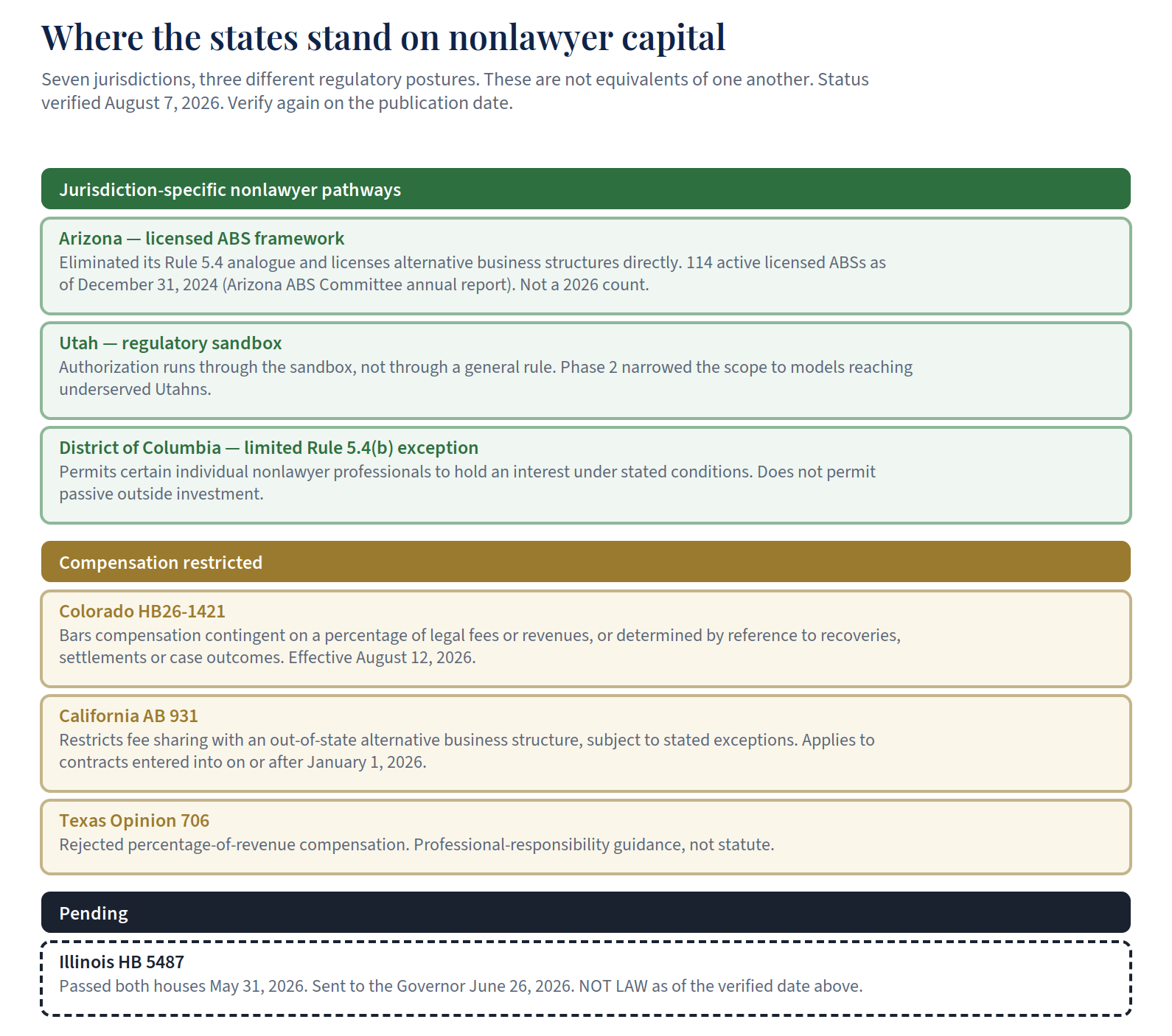
These authorities do not operate alike. Colorado, California and Texas address different compensation arrangements under different authorities, and Illinois HB 5487, now enacted as Public Act 104-0801 (approved August 7, 2026), adds restrictions. Texas Opinion 706 rejected the percentage-of-revenue arrangement before it and did not establish that any other fee form is permissible or economically supportable; the California statute does not use the term MSO. Arizona, Utah and the District of Columbia are separate jurisdiction-specific pathways and are not equivalents of one another. None of this should be read as a safe harbor for another fee form. Dashed border marked measures pending when this graphic was prepared; Illinois HB 5487 has since been signed (August 7, 2026) and is now Public Act 104-0801, effective on approval.
Sources: azcourts.gov · leg.colorado.gov · leginfo.legislature.ca.gov · legalethicstexas.com · ilga.gov
What Could Undercut the Consolidation Thesis?
An article presenting only the case for a trend is an advertisement for it. Three things are worth watching.
The control question. Breydo’s argument, above, is that lawyer control may not survive in substance even where it survives in form. Counsel should engage that critique rather than assume the form answers it.
The regulatory picture is still forming. Colorado enacted HB26-1421 and the Illinois General Assembly passed HB 5487 within weeks of each other in 2026, on the same issue; the Illinois bill was signed on August 7, 2026 and is now Public Act 104-0801. A structure evaluated against 2025 law may face a different test in 2027, and contingency-fee practices are where these measures aim most precisely. How deals handle that risk contractually: regulatory put and cure mechanics.
Succession framing cuts both ways. LawFuel notes that “tomorrow’s partners inherit a firm that now pays a management fee, for services it used to own outright and for the life of the agreement,” and calls control of AI assets “the single most under-negotiated term in the market” (LawFuel, July 25, 2026, https://www.lawfuel.com/private-equity-law-firm-mso-structure-2026/; trade commentary, not authority).
The honest summary: the demographic pressure is documented, the deal activity is on the public record, and the durability of the structures carrying it is unsettled.
What Does This Mean for a Firm That Is Not Selling?
Many firms reading this will not transact.
The pressures driving law firm consolidation apply whether or not a firm ever meets a buyer. The founder still retires. Administration still sits with people rather than systems. The reporting is still built for a tax return rather than an operating review.
The firm that never sells and the firm that eventually does are building the same operating record. Only one of them knows it yet.
Durable economics follow durable operations.
Where Does Guardian Tax Consultants® Fit?
Consolidation is what turns an operating record from an internal matter into a priced one. Guardian works in one lane within that. Independent counsel owns the legal and professional-responsibility analysis, including whether a structure is permitted in a given jurisdiction. Independent economists own the fee and valuation conclusions. The client’s CPA owns tax-return positions and filings. Guardian designs and administers the operating and economic record: governance, intercompany documentation, financial reporting, and the operating history those professionals rely on and that a regulator, a taxing authority, or a buyer eventually reads.
Fair market value is built, not bought.
Talk Through Consolidation and Succession in Your Segment
If you are a firm owner, managing partner, or advisor trying to understand how consolidation and outside capital are affecting your segment, Guardian is available for an educational conversation: what the deal data does and does not show for firms your size.
Start an educational conversation with Guardian
Guardian does not provide legal advice, prepare tax returns, or perform valuation or fee studies. It works alongside the professionals who do.
Frequently Asked Questions
How many law firm mergers were completed in the first half of 2026?
Fairfax Associates reported 43 completed law firm mergers for the first half of 2026 (Fairfax Associates, Q2 2026 merger report, July 1, 2026, https://fairfaxassociates.com/merger-reports/q2-mergers-see-the-launch-of-two-new-global-firms-reports-fairfax-associates/). That is a half-year figure on its own basis. It is not comparable to the full-year totals Fairfax reported for 2025 and 2024, which were 59 completed mergers and 50 combinations respectively (Fairfax Associates, 2025 year-end merger report, January 5, 2026, https://fairfaxassociates.com/wp-content/uploads/2026/01/Fairfax-Associates-2025-Year-End-Mergers-PR.pdf). This article states no first-half year-over-year direction.
Can Fairfax’s merger count and the MSO transaction counts in this article be added together?
No. They are different measures from different sources and are not interchangeable. Fairfax Associates counts completed law firm mergers (Fairfax Associates, Q2 2026 merger report, July 1, 2026, https://fairfaxassociates.com/merger-reports/q2-mergers-see-the-launch-of-two-new-global-firms-reports-fairfax-associates/). The services-company figures cited here, 17 to 18 transactions closed so far in 2026 with roughly 100 more in progress, are a law firm’s own count carried in trade reporting rather than a public register (PitchBook, June 22, 2026, https://pitchbook.com/news/articles/why-us-big-law-hit-the-pause-button-on-private-equity). Fairfax addresses this directly: its Q2 2026 report states that “alternative business structure transactions are not included in Fairfax’s merger numbers” (Fairfax Associates, released July 1, 2026). The separate counts of management services organization transactions cited here come from different sources on a different basis and should not be added to the Fairfax merger total. Counts of newly announced deals measure something different again from counts of completions.
Why are law firms consolidating?
Two pressures overlap: owners are retiring faster than internal successors are being developed, and firm economics are tightening. On the economics, the Citi Hildebrandt 2026 Client Advisory reported revenue growth of 11.3 percent for the first nine months of 2025 against demand growth of 1.9 percent and expense growth of 9.1 percent (Citi and Hildebrandt Consulting, 2026 Client Advisory, released December 11, 2025, https://secure.businesswire.com/news/home/20251211402428/en/Citi-Hildebrandt-Client-Advisory-Reports-Expected-Strong-End-to-2025-and-Optimism-for-2026-for-Law-Firm-Industry). Growth driven by rate increases leaves limited capacity to fund technology, administration, and recruiting.
Is law firm M&A slowing down in 2026?
No direction is stated here, because the measures available are not comparable. Fairfax Associates counts completed mergers and reported 43 completed mergers in the first half of 2026 (Fairfax Associates, Q2 2026 merger report, July 1, 2026, https://fairfaxassociates.com/merger-reports/q2-mergers-see-the-launch-of-two-new-global-firms-reports-fairfax-associates/). That is a half-year figure and is not comparable to the full-year counts of 59 for 2025 and 50 for 2024. This article does not state a first-half year-over-year direction. Counts of newly announced deals measure something different from counts of completions, and the two should not be combined.
Is an MSO transaction the same as selling a law firm?
No. A merger and a management services organization transaction resolve different variables. In a traditional combination, the practice itself is what is combined or sold: clients, name, governance. In the services-company transactions on the public record described in this article, the lawyers own the practice afterward, and what is held separately is the nonlegal infrastructure, meaning systems, intake, and administration. The January 22, 2026 announcement of Orion Legal’s first investment stated that “Dudley DeBosier will remain 100% owned and controlled by its founding partners,” who “will continue to direct the law firm’s legal practice” (Businesswire, January 22, 2026, https://www.businesswire.com/news/home/20260122313960/en/Uplift-Investors-Launches-and-Closes-First-Investment-Forming-Orion-Legal-MSO-with-Dudley-DeBosier-Injury-Lawyers). Whether a particular structure is permitted in a particular jurisdiction is a question for a firm’s own counsel. A worked illustration: the illustrative seven-partner law firm MSO example.
Does a law firm need to be planning a sale to build an MSO platform?
No. Separating and institutionalizing the nonlegal functions is useful whether or not a transaction occurs: better financial reporting, centralized administration, and an operating record a lender, investor, or buyer can evaluate on demonstrated results rather than on a model assembled during a sale process. A firm that builds the platform is not committed to selling it, only to being able to answer the question when someone asks. The firm that never sells and the firm that eventually does are building the same operating record. How the structure is reviewed before it is built: law firm MSO setup.
What is a law firm worth when it sells?
No general figure applies, and none is offered here. Any specific valuation conclusion belongs to an independent economist, not to a services provider or an article. How buyers underwrite these platforms: private equity value drivers in MSO platforms.
Start an educational conversation with Guardian
Related Reading
- What Is a Law Firm MSO? Definitional anchor; What Is a Management Services Organization? is the cross-industry companion.
- Law Firm MSO Structure · Law Firm MSO Agreement · Law Firm MSO Management Fees
- Private equity-backed MSOs for law firms The private equity-backed MSO hub.
- Illinois HB 5487 and Law Firm MSO Requirements · ABS, the Utah Sandbox, and Law Firm Capital
- Illustrative Seven-Partner Law Firm MSO Example · Law Firm MSO Case Study (published example)
- The MSO Transaction Pipeline · Regulatory Put and Cure Mechanics
Sources and Further Reading
- Fairfax Associates, 2025 year-end merger report (January 5, 2026): https://fairfaxassociates.com/wp-content/uploads/2026/01/Fairfax-Associates-2025-Year-End-Mergers-PR.pdf
- Fairfax Associates, Q2 2026 merger report (July 1, 2026), carrying the 43 first-half figure: https://fairfaxassociates.com/merger-reports/q2-mergers-see-the-launch-of-two-new-global-firms-reports-fairfax-associates/
- Hogan Lovells Cadwalader announcement (PR Newswire, July 1, 2026): https://www.prnewswire.com/news-releases/largest-law-firm-merger-in-history-creates-hogan-lovells-cadwalader-302815253.html
- Ashurst Perkins Coie completion (Global Legal Post, June 29, 2026): https://www.globallegalpost.com/news/ashurst-perkins-coie-complete-28bn-transatlantic-merger-2039988449
- Citi Hildebrandt 2026 Client Advisory (December 11, 2025): https://secure.businesswire.com/news/home/20251211402428/en/Citi-Hildebrandt-Client-Advisory-Reports-Expected-Strong-End-to-2025-and-Optimism-for-2026-for-Law-Firm-Industry
- Greenwich Capital Group, Private Equity & The Consolidation of Personal Injury Law (March 2026): https://greenwichgp.com/wp-content/uploads/2026/03/GCG-PE-and-the-Consolidation-of-Personal-Injury-Law.pdf
- PitchBook (June 22, 2026), on the large-firm pause, the Lucian Pera quotation, and the Holland & Knight pipeline: https://pitchbook.com/news/articles/why-us-big-law-hit-the-pause-button-on-private-equity
- ABA Journal (February 10, 2026), McDermott Will & Schulte and outside funding: https://www.abajournal.com/web/article/mcdermott-will-schultes-private-equity-plan-could-test-longstanding-prohibitions-on-outside-funding-for-law-firms
- Forbes (July 16, 2026), Uplift Investors fund close: https://www.forbes.com/sites/johnhyatt/2026/07/16/buyout-firm-uplift-investors-raises-670-million-to-invest-in-legal-and-other-services/
- Businesswire (January 22, 2026), Uplift Investors, Orion Legal and Dudley DeBosier, carrying the 100 percent ownership statement: https://www.businesswire.com/news/home/20260122313960/en/Uplift-Investors-Launches-and-Closes-First-Investment-Forming-Orion-Legal-MSO-with-Dudley-DeBosier-Injury-Lawyers
- Businesswire (July 22, 2026), Uplift Investors, Orion Legal and Bottaro Injury Lawyers: https://www.businesswire.com/news/home/20260722075888/en/Uplift-Investors-Orion-Legal-MSO-Forms-Partnership-with-Bottaro-Injury-Lawyers
- Bloomberg Law (April 6, 2026), Rafi Law Group back-office separation: https://news.bloomberglaw.com/business-and-practice/arizona-law-firm-severs-back-office-for-125-million-investment
- Reuters (June 5, 2026), “Law firm Morgan & Morgan explores stake sale, eyes long-term IPO, sources say,” as carried on TradingView: https://www.tradingview.com/news/reuters.com,2026:newsml_L1N41J1L3:0-law-firm-morgan-morgan-explores-stake-sale-eyes-long-term-ipo-sources-say/
- Illinois General Assembly, HB 5487 bill status and amendment synopses: https://www.ilga.gov/Legislation/BillStatus?DocNum=5487&GAID=18&DocTypeID=HB&SessionID=114
- Colorado General Assembly, HB26-1421: https://leg.colorado.gov/bills/HB26-1421
- Cal. Bus. & Prof. Code section 6156, added by AB 931 (2025): https://leginfo.legislature.ca.gov/faces/billNavClient.xhtml?bill_id=202520260AB931
- Financial Times, “Biggest US law firms explore selling stakes to private equity,” August 6, 2026 — https://www.ft.com/content/475d573a-886d-4b75-b07c-f74c38b093f2. Cited as trade reporting, not as confirmation of any transaction.
- Supreme Court of Arizona, ABS Committee Annual Report to the Supreme Court for 2024: https://www.azcourts.gov/Portals/0/26/ABS%20Committee%20Annual%20Report%20to%20Supreme%20Court%20for%202024%20(02_28_2025).pdf
- Texas Ethics Opinion 706 (February 2025): https://www.legalethicstexas.com/resources/opinions/opinion-706/ and the Texas Bar Journal reprint (April 2025): https://lsc-pagepro.mydigitalpublication.com/article/Ethics+Opinion+706/4947717/843020/article.html
- Lev E. Breydo, “Private Equity Is Coming for Law Firms and the Rules Aren’t Ready,” CLS Blue Sky Blog (April 30, 2026): https://clsbluesky.law.columbia.edu/2026/04/30/private-equity-is-coming-for-law-firms-and-the-rules-arent-ready/
- LawFuel commentary on MSO structures and under-negotiated deal terms (July 25, 2026): https://www.lawfuel.com/private-equity-law-firm-mso-structure-2026/
About the Author
Alex Jones is Founder and Chief Executive Officer of Guardian Tax Consultants®. He leads the MSO Platform™ initiative, focused on the operating, economic, governance, and documentation architecture of Management Services Organizations, in coordination with clients’ independent legal, tax, and economic advisors.
Guardian Tax Consultants® designs and administers the operating and economic architecture supporting Management Services Organizations, including the MSO Platform™ program. GTC™ does not provide legal advice, does not prepare tax returns, and does not perform valuation or fee studies. Independent counsel provides legal opinions, independent economists perform fee and valuation analyses, and the client’s CPA determines return positions. This article is educational and does not constitute legal, tax, accounting, valuation, or investment advice. Requirements vary by jurisdiction and may change over time. Market data cited is current as of the publication date shown above.