
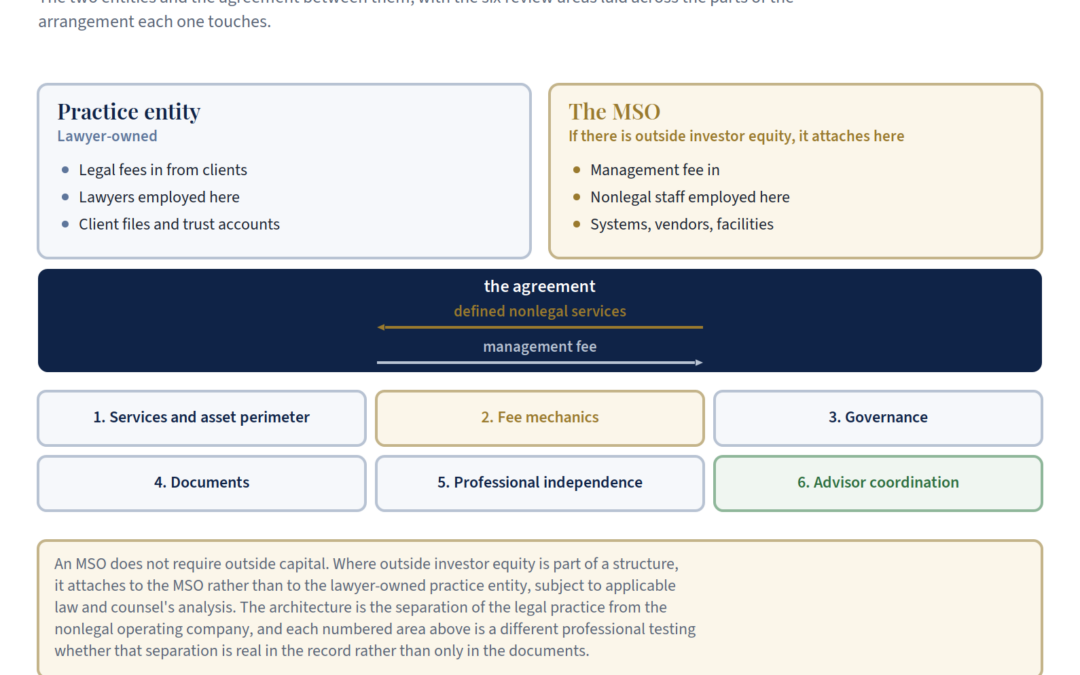
A law firm MSO structure separates one business into two: a lawyer-owned practice entity that receives the legal fees and holds professional judgment, and a separately owned management services organization that may employ defined nonlegal staff and provides defined business services under a management services agreement for a recurring fee. An MSO does not require outside capital. Where outside equity is part of a structure, it attaches to the MSO rather than the practice entity, subject to applicable law and counsel’s analysis — including, where Rule 5.4 applies, that rule as the adopting state has enacted it (American Bar Association, Model Rules of Professional Conduct, Rule 5.4; the Model Rules are not themselves binding, and the adopting state’s rule governs).
In short: A law firm MSO structure review covers six things before formation: which nonlegal services and assets move, how the fee is set and supported, how governance separates the two entities, what the documents contain, how professional independence is preserved, and which advisor owns which conclusion.
Mechanics sit in what is a law firm MSO. The cross-industry version sits in what a management services organization is. What follows is what advisors examine before one is stood up.
The MSO is not a document you file. It is an operating company that a professional-responsibility regulator, a taxing authority, a lender, and eventually a buyer will each read years later, and what happens before formation determines how legible it is to all four. Nothing here is a legal or tax conclusion.
From the Reference Edition
This topic is addressed in The Durable Law-Firm MSO — Reference Edition, Version 1.1, September 2026.
Relevant sections: Sections 10, 17, 25 and 32.
What Is the Law Firm MSO Setup and Review Sequence?
A setup can fail on something other than a bad term. Order matters: an impermissible fee form moots the economic support work, and an unsettled perimeter makes the fee unpriceable.
| Review area (in order) | What is examined | Who owns the conclusion |
|---|---|---|
| 1. Services and asset perimeter | What transfers, what stays, and the staffing plan behind it | Transaction counsel, with the owners |
| 2. Fee mechanics | Whether the form is permissible, and what supports the amount | Counsel on form; independent economists on amount; the client’s CPA on return positions |
| 3. Governance | Board composition, reserved decisions, reporting lines, ethics oversight | Counsel, investor, firm |
| 4. Documents | The services agreement and related transfer, employment, and lender papers | Counsel |
| 5. Professional independence | Whether judgment, clients, and records stay with the lawyers | Professional-responsibility counsel |
| 6. Advisor coordination | Who is engaged, what each concludes, how the record stays consistent | Owners, with a coordinator |
Every row above reads the same operating record. No row owns it.
The sections below follow that order.
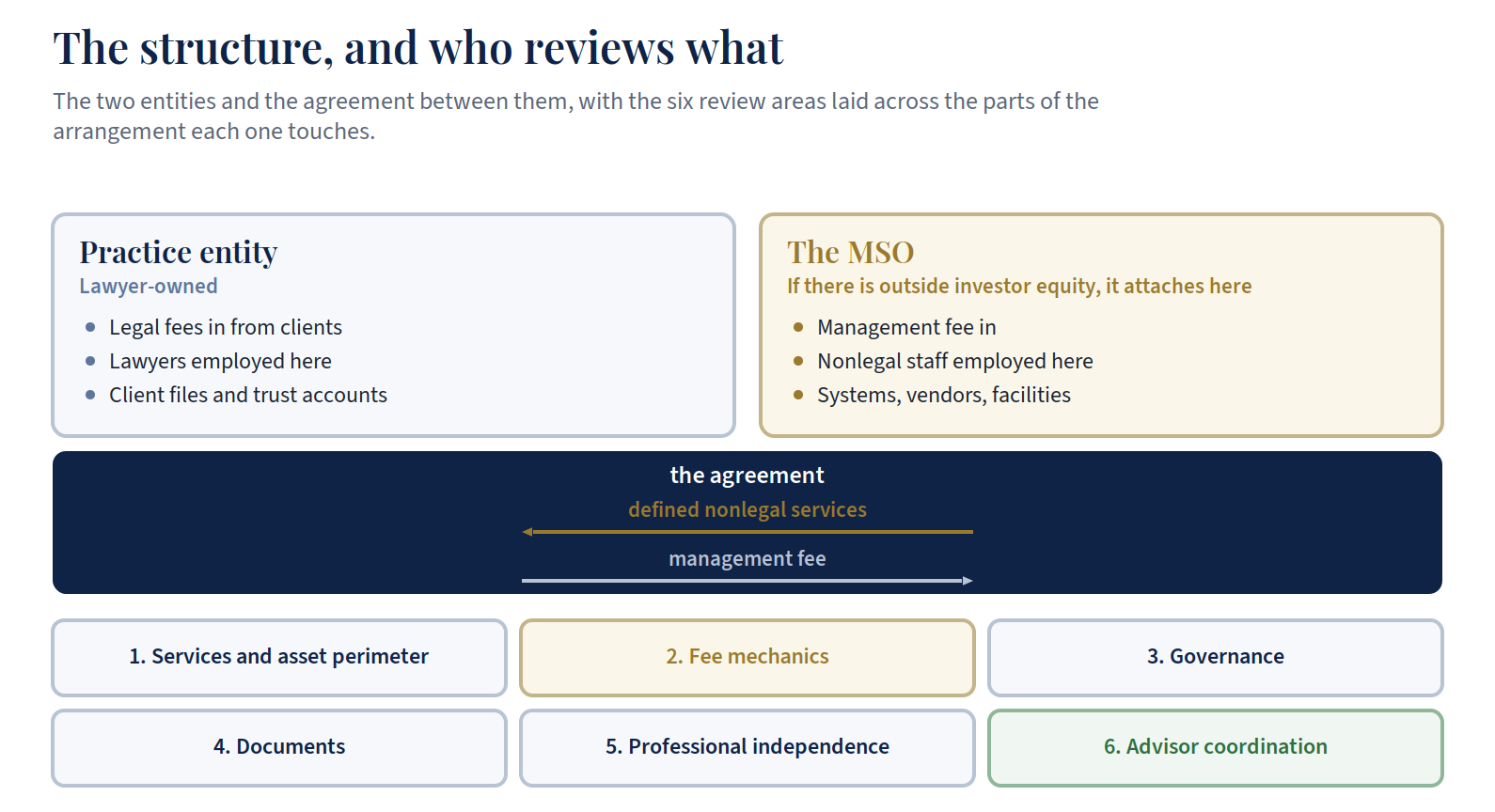
An MSO does not require outside capital. Where outside investor equity is part of a structure, it attaches to the MSO rather than to the lawyer-owned practice entity, subject to applicable law and counsel's analysis. The architecture is the separation of the legal practice from the nonlegal operating company, and each numbered area above is a different professional testing whether that separation is real in the record rather than only in the documents.
No single advisor owns all of the conclusions. The fee alone is an ethics question, an economic question, and a diligence question, and that overlap is where the unassigned question hides. For an illustrative structure to read this six-area map against, see the law firm MSO example.
Which Services Move to the MSO, and Which Stay With the Firm?
Services scope is the first thing counsel reads, because it determines everything downstream.
Hunton Andrews Kurth’s published overview makes a point worth carrying into any review: “It is crucial that investors understand that there is no ‘one-size fits all’ approach to MSO investments” (Hunton Andrews Kurth LLP, “Understanding Law Firm MSOs: A High-Level Overview for Investors and Firms,” May 27, 2026, https://www.hunton.com/insights/legal/understanding-law-firm-msos-a-high-level-overview-for-investors-and-firms — law firm commentary, not authority). A services schedule copied from another transaction is a review finding. Does the list describe functions the MSO will staff and perform, or functions the firm will keep performing under a new label?
How Are Fee Mechanics Reviewed at the Structure Stage?
The management fee is the output of an operating company, so the review is really a review of the operating plan behind it; the fee is evidence of that plan, not the subject of the exercise. Advisors ask two narrow questions at setup: whether the fee form is permissible where the firm practices, and whether there is a credible basis for the amount.
The methodology supporting that amount over time is a separate discipline, and the full menu of fee structures sits in the how MSO management fees are calculated cornerstone. The table below is narrower on purpose, reflecting only how the authorities discussed here treated each form. It is not a statement of law in any state.
How Is Governance Reviewed in a Law Firm MSO Structure?
Governance is where the paperwork either separates the two entities or quietly merges them. In L.E.K. Consulting’s published design principles, board separation runs one way: “Law firm representatives may sit on the MSO board, but MSO investors may not sit on the law firm board.” The same piece recommends at least one independent MSO director with ethics and professional-responsibility experience and no economic relationship to the sponsor, with a chief compliance officer reporting to the ethics committee rather than to the investor (Alexa Allen and Neil Menzies, L.E.K. Consulting, “MSO Design Principles for Law Firms and Investors,” June 22, 2026, https://www.lek.com/insights/legal-ops-and-tech-consulting/mso-design-principles-law-firms-and-investors — consulting commentary, not authority).
Which Documents Does the Review Cover?
Counsel drafts; advisors read for whether the papers describe the same business, so this part of the review is about existence and consistency.
Hunton writes that “MSAs are entered into simultaneously with the acquisition of a law firm’s non-legal assets,” which is why reading the agreement alone misses half the picture (Hunton Andrews Kurth LLP, “Understanding Law Firm MSOs: A High-Level Overview for Investors and Firms,” May 27, 2026, hunton.com — law firm commentary, not authority). Records and audit rights, staffing provisions, and cure and unwind mechanics are negotiated too; clause-level treatment sits in the companion law firm MSO agreement guide.
How Is Professional Independence Kept in View?
Professional independence is a legal question owned by professional-responsibility counsel; nothing here determines whether a given arrangement preserves it. A review surfaces the considerations counsel will address and keeps the operating design from creating facts counsel then has to explain:
- Who selects, supervises, compensates, and terminates lawyers. Illinois HB 5487, as enacted, reaches selection and termination; approved by the Governor on August 7, 2026, it is now Public Act 104-0801 (Illinois General Assembly, HB 5487, 104th General Assembly, https://www.ilga.gov/ftp/legislation/104/BillStatus/HTML/10400HB5487.html).
- Who holds client records and files.
- Whether services stay on the business side of the line, limited to administrative, technical, and business functions.
- Whether compensation could be characterized as sharing in legal fees, and whether the practice retains the capital to meet its professional obligations after paying the fee.
Why Is Law Firm MSO Setup Now a Multistate Review?
A 2026 review has to account for Rule 5.4 as adopted in the relevant state, the state's own professional conduct authority, and recent legislation affecting fee structure, ownership, records, and professional control. Three new state statutes changed the exercise.
Three states now have statutes on the books that a law firm MSO has to be read against — Colorado HB26-1421 (signed June 4, 2026; effective August 12, 2026), which reaches how a lawyer or law firm may compensate a provider of administrative or nonlegal business services, and California’s Cal. Bus. & Prof. Code § 6156, added by AB 931, which restricts fee-sharing with out-of-state alternative business structures , and Illinois HB 5487, approved by the Governor on August 7, 2026, and now Public Act 104-0801, effective on approval. That is what makes law firm MSO setup a multistate, multi-advisor review rather than a form to complete.
California AB 931 added Cal. Bus. & Prof. Code § 6156, repealed January 1, 2030. It is a restriction first, and a conditional one. Subdivision (a) reads: “No attorney licensed or otherwise authorized to practice in this state shall share legal fees directly or indirectly with an out-of-state alternative business structure unless all of the following apply” — the attorney is also licensed in the state where the alternative business structure is approved, the fees compensate the provision of legal services in that state, and that state’s law is controlling. The counterparty the subdivision names is the alternative business structure itself, an entity, not attorneys associated with one.
Two further exclusions sit outside subdivision (a). Subdivision (d) exempts fee-sharing ordered or approved by a court or tribunal and subject to that oversight. Subdivision (e) provides that the section “shall not apply to a contract in which all of the following are satisfied: (1) The contract outlines a specific dollar amount for services rendered. (2) No payment is related to the referral of legal services or purchase of a lead for a potential client or case. (3) No payment is contingent on the amount recovered in a specific case.” The statute uses “alternative business structure,” and it does not use the term “MSO” or “management services organization” anywhere. Subdivision (g) is an applicability rule rather than an operative date: the section “shall only apply to contracts entered into on or after January 1, 2026” (Cal. Bus. & Prof. Code § 6156, added by AB 931 (2025), California Legislative Information).
Reading a conforming management arrangement into the § 6156(e) exclusion is an inference, not something the statute states. The statute restricts fee-sharing with a named counterparty and carves out narrow exclusions; it does not permit, authorize, or bless any structure.
Colorado HB26-1421 was signed June 4, 2026, takes effect August 12, 2026, and is repealed September 1, 2029. Read the compensation rule in the act’s own words, because a paraphrase narrows it. The act prohibits a lawyer or law firm, in connection with providing legal services concerning a legal right arising in whole or in part in Colorado, from compensating a provider of administrative or nonlegal business services “unless the compensation is not contingent upon a percentage of legal fees or revenues and not determined by reference to recoveries, settlements, or other case outcomes.” Legal fees or revenues — a revenue-linked management fee is inside the bar, not outside it. The act also “exempts certain arrangements, activities, and organizations from the prohibitions in the act,” without enumerating them in the summary (Colorado General Assembly, HB26-1421, signed June 4, 2026, takes effect August 12, 2026, https://leg.colorado.gov/bills/HB26-1421).
Illinois HB 5487 was sent to the Governor on June 26, 2026 and approved by the Governor on August 7, 2026. It is now Illinois Public Act 104-0801, effective on approval. Under the Illinois Constitution, “[a]ny bill not so returned by the Governor within 60 calendar days after it is presented to him shall become law.” That timeline is moot: the Governor approved the bill on August 7, 2026, well within the period (Illinois General Assembly, HB 5487, 104th General Assembly, bill status, https://www.ilga.gov/ftp/legislation/104/BillStatus/HTML/10400HB5487.html; Ill. Const. art. IV, § 9(b), https://www.ilga.gov/commission/lrb/con4.htm). It is now a statute, and its provisions are operative as of August 7, 2026.
All of this is stated as of September 5, 2026, following enactment on August 7, 2026. Provision detail and the enacted text sit in Illinois HB 5487 and law-firm MSO requirements.
Running the other way are the permissive jurisdictions. Each is covered in ABS and the Utah sandbox. Licensure is a different set of obligations rather than a shortcut: direct ownership in one state against a structure that travels. How the differences between states bear on where a structure is designed to sit is taken up in the regulatory patchwork.
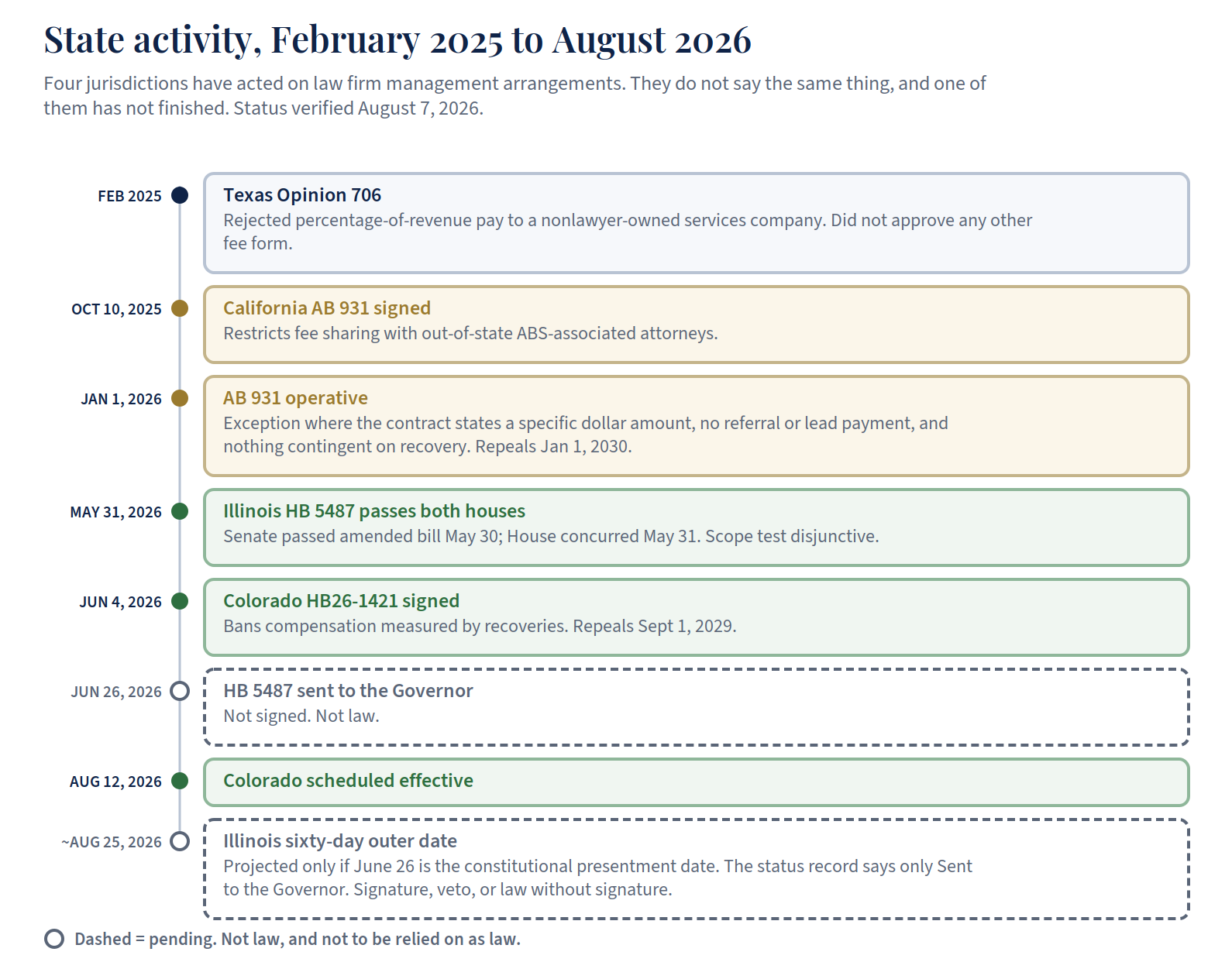
These instruments address different arrangements and should not be read as a common safe harbor. Texas Opinion 706 rejected the percentage-of-revenue arrangement before it and did not establish that another fee form is automatically permissible or economically supportable. California AB 931 creates an exception for contracts meeting specified fixed-dollar, nonreferral, and noncontingent-payment conditions; the statute does not use the term MSO. Colorado imposes its own statutory restriction. Illinois enacted HB 5487 on August 7, 2026 (Public Act 104-0801, effective on approval).
Sources: legalethicstexas.com · leginfo.legislature.ca.gov · leg.colorado.gov · ilga.gov
What Do Advisors Treat as Early Red Flags?
Red flags here are review triggers, not violations. Each sends the question to counsel before the structure goes forward.
- Compensation tied, directly or indirectly, to legal fees, revenues, profits, or recoveries. The item the Texas opinion and the Colorado and California statutes described above each reach, and the item the Illinois act, as enacted, reaches; cited in those sections.
- At-will replacement rights over firm leadership. Whether the agreement lets the MSO or an investor replace firm leadership, on what grounds, and with what notice, is a governance term the review reads rather than assumes.
- MSO access to or control of client records. Barred for covered firms under the Illinois act as enacted; approved August 7, 2026, it is now Public Act 104-0801 (Illinois General Assembly, HB 5487, https://www.ilga.gov/ftp/legislation/104/BillStatus/HTML/10400HB5487.html).
- A services schedule that does not match the staffing plan. If nobody is hired to perform a listed service, the service is a label.
For advisors reading on behalf of a client: run the six-area map as an ownership exercise, not a checklist. Name the professional who signs off on each row before any of them starts work; rows without a name surface later as findings. For the version you can hand back to the client, bring the map to Guardian Tax Consultants® and compare it against what the operating record has to carry.
Which Advisors Are Needed to Set Up a Law Firm MSO?
- Transaction counsel owns the structure, documents, and negotiation.
- Professional-responsibility counsel owns the independence and fee-sharing analysis, state by state.
- Independent economists own the fee and valuation conclusions; the client’s CPA owns return positions.
- Lender and investor counsel own diligence and security architecture where financing is involved.
Each advisor owns a different conclusion, and several may read the same underlying operating record. Nobody owns the seam between them by default, and the seam is where the unassigned question lives: the agreement stops matching the service scope, the economic support assumes facts that have changed, the governance minutes describe a relationship the invoices do not. Volume is why this has gotten louder. Law firm M&A in 2026 carries the wider context.
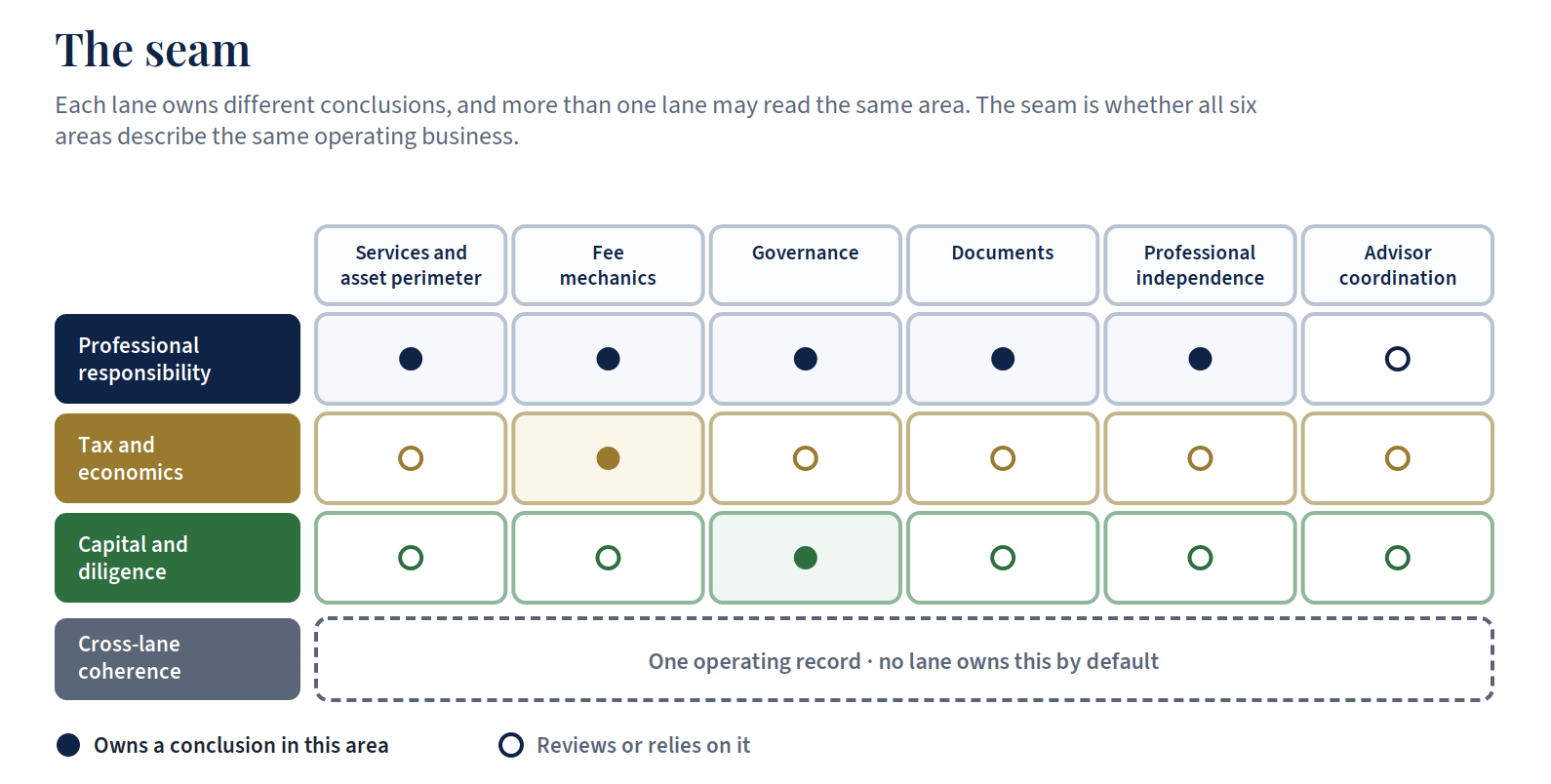
Counsel owns the conduct conclusion. Independent economists own the fee conclusion. The CPA owns the return position. Buyers and lenders own the diligence read. Every one of them may read outside the conclusion it owns, which is why ownership and access are different questions. What none of them owns by default is the band across the bottom.
Who Owns the Operating Record Between the Lanes?
Guardian Tax Consultants works the seam. Between the lanes sits the MSO’s operating and economic architecture: intercompany economics, service delivery, governance cadence, and the documentation that keeps a platform readable years later.
The lanes stay separate, and the separation is the point. Counsel owns the legal and professional-responsibility conclusions, independent economists own the fee and valuation conclusions, and the client’s CPA owns return positions. GTC™ designs and administers the operating and economic record all three read, through the MSO Platform™ model.
The economic report supports the operating company; it does not replace one.
Frequently Asked Questions
What does law firm MSO setup involve?
A review, not a filing. Before formation: a jurisdiction screen, a services and asset perimeter, a fee form with a credible basis for the amount, governance and document review, and an advisor roster with a named owner for each conclusion. It is counsel-led.
Does law firm MSO setup require private equity?
No. An MSO does not require outside capital. Where outside equity is part of a structure, it attaches to the MSO rather than the practice entity, subject to applicable law and counsel’s analysis. The six review areas are the same either way; where financing is involved, lender and investor counsel join the advisor roster and their diligence and security architecture come into the review.
Is law firm MSO setup complete when the entities and agreement are signed?
No. The MSO is not a document you file. It is an operating company that a professional-responsibility regulator, a taxing authority, a lender, and eventually a buyer will each read years later. Signed papers are one of the six review areas, not the whole of them: the review also asks whether the services schedule matches the staffing plan, whether there is a credible basis for the fee amount, and whether the agreement, the economic support, the governance minutes, and the invoices keep describing the same business over time.
Why does law firm MSO setup require a state-by-state review?
Because the rules a structure has to be read against differ by state, and several of them have moved recently. A 2026 review has to account for Rule 5.4 as adopted in the relevant state, the state's own professional conduct authority, and recent legislation affecting fee structure, ownership, records, and professional control. As of September 5, 2026 there are three statutes on the books — Colorado HB26-1421, California’s Cal. Bus. & Prof. Code § 6156, added by AB 931, and Illinois HB 5487, approved by the Governor on August 7, 2026 as Public Act 104-0801, effective on approval. Running the other way are the permissive jurisdictions. A firm that practices in more than one state is read against more than one set of rules, and professional-responsibility counsel owns that analysis state by state. Nothing here is a legal conclusion, and every status should be re-checked before it is relied on.
Who coordinates the operating record across counsel, economists, the CPA, and capital providers?
Nobody, by default — which is why the review names someone. Each advisor reads a different slice of the same operating record: counsel owns the legal and professional-responsibility conclusions, independent economists own the fee and valuation conclusions, the client’s CPA owns return positions, and lender and investor counsel own diligence where financing is involved. The seam between them is where the unassigned question lives, so advisor coordination is its own review area with a named owner rather than an assumption. Guardian Tax Consultants works that seam, designing and administering the operating and economic record all three lanes read.
Which advisors are needed to set up a law firm MSO?
Counsel leads, and not alone. Independent economists own the fee and valuation conclusions, the client’s CPA owns return positions, and lender or investor counsel joins where financing is involved.
Authorities and Sources
- American Bar Association, Model Rules of Professional Conduct, Rule 5.4 (American Bar Association, Model Rule 5.4; the Model Rules are not themselves binding and the adopting state’s rule governs); Texas Committee on Professional Ethics, Opinion 706 (February 2025), https://www.legalethicstexas.com/resources/opinions/opinion-706/, as reproduced in the Texas Bar Journal, April 2025
- Cal. Bus. & Prof. Code § 6156, added by AB 931 (2025), applying to contracts entered into on or after January 1, 2026, repealed January 1, 2030, https://leginfo.legislature.ca.gov/faces/billNavClient.xhtml?bill_id=202520260AB931; Colorado General Assembly, HB26-1421, signed June 4, 2026, takes effect August 12, 2026, repealed September 1, 2029, https://leg.colorado.gov/bills/HB26-1421; Illinois General Assembly, HB 5487, 104th General Assembly, sent to the Governor June 26, 2026, approved August 7, 2026; now Public Act 104-0801, https://www.ilga.gov/ftp/legislation/104/BillStatus/HTML/10400HB5487.html; Ill. Const. art. IV, § 9(b), https://www.ilga.gov/commission/lrb/con4.htm
- Hunton Andrews Kurth LLP, “Understanding Law Firm MSOs: A High-Level Overview for Investors and Firms” (May 27, 2026), https://www.hunton.com/insights/legal/understanding-law-firm-msos-a-high-level-overview-for-investors-and-firms; Alexa Allen and Neil Menzies, L.E.K. Consulting, “MSO Design Principles for Law Firms and Investors” (June 22, 2026), https://www.lek.com/insights/legal-ops-and-tech-consulting/mso-design-principles-law-firms-and-investors
Statuses are stated as of September 5, 2026. The Illinois status resolved on August 7, 2026, when the Governor approved HB 5487 as Public Act 104-0801. Requirements vary by jurisdiction and change frequently. Verify before relying on any description here.
Talk Through a Structure Review
If you have read this far, you probably know which of the six rows in your own situation has no name next to it. That is the conversation worth having: which questions belong to which advisor in the states where the firm practices, and what the operating record has to carry so all of them answer from one file.
Walk the six-row map with Guardian Tax Consultants in an educational discussion of the model and the operating architecture behind it. Capital follows operating architecture.
This article is educational only. It is not legal, tax, accounting, valuation, or investment advice, and it creates no professional relationship. The authorities described here are considerations, not conclusions. Whether a structure complies with the rules of professional conduct or any statute is a determination for qualified counsel; tax positions belong to the taxpayer’s CPA; fee and valuation conclusions to independent economists.
Alex Jones, Founder and Chief Executive Officer, Guardian Tax Consultants · Last reviewed September 15, 2026