
Technical Brief · Est. read time 16 minutes · Draws on The Durable Law-Firm MSO — Reference Edition, Sections 02, 03, 04, 11, 16, 28 and 29 · Published September 5, 2026 · Last reviewed September 7, 2026
A law-firm management services organization is a separately owned nonlegal company that employs the firm’s business functions and charges the practice an arm’s-length fee for them; what it is and how it is structured are answered elsewhere in this library. This brief answers the question the Reference Edition says is asked by the largest and least written-for group of owners — the founders and partners who never intend to sell: what does the structure change about who can own the enterprise they are building, what that ownership is worth when someone leaves, and how the next generation pays for it?
Canonical Answer
How does a law-firm MSO change partner succession and equity?
It creates a second ownership interest rather than a different owner for the law practice. The practice stays owned and controlled by licensed lawyers under the applicable professional rules; the platform — the nonlegal services company that employs the operators, holds the systems, and earns an independently supportable fee — is a separately governed business whose equity can be held, valued, and transferred on its own terms. That matters because the traditional form rewards its owners principally through current income while the interest they build carries little value that travels, which the Reference Edition says “removes much of the incentive to build one in the first place.” Platform equity can be held by the people who genuinely build and serve the services business; retained platform capital can, where supportable, fund an internal succession purchased over time; and the interest can be designed at formation so that a partner’s departure is an operating event rather than an improvised restructuring — but only if four questions are answered at formation: who may hold the interest, how it is valued, how a transition is funded, and what happens to the services fee when the people rendering the services change. Platform equity confers no interest in legal fees, clients, or matters, and it is an option for the owners who want it, not an obligation for the ones who do not.
From the Reference Edition
This article draws on The Durable Law-Firm MSO — Reference Edition, August 2026, Version 1.0.
Source: Section 02 (“What the Traditional Practice Structure Cannot Do”), Section 04 (“The income stops”; “The operators cannot own, and the producers can leave”), Section 16 (retention instruments), Section 28 (“Ownership Continuity: Departure, Death, and the Transfer of Platform Interests”); supporting Sections 03, 11 and 29.
Why the traditional form weakens the incentive to build
The Reference Edition’s diagnosis begins with a concession: the traditional practice form creates real wealth. A partnership or professional entity owned entirely by its licensed practitioners, distributing substantially all of its income each year, produces durable revenue, real margins, and client relationships that persist for decades, and a share of strong current earnings “is not nothing.” What the form was never designed to do is what every comparable operating business does as a matter of course — admit outside capital, build transferable enterprise value, grant ownership to the operators who build it, and invest across more than one budget cycle.
The succession consequence follows from the second of those. A partnership interest can hold substantial value to its holder; what it lacks is value that travels. Professional rules, client choice, personal goodwill, and the governing documents together constrain what an interest can be sold for, borrowed against, or passed on, and the paper describes a typical buy-in as “more accurately described as a claim on future draws than as the purchase of an appreciating asset.” That, the paper concludes, is why succession at substantial firms fails as often as it does: the founders hold something the next generation will not rationally pay much for, and a practice built over thirty years too often resolves into an income that simply stops.
The paper’s sharpest point is about behavior rather than outcome. With no way to later convert built-up value into something transferable, taking it out annually is the rational response, and investing in value the interest can never capture is not. “The traditional form does not merely fail to produce a transferable asset — it removes much of the incentive to build one in the first place.” That is the proposition this brief rests on, stated at the strength the paper gives it: much of the incentive, not all of it, and a consequence of the form rather than of the people in it. Two further constraints compound it. The professionals who make an operating business excellent — the chief financial officer, the operator, the technologist — cannot hold equity in a law practice outside the carve-out jurisdictions, so a firm competes for that talent against companies that can offer ownership without being able to. And covenants restricting a departing lawyer’s right to practice are barred by Model Rule 5.6(a) and its state analogues outside the rule’s retirement-benefit exception, so firms respond with the tools that remain — bonuses, deferred compensation, non-equity tiers, phantom arrangements — the most common of which “retains people chiefly by making departure forfeit compensation already earned.”
Two interests, not a different owner for the practice
The structural change is easy to misread, so it is worth stating precisely. A law-firm MSO does not create a way for nonlawyers to own the law practice. Under Rule 5.4 and its state analogues — everywhere but the handful of carve-out jurisdictions the Reference Edition’s Section 12 describes — a nonlawyer cannot own an interest in the practice, and subsection (d) separately bars a lawyer from practicing in a for-profit entity authorized to practice law if a nonlawyer owns an interest in it, serves as its director or officer, or holds the right to direct a lawyer’s professional judgment. The practice remains owned and controlled by licensed lawyers. Any investor’s interest, and any operator’s, is confined to the entity above the management company.
What the structure creates instead is a second interest. Section 28 of the Reference Edition puts it plainly: a partner holds an interest in the practice and, separately, an interest in the platform. The first is governed by the firm’s partnership agreement and by the rules of professional conduct. The second is governed by the platform’s own governing documents, “and nothing requires the two to move together; that is the point, and also the exposure.” The exposure is coupling. Where a partner’s platform interest is defined as a function of the partner’s practice interest, the platform’s economics track partner shares by construction — the substance problem the paper’s transfer-pricing sections identify, carrying the professional-responsibility problem with it “through the back door of the buy-sell rather than through the fee.” Where the interests are genuinely separate, a departure raises an ordinary question of business succession: who may hold the interest, at what value, on what terms, and funded how.
One tension is named rather than assumed away, because the record has to support the honest version of the claim. The services fee is the platform’s only revenue and it is funded out of the practice’s receipts. Decoupling the fee’s measurement from firm results does not decouple its source; the platform’s fortunes remain derivative of the practice’s health. What the discipline claims is narrower — that the fee is set independently of legal revenue, profit, and outcomes — and what a platform interest is worth is a contracted, renewing stream of arm’s-length service revenue whose durability rests on the operating substance behind it, not a share of legal economics.
What platform equity can do
Three things, each stated in the Reference Edition’s own terms. First, it can hold value that travels. A platform whose value derives from systems, contracts, workforce, and an operating record is capable of independent valuation on its own operating facts rather than as a proxy for the practice interest. Second, it can be owned by the people who build and genuinely serve the services business, subject to the service-relationship, securities, valuation, tax, and professional-responsibility requirements addressed below. The paper’s answer to the retention constraint is “the missing instrument: genuine equity in the services company for the people who build it, rather than one more forfeiture schedule” — the operators a practice cannot make owners, and the partners whose platform interest is a separately governed asset rather than a claim on draws. Third, it can fund the transition itself. The platform “is the part of the enterprise that can hold transferable value, and where it retains capital deliberately, that capital can fund the transition itself, an internal succession purchased over time from the platform’s own balance sheet rather than waiting on an outside buyer who may never come.”
The deeper change is to the incentive. “Once part of the enterprise can hold value an owner may someday capture, building that value stops being irrational, and the platform restores the reason to build alongside the means — an option for the owners who want it, not an obligation for the ones who do not.” Two qualifications travel with that sentence wherever it appears. The Reference Edition is written first for the founder who never intends to transact — Pathway One in its Section 03, “the largest group, and the least written-for” — and nothing in this brief asks that owner to contemplate a sale; ownership continuity is the objective, and a later capital event is a separate question the outside-capital brief owns. And the paper adds the clock: “Each year the question goes unaddressed, the set of workable successors and the time left to fund a transition both shrink.”
Where a lawyer holds platform equity, the professional rules follow the lawyer. As one jurisdiction-specific example, Texas Ethics Opinion 706 (2025), persuasive rather than binding outside its own setting, concludes that a lawyer may hold an equity interest in a company owned in part by nonlawyers so long as that company does not itself practice law, and notes that where such a company provides law-related services to the lawyer’s own clients, disclosure and informed written consent may be required — Model Rules 1.7 and 1.8(a) are the corresponding provisions, and state analogues vary. And a partner holding platform equity, or a deferred-compensation promise backed by the platform’s balance sheet, has a personal financial interest that Rule 1.7(a)(2) reaches: whether a given arrangement creates a significant risk of materially limiting a representation, and whether informed client consent is required and available, is counsel’s determination jurisdiction by jurisdiction, asked at formation and revisited when the economics a partner holds change shape.
The four questions answered at formation
Law firms are defined by partner mobility: equity partners lateral, retire, withdraw, and die, and the Reference Edition’s point is that ownership “is a variable, and it moves on a schedule nobody controls.” A structure whose professional-responsibility architecture depends on who owns what has to survive each of those events without being redesigned. Section 28 gives four questions that have to be answered at formation, “because answering them under the pressure of an actual departure produces documents that read as though they were.”
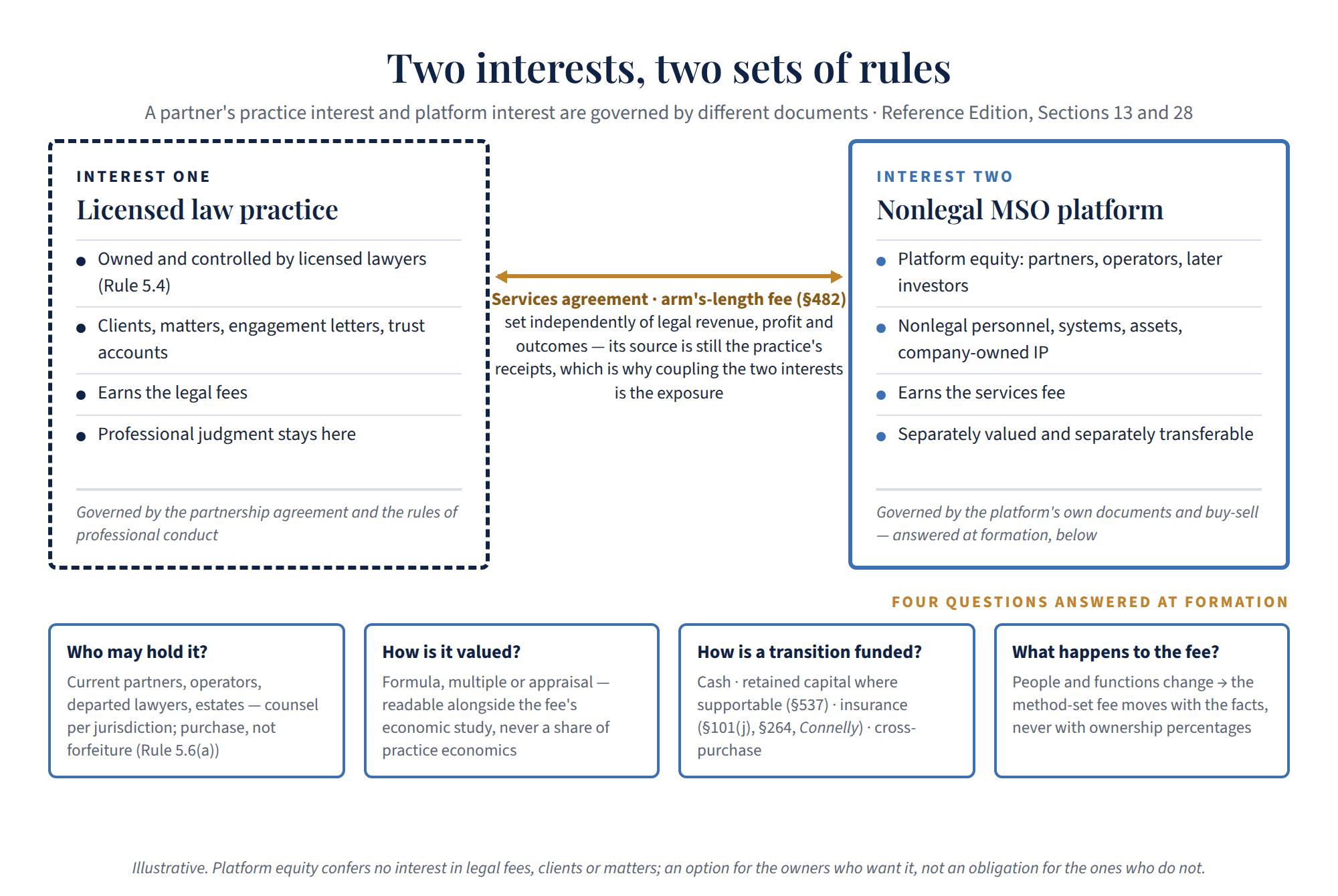
Who may hold platform equity
A departing lawyer who retains an interest in the services company while no longer practicing at the firm is in a different position from a current partner, and a deceased partner’s estate is in a third. Whether continued or inherited ownership is consistent with the applicable professional-conduct rules is a question for counsel in every jurisdiction the firm touches, and the answer determines whether the governing documents need a mandatory transfer on departure or can permit a holdover. A mandatory-transfer or forfeiture term carries a professional-responsibility dimension of its own: where losing the platform interest on departure operates economically as a penalty on leaving to practice elsewhere — and the paper has conceded that platform value tracks the practice’s health — the policy behind Rule 5.6(a)’s bar on restrictive covenants is in view. The Reference Edition’s design posture, which runs through the whole section, is to “value the interest independently and pay for it on defined terms, so that departure triggers a purchase rather than a forfeiture.”
How the interest is valued
A platform whose value derives from systems, contracts, workforce, and an operating record can be valued independently — which is the point of having one. But a valuation mechanism written into the governing documents, whether a formula, a multiple, or an appraisal process, becomes a data point that surfaces later, in a transaction or an examination, alongside whatever the economic study of the fee says. The two should be capable of being read together. A buy-sell that values the platform interest as a share of the practice’s economics has recreated the coupling the structure exists to avoid.
How the transfer is funded
An unfunded obligation to buy out a departing partner’s platform interest is a contingent liability, and how it is funded is decided at formation with the CPA and estate counsel rather than after a death. The Reference Edition is candid that funding a future redemption from accumulated corporate capital is a contested question rather than a given: as the paper reads it, §537(a)(2) makes redemption needs arising under §303 a reasonable need of the business, and the negative implication for other redemption accumulations cuts against them without foreclosing them, so the accumulation requires the same specific, definite, and feasible plan that governs every other retained-capital purpose — a determination for the CPA of record, and a subject the retained-capital brief owns. Where funding is arranged through insurance held by the platform, three constraints apply together: the notice and consent formalities for employer-owned life insurance under §101(j); the denial of deductions for premiums and carrying interest under §264; and the valuation consequence of Connelly v. United States, 602 U.S. 257 (2024), which on the facts before the Court rejected an offset for the corporation’s redemption obligation in valuing the decedent’s shares — read by the Reference Edition as making corporate-owned death benefit increase the corporation’s estate-tax value without an offset for the obligation it funds, and so a valuation question for estate counsel rather than an assumption. A cross-purchase or insurance-LLC alternative is one of the design choices settled at formation with estate counsel.
What happens to the fee
This is the question a cap-table view of succession misses, and it is the one that reconnects ownership to durability. A departure changes the services actually rendered, the personnel rendering them, and often the cost base underneath. A fee set on a method rather than on a result should move when the underlying facts move, and the record should show it moving for that reason. “A management fee that is identical in the year before and the year after a material change in the platform’s workforce invites the reasonable question of what method produced both numbers.” Ownership changes repeatedly across the holding period over which a §1202 position, a §482 method, and an independence posture must all stay continuously true; a platform with a documented answer to all four questions treats a partner’s exit as an operating event, and one without treats it as a restructuring — “and every restructuring is a new set of facts for a later reviewer.”
| Formation question | What must be decided | Why it matters | Record / instrument | Primary adviser |
|---|---|---|---|---|
| Who may hold platform equity? | Current partners, operators, departed lawyers, estates; holdover permitted or mandatory transfer; jurisdictional constraints | A forfeiture that penalizes leaving to practice elsewhere puts Rule 5.6(a)’s policy in view; the Reference Edition’s design posture is a purchase at independently determined value rather than a forfeiture, with the Rule 5.6(a) analysis left to counsel | Platform governing documents; transfer and holdover provisions; documented service relationship for any compensatory grant | Counsel, in every jurisdiction the firm touches |
| How is the platform interest valued? | Formula, multiple, or appraisal; independent of any share of the practice’s economics | The mechanism surfaces later beside the fee’s economic study; the two must read together, or the buy-sell recreates the coupling | Valuation provision; appraisal support; capable of being reconciled with the functional and economic record behind the §482 position | Independent appraiser and economist; counsel |
| How is the transition funded? | Current cash; accumulated corporate capital where supportable; entity-owned insurance; cross-purchase or insurance-LLC architecture | Redemption accumulation is contested under §537; entity-owned insurance requires §101(j) and §264 analysis and consideration of Connelly‘s valuation treatment | Buy-sell agreement; funding plan; specific, definite and feasible plan where capital is retained (see the retained-capital brief) | CPA of record; estate counsel |
| What happens to the services fee? | How the method responds when personnel, functions and cost base change on a departure | A fee that does not respond to a material change in the facts underlying its method invites the question of what method produced both numbers; a fee that moves with ownership percentages is coupling | Annual §482 substantiation refreshed for the changed functional facts (see the annual substantiation brief) | Independent economist; CPA |
Equity is not the only retention instrument
The Reference Edition’s Section 16 treats rollover equity — the form retention takes at a transaction — as one instrument among several, and its qualifications apply with equal force to platform equity granted with no transaction in view. Compensatory equity cannot be assumed to reach across the line between a licensed practice and its platform: a grant requires a bona fide service relationship to the issuing entity, with securities, valuation, and tax analysis of its own, so where that relationship is absent a newly promoted partner acquires any platform interest by purchase at fair market value rather than by grant. The dividing line is the service relationship, not the title: a compensatory grant is supportable only where the recipient genuinely serves the issuing entity, and where a partner lacks that relationship, purchase at fair market value is the paper’s illustrated alternative rather than treating practice service as platform compensation.
The alternative the paper describes is a company-financed deferred-compensation arrangement: for tax purposes an unfunded, unsecured promise backed by the corporation’s general assets; in substance cash, vested on a schedule and subject to clawback, earned by continued bona fide service rather than by a later sale, and never measured by legal fees, matter outcomes, or the practice’s profits. It answers a different part of the retention problem than equity does, and the two can address different retention objectives within the same architecture where each independently satisfies its own requirements — a partner who spent a career on partnership-style distributions does not always value equity the way a corporate seller would. Its own mechanics apply: a corporation can fund compensation only for people genuinely providing services to it, the payout is governed by §404(a)(5) and §409A, and where a clawback or forfeiture would operate economically as a penalty on leaving to practice elsewhere, the arrangement belongs in front of counsel under Rule 5.6(a). The paper’s own summary of the distinction is the one to keep: departure should trigger a purchase at independently determined value, not the forfeiture of value already built — and the retirement-benefit exception to Rule 5.6(a) is a narrow exception counsel applies, not a blanket license for forfeiture schedules.
How an internal transition is funded
Where the platform includes a C-corporation, earnings from services actually rendered can be retained for documented business needs, and an internal succession “purchased over time from the platform’s own balance sheet” is one of the uses the Reference Edition’s illustrations describe — alongside a funded buy-sell and key-person coverage in its Section 04 composite. What retained capital can fund, what it cannot, and what the record must show is the subject of the retained-capital brief, and this brief does not repeat it. The point that belongs here is narrower: funding a future redemption does not automatically establish a reasonable need of the business, the paper flags the statutory tension around redemption accumulations rather than assuming it away, and the funding architecture — cash, retained capital where supportable, insurance, a cross-purchase — is decided when the structure funds, with the CPA and estate counsel, not when a partner gives notice.
The generational fork
For a founder holding a corporate platform interest, the Reference Edition names a choice that is made when the structure funds rather than at a letter of intent: holding the stock until death, which brings a basis adjustment to the stock at the cost of the full date-of-death value sitting in the taxable estate, or moving value out early through an irrevocable structure, which removes the growth from the estate at the cost of that adjustment. The estate and transfer-tax work is performed by the client’s estate counsel and the valuation support by an independent appraiser; what the platform contributes is the operating record that makes the interest capable of being valued at all. The paper’s basis discipline sits underneath: a basis adjustment reaches the stock, not the assets inside the corporation, so later dispositions are modeled with the CPA and counsel on real numbers.
What this structure does not do
It does not make a nonlawyer an owner of the law practice, and it does not give a platform equity holder — lawyer or not — any interest in legal fees, clients, or matters; those remain with the licensed practice under the applicable professional rules. It is not a covenant: Rule 5.6(a) stands, a departing partner leaves with whichever clients choose to follow, and no retention design reaches client choice — “continuity there is a fact diligence prices, not a gap design closes.” It does not manufacture transferable value by declaration: a platform interest is worth what the operating substance behind its fee stream is worth, and a platform formed at the letter of intent has no record to value. It is not asset protection. And it is not a sale thesis: the Reference Edition is written for the owner who holds, and the structure’s succession value is that the next generation can acquire, over time, interests in a separately governed nonlegal enterprise that exists whether or not an outside buyer ever appears.
Advisor implications
For counsel, the formation agenda is the four questions above, plus the partner-level Rule 1.7(a)(2) analysis for any partner holding platform economics, the Rule 5.6(a) review of any transfer, forfeiture, or clawback term, and the disclosure and consent questions where a lawyer’s platform provides law-related services to the lawyer’s own clients. The compensatory-versus-purchase character of any partner or operator interest is a coordinated question for the CPA and counsel together — tax, compensation, securities, and professional-responsibility treatment each have a say. For the CPA of record, the return positions are the funding of redemptions against §537 where corporate capital is retained, the §404(a)(5) and §409A mechanics of any deferred-compensation arrangement, and the basis and entity-level consequences of the generational choice. For the independent economist, the valuation mechanism in the governing documents must be capable of being read alongside the fee’s economic study, and the fee method must be shown responding to the changed functional facts a departure produces. For estate counsel and the wealth adviser, the funding architecture — including the Connelly consequence of entity-owned insurance — and the generational fork are decided at formation. Guardian Tax Consultants® administers the contemporaneous operating record supporting the platform’s functions and economics and coordinates that record across the advisory lanes; counsel owns every legal conclusion, and the CPA owns the return.
Related Insights
- The Durable Law-Firm MSO — Reference Edition
- Law-Firm MSO Retained Capital: Growth, Retention and Succession
- Law Firm MSO Example: A Seven-Partner Illustrative Structure
- How Outside Capital Enters a Law-Firm MSO
- Rule 5.4 and the Law-Firm MSO: Ownership, Fee-Sharing, and Independence in Fact
- The Annual Substantiation Cycle for a Law-Firm MSO
- Law Firm M&A in 2026
- For Law Firms
Frequently Asked Questions
Does a law-firm MSO let nonlawyers own part of the law firm?
No. Under Rule 5.4 and its state analogues — outside the carve-out jurisdictions the Reference Edition’s Section 12 describes — a nonlawyer cannot own an interest in the practice, and the practice remains owned and controlled by licensed lawyers. What the structure creates is a separate, separately governed interest in the nonlegal services company. That interest confers no share of legal fees, clients, or matters.
Can the firm’s chief operating officer or technologist hold equity in the platform?
The operators who make an operating business excellent cannot hold equity in a law practice outside the carve-outs; a separately governed nonlegal platform can offer genuine equity to operators who genuinely serve it, subject to its governing documents and the applicable legal, tax, securities, and professional-responsibility analysis. Any compensatory grant requires a bona fide service relationship to the issuing entity and carries its own securities, valuation, and tax analysis.
Can a partner be granted platform equity?
Only where the partner has a bona fide service relationship to the platform; compensatory equity cannot be assumed to reach across the line between the practice and its platform. Where that relationship is absent, the Reference Edition’s answer is that a newly promoted partner acquires any platform interest by purchase at fair market value rather than by grant.
What happens to a partner’s platform interest when the partner leaves?
Whatever the platform’s governing documents provide — which is why the question is answered at formation. Whether a departed lawyer or an estate may continue to hold the interest is counsel’s question in each jurisdiction; where the documents require a transfer, the design answer is a purchase at independently determined value on defined terms rather than a forfeiture, because a forfeiture that penalizes leaving to practice elsewhere puts the policy of Rule 5.6(a) in view.
How is an internal succession paid for?
From current cash, from capital the platform has retained where that accumulation is supportable, from entity-owned insurance, or through a cross-purchase or insurance-LLC architecture — decided with the CPA and estate counsel at formation. Funding a redemption is not automatically a reasonable need of the business under §537, and entity-owned insurance requires separate analysis under §101(j) and §264 and consideration of Connelly‘s valuation treatment on the relevant facts, as the Reference Edition notes.
Is this a way to sell the firm?
No. The Reference Edition is written first for the owner who never intends to transact. The succession value of the structure is that part of the enterprise can hold value the next generation can buy into over time, whether or not an outside buyer ever appears; what a later capital event reaches is a separate question the outside-capital brief addresses.
Selected public authorities
- ABA Model Rules of Professional Conduct 1.7, 1.8(a), 5.4(a)–(d), 5.6(a) and its retirement-benefit exception; state analogues as adopted. Texas Ethics Opinion 706 (2025).
- IRC §537(a)(2); IRC §303 (redemptions to pay death taxes); IRC §§531–533.
- IRC §101(j) (employer-owned life insurance); IRC §264 (premium and interest deductions); Connelly v. United States, 602 U.S. 257 (2024).
- IRC §404(a)(5); IRC §409A; IRC §1202(c) (stock requirement); IRC §482; Treas. Reg. §1.482-9.
- The Durable Law-Firm MSO — Reference Edition, Guardian Tax Consultants®, August 2026, Sections 02, 03, 04, 11, 13, 16, 28 and 29.
Disclaimer
Informational only. Applicability depends on the specific facts, structure, and advisory environment of each engagement. Guardian Tax Consultants® provides MSO strategy, modeling, documentation coordination, governance support, fee-methodology coordination, and advisor-integrated implementation support. GTC™ does not provide legal opinions, prepare tax returns, or replace the client’s independent CPA, legal counsel, investment advisor, insurance advisor, or family office. Tax and legal advice, tax-return positions, legal conclusions, filings, and opinions are provided by the client’s independent legal and tax advisors. Guardian Tax Consultants® is not a law firm, does not practice law, and expresses no view on whether any arrangement satisfies any jurisdiction’s rule. Case illustrations are anonymized composites, not named clients or completed transactions. No outcome promises. No pre-packaged structures.