
Technical Brief · Est. read time 18 minutes · Draws on The Durable Law-Firm MSO — Reference Edition, Sections 02, 04, 16, 18, 20, 22 and 29 · Published September 5, 2026 · Last reviewed September 7, 2026
A law-firm management services organization is a separately owned nonlegal company that employs the firm’s business functions and charges the practice an arm’s-length fee for them; what it is and how it is structured are answered elsewhere in this library, and the cross-vertical treatment of retained MSO cash under §531 is the subject of MSO Cash Uses and §531. This brief applies that discipline to a law firm and answers the question a managing partner asks after a strong year: once a platform has earned and kept capital of its own, what can that capital actually do — and what has to be true for it to stay there?
Canonical Answer
What can a law-firm MSO do with retained capital?
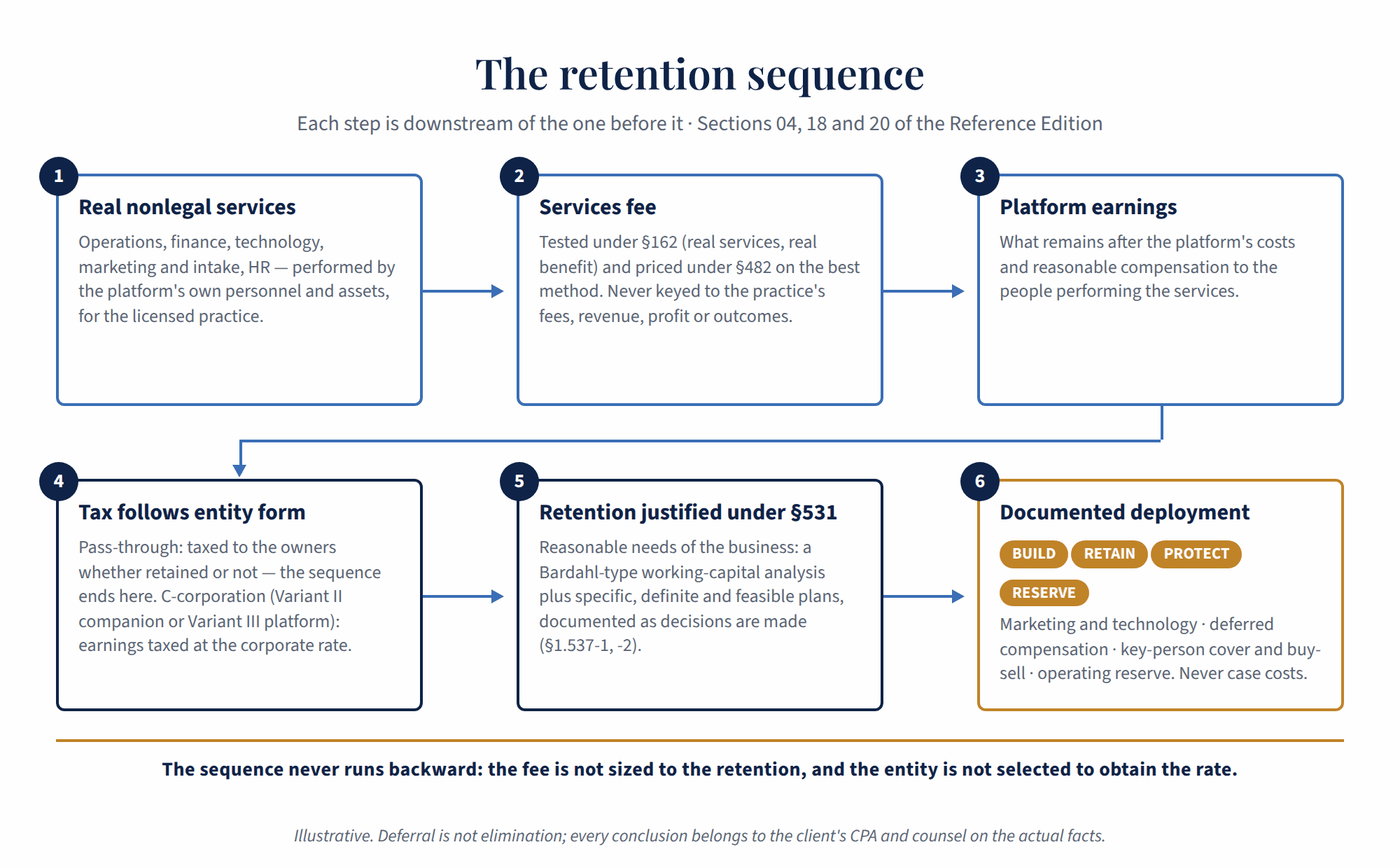
Where the platform includes a C-corporation, earnings from services actually rendered are taxed at the corporate rate, and capital retained for documented business needs can fund what the partnership form cannot easily hold: multi-year marketing, technology and AI-capability investment, an operating reserve sized to the firm’s own cash cycle, company-financed deferred compensation for people genuinely serving the platform, key-person coverage, a funded buy-sell, and an internal succession purchased over time. Three conditions govern every one of those uses. The capital is downstream of the fee — the services fee is set on a §482 method for the services rendered and is never sized to produce a retention amount. The entity shape follows the operating facts — a corporation is not selected to obtain its rate, and a pass-through platform retains nothing at the corporate rate because its earnings are taxed to the owners whether distributed or not. And accumulation requires a business answer — the accumulated-earnings analysis asks whether capital retained in the corporation is supported by the reasonable needs of the business, on a contemporaneous record of specific, definite, and feasible plans, not on a rate. Deferral is not elimination: shareholder-level tax arises on distribution, the personal-holding-company tests are revisited as ownership and income mix change, and every conclusion belongs to the client’s CPA and counsel on the actual facts.
From the Reference Edition
This article draws on The Durable Law-Firm MSO — Reference Edition, August 2026, Version 1.0.
Source: Section 20 (“Accumulated Capital and the §531 Question”) and Section 22 (“The Asset-Location Conflict”); the case illustrations in Sections 04 and 29; supporting Sections 02, 16, 18 and 29.
Why a law firm cannot easily hold capital in the first place
The Reference Edition’s diagnosis of the traditional practice form is that it creates real wealth annually and then makes that wealth hard to keep and hard to transfer. Partners are taxed on their distributive shares whether or not the cash is distributed, so every dollar retained for a multi-year commitment — technology, laterals, infrastructure, an acquisition — is a dollar the partners have paid tax on and not received, and the decision to keep retaining it is re-argued every year among owners on different timelines. Deferral of a partner’s distributive share is not among the available tools. The paper’s phrase is that retained dollars are “taxed, then re-argued.”
The same form has no institution to stand behind a long-term obligation. Firms do use bonuses, nonqualified deferral, and phantom arrangements, but a partnership that distributes substantially everything offers no corporate-level asset, liability, and funding architecture to stand behind the promise, and the most common retention tools hold people chiefly by making departure forfeit compensation already earned. Institutionalizing either — accumulated operating capital, or executive compensation with real assets behind it — takes an entity actually built to hold them.
Two limits belong here before anything else. A professional corporation can retain earnings at the corporate rate on its own, but it accumulates them inside the one entity a nonlawyer can never own, against the reduced §535(c)(2)(B) accumulated-earnings credit for a corporation whose principal function is legal services, and with every other constraint of the traditional form untouched. And the Reference Edition is explicit that retention alone was never the reason to build a platform: the founder who never intends to transact is solving succession, capital accumulation, and governance together; the growing firm is solving investment capacity, operator equity, and retention. Retained capital is one instrument inside that larger reason, and this brief reads it no more broadly than that.
Where retained capital comes from, and the sequence that governs it
Everything in this brief depends on a sequence, and the sequence runs one way. A platform performs real nonlegal services — operations, finance, technology, marketing and intake, human resources — with its own personnel and assets. The practice pays a fee for those services. Its deduction answers to §162 — whether real services were rendered, whether the payer benefited, and whether the expense was ordinary, necessary, and reasonable in amount — and the controlled-services price answers separately to §482, on the method that most reliably measures an arm’s-length result, without reference to the practice’s fees, revenues, profits, or matter outcomes. What remains after the platform’s costs and reasonable compensation to the people performing the services is the platform’s earnings. Only then does entity form determine how those earnings are taxed, and only after that does the question of retention arise: whether the capital stays in the entity for the reasonable needs of its business, and on what record.
The Reference Edition states the consequence with care. Where the platform includes a C-corporation, earnings from services actually rendered are taxed at the 21% federal corporate rate, and capital retained for documented business needs accumulates at that rate rather than at the owners’ top pass-through rate — “a consequence of entity form that Section 20’s discipline governs, and never the principle by which any fee is set.” The order matters more than the arithmetic. A fee sized backward from a desired retention amount reverses the §482 discipline the Reference Edition requires and invites the conclusion that the charge was driven by the desired result rather than the services; it can also present a professional-responsibility reviewer with evidence that the fee followed the practice’s economics rather than independently priced services, and it supplies a taxing authority the argument that the second entity exists for its tax characteristics rather than its functions. The retention is real only because the services, the fee, and the compensation were real first.
Which platform shapes can retain capital at the corporate rate
The Reference Edition describes three illustrative platform shapes and recommends none of them. Only two of them meet this brief. In Variant I, the management company is a single pass-through LLC; its earnings are taxed to the owners whether retained or not, so it “never meets” the §531 question — a design answering different problems, not a defect. In Variant II, the pass-through platform is joined by a companion C-corporation engaged under its own services agreement for defined functions — executive management, finance and treasury, and, where an actual guarantee is given and priced as one, credit support — with no cross-ownership between the two; the corporation retains capital at the corporate rate and finances deferred compensation, and its charge is a separate controlled transaction with its own benefit-test discipline. In Variant III, the management company is itself a C-corporation holding the operations, systems, and company-owned intellectual property inside it.
The two corporate shapes are not interchangeable ways of obtaining a corporation. Variant II’s companion corporation is a capital and defined-functions entity whose content is retained capital and deferred-compensation funding; Variant III’s corporation is the operating platform, which is why the §1202 analysis attaches there and only in a limited way to a companion corporation. Which shape fits a given firm is a feasibility question for the operating facts, counsel, and the CPA — the personal-injury brief applies the three shapes to a contingency practice — and what follows assumes a corporate shape was selected on those facts.
What retained capital can fund
The Reference Edition’s two case illustrations — a settlement-driven practice with a corporate platform in Section 04, and a contingency practice’s companion corporation carried through a sale in Section 29 — between them show every use this brief describes. Both are illustrative composites, not named clients or completed transactions, and the paper is exact about the order in which the uses arose: the business purposes came first, on the record, in the year they were adopted, and the rate arithmetic followed from the form rather than driving it. The four labels below are a way of reading the list, not categories the paper creates; several uses belong under more than one.
Build: marketing, technology, and multi-year investment
For a contingency practice, client acquisition can be a substantial nonlegal operating function, and it runs continuously while receipts arrive on the settlement calendar. In the Section 29 composite the companion corporation retained its own earned service fees at the corporate rate, “smoothing the contingency cycle and carrying marketing spend between settlements — corporate capital, never client funds or settlement proceeds.” That is the build use in its plainest form: a marketing and intake budget funded on the platform’s cadence rather than the docket’s. The same logic reaches the multi-year investments the traditional form re-votes every year — technology, infrastructure, an assembled operating team — because a corporation supplies an entity-level capital architecture in which a documented multi-year plan can stay funded without the same distributive decision among pass-through owners each year, while still substantiating annually why the capital remains necessary. Technology is the clearest current example. The intake systems, case-management and data infrastructure, and the AI tooling a contingency practice increasingly runs on are multi-year capital commitments, and in the corporate platform of Variant III they are the systems and company-owned intellectual property the Reference Edition places inside the corporation. The paper notes that the same structural separation is now being reached for by venture-funded legal-technology companies standing up licensed practices alongside their platforms and by AI-native firms pairing a technology company with a law firm; a platform that retains capital against a documented technology plan is funding that capability from its own balance sheet rather than re-arguing it annually among partners taxed on dollars they did not receive. The rules do not move for any of it: the lawyers’ professional obligations attach to how the tools are used, and the platform owns and operates the tools. The funding source changes nothing about the rules the function is performed under: Rules 7.1 through 7.3 and state lead-generation restrictions apply as they did before.
Retain: company-financed deferred compensation for people who serve the platform
Section 16 describes the instrument: a company-financed deferred-compensation arrangement — for tax purposes an unfunded, unsecured promise backed by the corporation’s general assets; in substance cash, vested on a schedule and subject to clawback, earned by continued bona fide service rather than by a later sale, and never measured by legal fees, matter outcomes, or the practice’s profits. In the Section 04 composite the retained capital funded vesting retirement benefits for the attorneys at highest attrition risk who also held documented management roles at the platform — “each covered person’s service relationship to the funding entity established in fact, and documented, before any benefit accrued.” That qualifier is the whole constraint: a corporation can fund compensation only for people genuinely providing services to it, a relationship that must exist in fact rather than by recital. The payout mechanics carry their own rules — §404(a)(5) timing for the corporation’s deduction and §409A for elections, payment events, and acceleration — and where a clawback or forfeiture would operate economically as a penalty on leaving to practice elsewhere, the arrangement belongs in front of counsel under Rule 5.6(a) and its retirement-benefit exception.
Protect: key-person coverage, a funded buy-sell, and succession
The Section 04 composite’s practice was dependent on one principal, with no succession or estate framework. The retained capital funded key-person coverage on that principal and a funded buy-sell prepared with counsel — each answering a stated business purpose in the year it was adopted. Corporate-owned coverage arrives with its own limits, which the Reference Edition names rather than assumes away: the denial of deductions for premiums and carrying interest on corporate-owned life insurance under §264, and the notice and consent requirements for employer-owned policies under §101(j). Succession is the longer form of the same use: the paper’s diagnosis is that founders hold something the next generation will not rationally pay much for, and a platform that retains capital deliberately can fund “an internal succession purchased over time from the platform’s own balance sheet rather than waiting on an outside buyer who may never come.” The paper’s word is protect only in the sense of continuity, liquidity, succession, and key-person risk — the exclusions below say what it is not.
Reserve: an operating reserve sized to the firm’s own cycle
The Section 04 composite kept “a documented settlement-cycle liquidity reserve in place of exposed retained earnings.” A reserve is the use most directly tied to the §531 record, because its size has an established method: a Bardahl-type working-capital analysis of the operating capital the business genuinely requires across its cash-conversion cycle — long and lumpy for a platform serving a contingency practice, and documented there rather than asserted. Two adjacent things are not the reserve. Intercompany credit — the documented, interest-bearing receivable that arises when an otherwise supportable fee falls due on the platform’s cadence and the practice’s receipts arrive on the settlement calendar — is a payment-timing asset under Treas. Reg. §1.482-2(a), serviced as debt; retained liquidity may make carrying it bearable, but a receivable is not a reserve and is not a use of capital. And the platform’s capital is never a case-cost fund: it does not advance litigation expenses or client costs and does not stand in for a litigation funder, a boundary Rule 1.8(e) and the state disclosure and funding statutes that regulate litigation funding keep exactly where it is.
The use-of-capital matrix
Each use answers to the same discipline, easier to see in one place than in prose. The rows are the uses the Reference Edition’s illustrations name; the columns are what a reviewer reopening the file will look for. Nothing in the table is available to a pass-through platform at the corporate rate.
| Proposed use | Business objective | Where it lives | Required factual connection | Contemporaneous record | Boundary |
|---|---|---|---|---|---|
| Marketing and intake investment BUILD | Client-acquisition capacity carried across the settlement cycle | Variant III, where the corporate platform actually performs and bears the marketing function; in Section 29’s Variant II illustration the companion corporation carried marketing spend between settlements under its own defined services arrangement | The entity retaining and deploying the capital has a factual business connection to the expenditure under its actual functions and services arrangement; the Section 29 illustration does not make the companion corporation the marketing operator in every Variant II structure | Approved budget, campaign plan with amount, timing and expected use; board approval; evidence of execution | The fee is never sized to the desired spend; Rules 7.1–7.3 and state lead-generation rules apply unchanged |
| Technology, data and AI capability; multi-year infrastructure BUILD | Owned systems and company-owned IP the practice uses under the services agreement; investment the partnership form re-votes annually | Variant III principally, where systems and company-owned IP sit inside the corporation; Variant II only to the extent the investment belongs to functions genuinely performed or funded by the companion corporation under its own supportable services arrangement | A specific planned deployment the platform will own and operate | Capital plan with project scope, budget and timeline, updated as circumstances change | Not a vague intention to accumulate; plans must be specific, definite and feasible under §1.537-1 |
| Operating and settlement-cycle reserve RESERVE | Operating resilience across a lumpy receipt cycle | Variant III where the operating corporation bears the liquidity need; Variant II only where the companion corporation’s own functions and obligations support the accumulation on its facts | The platform’s own cash-conversion cycle and continuous nonlegal costs | Bardahl-type working-capital analysis, refreshed annually | Never case costs or client advances (Rule 1.8(e)); distinct from intercompany credit, which is a receivable, not a reserve |
| Company-financed deferred compensation RETAIN | Retention of attrition-risk attorneys and operators who serve the platform | Variant II companion corporation (its stated content) or Variant III platform | Each covered person’s bona fide service relationship to the funding entity, established in fact and documented before any benefit accrues | Plan document; documented platform role; vesting and clawback schedule; §409A-compliant elections and payment events; approvals | Unfunded, unsecured promise; reasonable compensation for services actually rendered; never measured by legal fees or outcomes; Rule 5.6(a) review where forfeiture penalizes departure |
| Key-person coverage PROTECT | Enterprise continuity where earnings depend on one principal | Variant III in the Section 04 illustration; another corporate variant only where the insured risk is genuinely an economic risk of that corporation | An identified economic exposure of the platform itself | Coverage analysis; corporate purpose stated in the resolution; employer-owned-policy notice and consent | Premium and carrying-interest deductions denied under §264; §101(j) employer-owned-policy requirements tested separately; a corporate purpose does not make the asset an active-business asset for §1202(e) |
| Funded buy-sell PROTECT | Continuity of platform ownership on a death, disability, or departure | Variant III in the Section 04 illustration; another corporate variant on its own facts | An actual buy-sell obligation among the platform’s owners | Buy-sell agreement prepared with counsel; funding plan; valuation support | Reaches platform interests; the platform transaction does not itself transfer the licensed practice, and any sale of a law practice remains governed by the applicable professional rules, including Rule 1.17 where adopted |
| Internal succession / ownership transition PROTECT | A transition purchased over time from the platform’s own balance sheet | A corporate platform that has retained capital deliberately for that purpose | A documented succession plan of the platform’s owners on a stated timeline | Succession plan; approvals; funding schedule; valuation support; annual update | Platform interests only; Rule 5.6(a) review where any term would restrict a lawyer’s right to practice |
What retained capital cannot do
The list of exclusions is shorter than the list of uses and more important to a reviewer. Retained platform capital does not fund case costs, litigation expenses, or client advances, and does not stand in for a litigation funder; the platform’s capital is built from its own earned service revenue and is deployed for the supported business needs of the platform — it is not case-cost, client-advance, or litigation-funding capital. It does not fund compensation for people who do not genuinely provide services to the corporation, however the agreement recites the relationship. It does not size the fee: a services charge worked backward from a target retention amount is the fee “sized to the tax result” the Reference Edition rules out in every section that mentions one. It does not accumulate without a purpose, because §533 treats accumulation beyond the reasonable needs of the business as determinative of the avoidance purpose §532 requires unless the corporation proves otherwise by the preponderance of the evidence. It is not a shield: nothing in the structure describes retained capital as protection against creditors, malpractice claims, or the practice’s own liabilities, and a platform is not the place to look for that. And it does not acquire or share in the practice’s legal fees, clients, or matters; any intercompany credit arising from payment timing remains a separately documented controlled transaction rather than a participation in legal recoveries, and Rule 5.4 sits exactly where it sat before the corporation earned a dollar.
One further exclusion is a matter of sequence rather than prohibition. A corporation that has retained capital will be tempted to hold it in a diversified portfolio built for appreciation, because unrealized appreciation does not itself produce current personal-holding-company income. Section 22 of the Reference Edition calls that instinct correct as to §541 and then explains why it can materially impair or destroy a §1202 position in Variant III, where §1202(e)(1)’s active-business requirement, the §1202(e)(5)(B) ceiling on non-subsidiary securities, and the §1202(e)(6) cap on working-capital treatment after two years are each written to exclude exactly that asset. The two exposures are not equally reversible — personal-holding-company tax is answerable in the year it arises; §1202 qualification is tested across substantially the entire holding period — so the one that is not curable is decided first, at formation rather than at the letter of intent, by counsel and the CPA on the facts of the year the structure funds.
What the record must show
Section 531 imposes a flat 20% accumulated earnings tax on the accumulated taxable income of a corporation formed or availed of to avoid shareholder-level tax through accumulation — a penalty layered on top of the corporate rate, aimed at earnings retained beyond the reasonable needs of the business. The Reference Edition’s position is that the answer is not to avoid retaining capital but to justify the accumulation under the reasonable-needs standard, and that the justification has two established components. The first is a working-capital analysis of the Bardahl type, sizing the operating capital the business genuinely requires across its cash-conversion cycle. The second is specific, definite, and feasible plans for the retained capital — not a vague intention to accumulate but identifiable business purposes, supported by contemporaneous substantiation created as decisions are made and updated as circumstances change, under Treas. Reg. §1.537-1 and §1.537-2. Several rows of the matrix above can supply the subject of such a plan — when the amount, timing, purpose, and expected use are actually established and substantiated; a category of spending is not itself a plan.
The paper classifies the authorities by weight — the §1.537 regulations are binding; Bardahl is a memorandum decision that binds only its own taxpayers; Technalysis is a regular Tax Court opinion — and it publishes the category of substantiation a reviewer expects, never a representation that the right minutes preserve the accumulation or that the position is beyond challenge. One figure is deliberately left to the client’s CPA: the accumulated-earnings credit under §535(c)(2) is $250,000 generally but $150,000 for a corporation whose principal function is the performance of services in health, law, engineering, architecture, accounting, actuarial science, performing arts, or consulting, and whether a management-only platform serving a law practice sits inside that enumeration is a fact-specific determination that belongs to the CPA of record and stays there.
Procedure gives the record a second job. Under §534 the burden of proof on the reasonable-needs issue can shift to the Service where the taxpayer, after the statutory notification, timely submits a statement of the grounds on which it relies and facts sufficient to show the basis for them. That makes contemporaneous budgets, capital plans, board approvals, and evidence of execution more than good governance: they are the material from which that statement will one day have to be constructed, and a statement assembled from a contemporaneous record reads differently from one drafted for the occasion. The paper’s summary is the one to carry away — “Section 531 is not a scare number; it is a standing question with a documented answer” — and its economy: the corporate minutes and resolutions that substantiate the business purpose for retained capital are part of the same record that answers §482. One record, several readers. How that record is built and refreshed each year is the subject of the annual substantiation brief; this brief takes only the §531-specific entries.
What can go wrong
The failure modes are as specific as the uses. The first is accumulation without purpose, which §533 presumes to be avoidance and which the 20% tax then reaches on top of the corporate rate. The second is the personal-holding-company regime. The Reference Edition observes that the ownership condition of §542(a)(2) — more than half the stock’s value held by five or fewer individuals during the last half of the year, counted with §544 attribution — will ordinarily be satisfied by a closely held platform, on its actual ownership facts, so the analysis usually turns on the income test of §542(a)(1): whether at least 60% of adjusted ordinary gross income is personal holding company income. A services fee is not automatically outside it. Section 543(a)(7) treats amounts under a personal service contract as personal holding company income where someone other than the corporation holds the right to designate the individual who performs the services, or the contract names or describes that individual, and that individual owns 25% or more of the stock. A platform owned by the professionals it serves, under an agreement letting the practice name the people who will do the work, is that fact pattern. The paper’s design response is to draft so that the platform rather than the practice designates personnel and no individual is named or described — with the caution its Section 29 adds, that the drafting only holds where the facts can: a designation right means something only where the corporation has genuine performable capacity, and the contract and the parties’ actual conduct have to agree on who selects the people. Whether it succeeds on any set of facts is a determination for the CPA of record. Where the income test is met, §541 imposes a tax on undistributed personal holding company income in addition to the regular corporate tax.
The third failure is the one the Section 29 composite exists to show. When a third-party investor purchased into the platform, the companion corporation’s services agreement did not survive the closing — its fee was leakage from the earnings being priced — so the fee income stopped while the capital stayed, and the personal-holding-company analysis “became a live annual question the moment the fee income stopped.” The transaction did not create the problem; it removed the income that was keeping the ratio down. What the corporation does next depends on its post-closing functions, income mix, and its owners’ decisions — Section 29 and the outside-capital brief own that analysis, and none of it is automatic. The fourth is compensation design: a deferred-compensation promise to someone with no genuine service relationship to the corporation, administered outside §409A, or measured by legal fees. And the fifth is the oldest: a fee that tracks ownership rather than services, eliminates the practice’s taxable income, and rests on no contemporaneous documentation — the record Aspro, Inc. v. Commissioner criticized, analogy rather than authority, and the reason this brief began with the fee rather than the rate.
Deferral is not elimination
The Reference Edition states the arithmetic once, as illustration, and this brief does not enlarge it. In the Section 04 composite, roughly twenty points of spread between top personal rates — the top bracket plus the uncapped Medicare layer on active pass-through earnings — and the 21% corporate rate produced a meaningful federal deferral in the illustrated year on earnings retained after reasonable compensation to those performing the services. Then the sentence continues: “and deferral is not elimination.” Distributions bear shareholder-level tax; state taxes widen or narrow the spread; the result shown is neither typical nor promised.
Corporate-rate retention is timing, not elimination. Later distributions, a sale of the stock or the assets, a liquidation, a change of entity status, and the owners’ estate events each produce their own combinations of corporate and shareholder consequences from the same facts, and each is modeled with the CPA and counsel on real numbers rather than assumed from the labels; Sections 22 and 29 of the Reference Edition set those paths out. What retained capital buys is time and an institution to hold long-term obligations. It does not buy the absence of a second layer of tax.
Advisor implications
For the client’s independent tax advisers, this brief describes tax positions and annual determinations that remain theirs: the reasonable-needs analysis and the §535(c)(2) credit, the personal-holding-company income test including §543(a)(7), the §404(a)(5) timing of any deferred-compensation deduction, and the earnings-and-profits and basis consequences of any distribution. For counsel, the retention design raises the partner-level conflict analysis that applies to any platform economics a partner holds, the Rule 5.6(a) analysis where forfeiture would operate as a penalty on departure, and the services-agreement drafting that keeps designation of personnel with the platform. For the independent economist, the companion charge in Variant II is its own controlled transaction: stewardship activity, duplicative services, the owners’ investment management, and financing or guarantee functions are not made compensable by appearing in a second agreement. For the wealth and estate advisers, retained corporate capital raises separate asset-location and generational-planning questions that are addressed on the client’s facts rather than inferred from the structure. Guardian Tax Consultants® facilitates the maintenance of the record as part of the annual servicing program; the client’s CPA owns the return position and any personal-service-corporation determination within it, and counsel owns every legal conclusion.
When retention is not the reason to build
A desired corporate rate, standing alone, does not supply the operating reason for a platform, and the Reference Edition says so in several places: retention alone was never the reason to build one, and a professional corporation can retain earnings at the corporate rate on its own. A firm with no operating functions worth separating, no operator it wants to give equity to, and no succession or retention problem it is trying to solve has not, from those facts, identified the business purposes that would justify the structure or any particular accumulation — and a §531 file with nothing in it is not improved by a lower rate. A Variant I pass-through platform — the simplest shape, chosen by firms whose reasons for separation are operational — retains nothing at the corporate rate, and that is a different design rather than a failure. The decline conditions apply here unchanged, and the first of them is the absence of real services to price.
Related Insights
- The Durable Law-Firm MSO — Reference Edition
- MSO Cash Uses and §531: SG&A, Growth Capital, and Exit-Readiness Documentation
- The Annual Substantiation Cycle for a Law-Firm MSO
- Law-Firm MSOs for Personal Injury Firms: What Changes?
- How Outside Capital Enters a Law-Firm MSO
- Law Firm MSO Management Fees: Beyond the Fee Formula
- Law Firm MSO Setup: How the Structure Is Built and Reviewed
- When the Answer Is No: When a Law Firm Should Not Form an MSO
- For Law Firms
Frequently Asked Questions
What is retained capital in a law-firm MSO?
It is the platform’s own earnings — fee revenue from nonlegal services actually rendered, after the platform’s costs and reasonable compensation to the people performing them — kept inside the entity rather than distributed. Where the platform includes a C-corporation, those earnings are taxed at the corporate rate and can be retained for the reasonable needs of the platform’s business, subject to the §531 accumulated-earnings discipline. Once earned by the platform under a supportable services arrangement it is platform capital; it is not client or trust funds, settlement proceeds, or a share of legal fees.
Can a pass-through MSO retain capital?
It can keep cash, but not at the corporate rate: a pass-through platform’s earnings are taxed to its owners whether or not the cash is distributed, so the §531 question never arises, and the corporate retained-capital architecture this brief describes is not available to it. The Reference Edition treats that as a different design answering different problems, not a defect.
Is retaining capital inside the MSO a form of tax avoidance?
The question under §§531–533 is whether the corporation was formed or availed of to avoid shareholder-level tax through accumulation, and whether its accumulations exceed the reasonable needs of its business; §533 presumes the avoidance purpose from such accumulation unless the corporation proves otherwise by the preponderance of the evidence. No sequence of steps answers that by itself. What the Reference Edition’s discipline does is put the answer on a contemporaneous record — real services, a fee set on a §482 method without reference to the practice’s economics, reasonable compensation first, and retention tied to documented business needs — rather than avoid retaining capital.
Can retained capital fund case costs or client advances?
No. The platform’s capital is retained and deployed for the supported business needs of the platform; it is not case-cost, client-advance, or litigation-funding capital. It does not advance litigation expenses or client costs and does not stand in for a litigation funder. A lawyer’s advancing of litigation expenses remains governed by Rule 1.8(e), and third-party litigation funding by the state statutes that regulate it.
Can the MSO fund deferred compensation for the firm’s partners?
Only for people who genuinely provide services to the corporation, under arrangements that stand on their own legal footing. In the Reference Edition’s illustration the covered attorneys held documented management roles at the platform, with the service relationship established in fact before any benefit accrued. The illustrated arrangement is an unfunded, unsecured promise whose election, payment, and administration terms must satisfy §409A, deductible to the corporation only when included in income under §404(a)(5), never measured by legal fees or outcomes, and reviewed under Rule 5.6(a) where forfeiture would penalize leaving to practice elsewhere.
How much can the platform accumulate?
As much as its reasonable business needs support on the record, and no figure beyond that is safe to state. The accumulated-earnings credit under §535(c)(2) is $250,000 generally and $150,000 for corporations whose principal function is in enumerated service fields; whether a management-only platform serving a law practice falls within that enumeration is a fact-specific determination for the client’s CPA. The statutory credit and the reasonable-needs analysis interact in determining accumulated taxable income; the reasonable-needs case is supported by a Bardahl-type working-capital computation and by specific, definite, and feasible plans on the corporation’s actual facts.
What happens to retained capital if the firm later brings in an investor?
In the Reference Edition’s illustrated Variant II pattern the companion corporation sits outside the purchase perimeter and remains owner-held, but its services agreement with the platform is commonly terminated or re-scoped at closing. The fee income stops while the capital stays, and the personal-holding-company analysis becomes a live annual question. What happens after that depends on the corporation’s post-closing functions, income mix, and its owners’ decisions; Section 29 and the outside-capital brief own that analysis.
Selected public authorities
- IRC §§531–537 (accumulated earnings tax; avoidance purpose; presumption from unreasonable accumulation; burden-shifting procedure; accumulated-earnings credit; reasonable needs of the business); Treas. Reg. §1.537-1, §1.537-2.
- Bardahl Mfg. Corp. v. Commissioner, T.C. Memo 1965-200; Technalysis Corp. v. Commissioner, 101 T.C. 397 (1993).
- IRC §§541–543 (personal holding company tax; income and ownership tests; §543(a)(7) personal service contracts); IRC §544 (attribution).
- IRC §404(a)(5); IRC §409A; IRC §101(j) (employer-owned life insurance notice and consent); IRC §264 (premium and interest deductions).
- IRC §1202(e)(1), (e)(5)(B), (e)(6) (active-business, non-subsidiary securities, and working-capital limits).
- IRC §162; Treas. Reg. §1.162-7(b)(3); IRC §482; Treas. Reg. §1.482-1(c), §1.482-9, §1.482-2(a); Aspro, Inc. v. Commissioner, 32 F.4th 673 (8th Cir. 2022).
- ABA Model Rules of Professional Conduct 1.8(e), 1.17, 5.4, 5.6(a), 7.1–7.3; state analogues as adopted.
- The Durable Law-Firm MSO — Reference Edition, Guardian Tax Consultants®, August 2026, Sections 02, 04, 16, 18, 20, 22 and 29.
Disclaimer
Informational only. Applicability depends on the specific facts, structure, and advisory environment of each engagement. Guardian Tax Consultants® provides MSO strategy, modeling, documentation coordination, governance support, fee-methodology coordination, and advisor-integrated implementation support. GTC™ does not provide legal opinions, prepare tax returns, or replace the client’s independent CPA, legal counsel, investment advisor, insurance advisor, or family office. Tax and legal advice, tax-return positions, legal conclusions, filings, and opinions are provided by the client’s independent legal and tax advisors. Guardian Tax Consultants® is not a law firm, does not practice law, and expresses no view on whether any arrangement satisfies any jurisdiction’s rule. Case illustrations are anonymized composites, not named clients or completed transactions. No outcome promises. No pre-packaged structures.