
Technical Brief · Est. read time 17 minutes · Draws on The Durable Law-Firm MSO — Reference Edition, Sections 04, 08, 11, 12, 13, 20–23 and 29 · Published September 5, 2026 · Last reviewed September 7, 2026
A law-firm management services organization is a separately owned nonlegal company that employs the firm’s business functions and charges the practice an arm’s-length fee for them; what it is is answered elsewhere in this library. This brief answers a narrower question that contingency-fee firms keep asking: when the practice is a personal-injury or other contingency practice, what actually changes?
Canonical Answer
What changes when the law firm is a personal-injury or contingency-fee practice?
The structure does not change. Seven things around it do. Revenue arrives in lumps while nonlegal operating costs run continuously, so the fee’s cadence and any resulting intercompany credit have to be designed and documented rather than assumed. Marketing and intake are often among the largest nonlegal functions, and they remain subject to Rules 7.1 through 7.3 and, in Colorado, the state’s restrictions on covered lead-generation legal marketing. The platform’s capital is not a case-cost fund — MSO capitalization does not itself change the rules governing a lawyer’s financial assistance to clients or litigation expenses; Rule 1.8(e), its state variations, and any applicable litigation-finance law require separate analysis. A partner with platform economics has a Rule 1.7(a)(2) question adjacent to settlement authority. A percentage-of-recovery fee is most tempting here and most exposed, and Illinois’s statute contains a separate coverage test expressly addressing firms with substantial contingent-fee revenue. Entity shape matters to how platform earnings are taxed and retained: where the platform includes a C-corporation, earnings from services actually rendered are taxed at the corporate rate, and capital may be retained for documented business needs subject to the accumulated-earnings discipline — a properly substantiated marketing and intake investment plan can be one such purpose. A pass-through platform with a companion corporation also preserves transaction optionality: no transaction thesis is required at formation, and the Reference Edition’s later-capital pattern places the transaction on the pass-through side and leaves the companion corporation owner-held. And in the architecture addressed here, outside capital reaches the services platform, not the firm’s docket or client matters.
From the Reference Edition
This article draws on The Durable Law-Firm MSO — Reference Edition, August 2026, Version 1.0.
Source: Section 04 (“The contingency practice runs hot and cold”), its three platform variants and its case illustration; the Section 29 contingency-practice composite; supporting Sections 08, 11, 12, 13, 15, 18 and 20–23.
Why the question arises differently here
The Reference Edition’s diagnosis of the traditional practice form — personal debt, income that stops when a partner leaves, operators who cannot own, retained dollars taxed and re-argued — applies to every firm. Its own words on contingency practices are that every one of those problems “arrives amplified.” Settlements land in lumps while case costs, staffing, and client acquisition run continuously, and in the strong years the income lands at the owners’ top pass-through rate just as the next docket has to be funded. The gap is often bridged with litigation finance at a cost no ordinary operating business would accept for working capital.
The market has noticed the same thing. In January 2026 Uplift Investors publicly announced the formation of Orion Legal MSO to support plaintiff firms, with Dudley DeBosier Injury Lawyers as its founding partner firm and a public statement that the firm would remain 100% owned and controlled by its founding partners. That is evidence that contingency firms are an active early use case. It is not evidence that they are inherently the best candidates — the Reference Edition is written for firms that never intend to transact, and its decline conditions apply to a plaintiffs’ practice exactly as they apply to a transactional boutique. What follows is the list of things a contingency firm and its counsel have to design deliberately that a billable-hour firm can often take for granted.
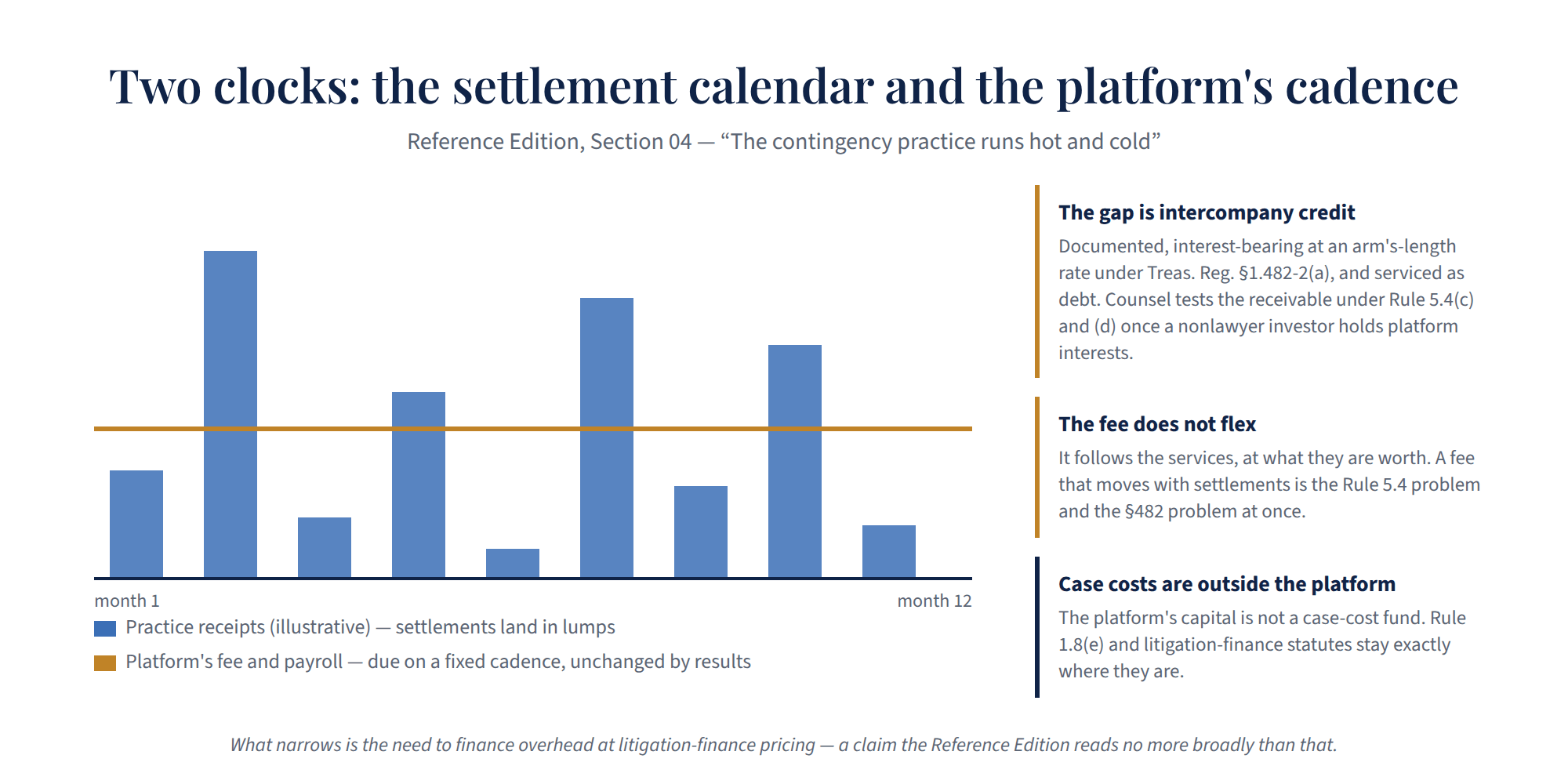
1. The revenue cadence and the fee cadence are different clocks
The Reference Edition’s claim is that a genuinely capitalized platform steadies that cycle in one specific way: the nonlegal operating functions are funded from the platform’s balance sheet on the platform’s cadence rather than the settlement calendar. It reads that claim no more broadly than this — what narrows is the need to finance overhead at litigation-finance pricing — and it is careful about the fee: the fee is unchanged by any of this. It follows the services, at what they are worth, and the smoothing is a consequence of a real platform rather than a purpose that sizes anything.
The design consequence is intercompany credit. Where an otherwise supportable fee falls due monthly but payment follows the practice’s settlement-driven receipt cycle, the resulting unpaid amount is an intercompany receivable — documented, interest-bearing at an arm’s-length rate under Treas. Reg. §1.482-2(a), and serviced as debt. That receivable is not a footnote. Once a nonlawyer investor holds platform interests, a platform receivable from the practice is an economic link counsel tests under Rule 5.4(c) and (d) like any other, because the size and terms of an obligation owed by the practice to a nonlawyer-owned entity raise independence and control questions of their own. The illustrated answer in the Reference Edition’s settlement-driven composite is a documented settlement-cycle liquidity reserve inside the platform, built from the platform’s own earned service revenue, in place of exposed retained earnings.
2. Marketing and intake: often the platform’s largest functions — and its most regulated
In many personal-injury firms, client acquisition and intake are substantial nonlegal functions: advertising, digital marketing, call centers, lead handling, and the data systems behind them. Those are functions a platform may employ and operate, while the governing professional obligations remain with the lawyers — and they are the functions the professional rules watch most closely. Advertising, intake, lead handling, and referral arrangements remain governed by Rules 7.1 through 7.3 and their state analogues — communications must not be false or misleading, solicitation is restricted, and paying for a recommendation is generally prohibited outside the rules’ narrow exceptions — regardless of which entity runs the campaigns, owns the domains, or employs the intake staff. A platform that centralizes marketing centralizes the compliance obligation’s operational side while leaving the professional obligation with the lawyers. The scripts, the compensation arrangements for intake personnel, and the data flows are properly reviewed by counsel against those rules before the function moves.
Two adjacent arrangements deserve a line each. The division of fees between lawyers not in the same firm — the referring-counsel and co-counsel splits common in contingency practice — is governed by Rule 1.5(e) and runs lawyer to lawyer; the platform is not a party to it, does not administer it, and its fee is unaffected by it. And Colorado’s SB26-174, effective August 12, 2026, treats covered lead-generation legal marketing — a lawyer, firm, or licensed paraprofessional paying a third party for information about a potential client — as a deceptive trade practice under the Colorado Consumer Protection Act, subject to the Act’s own criteria and exceptions. For a platform whose functions include marketing and intake, the Reference Edition calls that an operating constraint, not a footnote.
3. The platform’s capital is not a case-cost fund
This is the boundary a contingency firm most needs to hear stated plainly, because it is the one most easily blurred in a pitch. The platform’s capital is built from its own earned service revenue, funds its own operations, and stops there. It is not a case-cost fund. It does not advance litigation expenses or client costs, and it does not stand in for a litigation funder. A lawyer’s advancing of litigation expenses remains governed by Rule 1.8(e), and third-party litigation funding by the state disclosure and funding statutes that regulate it — a body of law this structure neither engages nor alters. Case costs and client advances are a different category of spending, one the platform’s capital does not touch. Working-capital credit between the entities is intercompany credit for the platform’s services; it is never case-cost or client-advance funding.
4. Settlement authority and the partner’s own stake
The governance carve-outs that keep an investor away from professional judgment do not reach one conflict the structure itself creates, and it is sharpest in a contingency practice. A partner holding rollover equity in the platform, or a deferred-compensation promise backed by its balance sheet, has a personal financial interest in the platform’s health — and the platform’s health tracks the practice’s cash-flow profile. Under Model Rule 1.7(a)(2), a concurrent conflict exists where there is a significant risk that the representation of a client will be materially limited by a personal interest of the lawyer. A partner whose platform economics benefit from the firm’s cash-flow profile has a personal interest adjacent to decisions about when and on what terms client matters resolve. Whether a given arrangement creates that risk, and whether informed client consent is required and available, is a determination for counsel jurisdiction by jurisdiction. What belongs in the design is that the question is asked at formation, documented like every other independence fact, and revisited when the platform economics a partner holds change shape.
5. The fee where results are volatile
A contingency firm is where a fee keyed to recoveries is most tempting — it feels like it matches risk to reward — and where it is most exposed. The professional-responsibility architecture depends on the services fee being measured by the nonlegal services rendered rather than by the practice’s fees, revenue, profit, or matter outcomes, and the tax architecture depends on the same thing. A fee that moves with settlements is the Rule 5.4 problem and the §482 problem at once, and no amount of documentation resolves either. For arrangements within its scope, Illinois Public Act 104-0801 bars a covered nonlawyer-owned entity from charging fees directly or indirectly on the basis of an attorney’s or firm’s fees, revenues, or profits, and the word “indirectly” is undefined and untested; Colorado HB26-1421 separately prohibits compensating administrative staff through arrangements contingent on a percentage of legal fees or revenues or on case outcomes — a compensation design that would be conventional in any other industry can now be actionable in Colorado, which makes intake and marketing compensation a specific Colorado review item.
The Reference Edition’s illustrations answer the volatility problem the other way round: a fee set on a method and benchmarked under §482 on contemporaneous functional analysis in every year, high-settlement and lean alike, with the platform’s own operating liquidity addressed through its reserve and any payment-timing difference documented as intercompany credit rather than absorbed by a fee that flexes. In the seven-partner plaintiffs’ illustration the fee was fixed monthly and reviewed annually on independent economic analysis — never a percentage of legal revenue. How the method is chosen and defended is the subject of the management-fee brief; what a contingency firm should take from this one is that the fee is not the instrument that manages volatility.
6. Illinois has a separate contingent-fee coverage prong
The common reading of Illinois Public Act 104-0801 as a large-firm statute is backwards, and for a plaintiffs’ practice the point is not academic. Coverage under the enacted text is disjunctive: one prong reaches a licensed attorney or law firm operating in Illinois with annual global legal-services revenue under $300 million; a separate prong reaches a licensed attorney or law firm that regularly represents clients on a contingent-fee basis and derived more than half its revenue from those arrangements in each of the previous three calendar years. A contingency practice that satisfies the second prong’s regular-representation and greater-than-50%-of-revenue tests therefore falls within the Act regardless of the $300 million threshold. The Act also requires disclosure of the covered arrangement in covered client contracts, which moves the compliance surface into the firm’s contingency engagement agreements. Illinois counsel owns the construction; the Illinois brief sets out the six workstreams. The broader design lesson from the Reference Edition applies with more force to a multi-state plaintiffs’ practice than to almost anyone else: under Model Rule 8.5 a firm cannot pick its most permissive jurisdiction and structure to it, so the durable posture is to design to the most restrictive regime the firm is meaningfully exposed to.
7. Which shape the platform takes — and why it matters more here
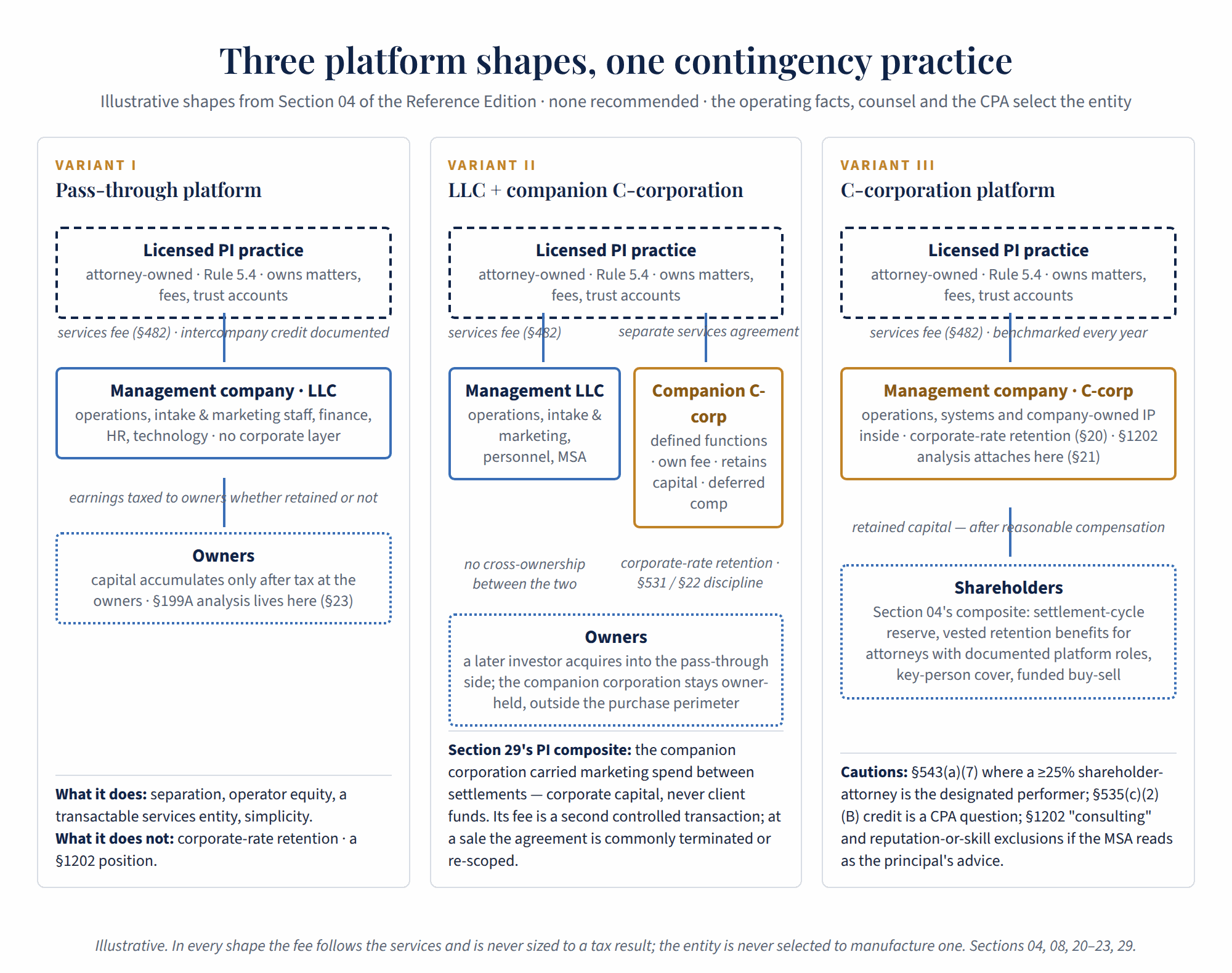
The Reference Edition describes three illustrative platform shapes and recommends none of them: a single pass-through management LLC (Variant I); a pass-through platform joined by a companion C-corporation engaged under its own services agreement for defined functions (Variant II); and a management company that is itself a C-corporation (Variant III). The operating facts, with counsel and the CPA, select the entity, and the entity is never selected to manufacture a result. For a contingency practice the choice carries more weight than usual, for two reasons.
The first is retention. A pass-through platform’s earnings are taxed to the owners whether retained or not. Where the platform includes a C-corporation — the companion corporation of Variant II or the corporate platform of Variant III — earnings from services actually rendered are taxed at the 21% corporate rate, and capital retained for documented business needs accumulates at that rate rather than at the owners’ top pass-through rate. The Reference Edition is exact about what that is: a consequence of entity form, never the principle by which any fee is set. The services fee is income to the platform, while the practice’s claimed deduction remains subject to §162 and the controlled-services charge remains subject to §482. The fee follows the services, at what they are worth, without reference to the practice’s fees, revenues, profits, matter outcomes, desired retention amount, or resulting tax rate; only after the platform earns the fee does entity form determine the tax treatment of what the platform retains.
The arithmetic is worth stating plainly, as illustration rather than promise. For a simplified federal-rate illustration, on $1,000,000 of platform earnings retained after reasonable compensation to those performing the services, comparing a 37% top individual rate with the 21% corporate rate produces a sixteen-percentage-point, or $160,000, first-level federal tax difference in that year — before state taxes, before the Medicare layer the Reference Edition counts toward a spread of roughly twenty points, and before the factual adjustments any real engagement carries. That difference illustrates timing, not permanent savings: deferral is not elimination, and shareholder-level tax arises when corporate earnings are distributed. What the retained capital can do in the meantime is fund the platform’s own nonlegal operating functions — and in a contingency practice, client acquisition is often the largest of those. For a purely illustrative sensitivity, assume the firm’s own historical data support a 10:1 relationship between incremental marketing spend and attributable fee revenue; if $160,000 of additional retained capital were actually committed to a documented marketing plan, the firm’s own multiple would produce $1.6 million of attributable revenue in that hypothetical. Neither the multiple nor the revenue is supplied or predicted by the Reference Edition; both depend on the firm’s data, execution, case mix, conversion, and collections. The tax point is only that entity form affects the timing of federal tax on earnings genuinely retained for supported business needs; it says nothing about the return those dollars will earn. The point that does travel is the governance one: a documented marketing and intake investment plan can support a specific, definite, and feasible plan for retained capital under §537 when the amount, timing, purpose, and expected use are established on the facts, and the budget, the board approval, and the evidence of execution are part of the contemporaneous record supporting it. The platform keeps its own books and budget cycle, and its tax-year treatment is determined by the CPA under the rules applicable to the entity; decisions to commit platform capital are documented through the platform’s own governance rather than sized to the practice’s settlement calendar.
The second reason is optionality. In the Variant II transaction pattern the Reference Edition illustrates, the pass-through side is what the investor acquires into, while the companion corporation remains wholly owner-held and outside the purchase perimeter, retaining capital and financing deferred compensation under its own services agreement. Built that way from the beginning, the Variant II structure can serve an owner with no transaction thesis while preserving the architecture for a later capital event: the pass-through side transacts and the companion corporation stays outside the purchase — though its services agreement with the platform is commonly terminated or re-scoped at closing, a consequence the deal model should carry rather than discover. The Reference Edition’s settlement-driven composite in Section 04 used the corporate shape of Variant III, with the retained capital funding vested retirement benefits for attorneys at attrition risk who held documented management roles at the platform, key-person coverage, a settlement-cycle liquidity reserve, and a funded buy-sell — every element answering a stated business purpose, in the year it was adopted. Which shape fits a given firm is the feasibility question; the outside-capital brief walks through what a transaction reaches in each.
The three shapes, applied to a contingency practice
The Reference Edition’s rule is that operating facts select the entity and the entity is never selected to manufacture a result. What follows is not a menu. It is the same contingency practice — lumpy receipts, continuous nonlegal costs, a large intake and marketing function, one or two rainmakers, a possible later capital event — placed inside each of the three illustrative shapes, with what each shape does and does not do stated plainly.
Variant I — the pass-through platform
The management company is a single pass-through LLC: the simplest shape, and the one whose case does not depend on corporate-rate retention or a §1202 stock position. It separates the nonlegal functions into an entity that can employ the operators, give them genuine equity in the services company, hold the systems and the intake infrastructure, and build a separately reviewable operating history. For a contingency practice it still changes the cadence question: where an otherwise supportable fee falls due on the platform’s schedule before settlement-driven receipts arrive, the payment-timing difference is documented and serviced as intercompany credit, and the marketing and intake function is performed under Rules 7.1 through 7.3 exactly as in the other two shapes. What it does not do is retain capital at the corporate rate: its earnings are taxed to the owners whether retained or not, so the Reference Edition says it “never meets” the §531 question — “not a defect but a different design answering different problems.” There is no stock to position under §1202. And the §199A question lives here: under Treas. Reg. §1.199A-5(c)(2), a services company with 50% or more common ownership that supplies services to a specified service trade or business — a law practice — is treated as an SSTB with respect to the services supplied to the commonly owned SSTB, under the regulation’s allocation approach, and the analysis is owner by owner, so a partner already phased out of the deduction finds that the fee “costs nothing in §199A terms.” The facts that put Variant I in view are operational: a firm that wants separation, operator equity, and simplicity, and does not need the corporate retained-capital or funded-obligation architecture that distinguishes Variants II and III.
Variant II — the pass-through platform with a companion C-corporation
The pass-through management company runs operations; a companion C-corporation is engaged under its own services agreement for defined functions — executive management, finance and treasury, and, where an actual guarantee is given and priced as one, credit support — with no cross-ownership between the two. The corporation retains capital at the corporate rate and finances deferred compensation, and its charge is a separate controlled transaction with its own benefit-test discipline: shareholder and stewardship activity, services duplicative of what the management company already performs, investment management conducted for the owners, and financing or guarantee functions are not made compensable by appearing in a second agreement. This is the shape of the Reference Edition’s second personal-injury composite, in Section 29, where the companion corporation retained its own earned service fees “smoothing the contingency cycle and carrying marketing spend between settlements — corporate capital, never client funds or settlement proceeds.” It is also the illustrated transaction pattern: a later investor acquires into the pass-through side, and the companion corporation stays owner-held outside the purchase perimeter — with the consequence that its services agreement is commonly terminated or re-scoped at closing, so the pre-closing fee stream may stop or materially change while the accumulated capital remains owner-held, and the resulting income mix can make the personal-holding-company analysis of Section 22 a live annual question. The §1202 analysis attaches to it only in a limited way, because its content is retained capital and deferred-compensation funding rather than an operating business. The facts that put Variant II in view are operating facts that support separating the pass-through management platform from defined corporate functions, retained-capital capacity, or deferred-compensation funding — whether or not a transaction is ever contemplated — at the price of a second controlled transaction that has to be substantiated every year.
Variant III — the C-corporation platform
The management company is itself a C-corporation, holding the operations, systems, and company-owned intellectual property inside it. This is the shape of the Reference Edition’s settlement-driven composite in Section 04: the fee set on a method and benchmarked under §482 in every year, high-settlement and lean alike, and the retained capital — built from the platform’s own earned service revenue — funding vested retirement benefits for the attorneys at highest attrition risk who also held documented management roles at the platform, key-person coverage on the principal, a documented settlement-cycle liquidity reserve, working-capital credit between the entities, and a funded buy-sell. Corporate-rate retention, the §531 discipline, the personal-holding-company tests, and the full §1202 analysis all sit in the same entity, so the corporation’s actual substance — its own personnel, systems, and assets performing the services — carries particular weight here. Three cautions are specific to a contingency practice. Section 543(a)(7) can treat amounts received under a personal-service contract as personal holding company income where someone other than the corporation holds the right to designate the individual who performs the services, or the contract designates that individual by name or description, and that individual owns 25% or more in value of the corporation’s stock; a rainmaker-led platform makes that fact pattern especially important to test, so the contract and the actual operating conduct require specific review, with the classification determined on the facts by the client’s tax advisers. Whether the platform falls within the reduced $150,000 accumulated-earnings credit of §535(c)(2)(B) is a fact-specific determination the paper leaves to the CPA of record. And “consulting” is an enumerated disqualified field under §1202(e)(3)(A): an agreement that reads as the principal’s advice rather than as defined management functions performed by the corporation’s own personnel — or a function description drafted around what the owners personally bring — has drafted itself toward the exclusion, and the reputation-or-skill exclusion bears on this variant with the most force. In the Reference Edition’s framing a later transaction here is a purchase of the corporation’s stock — the moment the §1202 analysis is tested on the accumulated facts — and the outside-capital brief owns the mechanics.
The three shapes compared
| Decision factor | Variant I — pass-through platform | Variant II — pass-through + companion C-corp | Variant III — C-corporation platform |
|---|---|---|---|
| Where operations, systems and IP sit | In the LLC | In the LLC; the corporation holds defined functions, retained capital and deferred-comp funding | Inside the corporation |
| How retained platform earnings are taxed | To the owners, whether retained or not | LLC earnings to the owners; the corporation’s earnings at the corporate rate | At the corporate rate |
| Corporate-rate retention for documented business needs | No | Yes, in the companion corporation, subject to §531 — what retained capital can fund and what the record must show → | Yes, subject to §531 — what retained capital can fund → |
| §531 accumulated-earnings analysis | Not applicable — earnings are taxed to the owners whether retained or not | Applies to the corporation; Bardahl analysis and specific, definite, feasible plans | Applies; §535(c)(2)(B) $150,000 credit question is the CPA’s |
| Personal-holding-company analysis | Not in issue | Tested on the corporation’s ownership and income facts; the Section 29 composite shows it becoming live when the pre-closing service-fee income stopped | Ownership and income tests on the corporation’s facts; §543(a)(7) requires specific review where its designation and ≥25%-ownership conditions are present |
| §199A at the platform | Relevant on the pass-through side; related-SSTB rule of §1.199A-5(c)(2); owner-by-owner | Same, on the pass-through side; none for the corporation | No §199A deduction in issue for the recipient |
| §1202 analysis | Does not attach | Limited — the corporation’s content is what §1202(e) discounts | Attaches here; fact-dependent; “consulting” and reputation-or-skill exclusions in view; analyzed, not promised |
| Deferred-compensation funding architecture | No corporate retained-capital architecture of the kind illustrated in Variants II and III | The companion corporation’s stated content | Yes — the Section 04 composite’s vested retention benefits |
| Later outside-capital perimeter | Runs in the LLC’s own interests or a holding entity above them (Section 08); no transaction thesis required | Pass-through side transacts; corporation stays outside, its services agreement commonly terminated or re-scoped — outside-capital brief → | A purchase of the corporation’s stock reaches the platform itself (Section 08) |
| Relative structural complexity | Simplest of the three; a single pass-through management platform | An additional entity and a separate companion-corporation charge with its own annual support; asset-location discipline | A single corporate platform carrying the applicable corporate regimes together |
| Contingency-practice facts that may put it in view | Operational reasons: separation, operator equity, simplicity | Defined corporate functions plus a genuine retained-capital or deferred-compensation funding need; later capital optionality may be relevant but is not required | Dependence on one principal, attrition-risk attorneys with real platform roles, a documented settlement-cycle reserve — the Section 04 composite |
| Principal caution | Do not sell it as retention or transaction architecture it is not | A companion fee that fails the benefit test hands a reviewer the argument that the second entity exists for its tax characteristics | An MSA that reads as the principal’s advice, or a platform whose substance is one lawyer’s reputation |
None of the three is recommended, and the table is not a selector. Which shape fits a particular contingency practice is the feasibility question — answered by the operating facts, counsel, and the CPA, and revisited when the facts change. What every shape shares is the sentence this section began with: the fee follows the services, at what they are worth, and the entity is never selected to manufacture a result.
8. What changes in diligence
When a contingency firm’s platform is refinanced or admits an investor, the capital thesis addressed here is the services platform and its operating economics — not ownership of the firm’s docket, client relationships, or legal fees. The case inventory, the client relationships, and the legal fees belong to the firm and stay there. What the platform offers a capital provider is a contracted, renewing stream of arm’s-length service revenue whose durability rests on the operating substance behind it — the marketing engine, the intake operation, the finance and technology functions actually employed there. The retention risk the Reference Edition describes for every services business is concentrated here: the earnings stream sits on attorneys, teams, and client relationships that can leave, and clients choose counsel — nothing in a retention design reaches that choice. A sponsor who prices a plaintiffs’ platform on the strength of its docket has priced the wrong entity; the outside-capital brief walks through what the capital actually reaches.
When it is still the wrong answer
Nothing above makes a contingency firm a presumptive candidate. The Reference Edition’s six decline conditions apply unchanged, and two of them bite harder here. Where the facts leave every candidate fee arrangement moving in step with firm results — where no services-based fee can remain decoupled from settlement outcomes — the fee cannot be decoupled, and the answer is no. And where a firm is already talking to a funder or a sponsor against a known timeline, the time horizon may be too short for the platform to accumulate the record that makes it worth anything; the Reference Edition treats that as a decline condition, and the When the Answer Is No brief owns that decision.
Advisor implications
For counsel, the contingency-specific review list is short and concrete: the intake and marketing compliance file under Rules 7.1–7.3 before the function moves; the Rule 1.7(a)(2) question at formation; the platform receivable under Rule 5.4(c) and (d); and, for any Illinois- or Colorado-exposed firm, the statutory overlay now rather than at renewal. For the firm’s CPA, the intercompany credit is a real loan with a real rate, the liquidity reserve needs a documented business purpose in the year it is adopted, and the fee file has to read the same in a record-settlement year as in a lean one. For a family office or sponsor, the diligence question is whether the platform’s functions, assets, personnel, risks, and operating history support the economics attributed to the platform independently of the firm’s docket. For a managing partner: the platform is a second company that runs the business side on its own calendar. If what the firm actually wants is case funding, this is not the instrument.
Related Insights
- The Durable Law-Firm MSO — Reference Edition
- What Is a Law Firm MSO?
- Law Firm MSO Management Fees: Beyond the Fee Formula
- Rule 5.4 and the Law-Firm MSO: Ownership, Fee-Sharing, and Independence in Fact
- When the Answer Is No: When a Law Firm Should Not Form an MSO
- How Outside Capital Enters a Law-Firm MSO
- Illinois HB 5487 and Law-Firm MSOs: A Contract and Compliance Readiness Guide
- Colorado HB26-1421 and SB26-174: Law-Firm MSO Fee-Sharing Rules
- For Law Firms
Frequently Asked Questions
Can a personal-injury firm’s MSO fund case costs?
No. The platform’s capital is built from its own earned service revenue, funds its own operations, and stops there. It does not advance litigation expenses or client costs and does not stand in for a litigation funder. A lawyer’s advancing of litigation expenses remains governed by Rule 1.8(e), and third-party litigation funding by the state statutes that regulate it.
Can the management fee be a percentage of recoveries?
Not in the architecture the Reference Edition describes. The fee is measured by the nonlegal services rendered, on a §482 method, and not by the firm’s fees, revenue, profit, or matter outcomes. A fee that moves with settlements carries the Rule 5.4 problem and the §482 problem at once; For arrangements within its scope, Illinois bars covered fees keyed directly or indirectly to firm fees, revenues, or profits; Colorado HB26-1421 separately bars administrative-staff compensation contingent on a percentage of legal fees or revenues or on case outcomes.
What happens when the fee is due before settlement-driven receipts arrive?
The fee itself does not change with settlements. In the Reference Edition’s illustrated design, the platform maintains a documented liquidity reserve for its own nonlegal operating obligations, and a payment-timing difference between the entities is treated as documented intercompany credit — interest-bearing at an arm’s-length rate and serviced as debt — rather than solved by resizing the fee. Counsel tests that receivable under Rule 5.4(c) and (d) once a nonlawyer investor holds platform interests.
Does Illinois’s new law apply to a small plaintiffs’ firm?
Under the enacted text, coverage is disjunctive: licensed attorneys or firms operating in Illinois with under $300 million in annual global legal-services revenue, or firms that regularly represent clients on a contingent-fee basis and derived more than half their revenue from those arrangements in each of the previous three calendar years. A firm that satisfies the contingent-fee prong’s tests falls within the Act regardless of the $300 million threshold. Application to a particular firm is a question for Illinois counsel.
Does the platform have to be a C-corporation to retain capital?
No, but a pass-through platform cannot do it at the corporate rate: its earnings are taxed to the owners whether retained or not. Where the platform includes a C-corporation — a companion corporation alongside a pass-through management company, or a corporate platform — earnings from services actually rendered are subject to the 21% federal corporate income-tax rate, and capital retained for documented business needs remains inside the corporation after corporate-level tax, subject to the §531 accumulated-earnings discipline and, where applicable, the personal-holding-company rules. The Reference Edition recommends none of the three shapes; the facts, counsel, and the CPA select the entity, and the fee is never sized to the tax result.
Which of the three platform shapes fits a personal-injury firm?
The Reference Edition recommends none of them; the operating facts, counsel, and the CPA select the entity. A pass-through platform (Variant I) answers operational needs — separation, operator equity, simplicity — and retains nothing at the corporate rate. A pass-through platform with a companion C-corporation (Variant II) adds a corporate architecture for retained capital and deferred compensation at the price of a second controlled transaction, and is the paper’s illustrated later-capital pattern. A C-corporation platform (Variant III) puts the operating business, corporate-rate retention, the §531 and personal-holding-company disciplines, and the §1202 analysis in one entity, which is why its substance matters most. Section 7 above sets the three side by side for a contingency practice.
Are personal-injury firms the best candidates for an MSO?
They are an active early use case, and their operating profile makes several MSO design questions unusually visible: substantial marketing and intake functions, settlement-driven receipts, operating-capital pressure, and contingency-specific professional-responsibility constraints. That is not the same as a presumption. The Reference Edition’s decline conditions apply unchanged, and a firm whose economics leave no services-based fee supportable, or whose transaction horizon is too short to build a record, should hear no.
Selected public authorities
- ABA Model Rules of Professional Conduct 5.4, 1.5(e), 1.7(a)(2), 1.8(e), 7.1–7.3, 8.5; state analogues as adopted.
- Illinois Public Act 104-0801 (HB 5487), approved August 7, 2026, effective on approval; enacted text and official bill status.
- Colorado HB26-1421, signed June 4, 2026, effective August 12, 2026; Colorado SB26-174, effective August 12, 2026.
- Treas. Reg. §1.482-9 (controlled services transactions); Treas. Reg. §1.482-2(a) (intercompany loans and advances).
- IRC §§531–537 (accumulated earnings tax; reasonable needs of the business); Treas. Reg. §1.537-1, §1.537-2; IRC §162.
- IRC §§541–543 (personal holding company; §543(a)(7) personal service contracts); IRC §1202(e)(1), (e)(3)(A); IRC §199A; Treas. Reg. §1.199A-5(c)(2).
- Business Wire, “Uplift Investors Launches and Closes First Investment, Forming Orion Legal MSO with Dudley DeBosier Injury Lawyers,” January 22, 2026.
- The Durable Law-Firm MSO — Reference Edition, Guardian Tax Consultants®, August 2026, Sections 04, 08, 11, 12, 13, 15, 18, 20–23 and 29.
Disclaimer
Informational only. Applicability depends on the specific facts, structure, and advisory environment of each engagement. Guardian Tax Consultants® provides MSO strategy, modeling, documentation coordination, governance support, fee-methodology coordination, and advisor-integrated implementation support. GTC™ does not provide legal opinions, prepare tax returns, or replace the client’s independent CPA, legal counsel, investment advisor, insurance advisor, or family office. Tax and legal advice, tax-return positions, legal conclusions, filings, and opinions are provided by the client’s independent legal and tax advisors. Guardian Tax Consultants® is not a law firm, does not practice law, and expresses no view on whether any arrangement satisfies any jurisdiction’s rule. Case illustrations are anonymized composites, not named clients or completed transactions. No outcome promises. No pre-packaged structures.