
Technical Brief · Est. read time 13 minutes · Draws on The Durable Law-Firm MSO — Reference Edition, Sections 03, 04, 08, 13 and 15 · Published September 5, 2026 · Last reviewed September 7, 2026
This brief does not ask whether a law firm may form a management services organization, or whether a particular firm should. Those questions are answered elsewhere in this library. It answers a narrower transaction question that the 2026 market has made urgent: when outside capital is involved, where does that capital enter the structure, what does the capital provider actually own, and what does it never reach?
Canonical Answer
Where does outside capital enter a law-firm MSO?
Outside capital enters the nonlegal services platform — typically through a holding entity above the management company, or in the management company’s own interests — and not the licensed practice, whose ownership and control remain where the professional rules require. An equity investor buys interests in a services business: its executed agreements, systems, workforce, company-owned intellectual property, and above all its operating history. In a platform recapitalization, the platform itself is the borrower, underwritten on its own balance sheet and operating history. In either case the return is a function of the platform’s own earnings, which rest on a services fee set independently of the firm’s legal revenue, profit, and matter outcomes. The practice is attorney-owned the day before closing and the day after; the master services agreement is the economic bridge; and investor and lender rights are designed to run to the platform, with counsel testing each against the control line before it is granted.
From the Reference Edition
This article draws on The Durable Law-Firm MSO — Reference Edition, August 2026, Version 1.0.
Source: Sections 03, 04 and 08; supporting Sections 11, 12, 13 and 15.
Why the question arises now
Until recently the outside-capital question was theoretical for most firms. It is not any longer. In January 2026 Uplift Investors announced the formation of Orion Legal MSO with the Louisiana personal-injury firm Dudley DeBosier as its founding partner firm; the announcement stated that the firm “will remain 100% owned and controlled by its founding partners.” By August 2026 two states had statutes in force aimed squarely at the economics between law firms and nonlawyer-owned service entities: Illinois Public Act 104-0801 took effect on August 7, and Colorado HB26-1421, signed June 4, took effect August 12. Sponsors, lenders, and family offices are now asking managing partners a question most partners have never had to answer: if money comes in, where does it go?
The Reference Edition’s framing is the right starting point. An MSO is a structural tool, not a deal type. The same separation is being reached for by venture-funded legal-technology companies standing up licensed practices beside their platforms, by traditional private-equity roll-ups, and by firms raising no outside capital at all — and every version of it faces the same test on the same timeline. What outside capital changes is not the structure. It changes who reads the record, and how carefully.
Three forms the capital takes
Three patterns recur, and they are worth separating because they are underwritten differently, documented differently, and tested differently by counsel.
| Form | What is sold or pledged | Who is admitted | How the return is earned | The question counsel tests |
|---|---|---|---|---|
| Minority or majority equity | Interests in a holding entity that owns the management company; founders roll a portion of their equity into the same entity | Institutional investor, family office, or strategic sponsor — at the platform level only | Platform earnings and enterprise value, both derived from a services fee set on a §482 method | Whether any negotiated right — board seat, consent, information — reaches the practice’s professional judgment or its freedom to terminate the services agreement |
| Platform recapitalization (debt) | Nothing is sold; the platform borrows from a third-party lender against its own balance sheet and operating history and distributes proceeds to its owners | No investor admitted; no equity sold | Debt service from the platform’s own fee revenue, earned on the same method as before the borrowing | Whether the lender has asked the licensed practice to guarantee the platform’s debt — a request that reverses the direction of credit support the structure exists to maintain |
| Internal transition | Interests in the same holding entity, admitted to a next generation or purchased over time from the platform’s own retained capital | The firm’s own successors; no outside party | The same platform economics, with no change of control | Whether capital retained in the platform to fund the transition carries a documented business purpose, year by year |
The Reference Edition is explicit that the third pattern uses the same anatomy as the first: the holding entity’s capitalization table is equally the mechanism by which a next generation is admitted or an internal succession is funded from the platform’s own balance sheet, with no outside investor in the structure at all. A firm that builds the platform for durability has already built the instrument a later capital event would use.
The capital-entry map
The pattern the Reference Edition illustrates in detail is its Variant II shape — a pass-through management company alongside a companion corporation — and the map is easiest to read there. Where the money goes, and where it stops:
| Layer | What happens at a capital event | Reached by outside capital? |
|---|---|---|
| New equity investor | Purchases interests in the holding entity | — (this is the capital) |
| Holding entity (commonly a partnership) | Capitalization table changes: investor admitted; founding owners roll equity and keep a retained stake on the same table | Yes — this is what changes |
| Management company (owned 100% by the holding entity) | Continues operating; its agreements, systems, workforce, company-owned IP and operating history are what the capital priced | Indirectly — through the holding entity |
| Master services agreement | Continues — commonly amended and restated in the buyer’s form at closing, so what survives is the arrangement and its economics; the fee remains an annual, examinable §482 position | It is the bridge the capital is priced against, not an asset the capital owns |
| Licensed practice | Not sold. Attorney-owned before and after; holds the clients, engagement letters, legal fees, and trust accounts throughout | No |
| Companion C-corporation (Variant II only) | Outside the perimeter; remains wholly owner-held with whatever capital it accumulated. Its own services agreement with the platform is commonly terminated or re-scoped at closing, because a related-party fee flowing to the sellers’ corporation is leakage from the stream being priced | No |
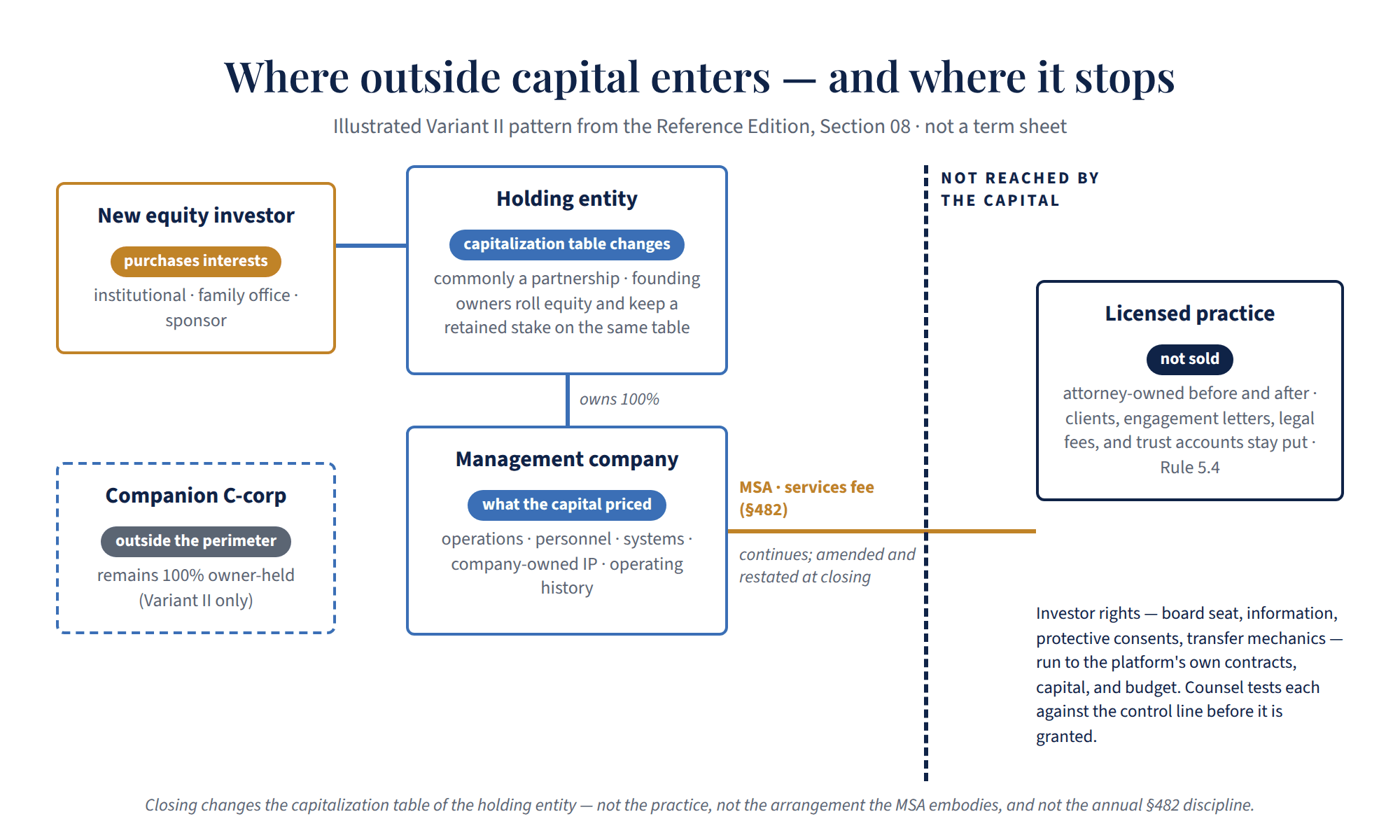
The anatomy by variant: in Variant I the transaction runs in the management LLC’s own interests, or in a holding entity formed above them. In Variant III it is a purchase of the corporation’s stock — the moment the §1202 analysis is finally tested on the facts as they accumulated across the holding period rather than as described at signing. Variant II divides the field as the table shows: the pass-through side transacts; the corporation does not. As the Reference Edition puts it, closing changes the capitalization table of the holding entity — not the practice, not the MSA, and not the annual §482 discipline.
What the investor owns — and what it never reaches
A minority check carries considerably more than a board seat, and an account of the structure that omitted the investor’s real rights would be underselling what a real investor negotiates. The Reference Edition’s seven-partner illustration — a single-state plaintiffs’ practice whose partners formed the platform, ran it for a year, and then admitted a thirty-percent investor — sets out, as an illustration, the package a real minority investor negotiates. Every element of it operates at the platform level, and none of it reaches the law firm.
| Right or asset | Investor | Lawyer-owners | Note |
|---|---|---|---|
| Equity in the platform holding entity | Yes — negotiated percentage | Yes — retained and rolled stake | Same capitalization table |
| Equity in the law firm | No | Yes — 100% | Rule 5.4 draws the perimeter; permissive regimes are jurisdiction-specific carve-outs |
| Legal fees, client files, trust funds | No | Yes | Only the practice may earn legal fees; the platform should not receive, hold, or disburse client or trust funds |
| Hiring and termination of lawyers; matter-level decisions; settlement authority | No | Yes | For covered entities, Illinois Public Act 104-0801 bars control over the hiring and termination of attorneys and allied legal staff |
| Platform board seat | One, in the Reference Edition illustration | Majority of seats in the illustrated pattern | Illustration: five seats — three partners, one investor, one independent director; no investor seat at the law firm |
| Information rights | Recurring, non-privileged platform financial reporting | — | On the metrics that drive the platform’s fee base; no information right at the law firm |
| Protective consents | Over major platform decisions — new debt, new equity, related-party agreements, budgets, executive hires | — | Each runs to the platform’s own contracts, capital, and budget |
| Transfer mechanics and liquidity path | ROFR, tag-along, often drag-along on partners’ platform interests; a defined path to liquidity | Reciprocal where negotiated | Platform interests only |
| The practice’s freedom to terminate or renegotiate the services agreement | Not reached | Retained | Each investor right is tested by counsel against the control line before it is granted |
The professional-responsibility line constrains what those rights may reach, not whether an investor is informed or protected. That distinction is the whole design. A term sheet that protects the investor at the platform and stops at the practice is doing what the structure asks; a term sheet that quietly reaches into the practice — through a consent right over “key personnel” that includes lawyers, or an information right that includes matter data — has crossed from investor protection into the control question that Rule 5.4(d) and, in Illinois, statute now address directly.
The fee is the investor’s return
Because only the licensed practice may earn legal fees, an outside investor’s economic participation is confined to the platform’s own enterprise value and earnings — a function of the nonlegal services the platform performs, the assets it owns, and the risks it bears, determined by a fee set independently of the practice’s revenue, profit, and matter outcomes. That is what the §482 method discipline exists to evidence, and it is why the fee method is the position a later reviewer is most likely to test.
The Reference Edition names the tension rather than assuming it away, and a capital provider should hear it named. The services fee is the platform’s only revenue and it is funded out of the practice’s receipts. Decoupling the fee’s measurement from firm results does not decouple its source: the platform’s economics remain derivative of the practice’s health. What a buyer prices on that narrower, honest claim is a contracted, renewing stream of arm’s-length service revenue whose durability rests on the operating substance behind it — not a share of legal economics, and not a margin. A fee set high enough to capture the practice’s entrepreneurial residual invites being read as fee-sharing in substance however it is denominated, and Illinois now reaches fees keyed to firm revenue indirectly as well as directly. How the fee method is selected and defended is the subject of a separate brief; what belongs here is the consequence for capital: the investor is buying the fee stream’s durability, and the fee stream’s durability is a function of how far it stays from the firm’s results.
Rollover equity and the partner’s own stake
One conflict the transaction creates runs through the partner rather than the investor, and no governance carve-out reaches it. A partner holding rollover equity in the platform, or a deferred-compensation promise backed by its balance sheet, has a personal financial interest in the platform’s health — and the platform’s health tracks the practice’s. Under Model Rule 1.7(a)(2), a concurrent conflict exists where there is a significant risk that the representation of a client will be materially limited by a personal interest of the lawyer. The sharpest version arises in a contingency practice, around settlement authority. The carve-outs that answer investor interference do not answer the partner’s own stake, because the rule’s concern is the lawyer’s interest, whoever else holds one. Whether a given arrangement creates that risk, and whether informed client consent is required and available, is a determination for counsel jurisdiction by jurisdiction; what belongs in the design is that the question is asked at formation, documented like every other independence fact, and revisited when the platform economics a partner holds change shape.
Debt: what a lender underwrites
A platform recapitalization is a category of its own — liquidity with no equity sold and no investor admitted. The lender underwrites the platform against its own balance sheet and operating history, and the platform services the debt from its own fee revenue, earned on the same method as before the borrowing. The Reference Edition’s boundary is stated in one line: a financing need is not a pricing method, and the fee is never resized to meet debt service.
Two requests recur and both belong to counsel. The first is a lender’s request that the licensed practice guarantee the platform’s debt. That reverses the direction of credit support the structure exists to maintain — it places the practice’s balance sheet behind the platform’s obligations — and it is evaluated with the same rigor as an investor’s request for control, because the two requests raise the same question in different clothes. The second is subtler: where the fee falls due on the platform’s cadence and the practice’s receipts arrive on a settlement calendar, the difference is intercompany credit, documented, interest-bearing at an arm’s-length rate under Treas. Reg. §1.482-2(a), and serviced as debt. Once a nonlawyer investor holds platform interests, a platform receivable from the practice is an economic link counsel tests under Rule 5.4(c) and (d) like any other.
The tax treatment of a recapitalization distribution belongs to the client’s tax advisers: for a pass-through platform it turns on basis and liability-allocation mechanics; a corporate platform answers under the corporate distribution rules on its own facts.
The jurisdiction overlay
Outside capital does not change which state’s rules apply, but it raises the cost of getting that question wrong. Three points from the Reference Edition’s jurisdictional analysis bear directly on a capital transaction.
Illinois. Public Act 104-0801, effective August 7, 2026, amends the Illinois Attorney Act to reach covered nonlawyer-owned entities. It bars fees charged directly or indirectly on the basis of an attorney’s or firm’s fees, revenues, or profits; interference with professional judgment; control over the hiring and termination of attorneys and allied legal staff; post-termination restrictive covenants on attorneys and allied legal staff; and specified powers over client records and attorney-client communications — owning or determining the content of client records, and revealing client records or attorney-client communications. It requires disclosure of the arrangement in covered client contracts, and it creates a private right of action with statutory damages, fee-shifting, and injunctive relief. Its coverage is disjunctive and broad: a licensed attorney or law firm operating in Illinois with annual global legal-services revenue under $300 million, or one that regularly represents clients on a contingent-fee basis and derived more than half its revenue from those arrangements in each of the previous three calendar years. The common reading of it as a large-firm statute is backwards: the $300 million figure operates as a carve-out for firms above it, not as a threshold narrowing the statute, and the contingent-fee branch operates separately. Illinois counsel owns the construction; the Illinois brief sets out the workstreams.
Colorado. HB26-1421, signed June 4, 2026 and effective August 12, 2026, bars sharing legal fees or revenues with nonlawyers or with organizations controlled by nonlawyers that participate in providing legal services, bars financial arrangements with alternative business structures, and prohibits compensating administrative staff through arrangements contingent on a percentage of legal fees or revenues or on case outcomes. Enforcement is private as well as regulatory — clients and competing law firms have rights of action, with disgorgement among the remedies — and the act repeals on September 1, 2029 absent further action. SB26-174, effective the same day, treats lead-generation marketing for legal services — a lawyer, firm, or licensed paraprofessional paying a third party for information about a potential client — as a deceptive trade practice under the state’s consumer-protection act. The Colorado brief covers both.
The permissive regimes are carve-outs, not the rule. Arizona’s ABS regime added an in-state nexus requirement in March 2026; Utah’s sandbox is closed to new ABS applicants and on track to sunset in August 2027; Washington’s pilot is applicant-specific; the District of Columbia’s Rule 5.4(b) exception has never traveled; and Puerto Rico’s 49% allowance requires that the nonlawyer owner contribute money only and provide no services to the office — an ownership exception, not a services-model authorization. Under Model Rule 8.5, authorization in a permissive jurisdiction does not cure exposure under a restrictive one. A capital structure premised on the permissive regimes expanding is premised on the least predictable variable in the analysis, which is why the durable posture is to design to the most restrictive regime the firm is meaningfully exposed to — in practice, traditional Rule 5.4.
The sequence, and what closing does not change
The order of operations is the argument of the entire Reference Edition, restated for a capital event. The platform is formed and the functions genuinely move. The first intercompany invoice issues and the fee basis is documented at inception. The platform operates before any capital event; in the Reference Edition’s seven-partner illustration, that operating period is one year, and the paper deliberately names no minimum. Diligence then reads a record that already existed; documentation deferred until after buyer involvement, or history established retroactively, is the failure mode. The investor’s counsel and the quality-of-earnings team revisit the taxing authority’s questions: is the fee sustainable and supported, does the platform own or operate meaningful business value, have the intercompany economics been administered consistently, does any claimed tax posture still rest on the historical facts. A file that reads cleanly through R&W diligence and in the data room is worth more than one inviting a QofE adjustment or an indemnity holdback.
Closing then changes the capitalization table of the holding entity — not the practice, not the arrangement the MSA embodies, and not the annual §482 discipline — and leaves the operating record running. The master services agreement continues, commonly amended and restated. The management fee remains an annual, examinable §482 position. The governance cadence, the invoicing, and the substantiation file all continue, because the reviewers do not retire when the ownership page changes. In the Variant II pattern the companion corporation’s own services agreement is commonly terminated or re-scoped, and the personal-holding-company analysis stops being theoretical the day its service-fee income stops — a consequence that belongs in the deal model, not in a post-closing surprise.
What this brief deliberately does not reach
A live process layers instruments onto this record that neither this brief nor the Reference Edition attempts: valuation and multiple construction; purchase-price allocation and, where the form allows one, a §338(h)(10) or §336(e) election; the treatment of identified tax positions in representations-and-warranties insurance, which typically excludes known exposures and pushes the §482, §531 and §1202 positions toward specific indemnity, escrow, or a separate tax policy; transition-services and earnout negotiation; and the investor’s own exit, transfer, and liquidity terms. Those belong to the deal team a process assembles — banker, transaction counsel, QofE accountants, and the parties’ tax advisers. What the discipline described here builds is the record every one of those instruments is priced against.
Advisor implications
For M&A counsel, the capital-entry map is a drafting checklist: every investor right is tested against the control line before it is granted, and the practice’s freedom to terminate or renegotiate the services agreement is not on the table. For the firm’s CPA, a recapitalization or an equity closing reopens every prior year’s fee file, and the companion corporation’s income mix changes on closing day. For a lender’s credit committee, the platform is the borrower and its fee revenue is what services the debt; a practice guarantee is a design question for counsel, not a covenant to be papered. For a family office or sponsor evaluating a platform, one of the most informative diligence questions is how long the platform ran, on its own facts, before anyone contemplated the check. And for a managing partner reading a term sheet for the first time: the licensed practice is not what is sold, and any document that suggests otherwise has answered the wrong question.
Related Insights
- The Durable Law-Firm MSO — Reference Edition
- Rule 5.4 and the Law-Firm MSO: Ownership, Fee-Sharing, and Independence in Fact
- Law Firm MSO Setup: How the Structure Is Built and Reviewed
- Law Firm MSO Agreement
- Law Firm MSO Management Fees: Beyond the Fee Formula
- ABS vs. MSO for Law Firms: A Capital-Architecture Framework for Private Equity
- Law Firm M&A in 2026
- Law Firm MSOs in Private Equity: Service Platforms, Governance, and Value Creation
- For Law Firms
Frequently Asked Questions
Can a private equity firm own part of a law firm by investing through an MSO?
No. An MSO investment does not itself create ownership of the licensed practice. In the traditional Rule 5.4 architecture the Reference Edition describes, the investor acquires interests in the nonlegal services platform, typically through a holding entity over the management company, while the practice stays attorney-owned before and after closing, holding the clients, the legal fees, and the trust accounts. Jurisdiction-specific regimes such as Arizona’s ABS program may separately authorize forms of nonlawyer ownership under their own rules, and those authorizations do not travel under Model Rule 8.5.
What does the investor actually get for its money?
Interests in a services business — its executed agreements, systems, workforce, company-owned intellectual property, and operating history — plus a negotiated package of platform-level rights — in the Reference Edition’s illustration, a board seat, non-privileged financial reporting, protective consents over platform debt, equity, budgets, related-party agreements and executive hires, and transfer and liquidity mechanics. None of those rights reaches the law firm.
How is the investor’s return connected to the law firm’s revenue?
Indirectly, and the Reference Edition says so plainly. The platform’s only revenue is a services fee funded from the practice’s receipts, so the platform’s economics remain derivative of the practice’s health. What the discipline claims is narrower: the fee is measured by the services rendered, on a §482 method, and not by the firm’s fees, revenue, profit, or outcomes. Illinois now prohibits fees keyed to firm revenue indirectly as well as directly for covered entities.
Can the platform borrow instead of selling equity?
Yes — a platform recapitalization. The platform borrows from a third-party lender against its own balance sheet and operating history and distributes proceeds to its owners, with no equity sold and no investor admitted. The fee is never resized to meet debt service, and a request that the practice guarantee the platform’s debt is evaluated by counsel with the same rigor as an investor’s request for control.
Does a law firm need to be planning a transaction to build an MSO?
No. The Reference Edition treats transaction planning as only one of three owner pathways. This brief addresses what changes when outside capital later enters a platform that already exists; the broader questions of whether and why a firm should build one belong to the Reference Edition and to the When the Answer Is No brief.
Selected public authorities
- ABA Model Rules of Professional Conduct 5.4, 1.7(a)(2), 8.5; state analogues as adopted.
- Illinois Public Act 104-0801 (HB 5487), approved August 7, 2026, effective on approval; enacted text and official bill status.
- Colorado HB26-1421 (Legal Practice Integrity and Fee-Sharing Prohibition Act), signed June 4, 2026, effective August 12, 2026; Colorado SB26-174, effective August 12, 2026.
- Treas. Reg. §1.482-9 (controlled services transactions); Treas. Reg. §1.482-2(a) (intercompany loans and advances).
- Business Wire, “Uplift Investors Launches and Closes First Investment, Forming Orion Legal MSO with Dudley DeBosier Injury Lawyers,” January 22, 2026.
- The Durable Law-Firm MSO — Reference Edition, Guardian Tax Consultants®, August 2026, Sections 03, 04, 08, 11, 12, 13 and 15.
Disclaimer
Informational only. Applicability depends on the specific facts, structure, and advisory environment of each engagement. Guardian Tax Consultants® provides MSO strategy, modeling, documentation coordination, governance support, fee-methodology coordination, and advisor-integrated implementation support. GTC™ does not provide legal opinions, prepare tax returns, or replace the client’s independent CPA, legal counsel, investment advisor, insurance advisor, or family office. Tax and legal advice, tax-return positions, legal conclusions, filings, and opinions are provided by the client’s independent legal and tax advisors. Guardian Tax Consultants® is not a law firm, does not practice law, and expresses no view on whether any arrangement satisfies any jurisdiction’s rule. Transaction illustrations are anonymized composites, not named clients or completed transactions; no valuation, multiple, or fee level should be inferred from them. No outcome promises. No pre-packaged structures.