
Technical Brief · Est. read time 15 minutes · Draws on The Durable Law-Firm MSO — Reference Edition, Sections 05, 07, 08, 09, 15, 17, 26, 27, 30 and 31 · Published September 5, 2026 · Last reviewed September 7, 2026
A law-firm management services organization is a separately owned nonlegal company that employs the firm’s business functions and charges the practice an arm’s-length fee for them; what it is, how it is structured, and how outside capital enters one are answered elsewhere in this library. This brief answers the question sellers and sponsors ask when a buyer is already in view — and corrects the assumption inside it.
Canonical Answer
Can a law firm set up an MSO right before a sale?
The entities can be formed and the management services agreement signed in weeks. What cannot be produced in weeks is the thing the buyer is actually underwriting: a services business with an operating history. A buyer underwriting a law-firm MSO will test whether the platform performs the nonlegal functions, employs or controls the people who perform them, bears the associated costs and risks, owns or contracts for its systems and assets, invoices the practice under a supportable methodology, and has operated that way long enough to leave a contemporaneous record — invoices, payroll, books, minutes, contemporaneous economic support for the fee and, as completed cycles accumulate, fee refreshes and filed returns. The Reference Edition names no minimum period, and none exists in law; what exists is an evidentiary continuum on which a structure formed at or after the letter of intent offers documents and forecasts and is read as a new diligence item carrying its own purpose questions. A platform assembled at the table, the Reference Edition says, “may invite repricing, additional escrow or indemnity protection, a delayed closing, or, in the bluntest terms deal teams use, simply die at the letter of intent.” Where the transaction clock is shorter than the time real operations need, the paper’s counsel is often to complete the transaction on the current structure and consider the platform afterward. The buyer can diligence the law firm; there may be too little independent operating history to diligence the MSO as the business the buyer is being asked to value.
From the Reference Edition
This article draws on The Durable Law-Firm MSO — Reference Edition, August 2026, Version 1.0.
Source: Section 07 (“Before the Process: Operating History and Transfer Pricing”), Section 15 (“Buyer, Lender, and Recapitalization Diligence”), Section 17 (“Real Functions, Assets, and Risks”), Section 09 (“The time horizon is too short”), Section 27 (“Two Files, One Structure”); supporting Sections 05, 08, 26, 30 and 31.
The transaction mistake: forming the platform after the buyer appears
The sequence usually runs like this. A sponsor or strategic buyer expresses interest in a firm. Someone on the deal team explains that, under Rule 5.4 and its state analogues, the buyer cannot acquire the law practice, and that in the nonlawyer-capital architecture the Reference Edition addresses the contemplated investment is in a separately governed nonlegal services company rather than the licensed practice. The firm has no such company. So counsel is asked to form one — an entity, a management services agreement, a fee provision — so that there is something for the buyer to buy. The documents can be produced quickly. The diagram matches the one in every conference deck. And the buyer’s quality-of-earnings team opens the data room and finds, in the Reference Edition’s words, “no operating history, no contemporaneous transfer-pricing record, and no demonstrated substance.” The paper’s next sentence is the one this brief exists to deliver: “A quality-of-earnings team reads the absence immediately.”
The mistake is not the structure; it is the order. Entity documents plus a services agreement are not an operating platform. They are a description of one. The Reference Edition draws the line in a single sentence about the durable alternative: “stand the platform up as a real operating business, move the nonlegal functions, staff the services company, run its systems, document the management fee under a defensible §482 method.” Every verb in that sentence is conduct, and conduct takes time to have happened. The paper puts the commercial consequence plainly: “Durability is usually discussed as a compliance virtue, and it is one, but in a transaction it is a price. A structure assembled at the letter of intent has to argue that it is real, and an argument is what a buyer’s counsel converts into disclosure obligations, a special indemnity, an escrow holdback, or some form of regulatory put — each of which is priced.”
One framing correction is worth making at the outset, because the version of this point that circulates in the market is stronger than the evidence supports. It is not true that a buyer has “nothing to diligence” when a firm arrives without an operating MSO. The buyer can diligence the law firm — its revenue, its matters, its people, its books. What the buyer may be unable to do is diligence the MSO as the business it is being asked to value, because that business has no independent history to test. The distinction matters: the problem is not an absence of information but an absence of the specific evidence that supports the specific asset being priced.
What a buyer is actually trying to diligence
The Reference Edition describes three reviewers who reopen the same record, and the third is the one whose verdict is priced rather than examined: “a future buyer, lender, or recapitalization committee, asking whether the platform owns real value and whether the intercompany economics have been administered consistently enough to underwrite.” Section 15 states the questions that reviewer brings: “is the management fee sustainable and supported; does the nonlegal platform own or operate meaningful business value; have the intercompany economics been administered consistently; does any claimed tax posture still rest on the historical facts.”
Behind those questions is a concrete list, and each item ultimately tests an operating fact, even where documents are the evidence through which the buyer tests it. Who actually performs the nonlegal functions, and are they employed by the platform. What the platform owns or licenses, and which vendor, technology, and license contracts run to it rather than to the firm. What costs it actually bears on its own general ledger, and what the cost base looks like over time. What it has actually invoiced, on what method, and whether the fees were settled on their stated terms rather than left as year-end entries. What the board decided, when, and whether the minutes match the fee study and the returns. Whether control of legal judgment, custody of client files, and matter decisions have stayed with the lawyers as an operating reality rather than a recital. And what the platform’s own financial reporting shows across whatever operating history actually exists.
Section 08 describes what the investor’s capital actually buys in the illustrated pattern: “interests in the services business: its executed agreements, systems, workforce, company-owned intellectual property, and above all its operating history. What that capital prices is the record.” A newly formed platform may have executed agreements and the first evidence of commencement, but little historical evidence across the rest of that list.
What has to move before the record becomes real
The Reference Edition’s Section 17 sets out six things that “have to be real, documented, and contemporaneous,” and it is the most useful checklist a seller can read before a process, because a buyer’s team will test each of them in turn. Real people: “the genuinely nonlegal personnel are employed by the platform, on its payroll, with its benefits and its multi-state registrations, and they actually work there.” Real agreements: “executed services agreements, separately scoped and priced, with schedules that describe what is delivered.” Real books: “the platform’s own chart of accounts, its own general ledger, intercompany invoicing that actually runs, and fees settled on their stated terms rather than left as year-end entries.” Real governance: “a board calendar, minutes kept as decisions are made, and an adopted plan for the deployment of retained capital.” Real deliverables: “contemporaneous records of work performed and service reporting that a reader can compare against the fee.” And real insurance: “coverage matched to the risks each entity actually bears.” The paper’s sentence on the alternative is the one to remember: “A recital does not satisfy any of the six.”
Two precisions belong here, because the shorthand version of “move everything into the MSO” is wrong in both directions. First, only the nonlegal functions move — the functions the platform is actually permitted and equipped to perform. Section 31 names the ones a design most often reaches: “billing and collections administration, marketing and intake operations, human resources and benefits administration, technology and systems administration, and facilities management — illustrative, not exhaustive, and not every design reaches all of them.” Professional judgment, the attorney-client relationship, client funds, legal-fee ownership, and matter decisions do not migrate to make the platform look fuller; Section 17 adds that personnel who assist in the delivery of legal services — paralegals, legal assistants, litigation support — “are a separate category and not a default,” with Rule 5.3 supervision staying with the supervising lawyer and some jurisdictions restricting a services entity’s control over them. Where those people sit is counsel’s question. Second, the platform’s business coverage does not replace the licensed practice’s professional-liability program, which stays aligned with the practice and its professional activity. The paper places the platform’s own coverage — “general liability, property, cyber, errors-and-omissions, and employment-practices coverage as its functions require” — alongside the practice’s professional-liability program, and then flags the item formation checklists miss: the firm’s malpractice program “was underwritten against the firm as it was,” and moving intake, marketing, and staff onto the platform’s books changes facts the carrier relied on. “A coverage review with the firm’s malpractice broker and carrier belongs on the formation checklist, before functions move, and again at the first renewal after they do.”
What actually moves, then, is a schematic specific to the firm — “which services, which personnel, which systems, which contracts” — executed in sequence, with the required professional sign-off for each function in hand before that function moves, and ending with the intercompany agreements executed and the first invoice issued. The Reference Edition’s phrase for what happens next is the point of this brief: “The administration begins with the first intercompany invoice, not with the first examination.”
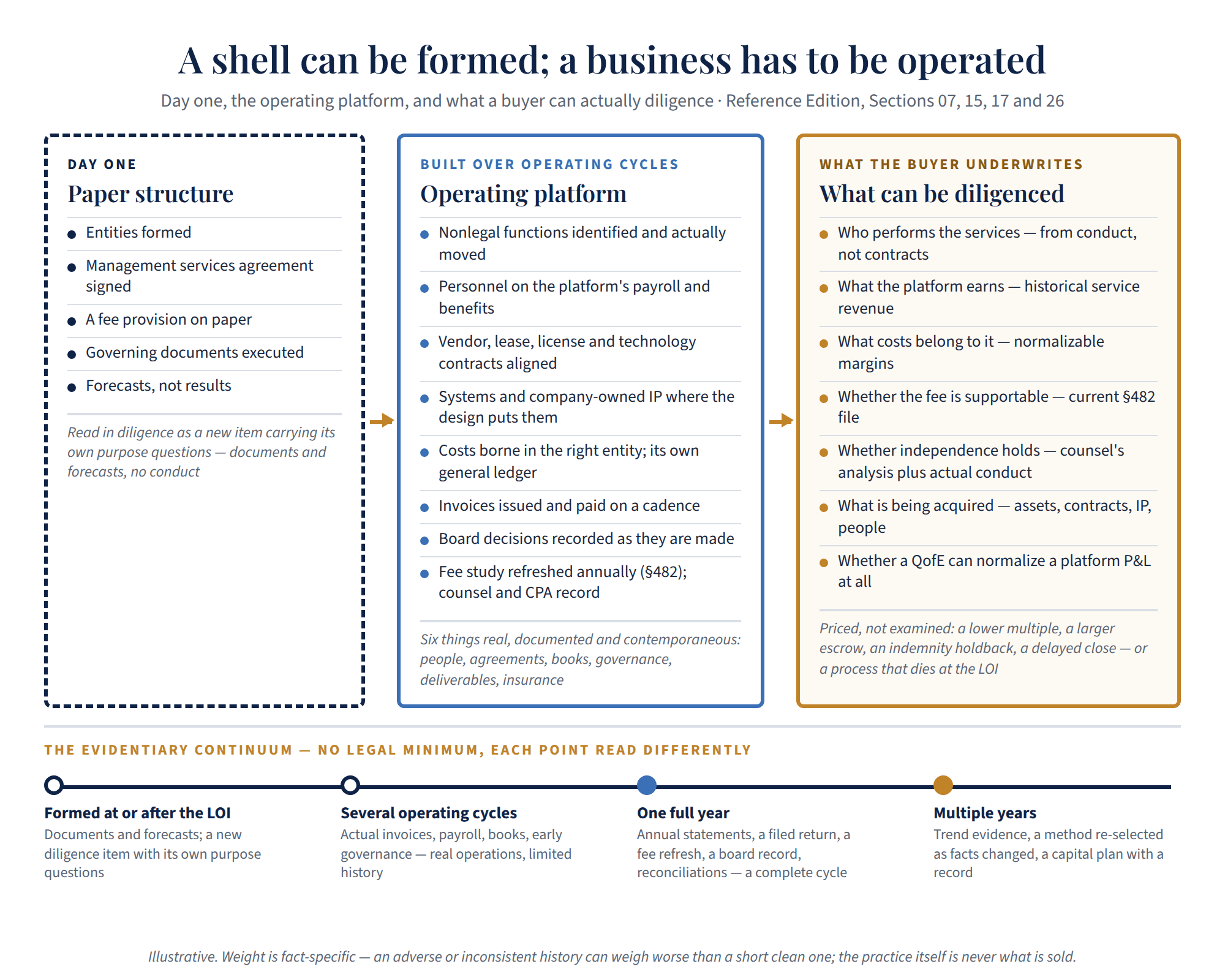
Why time matters — and why no number is given
The temptation in every conversation about transaction readiness is to name a period: twelve months, eighteen, two years. The Reference Edition refuses, and says why: “How much history is enough has no legal answer, and none is invented here: no authority establishes a safe harbor at four months, a year, or any other line, and a number asserted here would be the least defensible sentence in the document.” Time matters not because a rule imposes a minimum but because conduct has to catch up to paper, and each completed cycle produces evidence of a kind the previous one could not.
What the paper offers instead is an evidentiary continuum, “and each point on it is read differently.” A structure formed at or after the letter of intent “offers documents and forecasts, and is read as a new diligence item carrying its own purpose questions.” Several operating cycles “produce actual invoices, payroll, books, and early governance: commencement of real operations, with limited history.” One full year “produces evidence of a different kind rather than more of the same kind: annual statements, a filed return, a fee refresh, a board record, and reconciliations — a complete cycle that can be compared against the formation thesis.” Multiple years “produce what nothing shorter can: trend evidence, a method selected and re-selected as facts changed, and a capital plan with a track record, a record that visibly was not manufactured under transaction pressure.” The paper attaches a qualification that a seller should hear in full: “The weight any reviewer gives each point remains fact-specific: an adverse or inconsistent history can weigh worse than a short clean one.” More history is not automatically better; consistent, supportable history is. What holds, in the paper’s words, “is narrower and sufficient: assuming consistent and supportable operation, each completed cycle gives a reviewer more probative historical evidence than formation documents alone.”
How long a given firm needs therefore depends on what is being moved, how often services are invoiced, the firm’s operating cycle, the buyer’s diligence requirements, and the legal and tax facts in play. The seven-partner composite the Reference Edition illustrates in Section 08 operated “for a full year before an investor was in the room,” and the paper is explicit that the illustration is an illustration: the year is the composite’s fact, not a rule.
What the buyer later tests
The quality-of-earnings point is the one sellers most often hear too late, and it needs to be phrased exactly. A quality-of-earnings review can be performed on many sets of financial records, including the practice’s. What a newly formed MSO gives the buyer is little independent historical platform performance to normalize. The buyer’s team is trying to separate recurring services revenue from one-time items, costs genuinely borne by the platform from costs still sitting in the firm, related-party charges and allocations from third-party ones, migration and formation costs from run-rate expense — and, above all, the economics that survive closing from the economics that were arranged for it. A management agreement signed just before diligence answers none of those questions, because none of them is answered by an agreement. The Reference Edition’s Section 27 contrast between two platforms identical at closing puts the outcome in one line: to a quality-of-earnings team, the durable file “presents a locatable value”; the thin file, “the quality-of-earnings adjustment or holdback a thin record invites.”
The table below maps the questions a buyer’s team brings to what has to already exist for each to be answerable, and why a structure formed at the letter of intent cannot answer it however well drafted.
| Buyer question | What must already exist | Why a newly formed platform cannot answer it |
|---|---|---|
| Who performs the services? | Nonlegal personnel on the platform’s payroll and benefits; service logs and deliverables a reader can compare against the fee | A services agreement describes intended conduct; it is not evidence of conduct that has occurred |
| What does the platform earn? | Intercompany invoices actually issued and settled on their terms; the platform’s own financial reporting across the operating periods that actually exist | There is no independent earnings history — only a fee provision and a forecast |
| What costs belong to it? | Payroll, vendor, lease, license and asset records on the platform’s own general ledger; cost allocations behind the invoices | Margins cannot be normalized when the cost base has not yet lived in the entity |
| Is the fee supportable? | Contemporaneous economic support for the selected method — an independent study is the paper’s illustrated standard — refreshed annually on current facts under §1.482-1(c); minutes recording how the fee was set | A fee that first appears on the eve of a sale reads as a position assembled for diligence; a purchase price cannot create an arm’s-length history |
| Does professional independence hold? | Counsel’s professional-responsibility analysis plus an operating record showing professional judgment, client relationships and matter decisions remaining with the licensed practice, and client files outside the platform’s custody | Closing documents cannot rewrite how the arrangement actually operated before them |
| What is actually being acquired? | Executed agreements, systems, workforce, company-owned IP, contracts running to the platform — and the operating history behind them | A shell may own little beyond an agreement with a related party |
| Can a QofE normalize the platform? | Historical platform P&L; reconciliations between invoices, study, minutes and returns; a documented business purpose for any retained capital | There is little or no independent platform history to test; the Reference Edition identifies an adjustment or holdback as among the consequences a thin record can invite |
The record the buyer tests is the same record the Reference Edition describes for the other two reviewers. Section 25 puts it in one sentence: “Services documentation answers both §482 and Rule 5.4. Business-purpose minutes answer §531. Consistently administered intercompany economics answer buyer diligence.” A seller who has been keeping the file for a regulator and a taxing authority has, in the ordinary case, been keeping it for the buyer too.
What cannot be cured at closing
The Reference Edition’s remediation section is written for structures already built, but its central sentence applies with more force to a structure not yet built when the buyer arrives: remediation “cannot create operating history. The record begins when the facts begin.” A management agreement executed at signing cannot retroactively create personnel who were employed, vendors who were paid, services that were delivered, governance that was exercised, risk that was borne, or invoices that were issued. What the documents can do is describe what will happen from their date forward — and the paper is precise that dating them otherwise is not a technique: “Backdating is not a remediation technique; it converts a civil documentation problem into a question of fraud, with criminal, professional-responsibility, and evidentiary exposure of its own, and a reviewer who finds one instance of it reads every other document in the file differently.”
There is a second reason a structure formed against a known transaction is weaker than one formed before it, and the Reference Edition names it in the decline conditions: “a structure created against a known transaction invites the very step-transaction and business-purpose questions Section 19 sets out. Building it anyway, at that point, may add a diligence item rather than remove one.” The paper’s Section 19 describes the profile of arrangements that get unwound — a fee sized to sweep the firm’s profit, set by the related parties, tracking ownership or firm results, with “a file assembled after the fact, if at all” — and a management fee that first appears on the eve of a sale, the paper says, “can contribute to a record resembling the concerns the Eighth Circuit described in Aspro — especially where actual services, documentation, and economic rationale are also thin.” The tax and transaction reviewers reopen overlapping facts for different purposes: the first tests the position; the second prices the operating and diligence consequences it finds.
When the correct answer is not to force it
The Reference Edition lists six patterns that account for most declines, and one of them is written for exactly this situation. “The time horizon is too short. The record is what does the work, and a record accumulates. A firm already in a process — or close enough to one that no meaningful operating cycle can complete before diligence begins — is generally too late for this discipline to produce more historical evidence than additional questions.” The counsel that follows is the one a seller under deal pressure least wants to hear and most needs to: “The better counsel is often to complete the transaction on the current structure and consider the platform afterward.”
That is a decline condition, not a verdict on the firm, and the paper treats a decline as a deliverable: “a documented, dated answer on the client’s own facts” that “forecloses the costlier mistake of building a structure that must later be unwound, when unwinding is read as evidence about the original purpose.” The full set of conditions under which a firm should not form an MSO — thin nonlegal operations, a fee that cannot be decoupled from firm results, the wrong intended benefit, no appetite for the operating change, intolerable jurisdictional exposure — is the subject of When the Answer Is No, and this brief does not repeat it. What belongs here is the special case: the transaction clock may be shorter than the time required to create real operating substance and a usable record, and when it is, the Reference Edition’s better counsel is often to complete the transaction on the current structure and consider the platform afterward. The paper’s own observation about the reverse case is the reason: “a platform assembled for a process has no durability to fall back on if the process stalls.”
How this changes the transaction process
The practical consequence is a reordering. The sequence that fails runs buyer → structure → diligence. For the pre-transaction pathway the Reference Edition describes, the sequence is build → operate → substantiate → later diligence of the record that exists. Section 03 describes the owner who intends to grow and may one day transact as “building the operating history that keeps every later option open,” and the owner transacting now as “solving diligence: converting what would otherwise be argued at the table into what is simply read there.” The paper’s sentence on when diligence starts is the operating principle for a seller: “Diligence does not begin when the buyer opens the data room. It begins when the seller creates the first fact the buyer will later test.”
A platform built this way arrives at a process with “an operating history, an invoiced and benchmarked fee, and a contemporaneous file,” and the economics “arrive as an existing, documented operating history rather than as a position first assembled for diligence.” The Reference Edition’s annual evidence file — the ten records the annual substantiation brief describes — is designed to be handed over: “it exists in order to be handed over,” and a file organized to those categories from the first invoice forward “is a data room that assembles itself.” The paper’s account of the same record read by three reviewers ends on the buyer: weak intercompany economics “are settled in the currency of the transaction: a lower multiple, a larger escrow, an indemnity holdback, a delayed close.” A record built in advance does not remove the buyer’s questions; it gives those questions contemporaneous operating facts to test rather than formation documents alone.
What this brief does not say
It does not say that a law firm needs an MSO in order to sell. In the nonlawyer-capital architecture the Reference Edition illustrates, the contemplated investment is in the nonlegal platform rather than the licensed practice; a sale of a practice to another lawyer or firm under Model Rule 1.17, or a transaction inside a permissive alternative-business-structure regime, is a different transaction governed by its own rules. It does not say that a fixed number of months of operation makes a platform transaction-ready; the paper names none, and neither does this brief. It does not state a failure rate for law-firm transactions attempted without an operating platform: no defined dataset supports one, and none is asserted. It does not say that a quality-of-earnings review cannot be completed on a firm without an MSO; it says a newly formed platform gives the buyer little independent platform performance to normalize. And it does not reach the instruments a live process assembles — valuation and multiple construction, purchase-price allocation, representations-and-warranties coverage, transition-services and earnout terms — which the Reference Edition deliberately leaves to “the deal team a process assembles — banker, transaction counsel, QofE accountants, and the parties’ tax advisers.” What the paper builds, in its own phrase, “is the record every one of those instruments is priced against.”
Advisor implications
For transaction counsel and the banker, the readiness question belongs in the first conversation with a seller, not the data-room stage: whether an operating platform exists, how long it has operated, and whether the file described above can be produced shape how much independent platform history can be diligenced on the contemplated timeline and what remains forecast, representation, or new-structure risk. For firm counsel, the agenda is the professional-responsibility analysis on the firm’s own facts, the Rule 5.3 placement of legal-adjacent personnel, and the coverage review before functions move. For the CPA of record, the return positions are the management-fee deduction on a supportable method and, where a corporate platform retains capital, the documented business purpose behind it; for the independent economist, the method selected on the facts and its quantitative support refreshed annually on current facts and data, so that the fee arrives in diligence with current support rather than a retrospective study.
The Reference Edition’s observation about who holds the whole is the reason a readiness gap opens in the first place. “A lawyer can form the structure. An economist can support the fee. A CPA can report the tax position. Not one of those engagements, by itself, produces the longitudinal operating record that a regulator, a taxing authority, a lender, or a buyer will later examine.” Each of those deliverables is point-in-time; none is engaged to keep the others true as the facts move. Guardian Tax Consultants® serves as the continuing administrator across those lanes: developing the operating and economic design with the client, sequencing the professional work it requires, coordinating the nonlegal transition after the governing sign-offs are in hand, and administering the contemporaneous record as the facts change. Counsel owns every legal conclusion, independent economists own the fee study, and the client’s CPA owns the returns. The paper’s doctrine is “one structure, one contemporaneous record, three later readers.” The buyer is one of those readers — the one who prices what it finds — and the record it prices was either built as the years ran or it was not.
Related Insights
- The Durable Law-Firm MSO — Reference Edition
- How Outside Capital Enters a Law-Firm MSO
- When the Answer Is No: When a Law Firm Should Not Form an MSO
- Law Firm MSO Example: A Seven-Partner Illustrative Structure
- The Three Continuing Reviews of a Law-Firm MSO
- The Annual Substantiation Cycle for a Law-Firm MSO
- Law Firm M&A in 2026
- For Law Firms
Frequently Asked Questions
Can a law firm set up an MSO right before a sale?
The entities and the management services agreement can be created quickly. The operating business a buyer needs to diligence cannot: personnel, functions, contracts, systems, costs, invoices, governance and an independently supportable fee record have to exist in fact before they can be underwritten. A structure formed at or after the letter of intent is read as a new diligence item carrying its own purpose questions, and the Reference Edition’s counsel where the clock is too short is often to complete the transaction on the current structure and consider the platform afterward.
How long does a law-firm MSO need to operate before a transaction?
No legal minimum exists and the Reference Edition names none. What exists is an evidentiary continuum: a structure formed at the LOI offers documents and forecasts; several operating cycles produce invoices, payroll, books and early governance; one full year produces a complete cycle — annual statements, a filed return, a fee refresh, a board record, reconciliations; multiple years produce trend evidence. How much history carries meaningful evidentiary weight for a given firm depends on what is being moved, how often services are invoiced, the firm’s operating cycle, the buyer’s requirements and the legal and tax facts — and an adverse or inconsistent history can weigh worse than a short clean one.
What does a buyer actually diligence in a law-firm MSO?
Whether the platform performs real nonlegal services with its own people, owns or operates meaningful business assets, bears its own costs and risks, invoices the practice under a supportable and consistently administered method, and can show all of that in a contemporaneous record — invoices, payroll, ledger, minutes, annual economic study, filed returns. What the buyer’s capital prices, in the Reference Edition’s words, is the record.
Does the firm’s malpractice insurance move to the MSO?
No. The licensed practice remains responsible for the professional-liability coverage applicable to its legal practice; the platform separately carries the coverage a risk-bearing business carries — general liability, property, cyber, errors-and-omissions and employment-practices coverage as its functions require. Because moving intake, marketing and staff changes facts the firm’s carrier relied on, a coverage review with the malpractice broker and carrier belongs on the formation checklist before functions move and again at the first renewal after they do; the determination is the carrier’s and counsel’s.
Can a quality-of-earnings review be done if the MSO is new?
A quality-of-earnings review can be performed on many financial records, including the practice’s. What a newly formed platform gives the buyer is little independent historical platform performance to normalize — recurring services revenue, costs genuinely borne by the platform, related-party charges, allocations, working capital and one-time migration costs cannot be separated from a management agreement that has just been signed. The Reference Edition identifies an adjustment or holdback as among the transaction consequences a thin record can invite.
What if the firm is already in a process?
That is one of the Reference Edition’s decline conditions: where no meaningful operating cycle can complete before diligence begins, building the platform anyway may add a diligence item rather than remove one, and a structure created against a known transaction invites step-transaction and business-purpose questions. The paper’s counsel is often to transact on the current structure and consider the platform afterward — a documented, dated answer on the firm’s own facts, and the subject of the companion brief on when the answer is no.
Selected public authorities
- ABA Model Rules of Professional Conduct 1.17, 5.3, 5.4; state analogues as adopted.
- IRC §482; Treas. Reg. §1.482-1(c) (best-method rule); Treas. Reg. §1.482-9 (controlled services); Treas. Reg. §1.6662-6(d) (contemporaneous documentation).
- Aspro, Inc. v. Commissioner, 32 F.4th 673 (8th Cir. 2022); Gregory v. Helvering, 293 U.S. 465 (1935); Commissioner v. Court Holding Co., 324 U.S. 331 (1945).
- IRC §531 (accumulated earnings tax); IRC §1202 (holding-period facts tested at a stock sale).
- The Durable Law-Firm MSO — Reference Edition, Guardian Tax Consultants®, August 2026, Sections 03, 05, 07, 08, 09, 15, 17, 19, 25, 26, 27, 30 and 31.
Disclaimer
Informational only. Applicability depends on the specific facts, structure, and advisory environment of each engagement. Guardian Tax Consultants® provides MSO strategy, modeling, documentation coordination, governance support, fee-methodology coordination, and advisor-integrated implementation support. GTC™ does not provide legal opinions, prepare tax returns, or replace the client’s independent CPA, legal counsel, investment advisor, insurance advisor, or family office. Tax and legal advice, tax-return positions, legal conclusions, filings, and opinions are provided by the client’s independent legal and tax advisors. Guardian Tax Consultants® is not a law firm, does not practice law, and expresses no view on whether any arrangement satisfies any jurisdiction’s rule. Case illustrations are anonymized composites, not named clients or completed transactions. No outcome promises. No pre-packaged structures.