
Technical Brief · Est. read time 7 minutes · From The Durable Law-Firm MSO — Reference Edition, Sections 05–06, 14–15, and Appendix A · Published September 2, 2026 · Last reviewed September 7, 2026
A law-firm MSO is not tested by the counterparty at the table. It is tested later, by three reviewers who reopen the same record for three different reasons: a professional-responsibility regulator, a taxing authority, and a buyer, lender, or recapitalization committee. The first two ask whether a position holds. The third prices what it finds. And there is a fourth reader, in a different category, who renders no verdict at all — and is the reason the record holds.
Canonical Answer
Who reviews a law-firm MSO after it is formed?
Three reviewers, none of them rendering a verdict on the day the structure is formed. A professional-responsibility regulator asks whether the arrangement still honors the profession's limits on nonlawyer ownership and fee-splitting — under Rule 5.4, its state analogues, and the statutes now enacted in Illinois and Colorado. A taxing authority asks whether the management fee, the accumulation of capital, and any claimed gain exclusion reflect economic substance — under §482, §269A, §531, and §1202. A future buyer, lender, or recapitalization committee asks whether the platform owns real value and whether the intercompany economics have been administered consistently enough to underwrite. The third arrives only if the owner chooses a transaction; the first two can arrive whether or not the owner chooses anything.
From the Reference Edition
This article expands on The Durable Law-Firm MSO — Reference Edition, August 2026, Version 1.0.
Source: Sections 05, 06, 14 and 15; Appendix A.
Why the issue matters
Most attention on a law-firm MSO is spent at formation. That work is essential, and it is the smaller half of the problem, because the structure may be designed in weeks to months but will be reviewed for years — by people who were not in the room when it was designed. Durability asks whether a structure will still read correctly when someone reopens it. The three reviewers are who do the reopening, and naming them in advance changes how the platform is built: each reviewer's question implies a record that has to exist before the question is asked.
The first reviewer: professional responsibility and regulation
The threshold constraint on any law-firm MSO is ABA Model Rule 5.4 and its state analogues, and the rule is broader than the shorthand usually given for it: four operative subsections, of which (c) — barring a lawyer from permitting a person who pays the lawyer to render legal services to direct or regulate the lawyer's professional judgment — is the one that reaches a services arrangement most directly and is most often omitted. A design that satisfies only (a) and (b) has answered half the rule.
Formation asks whether the documents establish independence at signing. Post-formation review asks whether independent legal judgment has actually been preserved: whether lawyers, not the platform, control professional judgment; who hires and fires attorneys; where custody of client records and communications sits; who makes matter-level decisions; and whether delegated nonlegal functions remain supervised. A regulator reads operating reality across years, not a formation deck frozen at closing. The regulatory surface also moved twice in August 2026 — Illinois Public Act 104-0801 and Colorado HB26-1421 — which is why this review is a standing position rather than a closing item. Rule 5.4 and the Law-Firm MSO treats the rule, the statutes, and the carve-outs in depth.
The second reviewer: the taxing authority
The tax reviewer arrives under several headings, the four evergreen ones being §482 (the arm's-length character of the management fee), §269A (whether a services company serving essentially one practice invites reallocation between the company and its employee-owners), §531 (the accumulated-earnings posture where the platform includes a C-corporation), and §1202 (whether stock of a C-corporation services entity supports a gain exclusion). Which apply depends on the entity's shape: §482 reaches every variant with a controlled services charge; §269A applies only to a personal service corporation whose employee-owner, service-concentration, and principal-purpose elements are each satisfied; §531 and §1202 arise only in the corporate variants. None is resolved at closing. Each is re-tested against the facts as they actually developed — invoices issued or not, minutes kept or not, the method re-justified or not. The examination is of the record built while the platform operated, not the deck presented at the outset. For the fee, see Law Firm MSO Management Fees: Beyond the Fee Formula; for retained capital, MSO Cash Uses and §531.
The third reviewer: the one whose verdict is priced
The first two reviews are examinations: they test whether a position holds. The third is commercial, and it does something different — it prices what it finds. When the platform is refinanced or sold, counsel and the quality-of-earnings team revisit the taxing authority's questions in their own terms: is the management fee sustainable and supported; does the nonlegal platform own or operate meaningful business value; have the intercompany economics been administered consistently; does any claimed tax posture still rest on the historical facts. Weak intercompany economics do not merely create tax exposure. They are read as a quality-of-earnings problem and settled in the currency of the transaction: a lower multiple, a larger escrow, an indemnity holdback, a delayed close.
Diligence adds surfaces of its own. Coverage architecture — which policy responds when a nonlegal function performed at the platform fails — becomes a closing-date question. Retention is a diligence surface too, and the risk is specific to a services business: the earnings stream is concentrated in attorneys, teams, and client relationships that can simply leave, and a bid that competes only on multiple has said nothing about whether they stay. Rollover equity answers part of that; vesting, clawbacks, and contribution schedules answer the part equity alone does not; and clients choosing counsel is a fact diligence prices rather than a gap design closes. A platform recapitalization — the platform borrowing against its own balance sheet and operating history and distributing proceeds, with no equity sold — is its own category, and the boundary is that the fee is never resized to meet debt service, because a financing need is not a pricing method.
That is the part owners most often miss, and it is why durability is an enterprise-value discipline rather than a compliance one. The owner who never sells is protected by the same record. The owner who eventually does is better positioned to defend the economics already reflected in it. The converse carries the real cost: a record assembled in the weeks before a process cannot be made contemporaneous after the fact, and whatever uncertainty its absence creates is priced at the least convenient moment, on the buyer's calendar.
The fourth reader: the administrator
The regulator, the taxing authority, and the buyer each open the record once and decide something — permissibility, a deduction, a price. The owner's continuing adviser team — counsel, the CPA, the economist, the benefits and estate advisers — renders no external verdict; each decides real questions within a separate lane. What none of them is engaged to do is read the whole. The fourth function is administrative: reading the record across the lanes every year, noticing while the facts are still fresh that the documents, the economics, the books, the governance, the filings, and the estate plan still describe the same business, and routing each discrepancy to the professional responsible for resolving it. It is administration of alignment — never custody of privileged communications, client files, or professional judgment, which stay where the rules put them. Three verdicts, one administrator. A structure whose advisers each see their own slice annually, with no one reading the whole, has three verdicts coming and no administrator at all.
One record, three readings
The three reviewers do not need three files. They read the same evidence and ask it different questions:
- Services actually rendered. Regulator: nonlegal in substance, performed by the platform. Taxing authority: documented delivery supporting the deduction. Buyer: real functions behind the EBITDA.
- The fee and how it was set. Fixed or cost-based, not tied to firm revenue or profit — an arm's-length basis with a documented best-method selection under Treas. Reg. §1.482-1(c) — a fee that survives normalization.
- Governance and minutes. Authority over matter decisions left with the practice — business purpose for capital retained (§531) — consistent administration, not a year-end true-up.
- Invoicing cadence. An operating fact, not a paper arrangement — actual invoicing on a real cadence, decoupled from ownership — intercompany economics that tie out.
- Independence over time. Custody of client files and communications with the practice — facts that still match the return as filed — no latent regulatory repricing risk.
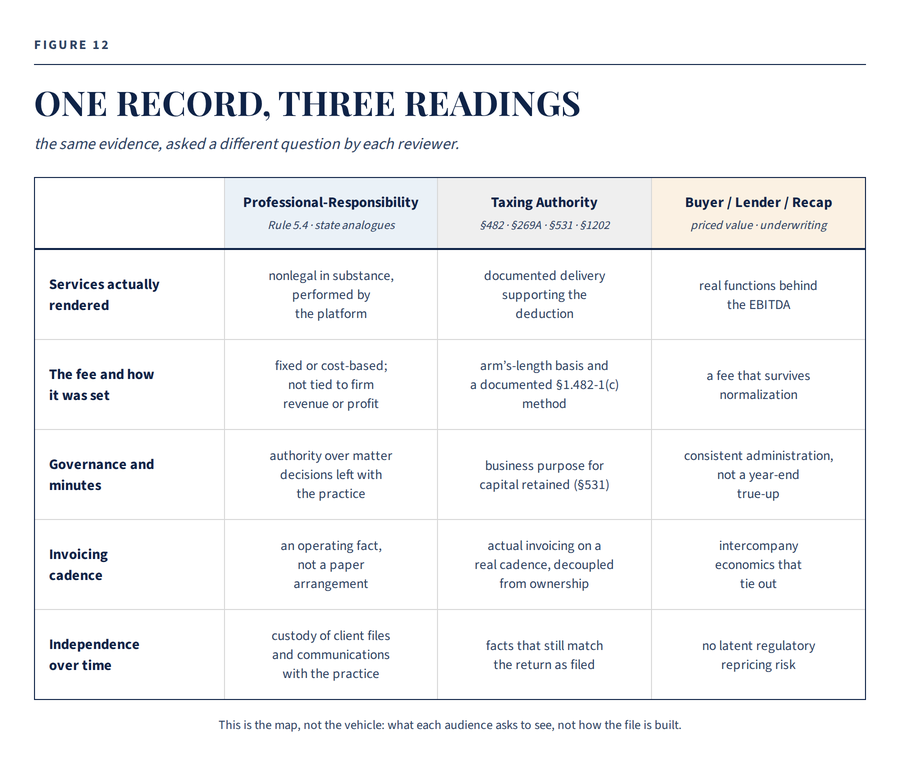
From Appendix A of The Durable Law-Firm MSO, Reference Edition, v1.0.
Advisor implications
For counsel: nothing in the Reference Edition opines on how a law-firm MSO is formed or whether a structure satisfies Rule 5.4 — those conclusions are counsel's — but the professional-responsibility analysis has a second life after the opinion is rendered, and the operating reality has to keep matching it. For the firm's CPA: the §482 and §531 positions are annual positions with annual substantiation, not formation-year conclusions carried forward. For a transaction adviser: the record either exists from the first invoice forward or it does not. The Reference Edition declines to name how much history is enough — no authority establishes a safe harbor at any line — and describes instead an evidentiary continuum on which each completed operating cycle gives a reviewer more probative evidence than formation documents alone.
Common failure points
A fee that tracks ownership percentages or firm revenue rather than services rendered, which fails the first and second reviewers at once. Independence real at formation but not demonstrable over time. A fee study rolled forward rather than refreshed. Capital retained without a contemporaneous business-purpose record. A file assembled for whichever reviewer shows up first rather than built once for all three. And the most common: advisers who each see their slice annually, with no administrator reading the whole.
How this connects to MSO governance
The three reviewers are why the Reference Edition treats durability as a documentation discipline before it is a legal or tax conclusion. The Annual Substantiation Cycle sets out the cadence that produces the record each reviewer reads, and the ten-part evidence file it maintains.
Related Insights
- The Durable Law-Firm MSO — Reference Edition
- The Annual Substantiation Cycle for a Law-Firm MSO
- Rule 5.4 and the Law-Firm MSO
- Law Firm MSO Management Fees: Beyond the Fee Formula
- Law Firm M&A in 2026
- For Law Firms
Frequently Asked Questions
Do all three reviewers examine every law-firm MSO?
The regulator and the taxing authority can arrive whether or not the owner ever transacts. The buyer, lender, or recapitalization committee arrives only if the owner chooses a transaction. The record is built once, on a cadence, and read by whoever is holding the platform when someone asks.
Is there a decided case that shows what a regulator will look for?
Research through September 2, 2026 identified no adjudicated holding approving or invalidating the modern law-firm MSO structure as a whole. Regulatory durability is reasoned from Rule 5.4, enacted state law, persuasive authority such as Texas Ethics Opinion 706, and carefully identified cross-industry precedent — which transfers as pattern, never as authority. Counsel owns that analysis.
Why does a buyer care about the tax position?
Because a fee unsupported by the historical facts, or a tax posture resting on undocumented facts, surfaces in diligence as a quality-of-earnings adjustment, an indemnity holdback, or a discount to value. The commercial reviewer prices what the examining reviewers would find.
Who is the fourth reader?
The administrator of the record: the function that reads across counsel's, the CPA's, the economist's, and the other advisers' lanes every year and routes each discrepancy to the professional whose conclusion it may affect. It renders no verdict and holds no privileged material, client file, or professional judgment. In Guardian Tax Consultants®' engagements that is the function Guardian performs.
Disclaimer
Informational only. Applicability depends on the specific facts, structure, and advisory environment of each engagement. Guardian Tax Consultants® provides MSO strategy, modeling, documentation coordination, governance support, fee-methodology coordination, and advisor-integrated implementation support. GTC™ does not provide legal opinions, prepare tax returns, or replace the client's independent CPA, legal counsel, investment advisor, insurance advisor, or family office. Tax and legal advice, tax-return positions, legal conclusions, filings, and opinions are provided by the client's independent legal and tax advisors. Guardian Tax Consultants® is not a law firm, does not practice law, and expresses no view on whether any arrangement satisfies any jurisdiction's rule. No outcome promises. No pre-packaged structures.