
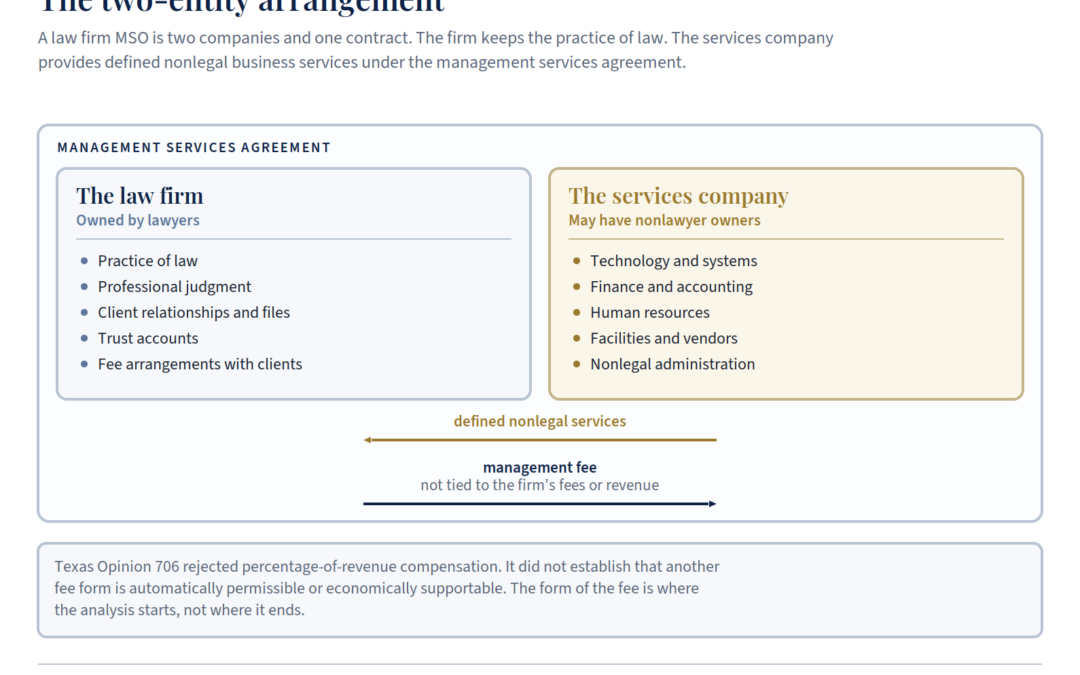
A law firm MSO is a management services organization: a separate company that provides the nonlegal services a law practice needs to operate. Depending on the structure, technology, marketing, finance, human resources, facilities, and administrative staffing can be provided through or housed in that company. The law firm stays owned by licensed lawyers, keeps the client relationships, and receives the legal fees. A management services agreement joins the two, and under it the firm pays the MSO for the services delivered.
The model separates the business of running a firm from the practice of law. The concept is old. What changed in 2025 and 2026 is that states began addressing the related questions — fee sharing, nonlawyer participation, and services arrangements — more directly, through both ethics opinions and statutes.
In short: A law firm MSO is a separate services company that runs a law firm’s business operations under a management services agreement. The firm stays lawyer-owned and receives all legal fees. The MSO is paid for services rather than with a share of those fees.
Lucian T. Pera, in the ABA’s Law Practice Magazine (January/February 2026), put the division of labor in one line: the services company is “everything but the lawyers and the practice of law” (Lucian T. Pera, “Law Firm MSOs Are Ethically Everywhere,” ABA Law Practice Magazine, January/February 2026, https://www.americanbar.org/groups/law_practice/resources/law-practice-magazine/2026/january-february-2026/law-firm-msos-are-ethically-everywhere/ — commentary).
An MSO for law firms borrows an architecture other regulated professions have used for decades; the general mechanics are covered in our explainer on what a management services organization is. The rulebook is where they diverge. Healthcare MSOs are designed against state corporate practice of medicine statutes. Law firm MSOs are designed against attorney conduct rules, principally Rule 5.4, and now against a small but growing body of state legislation written for this structure.
From the Reference Edition
This topic is addressed in The Durable Law-Firm MSO — Reference Edition, Version 1.1, September 2026.
Relevant sections: Sections 01, 02 and 04.
How Does a Law Firm MSO Work?
Two entities and one contract.
The law firm is owned by licensed lawyers. It is the only entity that receives legal fees, employs the lawyers, and holds authority over professional judgment and client matters.
The MSO can hold the business side: brand and other intellectual property, technology, marketing and nonlegal intake, real estate and equipment, and the nonlawyer workforce. Which of these actually move is a matter for the agreement and for counsel, not a fixed list.
The management services agreement defines which services the MSO provides, how it is paid, and how the relationship is governed; what those terms cover, and what advisors read them for, is the subject of our article on the law firm MSO agreement. These are long-term agreements rather than vendor engagements, which is why the operating record between the two entities is worth building deliberately from month one.
The order in which those two entities and that agreement are put together and reviewed is covered separately, in our article on law firm MSO setup.
What the MSO does not do. The MSO does not practice law. It does not receive legal fees as its own revenue. It does not control professional judgment. Those three things stay with the law firm, and the structure exists to keep them there.
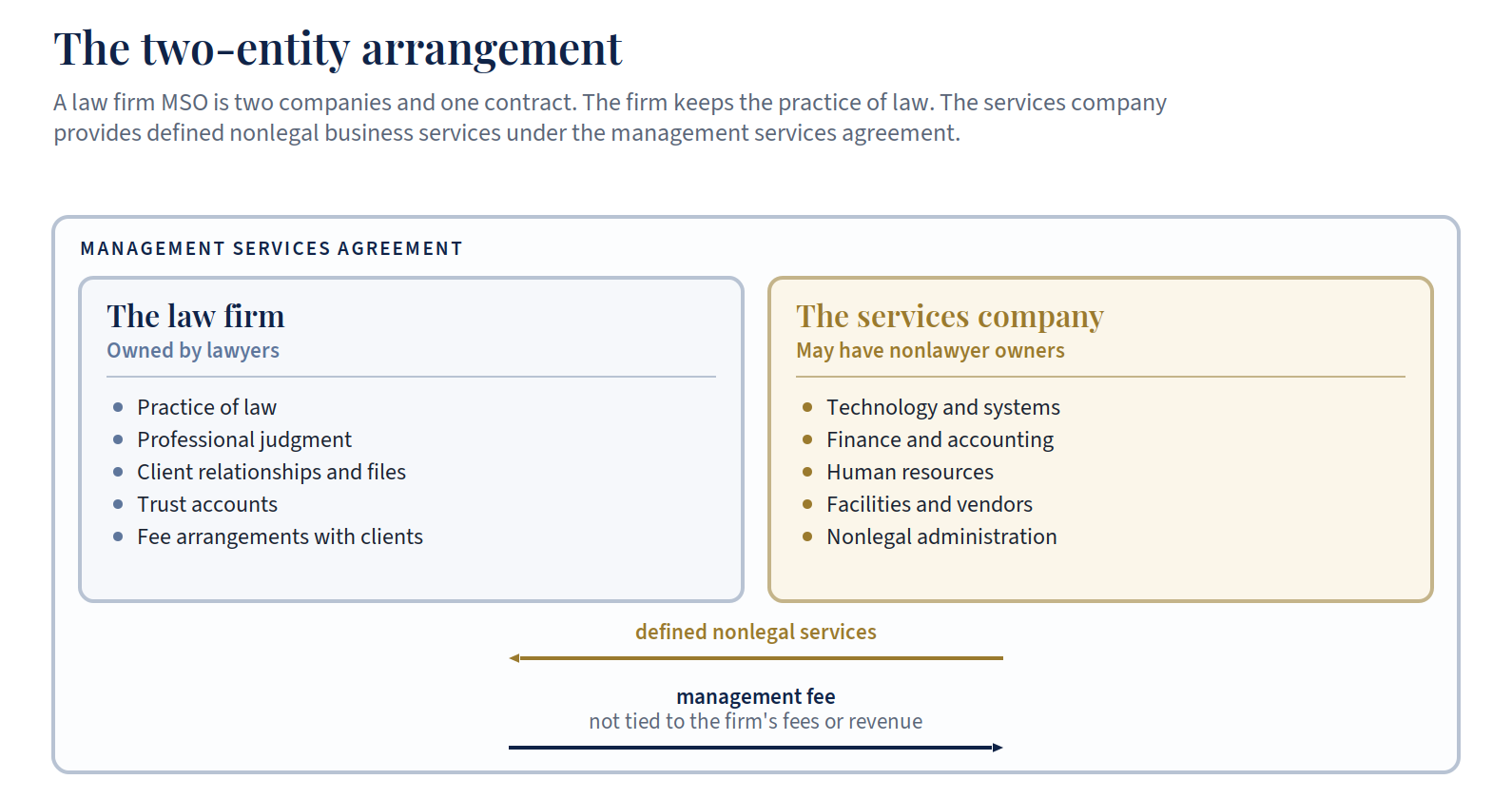
Texas Opinion 706 rejected percentage-of-revenue compensation. It did not establish that another fee form is automatically permissible or economically supportable. The form of the fee is where the analysis starts, not where it ends.
What Stays With the Law Firm, and What Moves to the MSO?
| Element | Law firm | MSO |
|---|---|---|
| Ownership | Licensed lawyers | May include nonlawyer owners, depending on structure and applicable law |
| Holds | Practice of law, client matters, legal fees | Brand and IP, technology, real estate, nonlegal staff |
| Professional judgment | Held by the lawyers, without qualification | No role |
| Revenue | Legal fees from clients | Management fee under the agreement |
A worked version of the same two boxes, with seven partners in it, appears in our law firm MSO example, which is illustrative rather than an account of a real transaction.
Why Does Rule 5.4 Matter to a Law Firm MSO?
Rule 5.4 of the rules of professional conduct is the reason the model looks the way it does (American Bar Association, Model Rules of Professional Conduct, Rule 5.4, Professional Independence of a Lawyer, https://www.americanbar.org/groups/professional_responsibility/publications/model_rules_of_professional_conduct/rule_5_4_professional_independence_of_a_lawyer/). It is a model rule. States adopt it with variations, so the operative text is the version the relevant state has adopted, not the model.
The rule is addressed to lawyers, not to the investors on the other side of the table, and that is worth stating precisely. The obligation sits with the lawyer. The structure is what has to change.
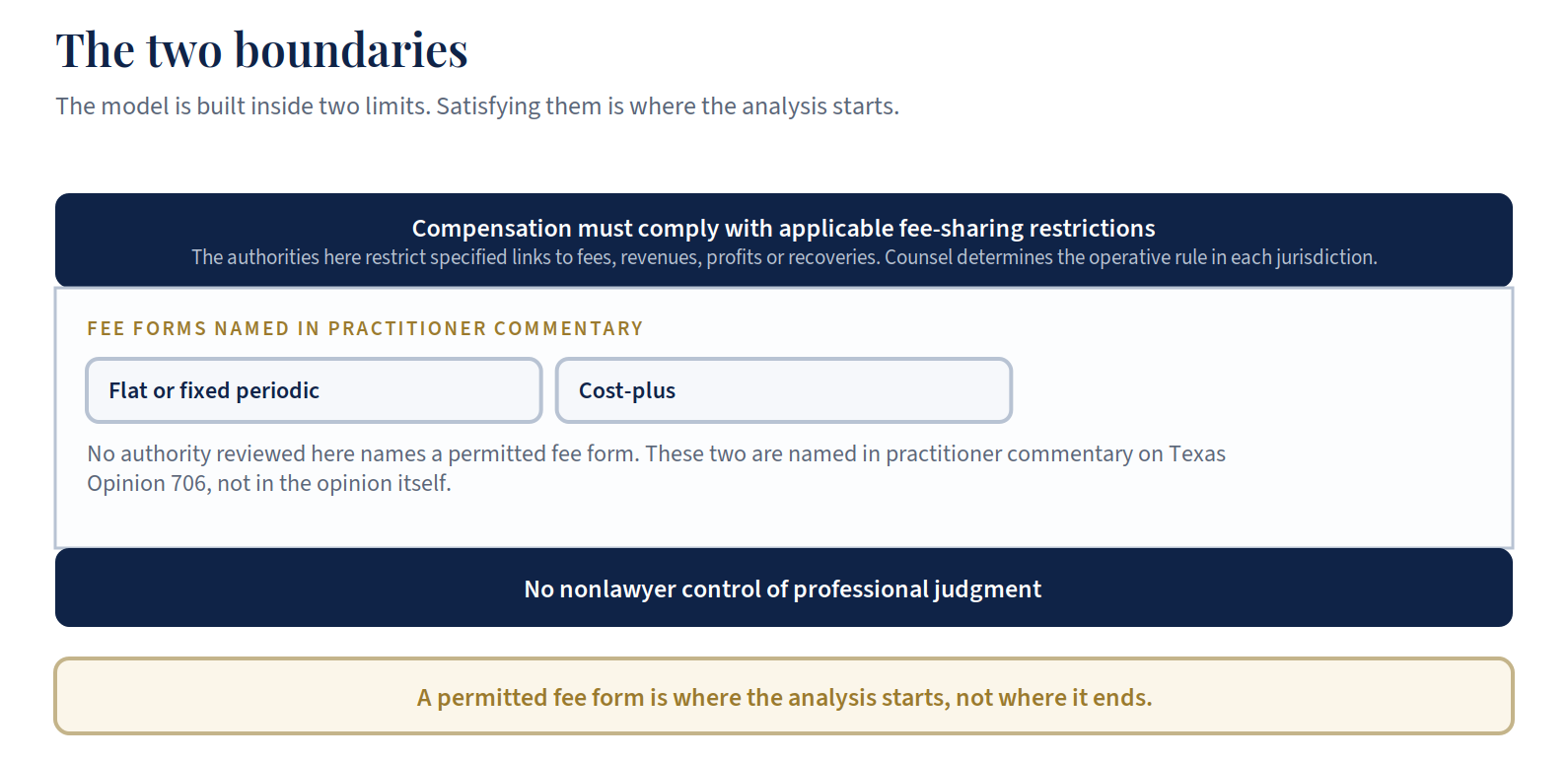
The two boundaries the model is built around:
- MSO compensation is structured to comply with the applicable jurisdiction’s fee-sharing restrictions rather than as a share of the firm’s fees, revenues, profits, or recoveries. The investor’s return comes from payment for services and from the value of the services company.
- Nonlawyers do not control professional judgment or the management of the practice of law.
Whether formal compliance with those boundaries produces lawyer control in substance is contested, as the criticisms below set out. Whether a particular arrangement satisfies Rule 5.4 in a given state is a question for professional responsibility counsel, and the authorities described here are considerations rather than conclusions.
How Is a Law Firm MSO Paid?
Through a management fee under the services agreement. Texas Opinion 706 rejected percentage-of-revenue compensation. It did not establish that another fee form is automatically permissible or economically supportable. The opinion concluded that a lawyer who engages a nonlawyer-owned company to provide a platform of support services “may not pay or promise to pay fees to the company based on a percentage of the revenues of the lawyer or the lawyer’s firm,” applying Rule 5.04(a) of the Texas Disciplinary Rules of Professional Conduct, which the opinion quotes as providing that “[a] lawyer or law firm shall not share or promise to share legal fees with a non-lawyer” (Professional Ethics Committee for the State Bar of Texas, Opinion 706, February 2025, https://www.legalethicstexas.com/resources/opinions/opinion-706/; quoted from the reproduction of the opinion in the Texas Bar Journal, April 2025, https://lsc-pagepro.mydigitalpublication.com/publication/?i=843020&article_id=4947717&view=articleBrowser). Holland & Knight, reading the opinion, writes that “the management fee must generally be structured as a ‘flat’ monthly fee, ‘cost-plus’ fee or another fee structure that is not directly tied to the revenues of the firm” (Rich, Porte and Brahin, Holland & Knight, August 18, 2025, https://www.hklaw.com/en/insights/publications/2025/08/law-firm-msos-and-legal-ethics-regulations-lessons-from-texas — law firm commentary, not authority). That reading is commentary, not a holding, and it does not address whether a given amount is economically supportable.
Clio describes MSO fee structures as “typically fixed, cost-plus, or benchmarked to arm’s-length market rates” (Joshua Lenon, “MSO Law Firm Deals Are Rising Fast, but Is One Right for Your Practice?”, Clio, May 25, 2026, https://www.clio.com/blog/mso-law-firm-structure/ — vendor commentary, not authority).
Choosing a permitted form is where the analysis starts, not where it ends. A fee is supported by the services actually performed, the costs actually incurred, and a record built consistently with arm’s-length methodology over time. Cost-plus is not a safe harbor, and selecting a fixed fee does not establish that the amount is reasonable. How a fee is reviewed under applicable transfer pricing principles, where those principles apply, and documented through an operating record is the subject of our cornerstone article on law firm MSO management fees.
Why Are Law Firms Looking at MSOs Now?
Capital. An MSO creates an entity that can raise and hold outside capital for technology, intake, and expansion.
Working capital. Contingency practices face settlement-cycle pressure on operating capital. A capitalized services company can finance its own nonlegal operating functions on a cadence different from settlement receipts; case costs and client advances remain with the practice, outside the platform's role.
Owner liquidity. Selling all or part of the services company converts operational value into cash plus rollover equity without selling the practice.
Institutionalization. Moving business functions into a separately governed operating company converts a founder-dependent practice into something that can be measured, staffed, and transferred.
Not every firm reaches for all four, and none of them is part of the definition of an MSO. They are reasons a firm might build one.
These decisions sit inside a wider consolidation picture, which is the subject of our article on law firm M&A in 2026. What investors underwrite when they back these platforms is the subject of our hub on private equity-backed MSOs for law firms. For a walk-through of how the pieces fit together, see the law firm MSO case study.
Is a Law Firm MSO the Same as an ABS?
A law firm MSO is not the same thing as an Alternative Business Structure (ABS). The difference is a useful distinction for a first-time reader.
An alternative business structure, or ABS, permits nonlawyers to hold equity in the law firm itself. That requires a state to have changed its rules. Our companion article on the ABS and Utah sandbox routes to law firm capital covers the 2025 and 2026 changes and the licensing counts in depth.
An MSO involves no nonlawyer ownership of the firm. If outside investors participate, their interest sits in the separate services company rather than the law firm. Whether that formal separation delivers lawyer control in substance is exactly what the model’s critics dispute, and the criticisms section below takes that up directly.
| Dimension | Law firm MSO | ABS |
|---|---|---|
| Who practices law | The law firm, owned by licensed lawyers. The services company has no role in professional judgment | The law firm. What an authorizing state changes is who may hold equity in it |
| Where nonlawyer ownership can sit | In the services company only. None in the firm | In the law firm itself, in the authorizing jurisdiction |
| Does the model require private equity | No. Outside capital is one use of the architecture, not part of its definition | No. The route permits nonlawyer equity in the firm; it does not require private equity |
| Is it available uniformly nationwide | No. Acceptability turns on the two boundaries above and on each state’s own rules, which differ | No. Only where a state has authorized it |
DLA Piper has written that “[u]nless and until the ABS Law Firm model is adopted in more jurisdictions, the MSO model may be the structure of choice for nonlawyers to invest in law firm businesses” (DLA Piper, “Managed Services Organizations vs. Alternative Business Structures: Two models for outside investment in law firms,” January 6, 2026, https://www.dlapiper.com/en-us/insights/publications/2026/01/msos-vs-abs-two-models-investment-in-law-firms — law firm commentary, not authority).
What Are States Doing About Law Firm MSOs in 2026?
Until recently, what counted as a compliant law firm MSO was inferred from ethics opinions. Legislatures have now started writing it down.
Our companion analysis of Illinois HB 5487 and its MSO requirements works through the scope test and the enforcement mechanics.

These instruments address different arrangements and should not be read as a common safe harbor. Texas Opinion 706 rejected the percentage-of-revenue arrangement before it and did not establish that another fee form is automatically permissible or economically supportable. California AB 931 creates an exception for contracts meeting specified fixed-dollar, nonreferral, and noncontingent-payment conditions; the statute does not use the term MSO. Colorado imposes its own statutory restriction. Illinois enacted HB 5487 on August 7, 2026 (Public Act 104-0801, effective on approval).
Sources: legalethicstexas.com · leginfo.legislature.ca.gov · leg.colorado.gov · ilga.gov
What Does a Permitted Fee Form Not Settle?
One ethics opinion and two enacted statutes constrain the fee form, and Illinois HB 5487, approved by the Governor on August 7, 2026 as Public Act 104-0801, does the same as enacted. A permitted label on an invoice can be common to the well-built structure and the thin one alike.
What a buyer’s quality-of-earnings review examines is not the formula. It is the record behind the formula, built through the years in which the fee was charged and readable by a stranger afterward. That work is cumulative, which is why it cannot be assembled in the quarter before a transaction or a demand letter. The fee is evidence, not the subject.
What Are the Common Criticisms?
A definition that omits the objections is incomplete.
A substantive critique goes to control as practiced rather than as papered. Writing on Columbia Law School’s Blue Sky Blog, Lev E. Breydo describes a structure in which “a PE-backed vehicle acquires the operating platform — technology, billing, marketing, HR, and everything else that isn’t ‘practicing law’” under a long-term management services agreement, and points to healthcare as the cautionary case: arrangements “that started with clean governance and independent practice boards drifted toward de facto investor control over professional decisions” (Lev E. Breydo, “Private Equity Is Coming for Law Firms—and the Rules Aren’t Ready,” CLS Blue Sky Blog, April 30, 2026, https://clsbluesky.law.columbia.edu/2026/04/30/private-equity-is-coming-for-law-firms-and-the-rules-arent-ready/ — commentary). Formal compliance with the two boundaries does not answer that question, and it is the question regulators and private plaintiffs will test.
None of this defeats the model. It describes the discipline the model requires.
Where Did the MSO Model Come From?
Medicine. State corporate practice of medicine doctrines barred lay ownership of medical practices, so capital organized around them: an investor-owned management company paired with a physician-owned professional corporation, joined by a management agreement. The pattern moved into dentistry, veterinary medicine, and accounting.
The legal profession is moving through a compressed version of that arc, which is the subject of the state-law section above. The lineage is precedent for how regulators reason, not authority: a design that satisfies a medical board says nothing about a bar regulator.
Where Does Guardian Fit?
The version of this that shows up in practice is mundane. A buyer’s diligence team does not ask to see the fee formula. It asks which services the MSO actually delivered in a given year, what they cost, who reviewed and approved the fee, and whether the minutes show two boards treating each other as separate parties. Firms that built that record as they went hand over a folder. Firms that did not spend the diligence window reconstructing years of intercompany history from memory and bank statements, while the counterparty prices the uncertainty into the number.
Guardian Tax Consultants® works with law firm owners and their advisors on that record: entity design, intercompany economics, governance cadence, and documentation that stays readable after the people who built it have moved on. GTC™ designs and administers it through the MSO Platform™ engagement model.
The lanes stay separate, and that separation is the point. Professional responsibility counsel owns the legal analysis. Independent economists own the fee and valuation conclusions. The client’s CPA owns return positions. Guardian designs and administers the operating and economic record that all three of them read.
Talk Through the Model
Frequently Asked Questions
What does MSO stand for?
Management services organization: a separate company that provides the nonlegal services a practice needs to operate, under a management services agreement with the firm.
Are law firm MSOs legal?
It depends on the jurisdiction, the structure, the fee arrangement, and how the arrangement is actually operated — there is no single national answer. The model is built around two boundaries: compensation structured to comply with applicable fee-sharing restrictions rather than as a share of the firm’s fees, revenues, profits, or recoveries, and no nonlawyer control of professional judgment. On top of those sit each state’s own rules, including the ethics opinion and statutes described above. Whether a particular arrangement satisfies them in a given state is a determination for professional responsibility counsel, not one this article can make.
Does an MSO own my law firm?
No. The firm remains owned by licensed lawyers. If outside investors participate, their interest is in the separate services company that holds the nonlegal assets and serves the firm under contract.
Will I lose control of my firm?
The honest answer is that control is a live question rather than a settled one. Governance terms, and how they are operated, answer that question deal by deal.
Which states allow law firm MSOs?
It depends on the state. The model is used in states that have not authorized nonlawyer ownership of firms, and its acceptability turns on the two boundaries above plus any state-specific statute, which is a determination for counsel in each jurisdiction.
Is a law firm MSO the same as an ABS?
No. An alternative business structure permits nonlawyers to hold equity in the law firm itself, which requires the state to have changed its rules. An MSO involves no nonlawyer ownership of the firm: if outside investors participate, their interest sits in the separate services company, the firm stays owned by licensed lawyers, and the firm receives the legal fees. Neither model requires private equity, and neither is available on uniform terms nationwide.
Can a private equity firm own a law firm?
An MSO does not itself give a private equity investor ownership of the law firm: the investor holds the services company, firm equity stays with its lawyer owners, and the firm keeps receiving the legal fees. Whether direct nonlawyer ownership of a firm is available at all depends on the jurisdiction and on any applicable alternative business structure framework, which is a different route covered in alternative business structures and outside capital.
Does a law firm MSO require private equity?
No. Outside capital is one use of the architecture, not part of its definition. An MSO is a separate company that provides a firm’s nonlegal services under a management services agreement; firms also build one for working capital, for owner liquidity, or to move business functions into a separately governed operating company that does not depend on a founder.
How is an MSO paid?
Through a management fee under the services agreement rather than as a percentage of the firm’s fees, revenues, profits, or recoveries. Choosing a permitted form is only the starting point; how the amount is supported and documented is covered in our management fee cornerstone.
Authorities and Further Reading
- American Bar Association, Model Rules of Professional Conduct, Rule 5.4 — https://www.americanbar.org/groups/professional_responsibility/publications/model_rules_of_professional_conduct/rule_5_4_professional_independence_of_a_lawyer/
- Professional Ethics Committee for the State Bar of Texas, Opinion 706 (February 2025) — https://www.legalethicstexas.com/resources/opinions/opinion-706/. That page renders the Question Presented and Statement of Facts but not the Conclusion. The conclusion quoted in this article is quoted from the reproduction of the opinion in the Texas Bar Journal, April 2025 — https://lsc-pagepro.mydigitalpublication.com/publication/?i=843020&article_id=4947717&view=articleBrowser
- California AB 931, enacted as Cal. Bus. & Prof. Code § 6156, Chapter 565, Statutes of 2025 (approved October 10, 2025; applies to contracts entered into on or after January 1, 2026; repealed January 1, 2030), chaptered text — https://leginfo.legislature.ca.gov/faces/billNavClient.xhtml?bill_id=202520260AB931
- Colorado HB26-1421, “Fee Sharing with Nonlawyers in Legal Practice” (signed June 4, 2026; takes effect August 12, 2026; repealed September 1, 2029) — https://leg.colorado.gov/bills/HB26-1421
- Illinois HB 5487, 104th General Assembly, bill status page, Illinois General Assembly — https://www.ilga.gov/ftp/legislation/104/BillStatus/HTML/10400HB5487.html. Passed both houses May 31, 2026; sent to the Governor June 26, 2026; approved by the Governor August 7, 2026; now Public Act 104-0801, effective on approval.
- Illinois Constitution, article IV, section 9 (veto procedure) — https://lrb.ilga.gov/Commission/lrb/con4.htm
- Lucian T. Pera, “Law Firm MSOs Are Ethically Everywhere,” ABA Law Practice Magazine (January/February 2026) — https://www.americanbar.org/groups/law_practice/resources/law-practice-magazine/2026/january-february-2026/law-firm-msos-are-ethically-everywhere/ — commentary
- Lev E. Breydo, “Private Equity Is Coming for Law Firms—and the Rules Aren’t Ready,” CLS Blue Sky Blog (April 30, 2026) — https://clsbluesky.law.columbia.edu/2026/04/30/private-equity-is-coming-for-law-firms-and-the-rules-arent-ready/ — commentary
- Trisha M. Rich, Joshua E. Porte and Leonard C. Brahin, “Law Firm MSOs and Legal Ethics Regulations: Lessons from Texas Opinion 706,” Holland & Knight (August 18, 2025) — https://www.hklaw.com/en/insights/publications/2025/08/law-firm-msos-and-legal-ethics-regulations-lessons-from-texas — commentary
- Joshua Lenon, “MSO Law Firm Deals Are Rising Fast, but Is One Right for Your Practice?”, Clio (May 25, 2026) — https://www.clio.com/blog/mso-law-firm-structure/ — commentary
- DLA Piper, “Managed Services Organizations vs. Alternative Business Structures: Two models for outside investment in law firms” (January 6, 2026) — https://www.dlapiper.com/en-us/insights/publications/2026/01/msos-vs-abs-two-models-investment-in-law-firms — commentary
Legislative statuses described in this article are current as of August 22, 2026. Illinois HB 5487 was approved by the Governor on August 7, 2026 and is now Public Act 104-0801, effective on approval. Requirements vary by jurisdiction and change frequently; verify current status before relying on any description here.
This article is educational only. It is not legal, tax, accounting, valuation, or investment advice, and it establishes no professional relationship. The authorities described here are considerations, not conclusions. Whether a given structure complies with the rules of professional conduct or any statute is a determination for qualified counsel; tax positions are determined by the taxpayer’s own CPA; fee and valuation conclusions belong to independent economists. Contact Guardian Tax Consultants for an educational discussion of the architecture.
Alex Jones, Founder and Chief Executive Officer, Guardian Tax Consultants · Last reviewed September 5, 2026