
Technical Brief · Law Firms · Est. read time 9 minutes · Draws on The Durable Law-Firm MSO — Reference Edition, Sections 02, 28 and 29 · Published September 2026
When a lawyer stops practicing, the traditional form leaves two things on the table. The family generally cannot go on owning the law practice after the lawyer is gone — the professional rules permit specified payments to an estate over a reasonable period, and an estate’s fiduciary may hold the interest only for a reasonable time — and, outside the carve-out jurisdictions the Reference Edition’s Section 12 describes, the practice may be sold only to a lawyer or firm. A practice built over decades is, in the paper’s words, too often resolved “into an income that simply stops.” A law-firm MSO changes neither rule. It changes what sits beside the practice: a separately owned nonlegal platform whose interest a founder’s spouse, children, or trust can hold where counsel concludes they may, sharing in the platform’s earnings as its owners when and as the platform distributes them under its governing documents and applicable law; and whose interests may be sold to a buyer who is not a lawyer, where applicable law and counsel’s analysis permit that holder, priced on the platform’s own operating record rather than as a claim on a departing lawyer’s draws. That is the thesis. The rest of this brief is its limits.
Published surveys point to a substantial succession-planning gap in the legal profession. In a 2021 Managing Partner Forum poll of 115 managing partners and firm leaders, 12% reported a “clearly articulated” succession plan at their firms; Illinois registration data separately found that 71.4% of active-status solo practitioners in private practice reported having no written succession plan in 2023. The Reference Edition identifies a structural problem behind the gap: traditional practice ownership can leave a founder with substantial current economic value but limited value that travels to the next owner. A management services organization does not write the plan. What it can change is what there is to plan around.
Canonical Answer
What can a law-firm MSO change about succession planning?
Not the rules. A law-firm MSO does not create a succession plan by itself, and it does not change who may own or buy a law practice: under the professional-rule framework the Reference Edition describes, the practice remains subject to lawyer-ownership and transfer rules. What it changes is that part of the enterprise a founder built — the separately governed nonlegal platform — can be held by people those rules bar from owning the practice: a spouse, children, or a trust, where counsel concludes they may hold it, sharing in the platform’s earnings as owners when and as it distributes them under its governing documents and applicable law. And platform interests may be sold to a buyer who is not a lawyer, where applicable law and counsel’s analysis permit that holder, priced on the platform’s own operating record. The platform adds time and design: a transfer that can be planned years ahead, run to a permitted holder, priced on an operating record capable of independent valuation, and funded from platform capital where the accumulation and its use are supportable under the applicable tax and business-purpose discipline.
From the Reference Edition
This article draws on The Durable Law-Firm MSO — Reference Edition, Version 1.1, September 2026.
Source: Section 02 (“What the Traditional Practice Structure Cannot Do”); Section 28 (“Ownership Continuity: Departure, Death, and the Transfer of Platform Interests”); Section 29 (“Succession: The Two Clocks”); supporting Section 24.
What the family can hold, and who can buy
Two facts organize everything else on this page. First, on the practice side, a founder’s family receives what the professional rules allow and no more. Rule 5.4(a) permits a firm to pay a lawyer’s estate or designated persons over a reasonable period after death; Rule 5.4(d)(1) permits the estate’s fiduciary to hold the lawyer’s interest only for a reasonable time during administration; outside the carve-out jurisdictions Section 12 describes, no other nonlawyer may hold it. The family does not go on owning the practice, does not share in its income once those payments end, and cannot sell it to anyone but a lawyer or firm. Second, on the platform side, those practice-ownership restrictions do not apply to the platform interest in the same way. The platform is a nonlegal company. Its interest passes, in the paper’s words, “to whoever the governing documents and the estate plan name, subject to counsel’s analysis of that holder” — a spouse, children, a trust — and those holders share in the platform’s earnings as its owners, when and as it distributes them under its governing documents and applicable law. They hold no authority over client matters; Rule 5.4(c) and (d) are tested on them as on any investor. Whether a given holder may hold the interest is counsel’s determination in every jurisdiction the firm touches.
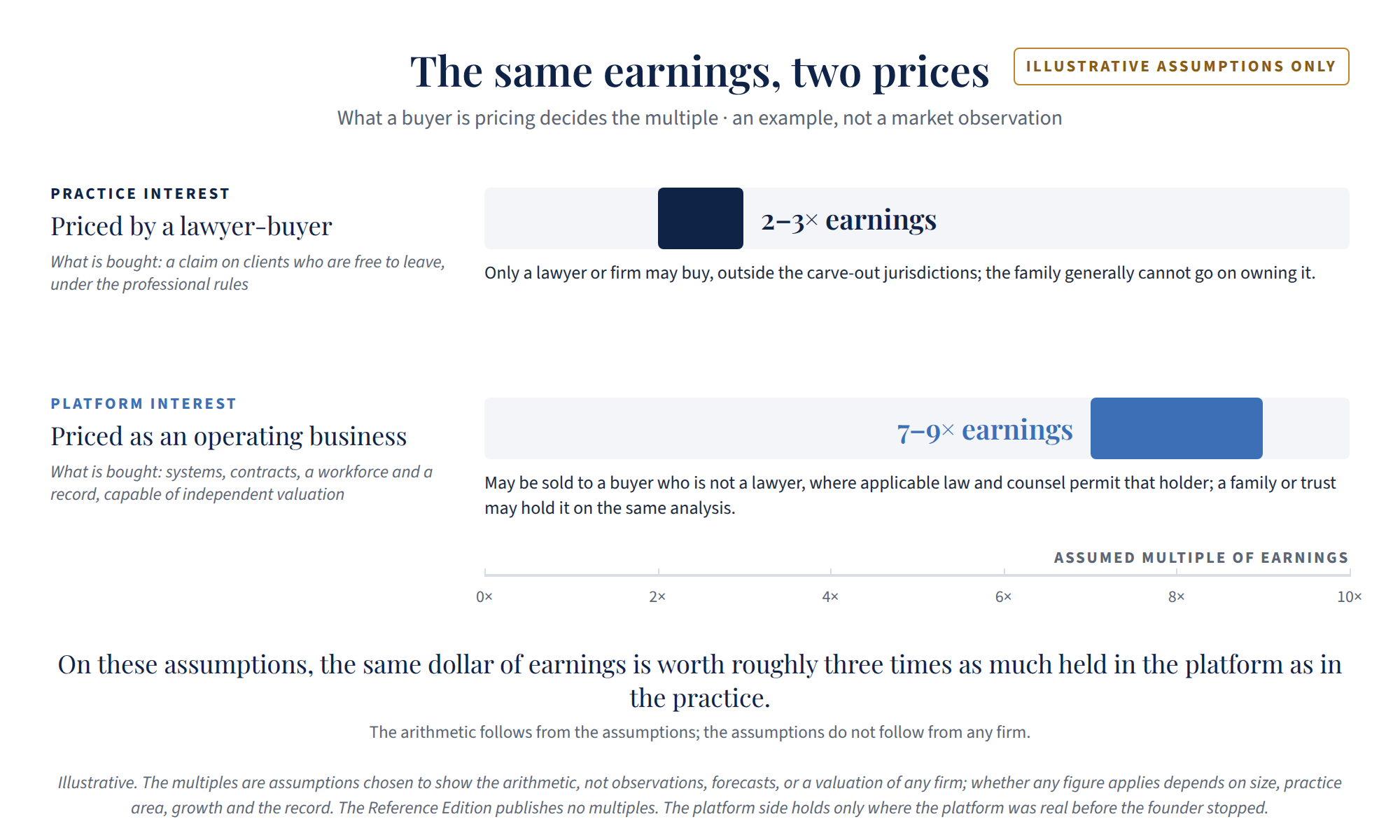
The second fact is about buyers. Under the same framework a nonlawyer does not buy a law practice. Platform interests, by contrast, may be sold to a buyer who is not a lawyer where applicable law and counsel’s analysis permit that holder; Section 29 recognizes a platform transaction coupled with a separate, lawyer-side succession arrangement for the practice, and “a buyer of platform interests acquires no interest in the practice.” Such a buyer prices what it is actually acquiring: an operating business with systems, contracts, a workforce, and a record, capable of independent valuation. That is a different thing from a claim on a departing lawyer’s future draws, and it can be priced on its own operating record. The Reference Edition publishes no multiples, and this page states none as fact. As an example only: assume a lawyer-buyer prices a practice at two to three times its earnings, because what is bought is a claim on clients who are free to leave; and assume a buyer of an operating company prices a platform with a record at seven to nine times its earnings, because what is bought is a business. On those assumptions the same dollar of earnings is worth roughly three times as much held in the platform as held in the practice. The multiples are assumptions chosen to show the arithmetic, not observations or a valuation of any firm; whether any figure applies depends on size, practice area, growth, and the record. What the paper does publish is the distinction in what is being priced, and the condition on which it rests — a platform that was real before the founder stopped. How the practice and the platform each transfer is Section 29’s subject; how a successor attorney comes to own part of the platform is the successor-equity brief’s.
The question owners actually ask
Much succession guidance for lawyers focuses first on a narrow question: what happens to the client files if I die tomorrow. That question matters — Comment [5] to Model Rule 1.3 specifically addresses that contingency for sole practitioners, and state requirements vary — and counsel designs that answer. But it is not the question an owner asks at sixty with a practice built over decades, a managing attorney who runs the docket, a staff whose jobs depend on the owner’s presence, and a family who will inherit whatever is left. The Reference Edition states the wider question in the owner’s own terms: what happens to the practice, the platform, the people, and the value I built when I retire, sell, become disabled, or die. Section 29 of the paper is organized around that question, and this brief is the door to it.
The wider question has four objects, and they do not resolve on the same terms. The practice resolves under the rules of professional conduct. The people resolve according to whether anyone has a reason to stay. The value resolves according to whether any of it can be held by someone other than the person who built it. And the family resolves according to what, of all this, they are permitted to receive. A plan that answers only the first has answered the part the rules would have forced anyway.
Why the traditional form answers it badly
Section 02 of the Reference Edition gives the diagnosis, and it is worth stating at the strength the paper gives it and no further. A partnership interest can hold substantial value to its holder; a share of strong current earnings is not nothing. What it lacks is value that travels. Professional rules, client choice, personal goodwill, and the governing documents together constrain what an interest can be sold for, borrowed against, or passed on, and a typical buy-in is, in the paper’s words, “more accurately described as a claim on future draws than as the purchase of an appreciating asset.” In the paper’s own words: “This is why succession at substantial firms fails as often as it does: the founders hold something the next generation will not rationally pay much for, and a practice built over thirty years too often resolves into an income that simply stops.”
The paper’s sharper point is about behavior rather than outcome. With no way to later convert built-up value into something transferable, taking it out annually is the rational response, and investing in value the interest can never capture is not. The traditional form, the paper concludes, “does not merely fail to produce a transferable asset — it removes much of the incentive to build one in the first place.” The surveys above establish the prevalence of planning gaps in the populations they measured; the Reference Edition separately offers a structural explanation for why ownership succession can be difficult to design.
The rules then fix the rest. Under Model Rule 5.4 and its state analogues, outside the handful of carve-out jurisdictions the paper’s Section 12 describes, a nonlawyer cannot own an interest in the practice, and Model Rule 5.4(d)(1) permits a fiduciary representative of a lawyer’s estate to hold the lawyer’s stock or interest only for a reasonable time during administration. Model Rule 1.17, where adopted and in the form adopted, permits a sale of a practice or an area of practice, but only to a lawyer or firm, with the seller ceasing practice, the clients notified and free to choose other counsel, and the fees not increased by reason of the sale. Rule 5.6(a) bars agreements restricting a lawyer’s right to practice after a relationship ends, outside its retirement-benefit exception, so a succession design cannot rely on a post-departure restriction on a lawyer’s right to practice beyond the rule’s permitted exceptions. None of this is the structure’s to move. It is the frame within which any plan is written.
Two transfers, not one
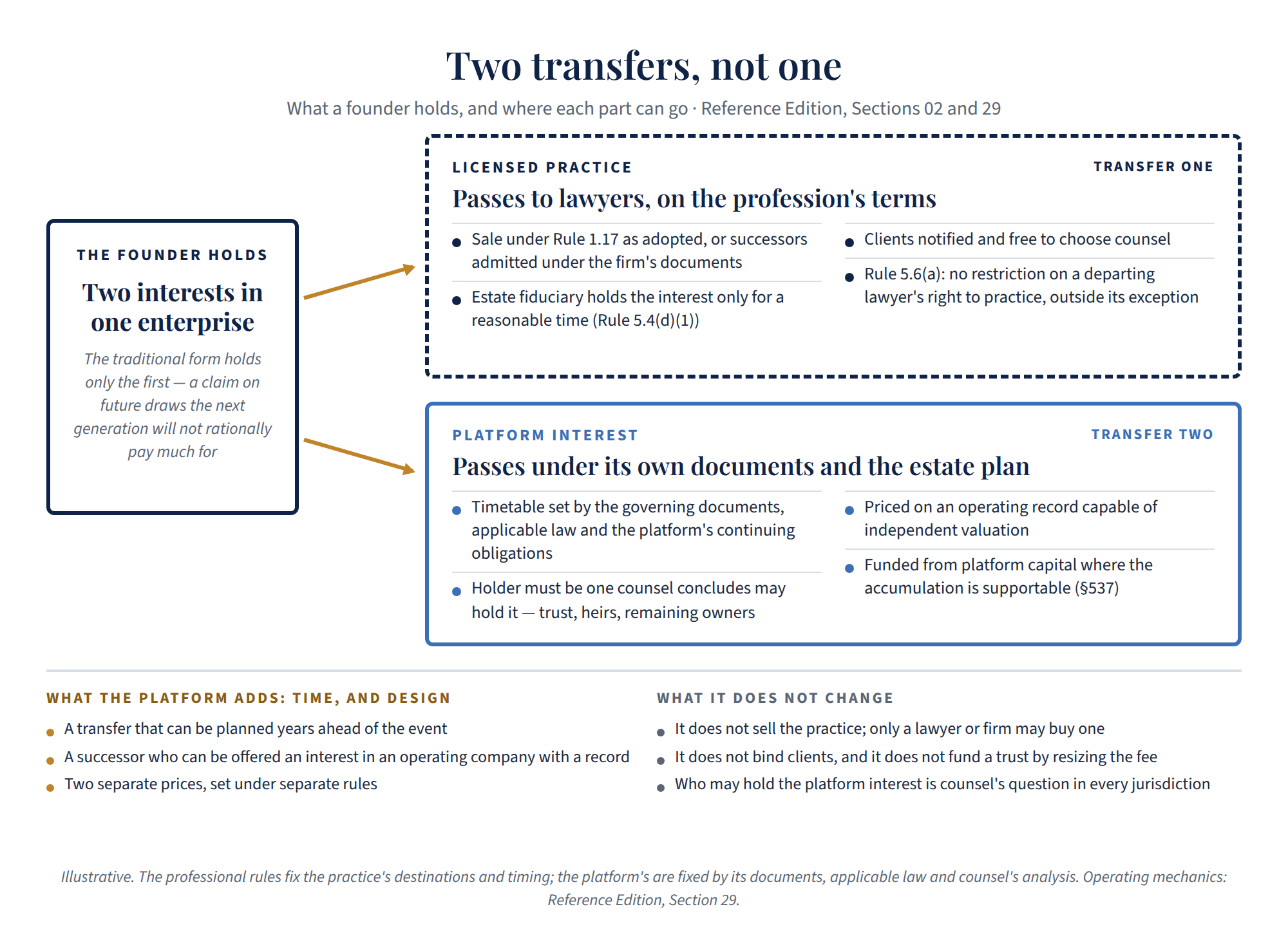
The Reference Edition’s central observation about succession in a two-entity structure is simple to state: it is two transfers, not one. The licensed practice passes to lawyers — by a sale under Rule 1.17 where adopted, by admission of successors under the firm’s own governing documents, or matter by matter under the rules that govern those transitions — under the professional rules that govern it and on the timetable those rules and the firm’s own documents set. The platform interest — the equity in the separately owned nonlegal services company that employs the firm’s business functions and charges the practice an arm’s-length fee — passes under the platform’s governing documents and the owner’s estate plan, subject to applicable law and to counsel’s analysis of who may hold it. The two transfers need not occur at the same time, run to the same people, or produce the same economic result.
That is the whole of the structural change, and the paper is careful about how much it claims for it. A platform interest is not an interest in a law practice, and a trustee, an estate representative, or an heir who comes to hold one stands in the same position as any other nonlawyer holder: no vote, consent, or veto reaches client acceptance, case strategy, settlement authority, or the hiring and termination of lawyers, and whether continued or inherited ownership is consistent with the applicable rules is counsel’s determination in every jurisdiction the firm touches. For the operating mechanics — how each transfer runs, the three scenarios that start them, the pathways a successor can take, and what has to be true the morning after — see Section 29 of the Reference Edition, which this page does not restate; the morning after has its own implementation brief, The Operating Bridge.
What the platform changes: time, and design
The paper’s own summary is that what the platform buys is “not permission. It is time, and design.” Four things follow from that, each stated in the paper’s terms.
A transfer that can be planned. A platform interest can be transferred on a schedule set years ahead of the event under its governing documents, because the profession’s timetable does not run on it. The practice-side transfer can be prepared in advance too, but its implementation remains governed by the applicable professional rules, the firm’s documents, and any cessation requirements that apply.
A holder the rules may permit. Where counsel concludes it may, a platform interest can pass to a holder who is not a lawyer — a trust, heirs, or the remaining owners — under the overlay the paper applies to every nonlawyer holder. The practice interest cannot, outside the carve-outs.
A price set on a record. A platform whose value derives from systems, contracts, workforce, and an operating record is capable of independent valuation on its own facts. A practice interest is priced by the profession’s own economics, with the clients free to leave. The paper treats the two prices as separate numbers set under separate rules, and its Section 28 exists to keep them from being read as one.
A transition the enterprise can fund. Where the platform retains capital deliberately and the accumulation is supportable, that capital can fund an internal succession purchased over time from the platform’s own balance sheet rather than waiting on an outside buyer who may never come. Whether reserving capital against a future redemption is a reasonable need of the business under §537 is a contested question rather than a given, and the determination belongs to the CPA of record; the paper says so, and so does this page.
The people are the fourth object, and here the platform changes the set of workable successors. A recruited successor can be offered an interest in an operating company with a record rather than only a promise of future draws. An internal successor — the managing attorney, the partner who runs the docket — can come to hold a minority interest in the platform on terms the paper governs closely: by purchase at an independently supported value, or by grant only against a documented service relationship to the platform, never as a reward for legal production, with a purchase rather than a forfeiture on departure. How that interest is acquired, vested, and priced is the subject of a separate brief, Successor Equity: How Attorneys Acquire an Interest in a Law-Firm MSO Platform, and Section 29 of the paper is its authority; this page only notes that the platform can provide a separately governed nonlegal equity instrument that traditional practice ownership cannot provide on the same terms.
What it does not change
The Reference Edition closes its succession section with a list of what it does not claim, and a door page should carry the same list rather than a softer one. The platform does not sell the practice, and cannot; under Rule 1.17 and Rule 5.4 as adopted in the firm’s jurisdiction, and outside the carve-outs Section 12 describes, only a lawyer or firm may buy one, on the rule’s terms. It does not bind clients, who choose counsel; neither the practice nor the platform may treat a client as an asset that transfers. It does not fund a founder’s trust by resizing the management fee, and a fee that moves for that reason is a disguised distribution whatever the succession plan calls it. It does not replace the designated-successor plan for client files, which is the practice’s obligation under the duty of diligence and counsel’s to design. It does not touch case costs, client advances, or client funds. And it does not settle, for any jurisdiction, who may hold a platform interest after a founder leaves; it gives that question to counsel with the facts organized so that it can be answered.
One further limit belongs here because it is the one most often assumed away. A platform that was never real — a fee the founder set, functions the founder performed, a record only the founder kept — does not become a succession asset because the documents call it one. The succession record has to show whether the platform’s operating substance survives the founder’s departure. The paper puts it this way: “A structure that was real on the day before the founder died is real on the day after. One that depended on the founder — a fee the founder set, functions the founder performed, a record only the founder kept — becomes the thin file of Section 27 at the moment it can least afford to.”
The decision made while every option is open
Succession, the paper says, does not begin at death. It begins the day an owner decides how the practice and the platform will each be transferred, and the decision is best made while every option is still open. Section 29 owns the successor pathways and the legacy-versus-price fork; this page stops at the point where an owner recognizes that a separately governed platform can create additional succession options, and sends the operating choices back to the Reference Edition.
None of this creates a new record. The succession plan is one of the governance decisions of record the paper enumerates, kept current through the annual substantiation cycle and reopened by the events that cycle names — a death, a disability, an announced retirement. A buyer, a regulator, and a taxing authority each read that record with a different question; in the paper’s words, “the file answers all three because it was built for all three.”
Advisor implications
The door opens onto work that belongs to named advisers, and the Reference Edition assigns it. Counsel owns the practice-side transfer — the designated-successor plan, the buy-sell or Rule 1.17 sale, the Rule 5.4(a) payment terms, the Rule 5.6(a) review — and the determination, in every jurisdiction the firm touches, of who may hold a platform interest after a founder leaves. Estate counsel owns the destination of the platform interest and the estate architecture around it. The CPA of record owns the tax positions, including whether any capital reserved for a transition is supportable. The independent economist owns the economic support for the fee when a founder’s exit can change the services rendered, the personnel rendering them, and the cost base, in the next annual substantiation refresh on the changed facts. Guardian Tax Consultants® administers the contemporaneous operating record that makes the platform’s half of the answer real and coordinates it across those lanes; counsel owns every legal conclusion, and the CPA owns the return. Sections 28 and 29 of the Reference Edition divide the mechanics: Section 28 addresses ownership continuity, valuation, funding and the fee; Section 29 addresses succession itself.
Related Insights
- The Durable Law-Firm MSO — Reference Edition (Section 29, Succession: The Two Clocks)
- Successor Equity: How Attorneys Acquire an Interest in a Law-Firm MSO Platform
- The Operating Bridge: What Happens When the Two Clocks Move on Different Dates
- Law-Firm MSO Retained Capital: Growth, Retention and Succession
- The Annual Substantiation Cycle for a Law-Firm MSO
- Rule 5.4 and the Law-Firm MSO
- Succession Without a Sale: Reading Tom Lenfestey
- Law Firm MSO Example: A Seven-Partner Illustrative Structure
- For Law Firms
Frequently Asked Questions
Does a law-firm MSO let a founder sell the law firm to a nonlawyer or leave it to family?
Not under the traditional framework. Under Model Rule 5.4 and its state analogues, outside the carve-out jurisdictions, a nonlawyer cannot own an interest in the practice, and Model Rule 1.17, where adopted, permits a sale only to a lawyer or firm. What the structure creates is a separate interest in the nonlegal services company, which may pass under its own documents and the estate plan to a holder counsel concludes is permitted. The practice still goes to lawyers.
What do published surveys show about law-firm succession planning?
Two different surveyed populations show substantial planning gaps. In the 2021 Managing Partner Forum poll, 12% of 115 managing partners and firm leaders reported a clearly articulated succession plan. In Illinois’s 2023 registration data, 71.4% of 12,395 active-status solo practitioners in private practice reported no written succession plan. Those figures describe the populations surveyed, not the profession as a whole. The Reference Edition separately offers a structural explanation: the traditional form leaves a founder holding what it calls a claim on future draws, and it removes much of the incentive to build anything else.
Does forming an MSO create a succession plan?
No. It creates a second, separately governed interest that a plan can be written around. The plan itself — the practice-side designation of a successor lawyer, the buy-sell agreements on both sides of the structure, the funding, the successor-equity terms, and the resolutions naming who may act in a transition — still has to be adopted, kept current, and reopened when the facts move.
What does a founder’s family actually receive?
Whatever the platform’s governing documents and the estate plan provide, subject to counsel’s analysis of the holder; on the practice side, payments over a reasonable period as Rule 5.4(a) permits, or the proceeds of a Rule 1.17 sale. Personal life insurance owned as estate counsel designs is unaffected by either transfer and is not a platform asset. No percentage or value should be inferred; the Reference Edition publishes none.
Where does the successor attorney fit?
On the practice side, as the lawyer who purchases or earns into the practice interest under the firm’s documents. On the platform side, where the design provides, as the holder of a minority interest acquired by purchase at an independently supported value or by grant against a documented platform role — never as a reward for legal production. The successor-equity brief linked above covers the terms; Section 29 of the Reference Edition is the authority.
Selected public authorities
- ABA Model Rules of Professional Conduct 1.3 (Comment [5]), 1.17, 5.4(a)–(d), 5.6(a) and its retirement-benefit exception; state analogues as adopted.
- IRC §537(a)(2); IRC §303; IRC §101(j); IRC §264; Connelly v. United States, 602 U.S. 257 (2024); IRC §482 and Treas. Reg. §1.482-1(c).
- Managing Partner Forum, “An Introduction to Law Firm Succession Planning” (webinar, October 13, 2021; 115 managing partners and firm leaders; 12% reporting a “clearly articulated” succession plan).
- Illinois Attorney Registration and Disciplinary Commission, 2023 Annual Report, p. 13 (12,395 active-status solo practitioners in private practice; 71.4% reported no written succession plan).
- The Durable Law-Firm MSO — Reference Edition, Guardian Tax Consultants®, v1.1, September 2026, Sections 02, 24, 28 and 29.
Disclaimer
Informational only. Applicability depends on the specific facts, structure, and advisory environment of each engagement. Guardian Tax Consultants® provides MSO strategy, modeling, documentation coordination, governance support, fee-methodology coordination, and advisor-integrated implementation support. GTC™ does not provide legal opinions, prepare tax returns, or replace the client’s independent CPA, legal counsel, investment advisor, insurance advisor, or family office. Tax and legal advice, tax-return positions, legal conclusions, filings, and opinions are provided by the client’s independent legal and tax advisors. Guardian Tax Consultants® is not a law firm, does not practice law, and expresses no view on whether any arrangement satisfies any jurisdiction’s rule. Survey figures are reported as published by their sources and describe the respondents surveyed, not the profession as a whole. No outcome promises. No pre-packaged structures.