
Technical Brief · Law Firms · Est. read time 9 minutes · Draws on The Durable Law-Firm MSO — Reference Edition, Sections 29, 24 and 28 · Published September 2026
A succession plan that names the eventual owners and says nothing about the morning after has, in the Reference Edition’s words, answered the wrong question. In a two-entity structure the licensed practice and the platform interest transfer under different rules and can move on different dates — the paper calls this the two clocks — and the interval between them is where a structure is either real or is found out. This brief is about that interval: what has to be true through it, who holds which authority during it, what happens to the management fee across it, and the founder-independence test the paper publishes — “does the enterprise run without this person?” — applied here as a governing test of whether the bridge rests on institutional capacity or on the founder personally.
Canonical Answer
What happens when the two clocks move on different dates?
The practice transfers on the profession’s timetable and the platform interest on the timetable produced by its governing documents, applicable law, the tax consequences that attach to it, and the platform’s continuing obligations, and the structure has to keep operating in the gap. The Reference Edition requires three things to be true through that gap, and the record to show them: operations continue under documented authority; professional control never passes to a nonlawyer by necessity, because the lawyers authorized under the practice’s own succession arrangements — a designated successor lawyer where one is named, and the remaining lawyers — hold it by document from the first hour; and the management fee moves with the changed facts in the next annual re-justification, not with the heirs. Client choice is the fourth boundary, and it is not the structure’s to move. One governing test of whether the operating structure depends on the founder personally is the question the paper publishes in place of any percentage: does the enterprise run without this person?
From the Reference Edition
This article draws on The Durable Law-Firm MSO — Reference Edition, Version 1.1, September 2026.
Source: Section 29 (“Succession: The Two Clocks” — “The operating bridge”; “The succession record”; “What this section does not claim”); Section 24 (“Events that reopen the existing answer”); Section 28 (“What happens to the fee”); supporting Sections 26 and 27.
Why the two transfers separate, and where this brief begins
Section 29 of the Reference Edition describes the two transfers and the two timetables that govern them, and this page does not restate that section. The practice’s clock starts on the day the founder stops and runs on the profession’s terms: the practice passes to lawyers under the applicable professional rules, the firm’s governing documents, and counsel’s plan, with the clients free to leave. The platform’s clock runs on its governing documents, the estate plan, the tax consequences that attach to the interest, and the services obligations that give the interest its value. Because one is set by the profession and the other by contract, the two need not land on the same day, and the paper’s warning is that a plan treating them as one event “will be read, later, as having confused them.” Why an MSO changes succession at all is the subject of the entry brief, Law-Firm Succession Planning: What an MSO Can Change.
This brief begins where the clocks diverge. Between the hour the founder stops and the date the platform interest settles into the hands of its permitted successor holder, someone has to sign the platform’s payroll, someone has to hold authority over client matters, and someone has to decide what the management fee is now. The Reference Edition calls the arrangement that answers those questions the operating bridge, and it names three things that have to be true across it, plus a fourth boundary the structure may not cross. Each is taken in turn below. Before any of them comes the test this brief applies to all of them.
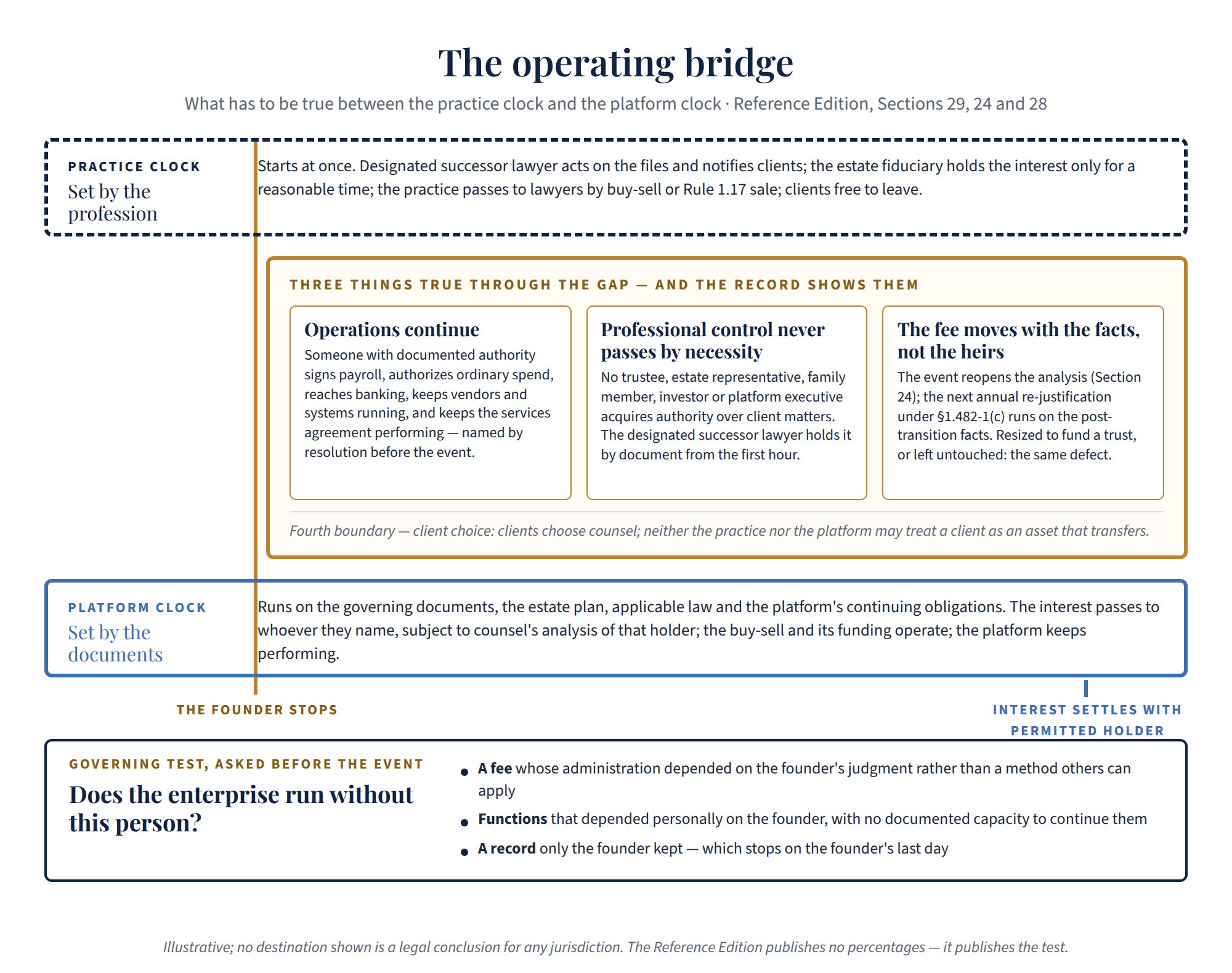
The governing test: does the enterprise run without this person?
The Reference Edition publishes no percentages for successor equity “because none would be right for a firm it has not seen.” What it publishes is a test: does the enterprise run without this person? The paper offers it as the honest way to size an interest. Read together with Section 29’s death-or-disability scenario, this brief applies that same question to the operating bridge: does the platform’s continuity depend on the founder personally, or on institutionalized functions, authority, and records? The paper’s own words in that scenario: “A structure that was real on the day before the founder died is real on the day after. One that depended on the founder — a fee the founder set, functions the founder performed, a record only the founder kept — becomes the thin file of Section 27 at the moment it can least afford to.”
Those three dependencies are the ones to look for, and they can be looked for in advance. A fee whose administration depended on the founder’s judgment rather than on a documented method others can apply presents the dependency the paper warns about; when the founder is gone, the method still has to operate on the changed facts rather than defaulting either to an inherited number or to a result-driven adjustment. Where material platform functions depended personally on the founder, without documented institutional capacity to continue them, the founder’s departure can leave the services agreement describing functions the platform can no longer demonstrate it performs, and the fee those functions supported has lost its substance. A record only the founder kept is a record that stops on the founder’s last day, which is the day a regulator, a taxing authority, or a buyer will most want to read it. The test is not whether the founder is important. Founders are. It is whether anything the structure’s durability rests on exists only in the founder’s person rather than in the platform’s documents, workforce, and file.
The question is asked before the event, revisited through the annual cycle, and reopened whenever the triggering events of Section 24 materially change the facts, because the answer changes as people, functions, and documents change. Where the honest answer is no, the remedy is not a better bridge; it is a platform that employs its own people, sets its fee on a method a stranger could apply, and keeps a record a stranger could read. Where the answer is yes, the three conditions below are what the record has to show.
First: operations continue under documented authority
Someone with authority the documents already granted can sign the platform’s payroll, authorize its ordinary expenditures, reach its banking, keep its vendors and systems running, and keep the services agreement performing while counsel manages the practice’s transition. The instrument is a resolution adopted before the event, naming who may act for the platform in a transition and within what limits, so that the first hour after a founder’s death or incapacity is governed by a document rather than improvised by whoever is in the office. The paper’s illustrative composite describes exactly this: “resolutions naming who could act for the platform from the first hour.”
The practice side has its own two items, and they are counsel’s, not the platform’s. In the paper’s words, “the malpractice carrier is notified and the trust accounts stay where Rule 1.15 puts them — under lawyer control, whoever else is signing anything”; whatever notice or coverage review the professional-liability policy and the transition facts require is handled there. Nothing in a platform transition reaches client funds, case costs, or client advances, and a bridge design that touches any of them has misdescribed the structure.
Second: professional control never passes by necessity
The Reference Edition states this condition as an absolute, and it is one of the few places the paper uses the word “never.” There is no moment in which a trustee, an estate representative, a family member, an investor, or a platform executive acquires authority over client matters because no one else is there to exercise it. In the paper’s words, “the designated successor lawyer and the remaining lawyers hold that authority by document from the first hour.” Which lawyer that is comes from the practice’s own succession arrangements: a designated successor where one is named — the mechanism Comment [5] to Model Rule 1.3 contemplates for a sole practitioner — and otherwise the remaining lawyers under the firm’s governing documents. A platform holder who comes to the interest through the estate — a trust, an heir, a fiduciary — stands in the same position as any other nonlawyer holder: no vote, consent, or veto reaches client acceptance, case strategy, settlement authority, or the hiring and termination of lawyers, and Rule 5.4(c) and (d) are tested on that holder as they would be on an investor.
This is the condition the practice-side instruments exist to satisfy. Comment [5] to Model Rule 1.3 contemplates that a sole practitioner prepare a plan designating another competent lawyer to review client files, notify each client of the lawyer’s death or disability, and determine whether protective action is needed, and a number of jurisdictions have adopted designation requirements of their own. Model Rule 5.4(d)(1) permits a fiduciary representative of a lawyer’s estate to hold the lawyer’s stock or interest in the practice only for a reasonable time during administration. The designation and the timetable are counsel’s to design; the bridge’s job is to make certain the platform side never fills a gap the practice side left open. A regulator reading the succession file asks one question, in the paper’s words: did professional control stay with lawyers through the transition?
Third: the fee moves with the facts, not with the heirs
Section 28 of the Reference Edition ends its formation agenda with a question many succession plans never ask: what happens to the fee. A founder’s death or retirement can change the services rendered, the personnel rendering them, the cost base, and often the key-person and related-party arrangements underneath. The fee methodology should respond when a material change affects the functions, personnel, risks, costs, or other facts on which the selected method depends, and the record should show it responding for that reason. The sequence is the paper’s: the succession event reopens the existing answer when it occurs, under Section 24; the question is then, in Section 29’s words, “answered in the next annual re-justification under §1.482-1(c), on the new facts” — the annual substantiation refresh documents the method and its quantitative support on the post-transition facts rather than rolling the pre-transition record forward.
Two failures are the same failure. A fee resized to fund a trust, or to support the heirs at the level the founder’s draws once did, is a disguised distribution whatever the succession plan calls it; the paper says as much in its list of what the section does not claim. A fee left unchanged because no one was left to change it is, in the paper’s phrase, “the same defect read by two different reviewers”: a management fee that is identical in the year before and the year after a material change in the platform’s workforce invites the reasonable question of what method produced both numbers. The bridge therefore carries a note into the annual file, as the paper’s composite does, that the next §482 refresh will be run on the post-transition facts. Under the Reference Edition’s design standard the independent economist refreshes the economic support on the changed facts; neither family economics nor successor ownership determines the charge.
The fourth boundary: client choice
Clients choose counsel. The practice provides continuity machinery — the designated successor, the client notices, the file review — and neither the practice nor the platform may treat a client as an asset that transfers. Rule 1.17, where adopted, requires written notice to each client of a proposed sale, the client’s right to retain other counsel or take possession of the file, and a presumption of consent only where the client does not object within the period the rule sets. A bridge that is well built keeps the lights on and the fee honest; it does not keep the clients, and the Reference Edition’s position is that continuity on that point “is a fact diligence prices, not a gap design closes.”
The events that reopen the answer
The bridge is not a document drafted once. Section 24 of the Reference Edition lists the events that reopen the existing analysis whenever they occur rather than at the next annual meeting, and several of them are succession events by another name: the death, disability, or announced retirement of a principal; personnel moving between the practice and the platform; a change in investors, governance, or control; a material change in the fee, the cost base, or the platform’s margin; a contemplated financing, sale, or recapitalization. Each moves at least one fact a prior conclusion rests on, and the discipline is that the event triggers the review, “not the next annual meeting, and not the reviewer who eventually notices.”
An announced retirement can allow operating authority and responsibility to migrate deliberately before the founder leaves — who signs, who decides, who supervises, moved by resolution rather than by default — which makes it possible to test the bridge against observed facts rather than only against an emergency. Section 29 owns the retirement pathway itself.
What the bridge is made of
None of this creates a new record. The succession plan is one of the governance decisions of record the Reference Edition enumerates in Section 26 — one of the ten, not an eleventh — and the bridge is the part of that plan through which a later reader can test whether continuity actually operated as documented. The bridge’s own components are few: the resolutions that name who may act for the platform in a transition and within what limits; the practice-side designation of a successor lawyer, which is counsel’s instrument; the documented migration of operating responsibility; the professional-control boundary, stated in the documents; the record of changed functions and personnel; and the note that the next fee refresh runs on the new facts. Section 28 owns valuation and transfer funding; the successor-equity brief owns how successor attorneys acquire and exit platform interests.
The file is re-read every year across the lanes: estate counsel for the instruments, the CPA for the funding and the basis consequences, the economist for what a change in personnel and functions does to the fee, the benefits advisers for the plans. A buyer reads it asking whether the platform’s operating record and economics remain underwritable after the transition. A regulator asks whether professional control stayed with lawyers. A taxing authority asks whether the fee followed the facts. The paper’s argument, made one last time in its succession section, is that a file built for all three answers all three.
What this brief does not claim
It does not describe how the practice is transferred, who may buy it, or on what timetable; those are Rules 1.17 and 5.4 as adopted, and counsel’s. It does not settle, for any jurisdiction, who may hold a platform interest after a founder leaves. It does not describe how a successor attorney acquires platform equity; that is the subject of a separate brief, and Section 29 of the paper is its authority. It does not touch case costs, client advances, or client funds. It does not suggest that a fee may be set, held, or moved for any reason other than the facts of the services rendered. And it does not promise that a well-drafted bridge preserves value; the paper’s position is that the bridge preserves a structure that was already real, and does nothing for one that was not.
Advisor implications
For counsel, the bridge is the practice-side continuity instrument — the designated-successor plan and whatever the firm’s documents provide for the practice interest — together with the professional-control boundary and the review of every holder the platform interest may pass to; the resolutions naming who may act for the platform belong on the same formation agenda. For estate counsel, the platform’s ownership documents and the estate plan are read together so that neither names a holder the other forbids; the funding architecture is Section 28’s subject. For the CPA of record, the transition implicates return positions that Section 28 and Section 30 set out. For the independent economist, the post-transition refresh on the changed functions, personnel, and cost base is the deliverable the bridge exists to trigger. Guardian Tax Consultants® administers the contemporaneous operating record and the annual cycle that carries it, and coordinates the transition file across the advisory lanes; counsel owns every legal conclusion, and the CPA owns the return.
Related Insights
- The Durable Law-Firm MSO — Reference Edition (Section 29, Succession: The Two Clocks)
- Law-Firm Succession Planning: What an MSO Can Change
- Successor Equity: How Attorneys Acquire an Interest in a Law-Firm MSO Platform
- The Annual Substantiation Cycle for a Law-Firm MSO
- Law-Firm MSO Retained Capital: Growth, Retention and Succession
- Rule 5.4 and the Law-Firm MSO
- For Law Firms
Frequently Asked Questions
Who runs the MSO the day after a founder dies?
Whoever the platform’s resolutions, adopted before the event, named to act for it in a transition — with authority to sign payroll, authorize ordinary expenditures, reach the banking, and keep the services agreement performing. That person holds no authority over client matters; the lawyers the practice’s succession arrangements authorize — a designated successor lawyer where one is named, and the remaining lawyers — hold that by document from the first hour.
Can the founder’s family or trust direct the law firm through the platform they inherit?
No. A trust, heir, or estate representative holding platform interests stands in the same position as any other nonlawyer holder: no vote, consent, or veto reaches client acceptance, case strategy, settlement authority, or the hiring and termination of lawyers. Whether that holder may hold the interest at all is counsel’s determination in each jurisdiction.
What happens to the management fee when the founder is gone?
The event reopens the analysis when it occurs; the annual substantiation refresh is then performed on the post-transition facts under Treas. Reg. §1.482-1(c), by the independent economist, to the extent the succession event materially changes the services rendered, the personnel, the risks, the costs, or other facts relevant to the selected method. A fee resized to support the heirs and a fee left untouched because no one changed it are the same defect read by two different reviewers.
Does a well-built bridge keep the clients?
No. Clients choose counsel. The practice provides continuity machinery under the duty of diligence and Rule 1.17’s notice requirements, and neither the practice nor the platform may treat a client as an asset that transfers.
How does a founder know in advance whether the structure will survive them?
By applying the Reference Edition’s test: does the enterprise run without this person? If the fee rests on a method only the founder applies, if material functions depend personally on the founder and the platform has no documented personnel or operating capacity to continue them, or if the record exists only in the founder’s keeping, the answer is no, and the remedy is to fix the platform rather than to draft a better transition document.
Selected public authorities
- ABA Model Rules of Professional Conduct 1.3 (Comment [5]), 1.15, 1.17, 5.4(a)–(d), 5.6(a); state analogues and state designation requirements as adopted.
- IRC §482; Treas. Reg. §1.482-1(c) (best-method rule; annual re-justification); Treas. Reg. §1.482-9 (controlled services).
- IRC §537(a)(2); IRC §303; IRC §101(j); IRC §264; Connelly v. United States, 602 U.S. 257 (2024).
- The Durable Law-Firm MSO — Reference Edition, Guardian Tax Consultants®, v1.1, September 2026, Sections 24, 26, 27, 28 and 29.
Disclaimer
Informational only. Applicability depends on the specific facts, structure, and advisory environment of each engagement. Guardian Tax Consultants® provides MSO strategy, modeling, documentation coordination, governance support, fee-methodology coordination, and advisor-integrated implementation support. GTC™ does not provide legal opinions, prepare tax returns, or replace the client’s independent CPA, legal counsel, investment advisor, insurance advisor, or family office. Tax and legal advice, tax-return positions, legal conclusions, filings, and opinions are provided by the client’s independent legal and tax advisors. Guardian Tax Consultants® is not a law firm, does not practice law, and expresses no view on whether any arrangement satisfies any jurisdiction’s rule. Case illustrations referenced from the Reference Edition are anonymized composites, not named clients or completed transactions. No outcome promises. No pre-packaged structures.