
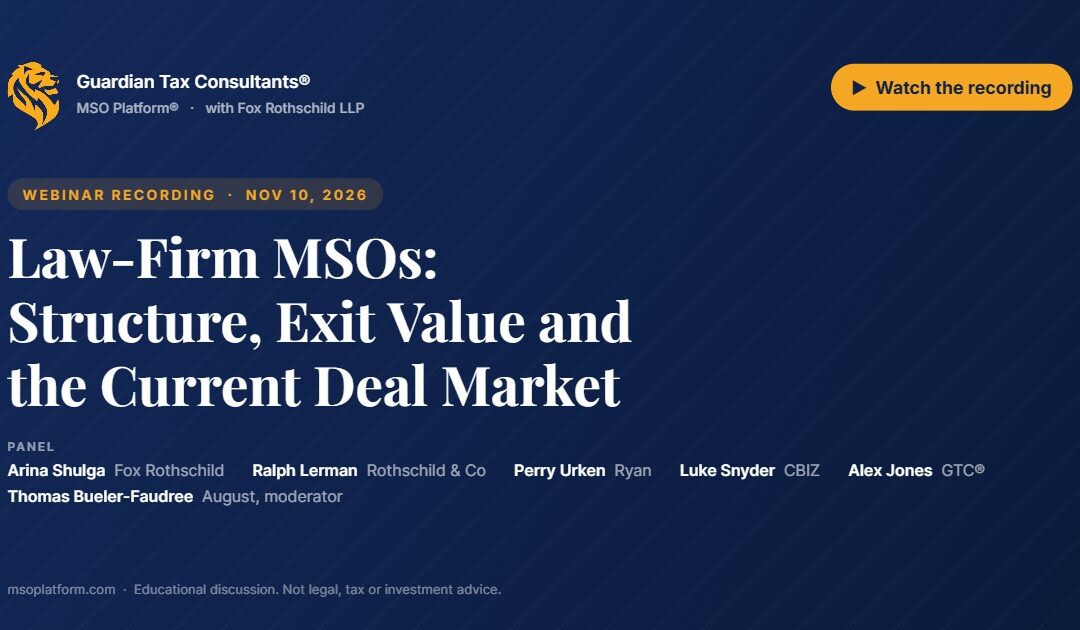
WEBINAR RECAP · NOVEMBER 10, 2026
This recorded discussion is educational only and does not constitute legal, tax, accounting or investment advice. Panelists express their own views.
Recording provided by Fox Rothschild LLP and shared with permission. The transcript is below.
On November 10, 2026, Guardian Tax Consultants® co-hosted a one-hour webinar with Fox Rothschild LLP on how management services organizations (MSOs) are being used by law firms, with much of the discussion on personal injury practices. A lawyer, a transfer pricing economist, an investment banker, a financial due diligence advisor and GTC® covered how the structure works, how the management fee is set and kept defensible, what investors are looking at, and where the ethics questions sit. The recording, a written summary and the questions from the session are below.
Co-hosted with Fox Rothschild. Event details are on Fox Rothschild's event page. Related: GTC is building the MSO Platform with August.
Key takeaways
1. An MSO is a separate services company. It takes on a firm's non-legal functions, such as finance, HR, marketing, intake and IT. The lawyers keep owning the practice. Where there is an outside investor, the investor owns the MSO, not the law firm. More on how a law firm MSO works.
2. Not every MSO is built for a sale. The panel described four models in the market: private equity backed, venture backed, lawyer owned, and vendor style. Lawyer-owned MSOs are often set up for succession planning and staff retention, with no outside money involved.
3. The management fee carries the economics. It is the one channel through which value reaches the MSO. Under the fee-sharing rules it cannot be set as a percentage of the firm's revenue or profit, so it has to be priced and documented as a market fee for the services and assets the MSO provides, and set out in the law firm MSO agreement.
4. Buyers read the numbers on an accrual basis. Most contingent-fee firms keep their books on a cash or tax basis. The panel's advice was to see the accrual-basis picture, through a sell-side quality of earnings review, before going to market.
5. Ethics guidance is still thin. There are few state bar opinions and no court decisions yet on where business services end and control of legal work begins. The structure has to be compliant on paper and in how it is run day to day.
Talk through your firm's situation
Tell us a little about your firm and the GTC® team will reach out to set a time.
Not ready to talk? See the law-firm MSO governance checklist →
What the panel covered
How the MSO model works
Arina Shulga of Fox Rothschild opened with the basics. Because a law firm cannot be owned by non-lawyers, a transaction does not buy the firm. An MSO is formed, acquires the firm's non-legal assets, and provides back-office services to the firm under a management services agreement. She walked through the four models she sees and noted that a firm can also create its own MSO. For background, see what a law firm MSO is and how it works.
Why now, and what other professions show
Alex Jones of GTC® placed the law-firm MSO in a longer history. The structure dates to physician practices in the 1990s and later spread to dentistry, veterinary medicine and accounting, each a field with licensing limits on who may own the practice. He noted that an MSO is a separate entity with uses beyond a transaction, including retaining capital for the business and planning for succession.
Transfer pricing and the management fee
Perry Urken of Ryan, LLC explained that an investor in an MSO owns only the non-legal assets and has no direct access to client fees. The management fee has to be established and documented as a market fee, and the federal transfer pricing regulations give a framework for doing that. He also covered what happens when the fee is set too low: income is left in the law firm, and it cannot be corrected after the fact without running into the fee-sharing rules. Periodic repricing and defined trigger events are the usual protections. The contract side is covered in the law firm MSO agreement.
Implementation and ongoing administration
Alex Jones described the fee study as a snapshot of the services, people and assets that sit in the MSO. When those change, the study typically needs to be updated, so the fee is reviewed on a regular cadence and after a significant change in staff or structure. He named three reviewers the structure should be ready for: the IRS, state regulators and a buyer in due diligence. A deal can stall when an MSO has no operating history for a buyer to examine. Related: how MSO management fees are calculated.
The deal market
Ralph Lerman of Rothschild & Co. grouped law firms into three categories: consumer (estate planning, family, immigration), corporate (transactional and other business-to-business work, including insurance defense) and contingent (largely personal injury). He said investors are increasingly choosing one lane. On why firms take capital, he pointed to ownership transition for long-time founders, the cost of technology, and keeping talent by spreading ownership more widely. Commentary reflects the market as of November 2026.
Quality of earnings
Luke Snyder of CBIZ Advisors, LLC explained the sell-side quality of earnings review: an advisor on the firm's side recasts the books the way a private equity buyer would read them. For contingent-fee firms the main step is moving from cash to accrual, recognizing revenue when a settlement is agreed. He noted that pre-litigation and litigation-heavy firms come out differently, since large settlements are uneven and a long-running case inventory is hard to value. He also discussed how purchased case leads may be treated.
Legal and ethics considerations
Arina Shulga listed the issues that shape how the MSO relationship is drafted and run: the prohibition on fee sharing, the Rule 5.4 limit on partnerships with non-lawyers, and investor rights that could amount to control of the practice, such as vetoes, approvals over hiring and budgets, long exclusive terms and heavy termination penalties. She added independence of professional judgment, client confidentiality and privilege, unauthorized practice of law, differences between states, and client disclosure and consent. Related: Rule 5.4 and the law firm MSO.
Where AI fits
Moderator Thomas Bueler-Faudree of August asked what happens to the management fee if AI changes a firm's costs and revenue. Perry Urken's answer was that technology is one of the assets the fee pays for. If the fee anticipated its value, the result follows the fee. If it did not, the repricing provisions matter.
Questions from the session
Answers are the individual panelists' views as given on November 10, 2026, edited for length.
Can a small or mid-sized firm use the MSO to give non-attorney staff an equity or profits interest?
Alex Jones said that, in his view, an MSO can hold management incentive arrangements such as phantom stock for people who are not practicing law, and that retention is one reason firms set up an MSO outside of a transaction. The ethics rules that apply depend on the state and should be confirmed with counsel.
Will an Am Law 20 firm do an MSO deal within three years?
Arina Shulga: probably not, though she expects carve-outs of areas such as technology or e-discovery with a minority investment. Alex Jones: likely, after smaller firms go first. Ralph Lerman and Luke Snyder: yes, with Ralph adding that it could be an AI-native firm.
Will a law-firm MSO go public within five years?
Arina Shulga: probably not. She expects sponsor-to-sponsor sales first, and noted that a public offering would require disclosing material contracts, including the management services agreement. Alex Jones: no. Ralph Lerman: yes. Perry Urken: yes. Luke Snyder: yes, noting that publicly traded law firms already exist overseas.
Will the first large exit come from personal injury or corporate practice?
The panelists who answered said personal injury. Arina Shulga added other consumer and high-volume practices.
Panelists
Titles and firms as given at the session on November 10, 2026.
- Arina Shulga, Partner, Fox Rothschild LLP (New York). Corporate and M&A attorney who represents participants in legal MSO transactions.
- Perry Urken, Principal, Transfer Pricing, Ryan, LLC. Economist with more than 25 years in transfer pricing, including management fee work for law-firm MSOs.
- Ralph Lerman, Managing Director, Business Services, Rothschild & Co. Investment banker advising on law-firm transactions.
- Luke Snyder, Managing Director, CBIZ. Financial due diligence and quality of earnings advisor, with more than 600 engagements on the buy and sell side.
- Alexander Jones, CEO, Guardian Tax Consultants®. Structures MSOs and services them each year so they hold up to review by the IRS, state regulators and buyers.
- Thomas Bueler-Faudree (moderator), Co-Founder, August. Works with law firms on AI.
Further reading
How GTC® Works · 9 Pages
What GTC® Does for a Law-Firm MSO
How GTC® designs, implements and services a law-firm MSO: how the structure works, the feasibility review, implementation, the independent fee study, who does what, and annual servicing. Written for law-firm owners, their counsel and investment bankers.
Download: How GTC Works (PDF) →
For the full practitioner reference, see The Durable Law-Firm MSO Reference Edition. Illustrative only; not legal, tax or accounting advice.
Read the full transcript
Transcript lightly edited for readability. Times match the recording.
Stephanie Forchi: [0:00] Welcome and thank you for joining us for today's program. Law firm MSOs, structure, exit value and the current deal market. We have just a few announcements before we get started. Please note the seminar and all accompanying materials are protected by copyright and that the material presented by our speakers at this program have been gathered for general informational purposes only. This program is being recorded by Fox Rothschild and the recording by others is not permitted. Please also refrain from using AI note taking tools as recording or automated note taking may misrepresent or distribute our content in unintended ways. Without further delay, I'll hand it over to our panelists.
Introductions
Thomas Bueler-Faudree: [1:03] Thanks, Stephanie, and thanks everyone for joining. I'm Thomas, co-founder of August. We work with law firms on the AI side and over the past year, more and more of our firms have started to ask the same question. What is an MSO and should we be thinking about doing one effectively? And we have a select group of analysts and hosts from Fox Rothschild, Ralph from Rothschild & Co and Alex from GTC. And to put this in perspective, two things are happening at the same time in law right now. The first is AI, which everyone is talking about. And the second is capital and MSOs, which far fewer people are talking about. For most of their history, US law firms could not take outside investment because only lawyers can own a law firm. The MSO is the structure that now lets investors put money into the business side of the firm while lawyers keep owning the practice. Law is getting a new technology and new money at the same time. And I don't think any other industry has had both arrived at once. And we have the right people to talk to about this today. So here's our panel. Arina from Fox Rothschild, Alex from GTC, Ralph from Rothschild & Co, Perry from Ryan, Luke from CBIZ and myself. And before we get into it, I think we should start with quick introductions. And if we can follow the order on the slides, that would be great. So I'm going to hand it off to Arina.
Arina Shulga: [2:29] Hello everyone and welcome to our webinar. I am Arina Shulga. I'm a partner at Fox Rothschild. And I am a corporate and a M&A attorney. And I focus on representing participants in this new and exciting legal MSO space that we're going to discuss here today. Thank you.
Alex Jones: [2:53] I'm Alex Jones with Guardian Tax Consultants. And our primary role is to structure and put in place MSO so that they're operational, either pre or post transaction and to service them on an annual basis so that they're durable. In case there's an IRS audit, a state regulator, or a buyer that would like to diligence a deal.
Thomas Bueler-Faudree: [3:19] And Perry, I think Ralph will be joining a few minutes late.
Perry Urken: [3:28] Okay. Thank you, Thomas. I'm Perry Urken. I'm a principal with Ryan LLC. I'm an economist who specializes in transfer pricing. I've been in the transfer pricing space for more than 25 years. And over the past year, I've spent a lot of time working with MSOs in the legal sector. And I've helped structure a large number of MSO fees in the last year or so.
Luke Snyder: [3:57] Luke Snyder, I'm a managing director at CBIZ, soon to be partner at Grant Thornton. I've done over 600 financial due diligence assignments, quality earnings over the past 12 years here, 500 on the buy side, 100 on the sell side. And I've been referred into over 20 law firms over the last 12 months seeking that MSO structure and the PE investment. Interestingly, there's a significant parallel here to the accounting industry that I've been in for my entire career. The private equity money started coming in about five years ago to accounting, culminating in last Monday, the Grant Thornton acquisition of CBIZ, the firm I'm at. It was a $5 billion transaction, the largest transaction since the Price Waterhouse and Coopers & Lybrand over 25 years ago. So we've been kind of in this, seeing this over the last five years, the evolution of it. And it's just now starting here in the legal profession. So working with Ralph, who's on the panel from Rothschild & Co on numerous deals across the space, and have kind of formed a law firm practice within my practice.
Thomas Bueler-Faudree: [5:20] Absolutely. And you see the same parallels, not just in accounting, but in banking as well over the past 30 years. So look, that's the panel. These are the five people who you should know in the space. This is the dream team, so to speak. We have the lawyer, we have the accountant, we have the banker, and we have the people who actually know how to set this up as well. So and today you get all five of us for free. And it's going to be a fantastic, fantastic panel today. So basically the plan for the hour is that we'll talk about, we'll talk, we'll talk about the basics, what an MSO is and why now, we'll talk about the deal market, we'll talk about how the management fee works and quality earnings, and about the legal ethics concerns as well at the end, and then we'll have a rapid fire round and audience questions from everyone. If you have any questions, if you put it in the Q&A tab, we will try to incorporate it as, try to incorporate it as best as we can throughout the panel here today. And so, Arina, let's start with the basics. In plain terms, what is an MSO and how are law firms setting it up?
What is a law-firm MSO?
Arina Shulga: [6:24] Okay, so MSO stands for Management Services Organization, right? So it's a services entity essentially that performs non-legal functions for a law firm. What type of functions? Well, it could be finance and accounting, HR, payroll, benefits, marketing and branding, intake, calls, operations, IT, management systems, vendor management, you know, all basically all of the back office operations. So, and you already know, I'm sure that a law firms cannot be owned by non-lawyers, non-licensed persons. And therefore, the MSO presents kind of like an interesting workaround structure, you know, in case of like a potential acquisition. But an acquisition of a law firm does not happen, right? It's the MSO that gets created that then acquires assets of the law firm. So I kind of identify for myself like four types of legal MSO structures that I'm seeing, right? The first one and the one that attracts kind of most attention is the private equity backed MSOs. So what happens here? A private equity, let's say, creates an entity, that's going to be a management services organization, MSO, which then enters into an asset purchase agreement with the law firm to acquire its assets, essentially. And then enters into a management services agreement, an MSA or business services agreement, to provide those back end services that I just mentioned to the law firm. So this is one model that we're seeing. And this is also it can be done on a standalone basis, you know, just one MSO, one law firm type of relationship, or a private equity could create a platform where one MSO provides services to multiple law firms, for example. Another model that I'm seeing is VC backed MSOs. So let's say we have founders who create an MSO and then they get backed or they get financing from VC firms that are actually now being, you know, kind of active in the space. So and then they create, either create a law firm or they enter into a relationship, MSA type of relationship with an existing law firm. And here I feel like there is less pressure to scale and exit than in the first model that I mentioned. Another model that I'm seeing is it's the MSOs that are created by lawyers themselves, you know, so I call it like a lawyer owned legal MSO. So here we have lawyers on both sides and they just separate their back end operations into a separate MSO entity. And sometimes it just stays as is like it's kind of like their internal MSO entity. Nothing gets funded, you know, there's no outside investment. Or perhaps they develop the technology in the MSO and then they start licensing it to others. Or perhaps they decide to take a minority investment, but it gives them options, right. And the last model, which is kind of, you know, that has nothing to do with equity, investors or anything, it's just a typical standard legal MSO, kind of like a vendor-like relationship that there is a vendor. And it's kind of like a PEO model that almost, right, vendor that provides all the services to a law firm. It's kind of like a law firm in a box type of situation, which means that the agreements that are entered into the MSA would be shorter term, right, and it could be easily terminated. So that's kind of what I'm seeing in this legal MSO type of space. And I think we'll talk mostly about the first one, the private equity backed MSOs. But I just wanted to mention that those other models are also out there. And it's possible for a law firm to go ahead and create its own MSO as well.
Thomas Bueler-Faudree: [11:03] Absolutely. I mean, I definitely love that four different pieces there. I think that basically the commonality between all four of those is you have the law firm and you have the MSO. And then you have an MSA that goes between them, between the two. There and then the differences between basically who owns which different entity there. So Alex, you've set up a huge amount of these over the past couple of years. Why now and how has this worked in other industries so far? And I think this is the slide that really represents this well.
Why now, and how MSOs worked in other industries
Alex Jones: [11:42] You know, it's fascinating. We've had the privilege to work with over 100 MSOs that we've set up in roughly 16 different industries. So the law firm variant of MSO is relatively new from a private equity standpoint. But the management service organization has been around quite a long time. And if you go back to the 1990s, the primary purpose was to set up an entity where doctors could put administrative staff and they could scale where a doctor could see more patients. They could focus on what they're actually good at, which is diagnosing and curing disease and move that administrative burden of running the practice into a management entity. At the same time, it also allowed them to have a corporate protection to help with malpractice. And that kind of migrated out of the PC space into the dentistry space and then the veterinarian space in the accounting space. And during this whole transition throughout the last 30 years, we've seen different variations of MSO planning beyond just the structure, right? Private equity really got involved because the bottom line is within all of these types of core businesses, you have to either be a licensed practicing individual or there's some sort of regulatory ownership requirement that would really limit the amount of buyers without an MSO being in place. And so it's kind of fascinating now that it's moved into the legal space. I guess it's not surprising and perhaps it'll move into the engineering and the PE space in the states where you're not able to own a engineering firm without that licensing requirement. But to piggyback on what Arina had mentioned prior, you know, the MSO itself doesn't have to be just for a transaction, right? It's a separate entity. It builds via a management service agreement, which we're going to hear about in just a little bit how those are set up and how the pricing works to make sure that because both parties own both sides of the company, that it's respected from a tax deduction standpoint. And what we end up seeing is multiple uses of that management entity, whether it's to collect capital, whether it's different ownership shares, whether even a good example in the law firm space, attorneys might set up a management entity and perhaps that management entity is taxed as a C corporation. Why would they do that? They want to retain capital in the PI space for marketing dollars for spend on the next cases they need expert witnesses. And because attorneys are specified service businesses, they're at the top federal tax rate of 37%, they're able to retain capital at a lower rate to help the business. And at the same time, that same structure allows for succession planning. If you think about the typical owner of a PI firm, what is their plan? They have to have someone inside of the law firm to buy it or they have to sell it to an external buyer. Well, the MSO in of itself allows the economics to flow to perhaps the family or their trust if they were to pass away while the transition of the firm can move to a different attorney. So it opens up so much more planning beyond just the private equity space. So I think we'll see more and more MSO involvement because it's court tested. The IRS has case law around it. So we really understand that aspect. And I think kind of moving to the next section of management fees is really where the focus on the law side is more granular because of the ethics provisions. That's that's kind of the difference when we're dealing with non attorneys owning an MSO linked to a law firm.
Thomas Bueler-Faudree: [15:45] So yeah, yeah, I mean, it's definitely very cool to see this transition over the past couple of years. I mean, you've seen MSOs go from something that very few firms are thinking about to even Am Law 100 firms are thinking about today. And it's definitely a very common thing to do throughout PI throughout contingency based work today. So I guess we're going to skip I don't believe Ralph is here right now. Is that correct? So we're going to skip from talking about the market in terms of investment to talking about how you actually set these things up and what that looks like. So we're going to talk about how you actually set up the management fee and how you review that. So let me go to the next slide. And so I'm going to hand it over to Perry. So investors are really one part of the MSO and of course, none of the law firm. And how does the fee transition from the law firm to the MSO? And how does the cash flow transition there without violating fee sharing fee sharing rules?
How the management fee works
Perry Urken: [17:07] Thank you, Thomas. Yeah, that's right. And, you know, in some cases, investors may look at a potential target law firm its operating as a partnership, for example, and look at their EBITDA and just assume without too much forethought that if they invest in that entity, they'll have access to all the EBITDA. And that is generally an oversimplification because of the structure of the MSO structure. When effectively when an investor in an MSO structure for a law firm, they only own the non legal assets, not all the assets. And so furthermore, the legal entity that actually collects fees from clients from legal clients, they don't own that entity. So they don't have access direct access to those revenue streams. The only the sole mechanism that investors have to extract value out of their investment is the MSO fee, the fee that's paid by the law firm to the MSO for services performed and assets provided. And the fact that there are, as Thomas said, limitations on those fees for fee sharing reasons, meaning that you can't structure those fees based on a percentage of revenues or percentage of profits, it complicates the situation and reveals why just looking at the EBITDA is not really all investors need to do. But luckily, there are reliable means of optimizing MSO fees to minimize the leakage that potentially exists in terms of income being stranded at the law firm and not being moved to the MSO where the investors have access to it. And there's one main step is that it's imperative that MSO fees are established and documented as market fees for services performed by the MSO and assets owned by the MSO that are provided to the law firm. And luckily, there's a, in terms of how you do that, there's an exhaustive guidance in the tax world. The Treasury regulations in Section 482 provide about 800 pages of guidance for how to price controlled transaction in an arms-length manner. And that guidance is a helpful framework to use for establishing the market nature of MSO fees. And so that's something that's important and useful to do. Secondly, Section 482, the principles that underlie it are helpful in terms of realizing a goal of minimizing investor leakage. And the reason why is because under the 482 framework, you can think of a firm as a series of investments in assets by the enterprise. And each of those assets generates its own income stream. And what we often find is the case is that most of the assets at the enterprise value in an MSO structure are actually after the asset migration are actually at the MSO, not the law firm. So it follows that if most of the value of the assets are at the MSO, and most of the income is attributable to those assets, if properly priced, the MSO fees should reflect compensation for what's provided by the MSO in a way that effectively allocates most of the income to the MSO on an ex-ante basis. Now, on an ex-post basis, there are dynamics related to difficulties of accurately pricing on a prospective basis that I'll talk about. But that's really the challenge. And that's the way we look at trying to achieve what investors are looking for through a means that's supportable with respect to fee sharing rules.
Thomas Bueler-Faudree: [21:25] Yeah. Yeah. And just to summarize, basically, arms length means that you have to sort of be away from the law firm there and to charge the law firm the same price as the outside vendor would have charged for the same services there. And so, Alex, basically, the fee has to hold up over time. How does the fee keep up as the firm changes over the past over the next two or three years? And what do the IRS, state regulators and buyers look for when they review it?
Keeping the fee defensible over time
Alex Jones: [22:02] Right. So that is an actually complex question. I think we have to go back to what is the MSO actually delivering? Because if we all step back, the reports, the strategy, the structures, it's all important, but it's a snapshot in time. And what all those reports reflect is the actual activities and services provided or the IP that has been moved over into the MSO. So the first step is designing who actually moves to the MSO, what contracts, what IP, all of that information. And I think we're going to go into quality earnings and pro forma, which kind of details out that a little bit more. But once that's in place, and the MSO is what we would call stood up or operating, it becomes a lot easier, in my opinion, for us to understand on an annual and quarterly basis, how do we continue to defend not only the durability across these three reviewers, but the profits and the business economics itself of why we set the MSO up in the first place. I would tell you that part of the reason in the PE space deals tend to struggle or die is there's not necessarily an MSO that's set up, that's operating with historic financials to go back in diligence. And so a buyer is taking on faith or pro forma that they're going to be able to move EBIT up from one year, two year, three year, and that they're going to be able to take that and turn it into something that's worth that investment. Now, I think back to what Perry had alluded to with the IRS, section 482 and 162 has thousands of pages of documents. So from the IRS standpoint, as long as the management fee itself falls within what the reporting ranges are and the services are being provided, then you have a good basis to claim that deduction. And so what does that mean? That means either an annual or bi-annual basis having an updated study done. If there's a big change within the actual organization, you've added companies, you've had a significant change of staff that sits within the management entity, well, all of those services and labor movements are going to change the amount of related party deduction because the service and value that's charged back would have changed. So I think from that standpoint, a cadence of what we like to do quarterly is look at the census. We like to look at all the different data points that would indicate to are we within the management fee range or not. And the other side of this is what is the pricing methodology under 482 that you started with? Does it evolve with the firm? Because if you're simply relying on a cost basis, well, is a cost basis going to catch up and keep up. And also what happens if you have efficiencies like AI that could potentially impact a cost basis study? I think the state regulators, I'd love to tell you, have a great answer on that, but I've seen none of these tested. So from an ethics standpoint, I think the best thing that we can do is keep the attorneys in the law firm, the legal staff in the law firm, and only have the non legal services, the non legal staff inside of the MSO. And we put together attestations around the ethics requirements that would be expected and have those maybe documented on a quarterly basis have a ethics memorandum done prior to a transaction if a nonlawyer owns the MSO. And then from there, you have got to review what's happening. Some of the things around that I think are really critical could be anything from a malpractice claim in the MSO from someone who wired money that's not even not even a legal assistant, like have people thought down that far and down that rabbit hole. And finally buyers, you know, buyers are really looking at what is the future going to look like. And so I do think we have Ralph has joined, I do see him here who could probably speak much more into the buyer standard, because once a buyer has bought, what's he going to look at? He's going to look at, well, if it didn't work out, what are my exit options or what are my economic options to go back in our regulatory put of some sort of that stance. But, you know, ongoing, it's going to be monitoring. And I think the first, you know, to sum it all up, the first cases from state regulators and what they come out with is going to give us a road map to continue to improve upon the processes we have today.
Thomas Bueler-Faudree: [26:45] Absolutely. And thanks, Alex. I'm going to push back to Ralph to talk a little bit more about the buyer side and what's happening in the law firm deal market. This is the most interesting question and what kind of firms are investors looking at.
The deal market: where investors are looking
Ralph Lerman: [27:02] Hi, all. I apologize for being late. Just so this is a quick mic check. It works. It works. Awesome. Great. Well, I am living proof that these transactions are happening outside of the public domain. So what I would say is the law firm market is rapidly evolving both on the firms that are getting inbound interest from investors and the investors themselves. On the law firm side, I think the way I divide the world is into three different buckets. My simple brain likes to have the alliteration of consumer, corporate and contingent. So in that consumer bucket, what I normally say is that includes some estate planning, trusts and estates firms. There is a family law contingent and immigration law. Those are all broadly marketed to either high net worth individuals in the case of trusts and estates, family law. Sometimes that can be divided into firms that focus on one spouse or the other and then immigration law again, which is really interesting on the corporate side. What's interesting and evolving there is that is including not just transactionally oriented work, but also other business to business work. Many of you may have seen the recent public transaction involving an insurance defense firm called Wood Smith and the private equity investment bank, private equity firm called Charlesbank. And that was an insurance defense firm that worked on behalf of insurers defending against claims brought against them by personal injury lawyers and people who were involved in accidents. And there are also other categories within corporate law broadly defined as just M&A and real estate work and other corporate defense style transactions, governance, M&A and debt raises. On the contingent side, that is probably what got this party started as investors and investment bankers landed in new cities and went from the airports to their hotels and saw billboards everywhere. And then they once the as we know that know the Arizona ABS structure happened in 2022 that got people interested that this could be a real source of interest. So the contingent firms are broadly speaking personal injury, but then within personal injuries, smart and savvy and sophisticated investors understand that there are personal injury law firms that have sub focuses either on very high complex high value litigation and all they do is just go to court. And these are like that type of lawyer and they just do go to court because it's a very special emotion that requires a lot of paralegals and then also the higher volume motor vehicle accident firms. And within kind of that higher value consumer oriented firms, you're going to find firms that are focused on maybe workers comp, which include wrongful termination or wage and hour disputes and sexual harassment, as well as law firms focused on nursing home accidents or elder abuse and veterans disability. So there's just a wide panoply of investment opportunities within legal ecosystem, which is interesting because investors are now realizing that and then choosing lanes, that's the most interesting thing that I see. Because and I'm just going to go off video here for two seconds as I as I step into my next, but what's really interesting is firms are understanding that and they're choosing lanes. And so I say that people are on the spectrum of legally curious or legally committed. And then within that they want to choose a lane within. They just want to choose a lane between the corporate consumer and contingent. So that's what's really interesting to me. And I'll just move on to the next slide where we can talk about why these transactions are happening.
Thomas Bueler-Faudree: [31:39] Yeah, absolutely. I mean, basically, the two questions I get most often are how much are these firms actually worth and what is the use of funds? How do firms actually use these how do firms actually use this capital?
Ralph Lerman: [31:50] Great. So I would say on again, just going back to the continuum of different law firms, the consumer law firms use this as an opportunity to realize the fruits of 30 years worth of work in the case of many personal injury law firms that have advertised for 30 years either inherited it from their parents, but then also or built it more recently. And so it's more of like a generational ownership transition, I think, type facilitating it. That's, you know, in recognition of a silver tsunami. And I think that's also in relation of the fact that the future of laws, they project will change whether that's the rise of investments in technology that are required. And then also rising case acquisition costs as we need to feed the ever growing beast that is AI data centers or ad costs are going up and Google is taking more and more of a toll. So that is the primary motivation for private equity investment in personal injury law firms. What I'd say is on the corporate side, it is it is different. It is different in its recognition of once again, the three T's my simple brain. So that's the transfer of wealth. So of course, into retiring founder founders or partners who are have been at the firm for many years and are no longer economically relevant to revenue generation, but own quite a bit of the partnership shares. The other T is technology. I think it reflects the fact that firms do need to invest significantly in technology, whether that's Harvey or Legora or even like Kirkland & Ellis and devoting $500 million to build up their own AI tools. And then and then the third T is talent, which is to say that frankly, we saw what happens when talent does not have a vested ownership stake in a major law firm where there's a run on the law firm. And so the talent proposition of investment enables a broader diffusion of equity into law firms, which in theory would help retention and people stick frankly, rather than just leave for the highest dollar. There are obviously complications with the corporate law at the moment. I don't think any of any investor has like the perfect answer. But those are some of the primary motivations across again, the continuum of consumer to corporate law.
Thomas Bueler-Faudree: [34:26] Sounds great, Ralph. I mean, look, you I think that this is definitely a space that's moving very fast right now, especially on the multiple side as well. So we see we see a lot of momentum there. It's definitely can be a very frothy market today. And look, I know you also see this on the buyer side as well. I mean, I'd love to get a sense of how has how has how have buyers how have buyers changed over the past couple of years and how has quality of earnings worked on the deals that you've done and what has changed when a firm moves from cash to accrual accounting and what are the issues they what are the issues they get?
Quality of earnings and valuation
Luke Snyder: [35:00] Yep, happy to kind of frame it a little bit with what a sell side quality of earnings is. It would be, you know, when a law firm's thinking about kind of an MSO and potentially private equity money, they would hire, you know, someone like myself on their side of the table to kind of look at their numbers in a way that private equity would look at the numbers ahead of, you know, Ralph putting together a confidential information memorandum and taking it to market just so that you kind of square that up because typically they would be doing their books and records on a tax basis, especially a contingent fee personal injury firm. There would be no reason to be accruing that because then you would be accelerating your tax bill. So Ralph and I found ourselves in the third of the large PI firms to go to be sold the beginning of the year. And the first two were transacted on a cash basis. We kind of forced the issue of now like any other private equity deal. When you have a settlement that everybody's agreed to, you have revenue. So we accelerated the revenue to that date, the settlement occurred. It can create a 20, 30 plus million dollar receivable asset, settlement receivable that will come on the balance sheet for the first time. It also plays out in the working capital, which is there's kind of three things that private equity looks at is the adjusted EBITDA, the adjusted net working capital, and then the deal multiple. And like Ralph and I have learned, these pre-litigation shops that are doing kind of the higher volume, settling easier cases, monetizing through kind of commission or selling complex cases, were kind of the first to go and that revenue model they've been growing and this cash to accrual adjustment yields significant EBITDA. For example, if you generate $5 million of incremental EBITDA at a six times multiple, that's $30 million of enterprise value that you've just created for the founder. So you would want to examine that before you go into the market and know what your accrual based numbers look like. Let's see here. And then in a person, yeah, we talked about kind of pre-lit versus lit shops are very different. What the litigation shops will complain about is, look at all these cases that I've been working for years and years and years. I have this robust case inventory. How is the private equity model compensating me for that? And the answer is it's kind of really tough. Like it's the only lever that I've seen appropriately applied is you try and get a higher multiple for delivering all this robust case inventory. And that's a whole separate analysis from a traditional QoE. But when you're doing a recast from cash to accrual in a litigation heavy shop, that could work against you theoretically. If there's a huge settlement or two, it's very lumpy where these big settlements hit. So you got to be sensitive to that. But yeah, that's kind of the QoE in a nutshell. And we've gotten some another kind of specific thing into personal injury. They've been buying leads. So you'll pay $2,000 for per lead for a specific case. And you may be spending $200,000 or $300,000 a month to buy those leads. Our argument would be those are case specific. And instead of having to expense that as advertising in the month that you're buying a couple hundred thousand dollars worth of leads, you should be able to treat them like a case cost, like any other case cost, with a reasonable, they disengage. So you have to apply a disengagement rate. But that's kind of what the practitioner on the law firm side of the table would want somebody looking at all those things on their behalf. And I've been working with Ralph and some other investment bankers quite a bit in all these different, the consumer side, corporate side, contingent side, but the most action and the deals that are, I've been in that have been closing are on the personal injury side. So I'm kind of most well versed in that.
Ralph Lerman: [39:31] My name was invoked. So I feel like I can chime in right here using the presidential debate rules. Okay. So that was real alpha that Luke shared. This is middle market M&A where everything goes. And I love having fights about gaps. So Luke was sharing with you this concept of settled but not yet collected case receivables, which really matters when firms are growing 15 to 20%, they're effectively pulling forward today's revenue, which is greater, significantly greater than where it was 12 months ago. And then separately for firms that are acquiring leads, we believe there's some offset to those case expenses, not too dissimilar from the reimbursable case expenses that you might ordinarily not ding your profit and loss statement, you would just put it on your balance sheet that would be reimbursable. The other thing that we are advancing and trying to again push forward this because we like to represent sellers, sorry, investors who are on phone call, is around your tax basis. These transactions carry with them enormous favorable treatment for tax. And that's where you're going to want to speak with Luke and his expert team to value the tax basis step up. And you as sellers may want to get value for that going forward, or at least a share of that. And there's some strategy and tactics about when specifically you drop that bomb on the investors to get the most value. But those are that's some real alpha for this group right here.
Alex Jones: [40:57] Absolutely. And I don't know Thomas real quick, you know, from a simple standpoint, because I know who we have the folks on this call, we may have some that are very, very deep in QoE and understanding, but is there a way to level set what values are actually being applied, whether it's a multiple of EBIT, some way that could help translate what the value is within these practices that these owners probably do not even understand that they're sitting on. And I think that's really important because to tie the relevance to why would someone want to go through all of this analysis really has to go back to you're sitting on something incredibly valuable, but you probably don't even know it.
Thomas Bueler-Faudree: [41:47] Yeah, I mean, absolutely Alex, I think that like, especially for firms today, like there was incredible enterprise value that's been created. And it's been created for the first time. And I think that like, we really see multiples in a very wide range. I mean, the smaller the firm, maybe from three to 10, from my understanding, and then and then larger Am Law 100 firms are getting north of 15 at this point. And so that's an incredible amount of value on top of on top of on top of what you've built for the past 20, 30, 40 years there. And it's an incredible moment in history today. I mean, I really work on the AI side a lot every day. And so I'll put this as a scenario to as a scenario to Perry, but basically like, if AI cuts a firm's cost by 30% and this and lifts revenue by a lot, what happens to the management fee and what happens to the valuation today?
AI and the management fee
Perry Urken: [42:44] Sure. So I think, as was mentioned, as Alex mentioned earlier, the MSO fee, the management fee is a means of compensating for assets and services provided by the MSO. And in general, for well-run profitable firms, the largest value drivers are intangible property, things like trademarks, especially the PI space, but also technology, which may underlie AI tools, such as the reference in this question. And if priced correctly, the value that AI might bring by cutting costs by 30% and reaching revenue by 80%, if that value is embedded in the pricing of the MSO fee, then the value created by the AI will appropriately be reallocated through the MSO fee to the MSO. However, if either the pricing doesn't anticipate correctly the value of the AI or it's just a mispricing of the AI, then the total profits of the firm might be so high that the MSO fee does not appropriately extract the value that investors hope and you end up with stranded income in the law firm. And that's a bad thing because you cannot retroactively address mispricing without violating fee sharing restrictions. So, mispricing is a problem not just in the MSO structures. Mispricing is a problem in commercial dealings everywhere. I mean, think about, one example could be a landlord that leases a space for a restaurant on a quiet street and sets the lease fee at a certain level. And they in two years, the chef becomes famous and people are lined up around the block, they're going to want to have the ability to reprice that lease to extract the value out of that property. And so, there are ways that third parties set up arrangements such as compensation for services and assets to protect against mispricing, the impact of mispricing. These are things like periodic repricing on a normal basis and identification of specific triggering events that would justify repricing so that if for whatever reason the initial pricing for the technology underlying the AI is not sufficient, there might be a way to address that before the problem of stranded income becomes too big.
Thomas Bueler-Faudree: [45:22] Yeah, yeah. I mean, this only poses a lot of issues, poses a lot of interesting questions. I mean, I'm going to go all the way back to Arina and ask really, really, what are the key legal and ethical concerns that arise when structuring this, this relationship between the MSO and the law firm today?
Alex Jones: [45:46] And Arina, we had a question that may tie into this small to mid-sized firm setting up or giving equity or profits interest to non-attorneys to incentivize them. So that kind of ties into the ethics side of how the MSO would work. You may be able to hit both at one time.
Legal ethics
Arina Shulga: [46:04] Yes, sure. I'll try. So first of all, let me just mention that we haven't heard from any state bar about the issues related to governance like standards and legal ethics. I mean, okay, we have like one opinion from Texas from 2025 and one opinion from North Carolina going back like 20 years ago. But that's all the guidance we got. So we also know that no state, no court has decided on where those business services and improper control of legal work begins. So we really are kind of operating in the dark here. But it like really touches upon all legal ethics rules, right? Everything we draft has to be compliant. And then actually the challenge is, and I think Alex mentioned that before, is that it needs to actually be implemented in a compliant way and people being implemented in the right way. So controls definitely have to be set in place for the structure to not just be correct on paper, but also be implemented in a compliant way. But I mean, okay, so what are the main concerns? Like obviously there is a prohibition on fee splitting, but we've discussed that, right? The next one that comes to mind is again, rule 5.4B prohibition on forming partnerships with non lawyers, right? And here, you know, it can be like a little tricky in a sense like, for example, investor rights such as veto rights, some board seats, some approval over hiring, over budgets, like some exclusivity, you know, termination rights, right? They all can amount to like de facto control of the law practice. So it's not like, it's subtle. And I think there's a lot of devil in the details of how you draft it and how that can actually be interpreted. Also, even the MSA agreement, you know, the long term nature of it, the exclusivity, they have a penalties that come with early termination early. That can also be interpreted as eroding the law firm's independence, right? So next, it's definitely in the challenges, the interference with independent professional judgment, right? And that again can come through subtle ways like MSO's control over staffing, technology, marketing, intake, budgets, case selection criteria, all that if we put it all together, that can, you know, bring, you know, that independence of legal judgment into question, right? But then moving on to other things that you need to also consider about is a confidentiality. That's key. Data security, keeping the privilege, right? Maintaining the privilege, the attorney-client privilege in there, right? Because now the MSO will have access and will be dealing with client, you know, access to client files will be dealing with billing data and communications. So for all that, you need to have very clear guardrails in place. The whole system needs to make sense, like I'm kind of thinking through this legal ethics concerns, like that should really affect how you structure your MSO relationships. Also, don't forget about unauthorized practice of law, right? So the MSO cannot be personnel, they cannot be practicing law, obviously, to the extent that they are within the MSO. And finally, think about the multi-jurisdictional problems that may arise, right? So if the MSO is serving firms or lawyers in several states, then the MSO and the law firm, they need to comply with laws of all the states, right? Because now we all talk about the model, ABA model rules, but actually states have their own variations sometimes, right? And so it's really important when you're setting up the structure to kind of think, okay, which states are going to be affected, right? And then really dig into the laws of those states. Also, client disclosure, informed consent, all that also becomes relevant when setting up the structures.
Rapid-fire round
Thomas Bueler-Faudree: Rapid-fire round, one word each. Will an Am Law 20 firm do an MSO deal within three years? Arina?
Arina Shulga: For me, probably not. But I do expect to see carve-out deals, where law firms carve out technology, e-discovery or other services and take minority investment into those.
Alex Jones: I think so, but we'll have to see some smaller ones go first.
Ralph Lerman: I would say yes, but it could very well be an AI-native law firm that's quickly rising through the ranks.
Perry Urken: Pure speculation, but I'd say yes.
Luke Snyder: I'm going to say yes as well.
Thomas Bueler-Faudree: Will a law firm MSO go public within five years? Arina?
Arina Shulga: I would probably say no. I expect to see more sponsor-to-sponsor sales first, and then an IPO later, if ever. When you do an IPO you have to disclose a lot, including copies of material contracts like the MSAs, so it invites scrutiny into the fees and how it's all set up.
Alex Jones: No.
Ralph Lerman: I hate to argue with Arina because she's the lawyer, but there are a lot of smart people tackling this challenge in real time, and I've spoken to them about it. I would say yes in five years.
Perry Urken: I'm a yes.
Luke Snyder: Just the fact that there are publicly traded law firms overseas means there's at least a chance it happens here, so I'd say yes.
Thomas Bueler-Faudree: Will the first big exit come from PI or from corporate? Arina?
Arina Shulga: I would say PI, and also other consumer or high-volume practices.
Alex Jones: I think it'll be PI.
Ralph Lerman: It's publicly disclosed that Morgan & Morgan is seeking minority investment, and I'm in Dallas for what I believe is the largest personal injury institutional capital investment, so I'd say PI as well.
Perry Urken: PI.
Luke Snyder: I would say PI as well.
Thomas Bueler-Faudree: We're closing in on time, so we'll skip the last one. Any last questions from the audience?
Audience question and close
Alex Jones: [55:06] Yeah, we saw a question about compensating non-attorneys inside of the MSO with equity shares and not to speak out of turn, but I do believe that as long as they are not practicing law, the MSO and the structure of it can allow for management incentive comps, phantom stock, SARs. In fact, that's why a lot of attorneys are setting them up, not necessarily for transaction, but to keep the talent. And now that you've got other firms competing with capital to poach attorneys, if you're not setting up those long-term incentive plans, then you might have some liability within the practice to look at.
Thomas Bueler-Faudree: [55:44] Absolutely, Alex. I agree with you. I mean, I think we're at time now, but thank you to Arina at Fox Rothschild and Alex at Guardian Tax Consultants for hosting and thank you, Ralph Perry and Luke for being here. I think this has been an incredible session and I'm very much looking forward to round two here. If we didn't get to your question, I know there's a lot of them. Please email Fox Rothschild and Arina there and she'll pass it to the right person. And you also have all of our contact information here as well. Please reach out to us. This has been an incredible hour and I can say that there's many more information that we can cover here. I think there's probably three or four different sessions, three or four different webinars that we could cover on this. So thanks again, everyone. And I'm going to hand it back to Fox to close it out.
Stephanie Forchi: [56:44] Thank you guys. Thank you, everyone. We will be passing along the recording and materials. So we'll be in touch within the next couple of days. Have a great afternoon. Thank you. Bye.
Transcript is machine-generated and lightly edited; refer to the recording for exact wording.
Hosted by Fox Rothschild LLP. This page is GTC®'s summary of the session and is informational only; it is not legal, tax or accounting advice. Statements attributed to panelists are their own views. Market commentary reflects the discussion as of November 10, 2026. Applicability depends on the specific facts, structure and jurisdiction. Counsel owns the legal conclusions; the firm's CPA owns the returns.