
EVENTS · 3RD ANNUAL COLI SKI RETREAT
Notes from the 2026 COLI Ski Retreat in Ridgway: Reading Where the Nonqualified + COLI Architecture Is Moving
Three days at the Chipeta Lodge Resort + Spa in Ridgway, Colorado, with afternoon skiing at Telluride Mountain Village. The retreat is hosted by mapbenefits®. The substantive read sits in the morning sessions, where COLI product evolution, regulatory updates, and emerging nonqualified solutions are addressed by the institutional carriers and sponsors that anchor the category.
By Alex Jones, EA, CFP®, ChFC®, CLU®, CEPA®, Founder & CEO, and Mike Claudio, Co-Founder, Guardian Tax Consultants® · March 5, 2026 · 8 min read
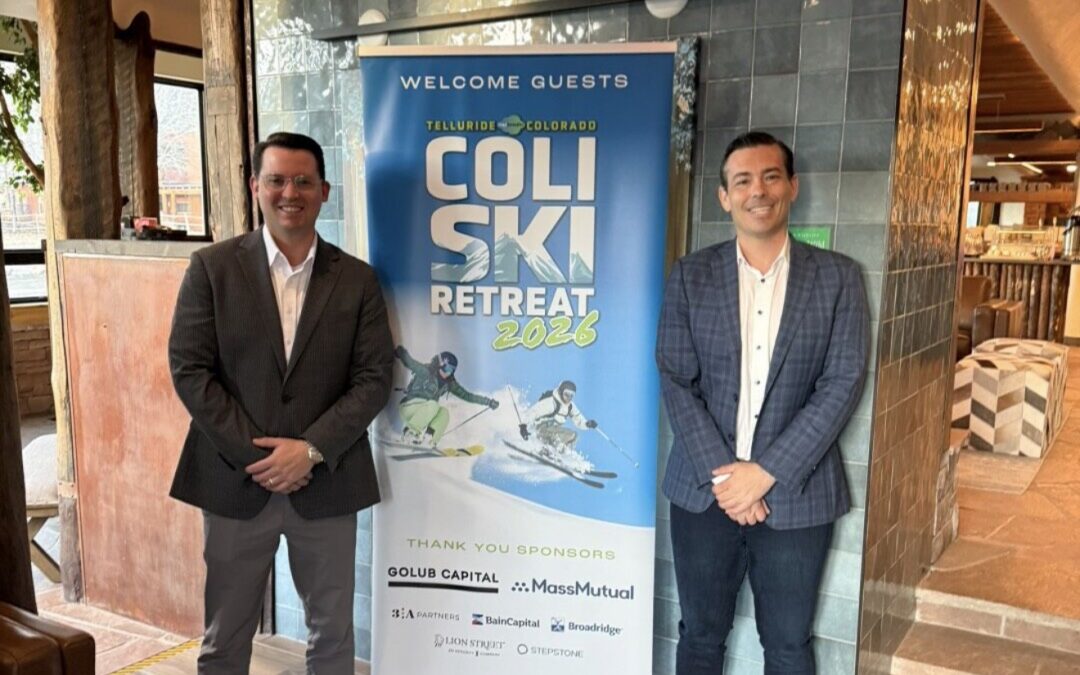
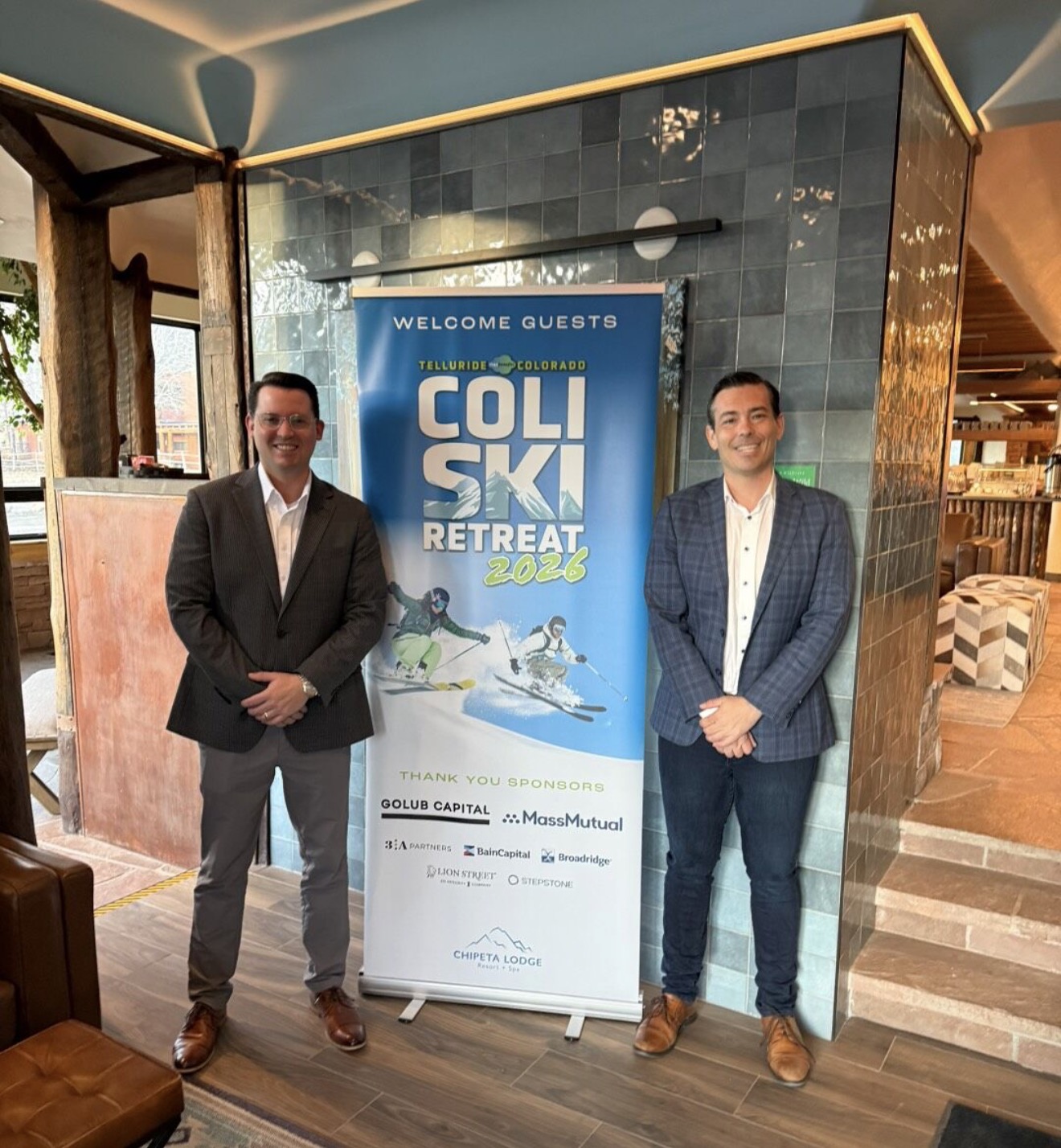
The 3rd Annual COLI Ski Retreat ran from Thursday February 26 through Saturday February 28, 2026, hosted by mapbenefits® at the Chipeta Lodge Resort + Spa in Ridgway, Colorado. Event sponsors included MassMutual, Golub Capital, 3:A Partners, Broadridge, Bain Capital, Lion Street, and StepStone. The format pairs expert-led morning sessions with afternoon skiing at Telluride Mountain Village, with shuttle service running between the lodge and the mountain. The closing dinner on Saturday February 28 was hosted at the Mezrah Residence — "Mt. Mez" — with shuttle returning to Chipeta at 8:00 PM. The notes that follow are an observational read from the seat of two practitioners who structure Management Services Organizations for closely held families and PE-integrated transactions, not a transcript of any single session.
Why this retreat reads differently than a general carrier conference
Corporate-Owned Life Insurance is one of the categories where the practitioner room and the carrier room sit in close enough proximity to make the format productive. The retreat is sponsor-led, which means the keynote sessions concentrate on COLI product evolution, regulatory updates that affect the wrapper, and the emerging solutions that institutional carriers, asset managers, and platform partners are taking to market for nonqualified deferred-compensation use cases. The audience is the wholesalers, advisors, and firm principals who design and deliver those plans for closely held companies and their executive teams. That audience is not the same as the general-session insurance crowd, and the questions are different in kind.
What we listen for in this room is the relationship between the COLI wrapper and the broader architecture the closely held client is operating inside. The COLI policy itself sits at the intersection of Internal Revenue Code §101 — the income-tax treatment of death-benefit proceeds — and §2042, which governs the inclusion of life-insurance proceeds in the gross estate when the decedent held incidents of ownership. For the closely held business owner whose operating company funds the policy, the relationship between the corporate ownership of the contract, the nonqualified deferred-compensation obligation it informally finances, and the eventual transition planning is not a peripheral question. It is the structural question. The morning sessions reach that conversation more often than the afternoon shuttle conversations do, but both are useful.
Where the nonqualified + COLI architecture is moving
The retreat's stated focus is on evolving industry practices, regulatory updates, and emerging solutions. Across the morning sessions, the consistent observation is that the nonqualified deferred-compensation market is being asked to do more inside the closely held company than it once did. The traditional use case — a SERP for senior executives, informally financed by COLI — remains the structural backbone. What is changing is the surrounding architecture. The COLI policy is being asked to coordinate with the operating company's broader cash-flow and benefit posture, with the principal's personal estate-liquidity plan, and increasingly with the entity architecture sponsors and operators are using to capitalize advisory and professional-services practices.
For the MSO practitioner specifically, the COLI conversation matters in two places. The first is at the funding decision. When the Management Services Organization is the entity that holds and pays the management fee from the operating company, and when that structure is supporting a nonqualified deferred-compensation obligation to the operating-company executives, the question of which entity owns the COLI policy — and the related-party documentation supporting the arrangement — sits inside the broader §482 substantiation file we maintain for the MSO arrangement. The second is at the eventual transition. The death-benefit proceeds, the policy basis, and the cash-value behavior over time all interact with the operating-company shareholders' transition planning, and the COLI architecture should be designed with that interaction in view rather than as a standalone product decision.
The COLI policy is rarely a standalone product decision. It is a financing decision inside a larger architectural question about what the closely held company is funding and for whom.
Observation · 3rd Annual COLI Ski Retreat · Ridgway, Colorado · February 2026
What the sponsor lineup tells you about the category
A retreat's sponsor list reads as a market-structure document if you let it. MassMutual is a primary carrier presence in the institutional COLI segment. Golub Capital and Bain Capital sit on the private-credit and direct-lending side, where the underlying COLI investment menu increasingly includes private credit allocations inside Separately Managed Accounts. StepStone brings the private-markets perspective into the same conversation. Broadridge is the platform infrastructure layer that supports the recordkeeping and regulatory function for institutional NQDC plans at scale. Lion Street is the independent advisor platform whose member firms deliver these plans into the closely held company and family-office channel. 3:A Partners sits in the actuarial and consulting layer where the plan-design and modeling work occurs. The composition of the sponsor list is the same composition the closely held client is touching when the COLI policy is designed correctly — a carrier, an asset manager (or several), a recordkeeping platform, an advisor, and the consulting layer that ties them together.
After the retreat, our team reviewed the published record on where the institutional COLI and BOLI market sits. The NAIC's Center for Insurance Policy and Research treats institutional COLI as an established balance-sheet financing vehicle for executive benefit obligations, and the regulatory and accounting framework around the wrapper has stabilized enough that the practitioner conversation has moved on to architecture and integration rather than to product mechanics. That is the conversation the morning sessions reflected, and it is the conversation the practitioners in the room are increasingly leading.
Speakers and sponsors
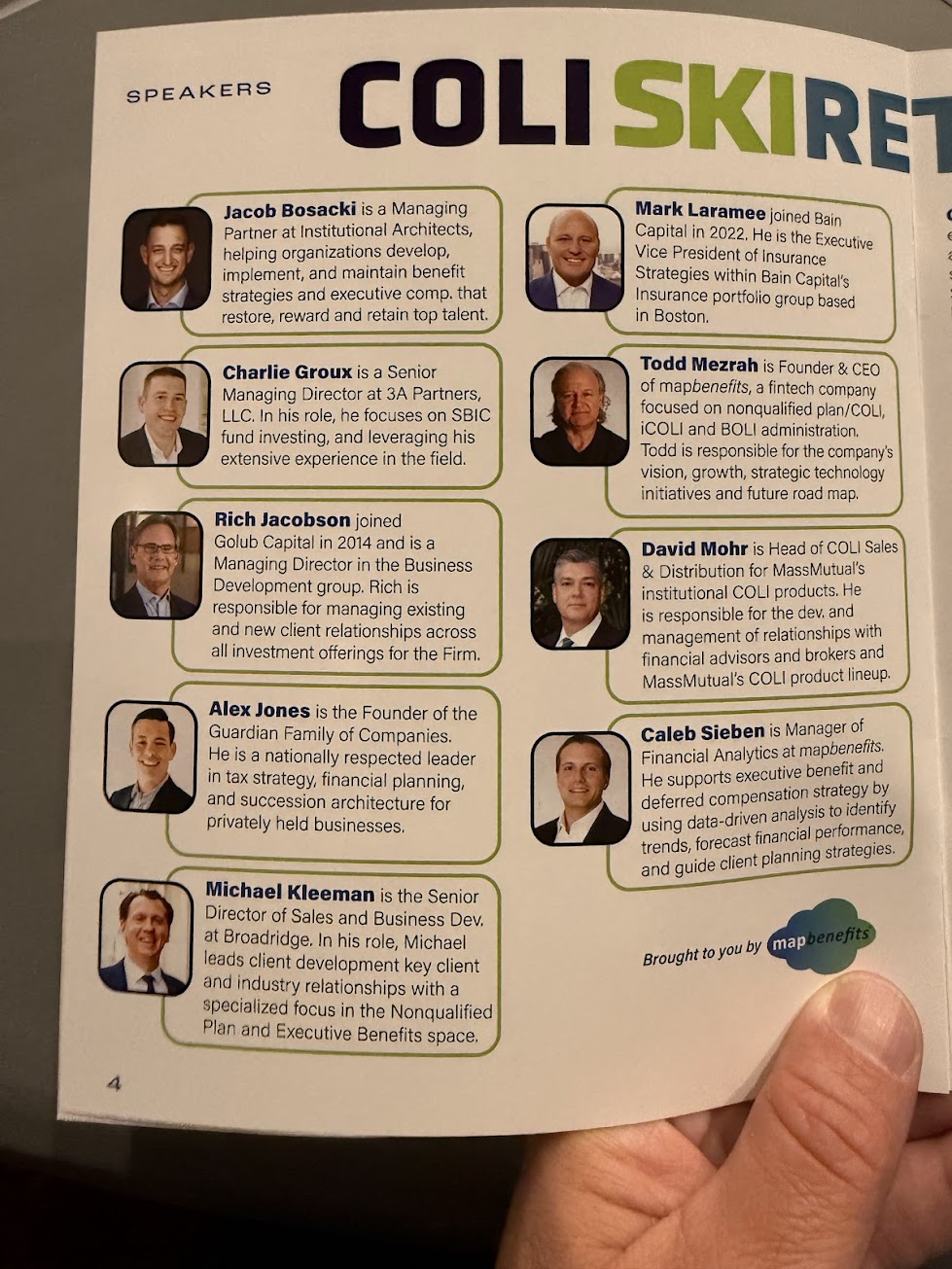
- Todd Mezrah — Founder & CEO, mapbenefits (fintech for nonqualified, COLI, iCOLI, BOLI administration)
- Jacob Bosacki, JD, FSRI — Managing Partner, Institutional Architects · LinkedIn
- Charlie Groux — Senior Managing Director, 3A Partners
- Rich Jacobson — Managing Director, Golub Capital
- Mark Laramee — Executive VP Insurance Strategies, Bain Capital
- Michael Kleeman — Senior Director, Sales & Business Development, Broadridge (NQ & Executive Benefits)
- David Mohr — Head of COLI Sales & Distribution, MassMutual
- Caleb Sieben — Manager of Financial Analytics, mapbenefits
- Alex Jones, EA, CFP, ChFC, CLU, CEPA — Founder, Guardian Family of Companies
Sponsors: MassMutual, Golub Capital, Bain Capital, StepStone, Broadridge, Lion Street, and 3A Partners.
From our library
Closing observation
Three days in Ridgway, with morning sessions and afternoon shuttle conversations on the way to and from Telluride, produces a different read than a general carrier conference. The category itself is stable. The architecture around it is not stable in the same way — it is being asked to do more, in coordination with more adjacent planning disciplines, than the COLI wrapper alone was designed to address. That is the right kind of pressure for a category to be under. It produces better-designed plans for the closely held client, and it brings the COLI conversation into the architectural seat where MSO practitioners and family-office principals can use it. See the rest of our Insights library for the technical briefs that sit underneath the architecture conversation.
Working through a related fact pattern?
For platform partners — independent advisor networks, CPA firms, family offices, and PE platforms — seeking MSO education, CPE programming, or advisor-facing training, GTC™ develops co-branded education and on-site sessions.
Explore Co-Delivery Programming →- Presenting at the Lion Street Corporate & Business Solutions Summit in Nashville: MSO Market Opportunities for Corporate Markets
- Recording the Life Matters Podcast with Bill Bell at Penn Mutual: A Conversation on MSO Architecture and Institutional Insurance Planning
- Business Excellence Symposium Greenville: MSO Architecture and Enterprise Value