
At a glance
Situation: Two medical device companies, $8M net income; unfunded buy-sell; growing exposed retained earnings.
Design: $5M documented management fee to a C-corporation MSO; loan-regime split-dollar insurance funding; intercompany credit facility.
Outcome: ≈$850K first-year federal tax deferral; buy-sell moved from unfunded to insurance-funded.
Engagement Profile. Two medical device companies; $45 million gross revenue; $8 million net income; taxed as an LLC; majority/minority partnership between two owners.
The Situation
The partners operated without a funded buy-sell agreement — the most common single point of failure in closely held partnerships. Retained earnings were accumulating inside the operating companies without a plan for their deployment or protection, and the owners faced a projected estate tax liability with no funding mechanism that did not compromise operating liquidity.
The Structural Question
Could a management structure both discipline the growing retained earnings and create the after-tax capital to fund key person coverage, the buy-sell obligation, and estate liquidity — without pulling working capital out of the operating companies at personal tax rates?
The Design
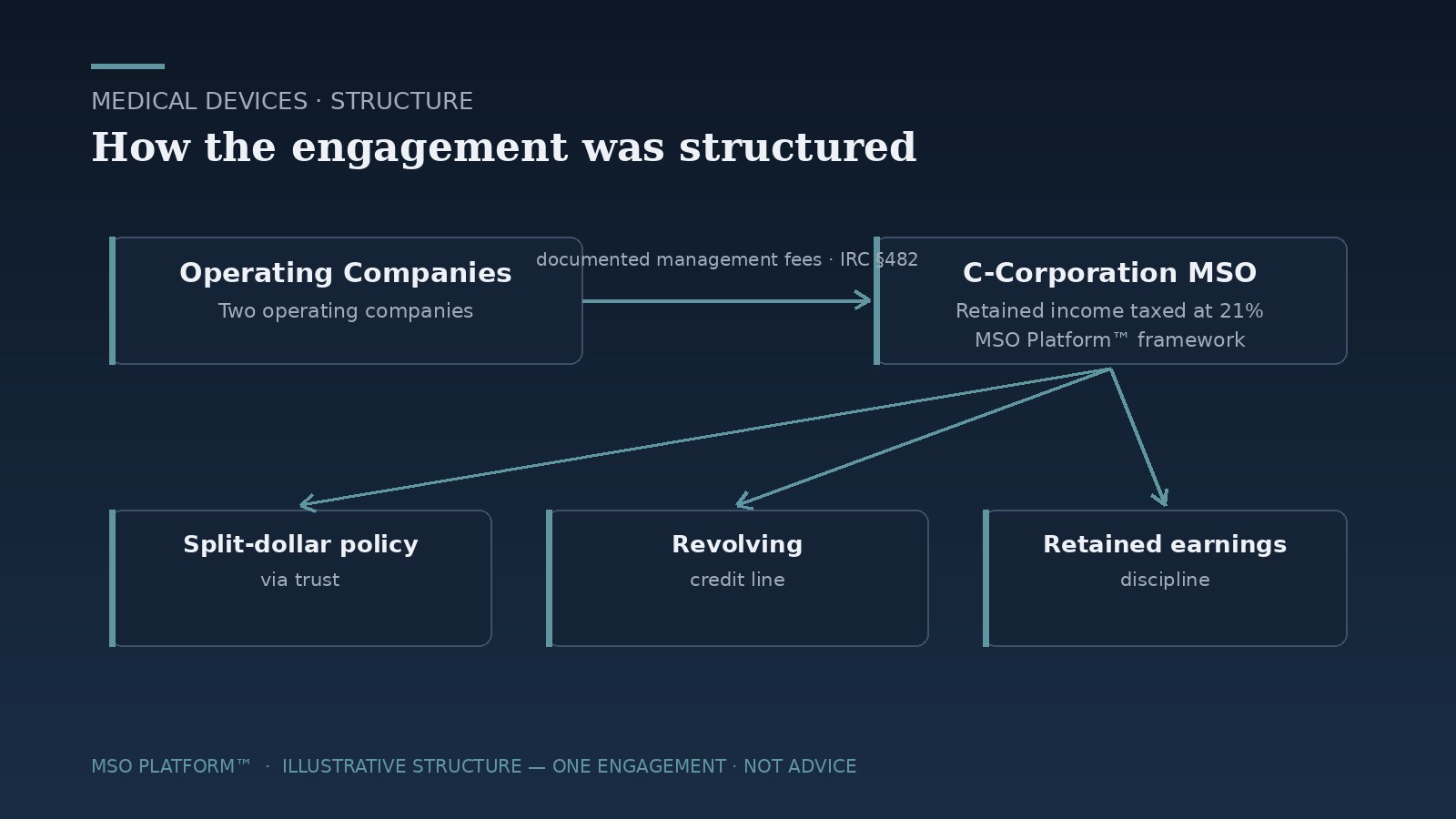
Guardian Tax Consultants® implemented the MSO Platform™ structure. The operating companies pay documented management fees — $5 million in the initial year, supportable by the services actually performed and subject to ongoing review as those services evolve — to a C-corporation MSO for centralized management services, with income retained at the 21% corporate rate rather than the owners’ personal rates. From the retained capital: approximately $500,000 funded life insurance through a loan-regime split-dollar arrangement between the MSO and a trust, designed to provide key person protection while supporting trust ownership intended to keep the death benefit outside the owners’ taxable estates, structured under the loan regime to avoid treating the premium funding as a current shareholder distribution, subject to split-dollar documentation, AFR interest, and counsel/CPA review; and the MSO extended a revolving line of credit back to the two operating companies, converting idle retained earnings into a documented intercompany facility that supports liquidity where and when it is needed.
Substantiation and Governance
The management fee is supported by a contemporaneous functional analysis and benchmarking under the §482 arm’s-length standard, including the applicable Treasury regulations for controlled services transactions. The split-dollar arrangement is documented under the loan regime with interest at the applicable federal rate; trust ownership was coordinated with estate counsel; and the structure was delivered in coordination with the CPA of record.
Record reviewed: management services agreement, initial-year fee file, split-dollar loan documents, trust ownership records, credit-facility documents, and CPA-of-record file.
Measured Outcomes
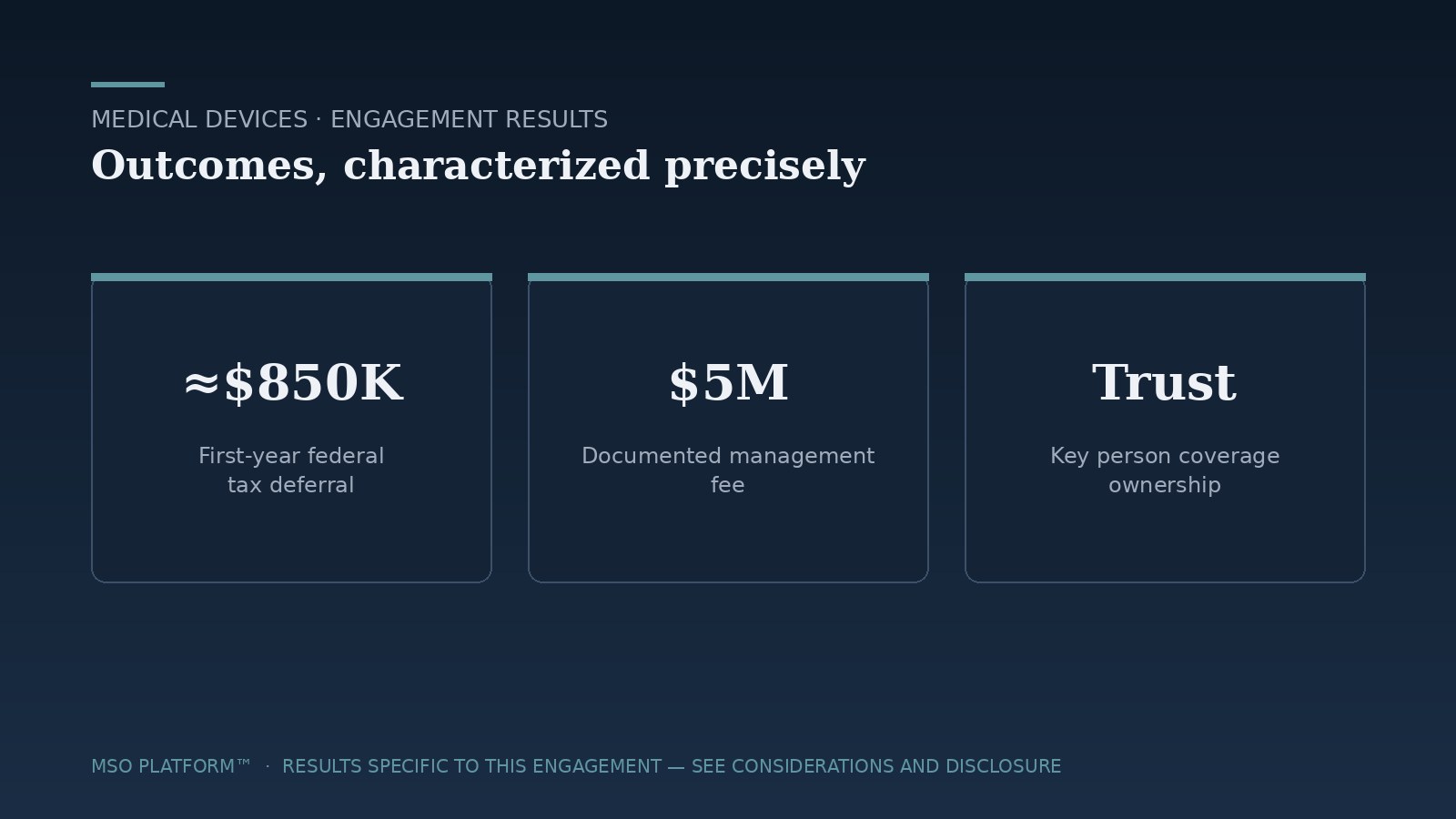
Results are specific to this engagement and depend on the facts, documentation, and implementation. The initial-year fee produced approximately $850,000 in federal tax deferral, potentially recurring in later years only to the extent the annual fee remains supportable by services actually performed and documented. The buy-sell agreement moved from unfunded to insurance-funded; the death benefit is designed to be held through trust ownership outside the taxable estates, subject to continued administration and counsel review; and retained earnings that previously sat exposed now cycle through a documented credit facility serving both operating companies.
A written feasibility review against your own facts is the first step of every engagement. The initial review is no-cost; the written analysis follows within six weeks of receiving the required materials. Inquire about partnership.
Related Reading
- MSO Case Studies: the full library
- How MSO Management Fees Are Calculated
- MSO Cash Uses and §531 Accumulated Earnings
- Avoiding Double Taxation in a C-Corp MSO
- The Dynasty Trust MSO: Estate Tax Planning After the Exemption Is Used
- Engineering Services MSO Case Study: Labor Risk and Partner Succession
- RIA MSO Case Study: Entity Separation, §199A Qualification, and a Funded Partner Buyout
Frequently Asked Questions
How can an MSO help fund a buy-sell agreement?
By retaining documented management income at the corporate level and directing it, through arrangements such as loan-regime split-dollar, to life insurance funding the buy-sell obligation — rather than pulling working capital out of the operating companies at personal rates.
How does a C-corporation MSO affect retained earnings planning?
Retained management income is taxed at the 21% corporate rate and can be deployed through documented intercompany facilities; the difference from personal rates is a deferral, and accumulation requires documented business purpose.
What is loan-regime split-dollar?
An insurance funding arrangement in which premium advances are treated as loans bearing interest at the applicable federal rate, documented so the policy can be owned by a trust while the advancing entity holds a repayment right.
What records should support an MSO credit facility?
Loan agreements executed by both entities, stated interest at or above the applicable federal rate, repayment schedules and payment history, collateral terms where applicable, and board-level documentation of the business purpose for the facility. The record should demonstrate that the facility operates as genuine intercompany credit rather than informal cash movement.
Assumptions and Methodology
Facts are sanitized and figures rounded to preserve client confidentiality. Deferral figures represent the rate differential on documented management fees retained in the MSO — the owners’ marginal rate less the 21% corporate rate, applied to the fee for the period stated — and are not permanent savings; amounts later distributed bear shareholder-level tax. Here, $850,000 on the $5 million initial-year fee reflects an approximately 17-point spread — the owners’ blended marginal rate, net of qualified business income deduction effects at the operating level, less 21% — with no state income tax assumed.
Rate assumptions reflect federal law in effect during the engagement period; figures are rounded.
Considerations
The rate differential is a deferral; MSO distributions bear shareholder-level tax. Split-dollar loans must remain documented and serviced to preserve their characterization. The management fee must track services actually performed, reviewed as the businesses evolve. Insurance outcomes depend on policy performance and are not guaranteed.
State income and franchise taxes vary by jurisdiction and can widen or narrow the modeled spread; figures tie to the assumptions stated above.
Intercompany credit must be respected as genuine debt — documented, interest-bearing, serviced, and reflected in the accounting records — to reduce recharacterization risk, including constructive-dividend, disguised-distribution, and circular-cash-flow arguments, and because interest income inside a C corporation can, where applicable, contribute to personal holding company exposure under §541; the structure manages these through documented operating functions and ongoing monitoring.
The fee, retained-earnings position, intercompany balances, insurance funding, and business-purpose file should be reviewed annually with the CPA of record and counsel.
This case study describes one engagement and is provided for educational purposes only. It is not tax, legal, or investment advice, and results are not representative of every engagement. Outcomes depend on each client’s facts, the services actually performed, documentation quality, and applicable law. Any strategy should be reviewed with the client’s own tax and legal advisors. Guardian Tax Consultants® does not prepare or sign client income tax returns; management fee arrangements are documented and benchmarked to support the position taken by the CPA of record.
Evaluate this structure against your own facts
Every engagement begins with a written feasibility report, coordinated with your CPA of record and counsel. The initial review is no-cost; the written analysis follows within six weeks of receiving the required materials.