
At a glance
Situation: High-hazard engineering firm; three entities with commingled labor; unfunded 50/50 buy-sell.
Design: Common-employer management LLC under a C-corporation MSO; vested SERPs, trust-held buy-sell insurance, revolving credit.
Outcome: $1–5M annual tax deferral as income grew; $15M+ cumulative (2019–2025).
Engagement Profile. Engineering firm with three operating entities (design, installation, service); 80 employees; $85 million gross revenue; $15 million net income; taxed as a PLLC; two equal 50/50 partners with a significant age difference.
The Situation
The firm’s work involved high-voltage installation — a genuine severity risk — yet employees worked across all three entities while being paid from one, without intercompany documentation. That practice exposed the group to asset commingling and put each entity’s capital at risk for the others’ liabilities. Senior directors were compensated with profit-based bonuses that fell in lean years, creating retention exposure. The partners had no funded buy-sell agreement and no structured exit plan, despite the age gap making a staggered exit likely rather than merely possible.
The Structural Question
Could employee management, capital allocation, and executive retention be centralized above the operating entities in a way that reduced cross-entity exposure and improved separateness among the operating companies, funded the buy-sell obligation, and improved the after-tax cost of doing all three?
The Design
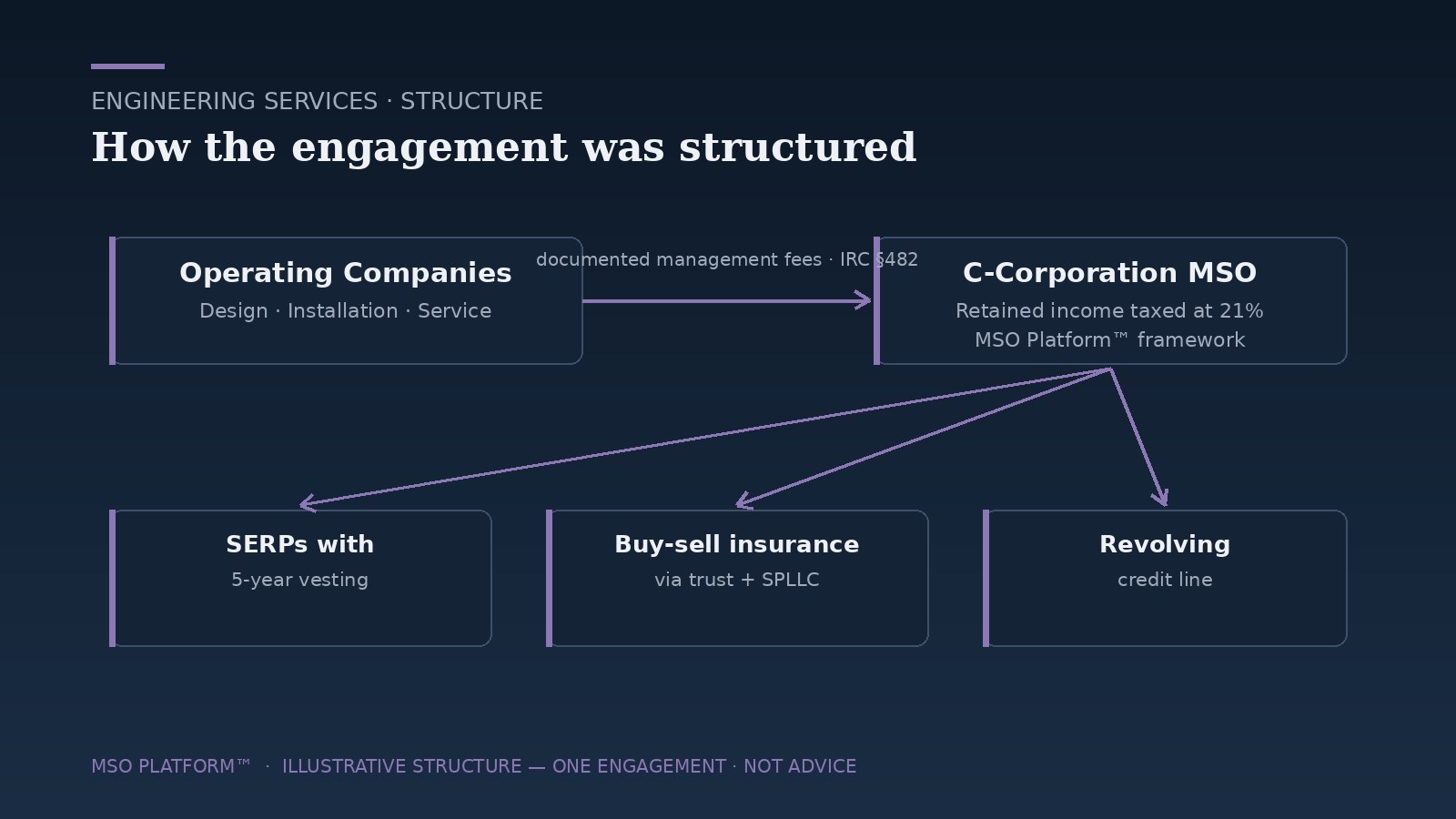
Guardian Tax Consultants® implemented the MSO Platform™ structure in two tiers: a C-corporation MSO holds a management LLC, and the LLC — as the common employer — contracts with each operating entity for the labor and administrative functions it performs. The common-employer arrangement resolved the commingling issue, documented intercompany labor at arm’s length, and reduced the risk that employment claims arising in one labor channel would reach operating capital across the group. The operating entities pay documented management fees to the MSO, where retained income is taxed at 21% rather than the partners’ personal rates. From that retained capital: supplemental executive retirement plans (SERPs) with five-year vesting for the directors whose retention was at risk; life insurance policies funding the partners’ buy-sell agreement, held through a trust using a special-purpose LLC, with ownership designed to keep the death benefit outside the taxable estates, subject to counsel review and continued administration; and a revolving line of credit from the MSO to the operating companies that smooths the receivables/payables cycle.
Substantiation and Governance
Intercompany fees and the employee-leasing arrangement are supported by contemporaneous functional analysis and benchmarking under the §482 arm’s-length standard, including the applicable Treasury regulations for controlled services transactions. The arrangement was designed for co-delivery with the firm’s CPA of record and reviewed with counsel responsible for the buy-sell and trust documents.
Record reviewed: employment structure documents, intercompany service agreements, fee benchmarking file, buy-sell documents, insurance records, and CPA coordination file.
Measured Outcomes
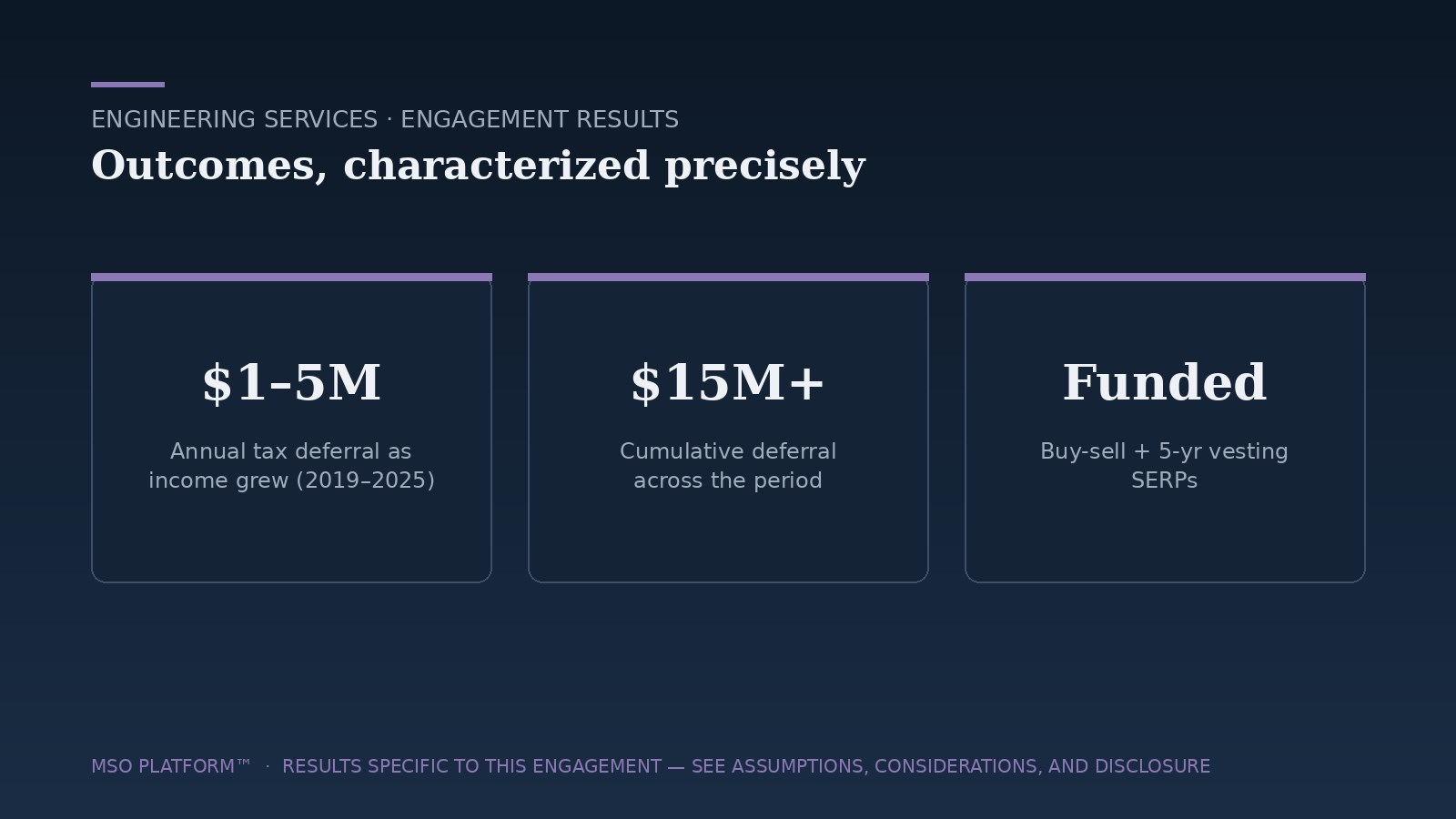
Results are specific to this engagement and depend on the facts, documentation, and implementation. The structure produced between $1 million and $5 million in annual combined federal and state tax deferral across the two partners as income grew — more than $15 million cumulatively across 2019–2025 (see Assumptions and Methodology) — capital that funded the SERPs, the buy-sell insurance, and the credit facility rather than being consumed by current personal tax. Employment risk was structurally separated from operating capital; director retention was supported through vested deferred compensation; and the partners moved from an unfunded, undocumented succession posture to a funded buy-sell with a defined exit sequence.
A written feasibility review against your own facts is the first step of every engagement. The initial review is no-cost; the written analysis follows within six weeks of receiving the required materials. Inquire about partnership.
Related Reading
- MSO Case Studies: the full library
- The Premium-Financed MSO: this engagement’s insurance program, followed through the six-year bank exit
- How MSO Management Fees Are Calculated
- MSO Cash Uses and §531 Accumulated Earnings
- Avoiding Double Taxation in a C-Corp MSO
- Medical Device MSO Case Study: Buy-Sell Funding and Retained Earnings Discipline
Frequently Asked Questions
How can an MSO help an engineering firm manage labor risk?
By centralizing employment in a common-employer management entity that contracts with each operating company on documented intercompany terms, so labor is properly allocated and employment claims in one channel are less likely to reach operating capital across the group.
How does an MSO support partner succession?
Retained corporate capital can fund buy-sell insurance and structured exit planning — in this engagement, policies held through a trust and special-purpose LLC funded the partners’ buy-sell agreement.
What documentation supports a common-employer MSO arrangement?
Employment agreements, intercompany service agreements, payroll allocation records, and a contemporaneous functional analysis and fee benchmarking under the §482 arm’s-length standard, including the applicable Treasury regulations for controlled services transactions.
Are SERPs funded through an MSO guaranteed benefits?
No. Supplemental executive retirement plans are unsecured promises of the sponsoring corporation, not guaranteed or trust-protected benefits. Participants rely on the MSO’s ability to pay when benefits vest and come due, so the obligations must be managed against the MSO’s balance sheet, funded with discipline, and reviewed alongside the entity’s other capital commitments each year.
Assumptions and Methodology
Facts are sanitized and figures rounded to preserve client confidentiality. Deferral figures represent the rate differential on documented management fees retained in the MSO — the owners’ marginal rate less the 21% corporate rate, applied to the fee for the period stated — and are not permanent savings; amounts later distributed bear shareholder-level tax. Here, fees scaled with income across 2019–2025 at a combined federal and state spread of approximately 20–25 points (the spread ranged with the owners’ year-by-year §199A posture — approximately 20 points where the deduction was fully available, wider where wage-and-basis limits reduced it — plus state tax), producing between $1 million and $5 million of annual deferral as income grew and more than $15 million cumulatively across the period — figures consistent with the premium-financed engagement record published separately.
Rate assumptions reflect federal law in effect during the engagement period; figures are rounded.
Considerations
Deferral inside a C corporation is not permanent savings; distributions bear shareholder-level tax, and accumulated earnings require documented business purpose. SERP obligations are unsecured corporate liabilities and must be managed against the MSO’s balance sheet. The labor structure depends on genuine centralized employment functions, contemporaneously documented.
State income and franchise taxes vary by jurisdiction and can widen or narrow the modeled spread; figures tie to the assumptions stated above.
Intercompany credit must be respected as genuine debt — documented, interest-bearing, serviced, and reflected in the accounting records — to reduce recharacterization risk, including constructive-dividend, disguised-distribution, and circular-cash-flow arguments, and because interest income inside a C corporation can, where applicable, contribute to personal holding company exposure under §541; the structure manages these through documented operating functions and ongoing monitoring.
The fee, retained-earnings position, intercompany balances, insurance funding, and business-purpose file should be reviewed annually with the CPA of record and counsel.
This case study describes one engagement and is provided for educational purposes only. It is not tax, legal, or investment advice, and results are not representative of every engagement. Outcomes depend on each client’s facts, the services actually performed, documentation quality, and applicable law. Any strategy should be reviewed with the client’s own tax and legal advisors. Guardian Tax Consultants® does not prepare or sign client income tax returns; management fee arrangements are documented and benchmarked to support the position taken by the CPA of record.
Evaluate this structure against your own facts
Every engagement begins with a written feasibility report, coordinated with your CPA of record and counsel. The initial review is no-cost; the written analysis follows within six weeks of receiving the required materials.