
In short. When a business owner forms a management services organization, the banking relationship changes before anything else does. Commercial lenders, treasury teams, and credit committees each see a different piece of the restructured enterprise, and most see it for the first time at renewal, without warning. The questions they ask are practical, and they arrive earlier than most advisors expect.
The room
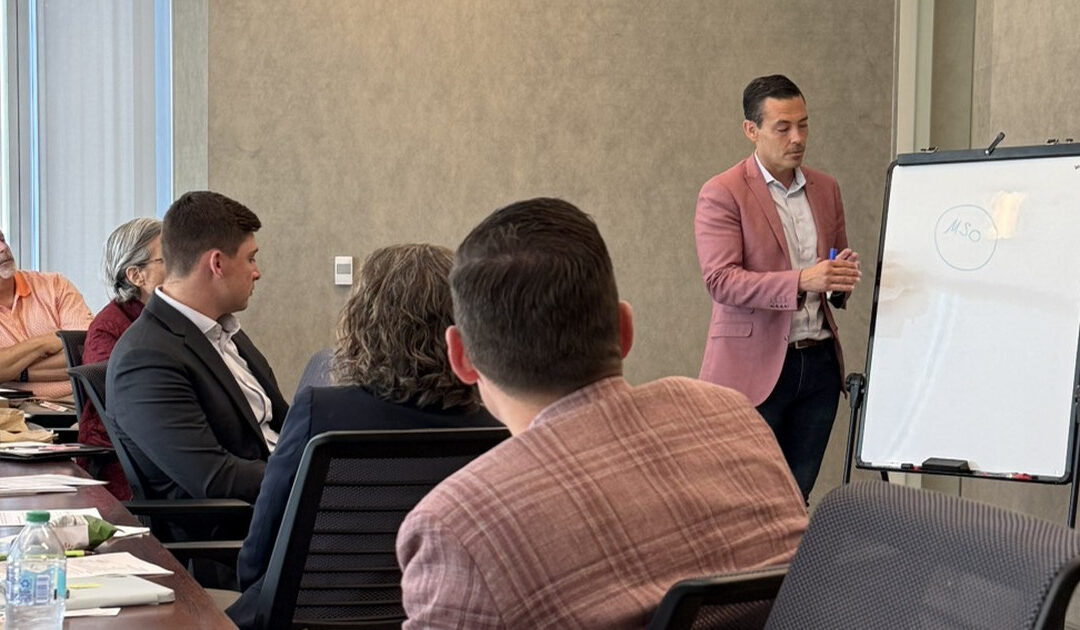
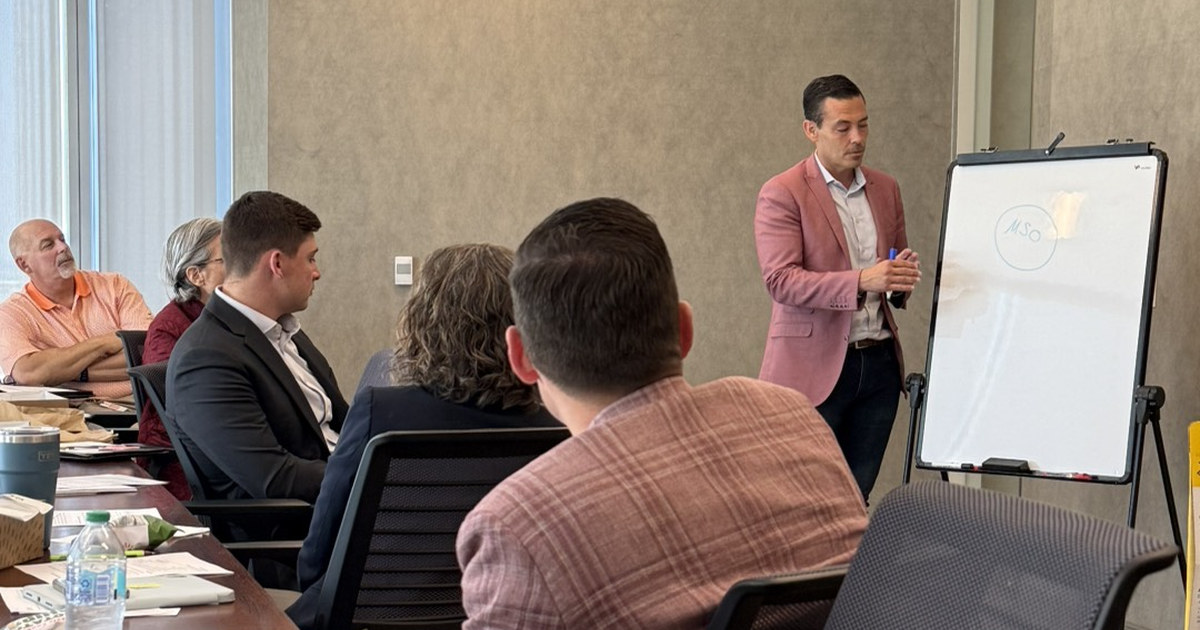
A working session in Oklahoma City with the commercial, corporate, treasury, and institutional wealth teams of Bank of Oklahoma. Roughly a dozen bankers across four lines of business, most of whom serve closely held companies in the $10M–$75M revenue range, some materially larger.
The session was not structured as a presentation. It went line of business by line of business, and the recurring pattern was the one that makes these rooms worth writing about: every banker at the table serves the same client, and each one encounters the MSO at a different moment, through a different document, for a different reason. The commercial lender meets it at renewal. Treasury meets it when a second operating account appears. The credit analyst meets it in a spreadsheet that no longer foots. Institutional wealth meets it when a new plan sponsor shows up on a retirement plan.
None of them had been briefed in advance. That is the finding.
Our thanks to the Bank of Oklahoma team for hosting the session and for the candor of the questions.
What follows is what the room actually asked, organized by the function that asked it. Names, institutions, and client facts are omitted; the questions are the content.

Why does the credit file stop making sense after an MSO is formed?
From the room. The first question, and the one raised most directly by the credit side: after a client restructures, the financial statements arrive and the analysis no longer reconciles. Margin at the operating company appears to have deteriorated. A second entity appears with revenue and no history. The analyst is asked to underwrite a business that, on paper, looks worse than the one approved last year.
The mechanics. A management services organization is a separate legal entity performing administrative, management, and shared-services functions for one or more affiliated operating companies, compensated through a documented management fee under a management services agreement. Because the payment moves between related parties, the arrangement is tested against an arm's-length standard, which is why independent economic substantiation sits at the center of a properly built structure.
The credit consequence follows mechanically. The management fee is an expense at the operating company and revenue at the MSO. Read the operating company alone and margin appears compressed, sometimes severely. Read the MSO alone and a services company appears with revenue and no apparent operating history. Neither statement describes the enterprise.
The implication. Underwriting the enterprise correctly requires combined or consolidating statements in which the intercompany management fee is eliminated. Absent that, the analyst is working from two partial pictures and reconciling by inference. The elimination entry is not an accounting nicety. It is the difference between a credit file that reads and one that does not.
What happens to global debt service coverage?
From the room. The credit officers' concern was narrower than the structure itself: where do the obligations now sit, and what is the coverage across the whole group.
The analysis. Where guarantees, obligations, and cash flows are distributed across two or more entities, global debt service coverage has to be calculated across the group rather than at a single borrower. That is ordinary practice for multi-entity borrowers. What is different here is that the group's shape changed recently, deliberately, and often without the bank being told.
Two observations worth preserving. First, no one in the room objected to the structure. Several noted that a properly documented services entity with real operating substance can make an enterprise easier to read, not harder, because shared functions become visible and separately measurable rather than buried in a single P&L. Second, the objection was to timing, not architecture.
The implication. A structure explained in advance is a conversation. The same structure discovered during renewal review is a problem to be resolved.
Do existing covenants survive the restructuring?
From the room. This is where the bankers were most emphatic, and the questions were specific rather than conceptual.
Guarantor structure. Loan documents name specific obligors. Where operating cash flow now supports a new affiliate, lenders commonly want that affiliate added as a guarantor, or want its obligations otherwise addressed in the credit agreement.
Restricted payments and affiliate transfers. Many credit agreements limit transfers to affiliates, distributions, and intercompany transactions. A recurring management fee is, by construction, an intercompany transfer. Whether existing language permits it is a document question.
Negative pledge and collateral. Where assets, receivables, or employees move between entities, the collateral description and any negative pledge language may no longer describe the enterprise accurately.
Reporting covenants. Financial reporting requirements written for a single borrower may need restatement for a group, including which statements are delivered and at what level of consolidation.
The implication. The sequencing point the room made repeatedly: obtain lender consent before money moves, not after. A structure that is technically sound and contractually unapproved is still a covenant problem.
Can an owner borrow against an MSO, and who lends against one?
From the room. This is the question that made the room lean forward, and it came from the bankers rather than from us. Their clients are asking it. They do not yet have an answer.
Why it is hard. The MSO holds contracted, recurring, documented revenue from affiliated operating companies. That is a recognizable cash-flow profile. It is also an unusual one: the counterparty is related, the contract is intercompany, and the entity is young by construction.
Three observations from the session. Most institutions have no established framework, and the question is being asked faster than credit policy is being written. The instinct in the room was that the analysis sits closer to a services-company credit than a holding-company credit, provided operating substance is real and documentation supports it. And the dependency runs through substantiation: a services entity whose fee is documented, economically supported, and consistent with functions actually performed presents very differently to a credit committee than one whose fee is a plug.
No one claimed to have solved it. Everyone recognized the question is arriving.
The implication. For advisors this is narrower and more useful than the market opportunity. The quality of the §482 documentation is not only a tax matter. It is increasingly a credit matter. The file that supports the fee is the same file a lender will read.
Where does treasury encounter the structure?
From the room. Treasury raised the operational reality that rarely reaches the design table: a new entity means new accounts, new signers, new payment origination, new controls, and a changed liquidity picture. Payables and receivables that moved through one operating account now move through two or more. Fraud controls calibrated to one entity's payment patterns need recalibration.
Payment origination and controls. Who is authorized to originate payments at the MSO, whether dual control is configured, and how the recurring management-fee payment is executed, documented, and reconciled, because a fee invoiced but paid irregularly, or paid without an invoice, weakens the documentary record the whole structure depends on.
Liquidity across entities. Where operating cash sits, whether balances are swept, and how aggregate liquidity is measured when distributed across multiple accounts.
The implication. The recurring administration that makes a structure defensible on examination is largely the same administration that makes it legible to a bank. Invoices, timing, documentation, and consistency serve both readers.
What about retirement and deferred compensation at the MSO?
From the room. Institutional wealth raised this independently, without prompting, which is a signal in itself about how quickly the question surfaces.
The analysis. Once a services entity exists and employs people, it becomes a potential plan sponsor. Qualified plans, nonqualified deferred compensation, and executive benefit arrangements can be evaluated at the MSO level. Controlled-group and affiliated-service-group rules govern how the entities are treated together for plan-testing purposes, which is a technical analysis in its own right and belongs to qualified benefits counsel.
The implication. Forming the entity creates the question whether or not anyone at the design table raised it.
Why does this show up before the transaction rather than after?
From the room. The closing theme, and the one with the longest reach. The bankers described a consistent pattern: owners do not encounter these questions at formation. They encounter them at the next event, whether a renewal, an acquisition line, a real estate purchase, a partner buyout, or a sale process.
The implication. By then the structure is in place, the covenant question is retroactive, and the financial statements have already been submitted in a form that did not anticipate the question. The sequencing that works is the reverse. The banking relationship is a design input, not a downstream consequence. The record is built while the facts are occurring, or it is reconstructed later under less favorable conditions.
What the session suggests about the market
Three observations, offered as observations rather than conclusions.
The lending lane is genuinely open. Owners are asking who lends against an MSO. Most institutions do not yet have an answer. The institutions that develop a framework will be answering a question their competitors are currently deflecting.
Cross-functional literacy is the constraint, not appetite. No banker in the room objected to MSO structures, and several saw them as clarifying. What was missing was a shared internal vocabulary, with commercial, credit, treasury, and wealth each holding one piece of a structure none had been briefed on as a whole.
The advisor's job includes the introduction. Where a structure changes how an enterprise reads to its lender, informing the lender is part of the implementation, not a courtesy afterward. That is a workstream, and it belongs on the plan.
Frequently asked
Does forming an MSO require lender consent?
It depends on the existing credit agreement. Provisions governing affiliate transactions, restricted payments, transfers, guarantor structure, and reporting frequently require review and may require consent or amendment. The documents have to be read before the structure is implemented.
Why do management fees have to be eliminated in the financial statements?
Because the fee is an intercompany transaction, an expense at the operating company and revenue at the MSO. Presented without elimination it distorts both entities' apparent performance and misstates the enterprise. Combined or consolidating presentation with the intercompany fee eliminated is what allows an analyst to underwrite the group accurately.
Can a lender treat an MSO as a borrower?
Some may, depending on institution, credit policy, operating substance, documentation quality, and the nature of the services revenue. There is no market-standard framework at present. Facts and institutional appetite govern.
Does an MSO make a company harder to bank?
Not inherently. Several bankers in this session observed that a well-documented structure with genuine operating substance can make an enterprise easier to analyze, because shared functions become separately visible. Difficulty arises from late disclosure and incomplete financial presentation, not from the structure itself.
When should the bank be brought into the conversation?
Before implementation, and certainly before funds move under a management services agreement.
The host institution is named with permission. All other field observations are recorded generically. No client, engagement, or counterparty facts appear in this note.
Informational only. Applicability depends on the specific facts, structure, and advisory environment of each engagement. This material does not constitute legal, tax, or investment advice. Guardian Tax Consultants® does not provide legal or tax advice. All MSO structures are implemented in coordination with the client's independent legal and tax advisors. All illustrative examples are hypothetical and for educational purposes only.