
At a glance
Situation: Retail showroom constrained by inventory space and delivery timing; no estate funding mechanism.
Design: $2.8M documented fee; MSO lease with discounted purchase option; inventory credit line; estate liquidity policy.
Outcome: ≈$550K annual federal tax deferral; ≈25% revenue growth (management-attributed, among concurrent factors).
Engagement Profile. Retail showroom and warehouse serving new home construction and renovation; 30 employees; approximately $12 million gross revenue; approximately $3 million net income; taxed as an S corporation; single owner.
The Situation
The business was constrained on two fronts. Operationally, inventory space was inadequate and supplier delivery timing was slow enough to cost sales — the business could not buy ahead or hold stock at the depth its order flow justified. Structurally, the owner had no succession plan, no estate plan, and no funding mechanism for estate taxes or wealth preservation, in a business whose value was compounding.
The Structural Question
Could a management structure convert income currently taxed at the owner’s personal rate into disciplined capital — enough to fund a larger physical footprint, deepen inventory, and establish estate liquidity — without new outside debt at the operating level?
The Design
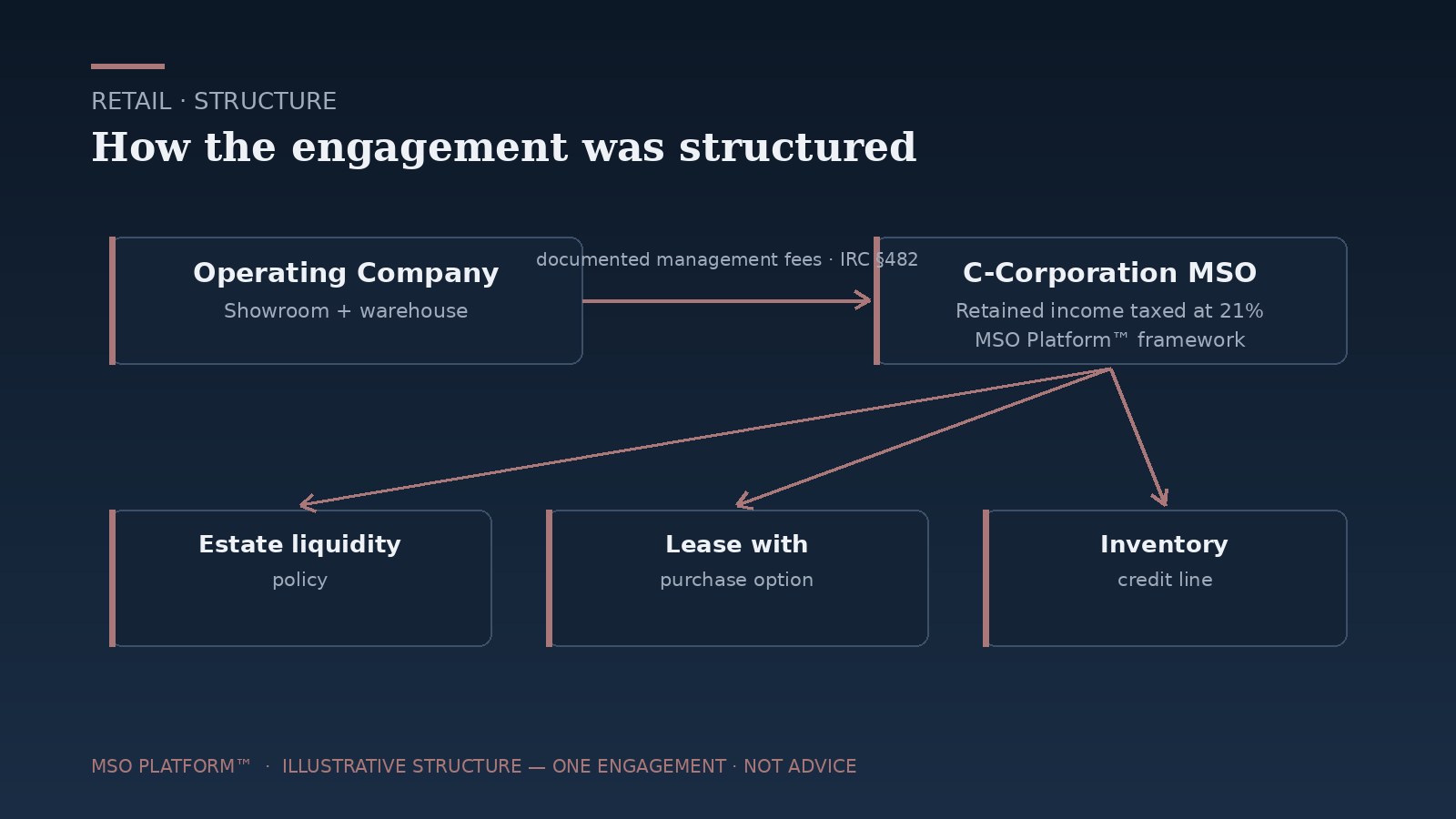
Guardian Tax Consultants® implemented the MSO Platform™ structure. The operating company pays documented management fees — $2.8 million in the year described — to a C-corporation MSO, with retained income taxed at the 21% corporate rate rather than the owner’s personal rate. The MSO leased a new warehouse and showroom with a negotiated option to purchase the building at a discount at the end of the lease term, and funded the showroom build-out. A line of credit from the MSO enabled the business to purchase inventory ahead of need, reducing delivery times in the engagement period. A portion of the deferral-driven capital was directed to a life insurance policy designed to support estate tax liquidity — the funding mechanism the estate plan had lacked. Earnings accumulating in the MSO across the lease term are the intended source of the building purchase.
Substantiation and Governance
Management fees are supported by contemporaneous functional analysis and benchmarking under the §482 arm’s-length standard, including the applicable Treasury regulations for controlled services transactions, maintained for the CPA of record. The lease, purchase option, and intercompany credit facility are documented on arm’s-length terms. Insurance and estate elements were coordinated with counsel.
Record reviewed: lease and purchase-option documents, inventory financing records, fee benchmarking file, insurance records, and CPA-of-record documentation.
Measured Outcomes
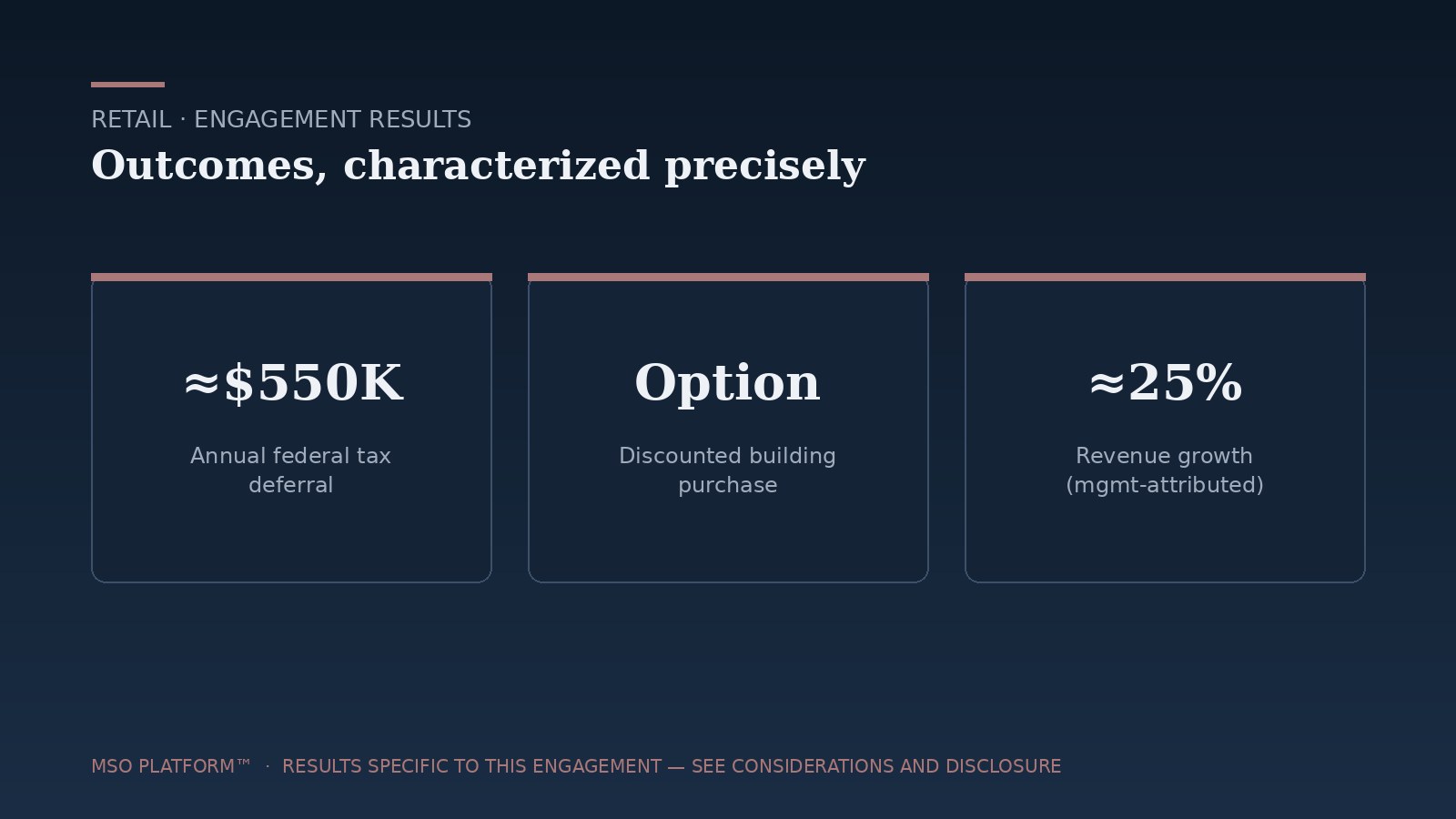
Results are specific to this engagement and depend on the facts, documentation, and implementation. The fee produced approximately $550,000 in annual federal tax deferral, and a portion of the resulting retained corporate capital was used to fund a life insurance policy designed to support estate liquidity. During the same period, revenue increased by approximately 25%; management attributed the increase to faster inventory availability and the new showroom, among several concurrent factors. The business is accumulating toward exercise of the discounted purchase option, and the owner moved from no estate funding mechanism to a funded one.
A written feasibility review against your own facts is the first step of every engagement. The initial review is no-cost; the written analysis follows within six weeks of receiving the required materials. Inquire about partnership.
Related Reading
- MSO Case Studies: the full library
- How MSO Management Fees Are Calculated
- MSO Cash Uses and §531 Accumulated Earnings
- Real Estate MSOs: Property-Level Tax Benefits, Service Income, and Governance
- Avoiding Double Taxation in a C-Corp MSO
- Home Building Supply MSO Case Study: Expansion Capital and Inventory Resilience
- Real Estate Development MSO Case Study: Centralized Management and Estate Liquidity
Frequently Asked Questions
How can an MSO support inventory velocity in a retail business?
By retaining documented management income and deploying it as working-capital support — here, a credit facility that let the business purchase inventory ahead of need and cut delivery times.
Can an MSO lease or purchase real estate used by an operating company?
Yes, where the arrangement is documented on arm’s-length terms; in this engagement the MSO leased the warehouse and showroom with a negotiated option to purchase at a discount at lease end.
How should revenue growth be described in an MSO case study?
Cautiously and engagement-specifically: growth reflects several concurrent factors, and management attribution should be stated as such rather than implied as a product of the tax structure.
What are the main considerations in a retail MSO structure?
Management-fee support, documented business purpose for accumulated earnings, arm’s-length intercompany terms, and the market-dependence of any real estate option. Each element should be documented contemporaneously: the fee benchmarked to services performed, earnings retention tied to the stated purchase objective, and the lease and option reviewed against market terms at signing and at exercise.
Assumptions and Methodology
Facts are sanitized and figures rounded to preserve client confidentiality. Deferral figures represent the rate differential on documented management fees retained in the MSO — the owners’ marginal rate less the 21% corporate rate, applied to the fee for the period stated — and are not permanent savings; amounts later distributed bear shareholder-level tax. Here, approximately $550,000 on the $2.8 million fee reflects an approximately 19.6-point spread. Composition depends on how the displaced income would otherwise have been characterized — S corporation distributions bear neither self-employment nor net investment income tax, while compensation-characterized amounts do — and on the owner’s §199A posture in the engagement period; where the full deduction is available on S corporation income, the spread narrows materially. No state income tax assumed.
Rate assumptions reflect federal law in effect during the engagement period; figures are rounded.
Considerations
Deferral is not elimination; MSO distributions bear shareholder-level tax, and accumulation toward the building purchase is itself the documented business purpose that supports retention. The purchase option’s value depends on market conditions at exercise.
State income and franchise taxes vary by jurisdiction and can widen or narrow the modeled spread; figures tie to the assumptions stated above.
Intercompany credit must be respected as genuine debt — documented, interest-bearing, serviced, and reflected in the accounting records — to reduce recharacterization risk, including constructive-dividend, disguised-distribution, and circular-cash-flow arguments, and because interest income inside a C corporation can, where applicable, contribute to personal holding company exposure under §541; the structure manages these through documented operating functions and ongoing monitoring.
The lease and purchase option should be supported by contemporaneous market terms so the discount is not later recharacterized as disguised compensation, distribution, or non-arm’s-length value transfer.
The fee, retained-earnings position, intercompany balances, insurance funding, and business-purpose file should be reviewed annually with the CPA of record and counsel.
This case study describes one engagement and is provided for educational purposes only. It is not tax, legal, or investment advice, and results are not representative of every engagement. Outcomes depend on each client’s facts, the services actually performed, documentation quality, and applicable law. Any strategy should be reviewed with the client’s own tax and legal advisors. Guardian Tax Consultants® does not prepare or sign client income tax returns; management fee arrangements are documented and benchmarked to support the position taken by the CPA of record.
Evaluate this structure against your own facts
Every engagement begins with a written feasibility report, coordinated with your CPA of record and counsel. The initial review is no-cost; the written analysis follows within six weeks of receiving the required materials.