
At a glance
Situation: Building materials supplier, ~$2.8M net income; constrained by space and supplier timing; no key person coverage.
Design: $2M+ documented first-year fee; new out-of-state location; inventory credit line; key person and survivorship coverage.
Outcome: ≈$420K first-year federal tax deferral; expansion funded from internal capital.
Engagement Profile. Building materials and equipment supplier serving new construction and renovation; approximately $12 million gross revenue; approximately $2.8 million net income; two co-owners; taxed as an LLC.
The Situation
The business had outgrown its founding market and needed to open locations in new territory, but its single-LLC structure offered no subsidiary framework for expansion, exposed the owners to the additional Medicare tax on the full net income, and left them without key person coverage on either co-owner. COVID-era supply shocks and inflation had shown how dependent the business was on suppliers’ delivery timing, and the owners’ estate planning had not kept pace with the growth in enterprise value.
The Structural Question
Could a management structure fund the expansion and an in-house inventory buffer out of income that would otherwise have been consumed by current personal tax — while creating the entity framework and insurance foundation the growth now required?
The Design
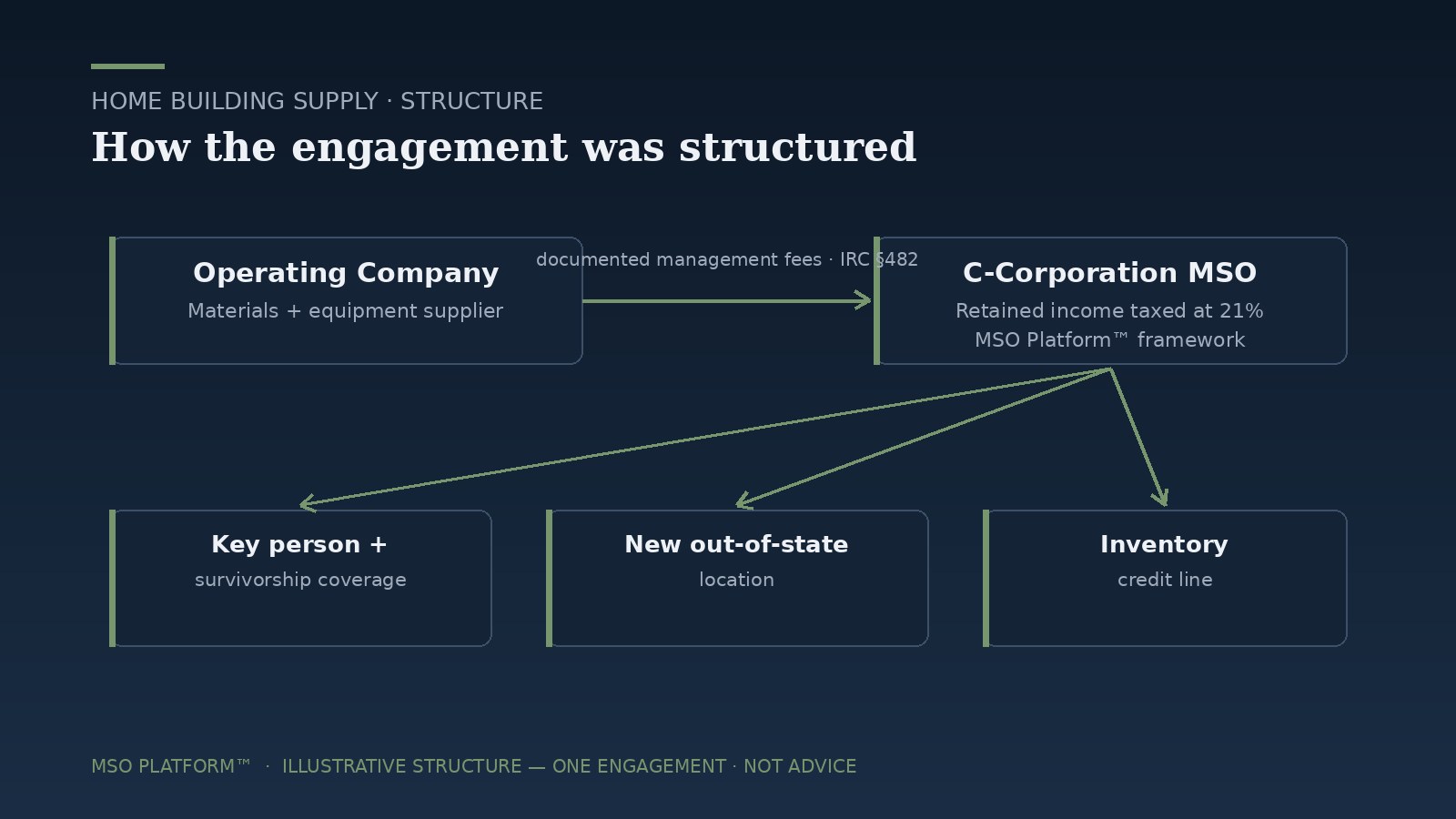
Guardian Tax Consultants® implemented the MSO Platform™ structure. The operating company pays documented management fees — over $2 million in the first year — to a C-corporation MSO, with retained income taxed at 21% rather than the owners’ personal rates, while reducing current pass-through income otherwise exposed to owner-level Medicare-tax analysis, subject to the owners’ facts and CPA review. The retained capital funded: key person policies on both co-owners and survivorship coverage benefiting their children, addressing the insurance and estate gaps in one design; a new out-of-state wholesale location, established within the entity framework the MSO structure created; and a line of credit supporting in-house inventory holdings, so the business could buy ahead of need and reduce dependence on supplier delivery timing. The management company was integrated into the owners’ estate plan as the vehicle for future asset management and business transition — the survivorship coverage and entity framework giving the estate plan, for the first time, assets and structure matched to the enterprise’s actual value.
Substantiation and Governance
Management fees are supported by contemporaneous functional analysis and benchmarking under the §482 arm’s-length standard, including the applicable Treasury regulations for controlled services transactions, coordinated with the CPA of record. Insurance and estate elements were documented with counsel.
Record reviewed: expansion budget, management-fee file, insurance records, intercompany inventory-facility documents, estate-planning coordination file, and CPA-of-record documentation.
Measured Outcomes
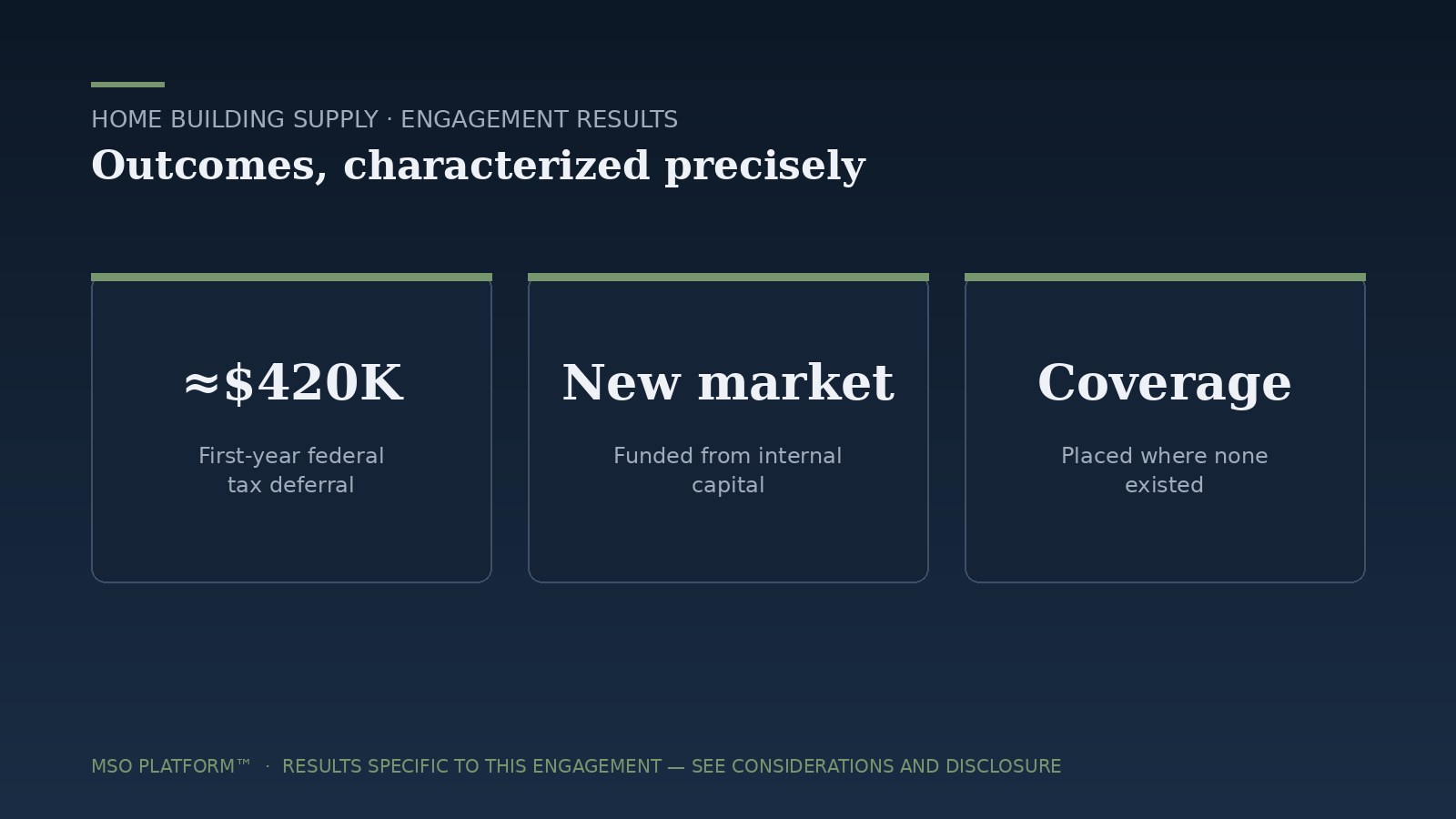
Results are specific to this engagement and depend on the facts, documentation, and implementation. The first-year fee produced approximately $420,000 in federal tax deferral. The business expanded into a new market from internally generated capital, carries an inventory buffer that reduced its exposure to supplier delays, placed key person and survivorship coverage where none previously existed, and separated growing retained earnings from operating risk.
A written feasibility review against your own facts is the first step of every engagement. The initial review is no-cost; the written analysis follows within six weeks of receiving the required materials. Inquire about partnership.
Related Reading
- MSO Case Studies: the full library
- How MSO Management Fees Are Calculated
- MSO Cash Uses and §531 Accumulated Earnings
- Avoiding Double Taxation in a C-Corp MSO
- Strategic Exit Paths for C-Corp MSOs
- Retail MSO Case Study: Inventory Velocity, Real Estate Optionality, and Estate Liquidity
- Real Estate Development MSO Case Study: Centralized Management and Estate Liquidity
Frequently Asked Questions
How can an MSO support expansion for a building supply business?
By centralizing documented management functions and retaining capital at the corporate level, which in this engagement funded a new out-of-state location from internally generated capital rather than new operating-level debt.
Can MSO-retained capital be used for inventory resilience?
Yes, where documented as a business-purpose use — here, a credit facility supporting in-house inventory holdings that reduced dependence on supplier delivery timing.
What role does key person insurance play?
It addresses continuity risk where co-owners are central to operations; in this engagement, coverage was placed on both co-owners along with survivorship policies serving the estate plan. Coverage amounts should track enterprise value as it grows, and ownership and beneficiary designations should be reviewed with counsel as the estate plan evolves.
What documentation supports an MSO expansion strategy?
Management agreements, fee benchmarking under IRC §482, expansion budgets, intercompany credit terms, and board-level records of business purpose.
Assumptions and Methodology
Facts are sanitized and figures rounded to preserve client confidentiality. Deferral figures represent the rate differential on documented management fees retained in the MSO — the owners’ marginal rate less the 21% corporate rate, applied to the fee for the period stated — and are not permanent savings; amounts later distributed bear shareholder-level tax. Here, approximately $420,000 on just over $2 million of first-year fees reflects an approximately 20-point spread — 37% federal plus self-employment Medicare tax on the owners’ LLC income, less 21% — with no state income tax assumed, and reflecting engagement-period limits on the §199A deduction; where the full deduction is available, the spread narrows materially.
Rate assumptions reflect federal law in effect during the engagement period; figures are rounded.
Considerations
The rate differential defers rather than eliminates tax; distributions from the MSO bear shareholder-level tax. Fees must continue to reflect services performed as the entity group grows. Inventory financing through the MSO requires documented intercompany terms.
State income and franchise taxes vary by jurisdiction and can widen or narrow the modeled spread; figures tie to the assumptions stated above.
Intercompany credit must be respected as genuine debt — documented, interest-bearing, serviced, and reflected in the accounting records — to reduce recharacterization risk, including constructive-dividend, disguised-distribution, and circular-cash-flow arguments, and because interest income inside a C corporation can, where applicable, contribute to personal holding company exposure under §541; the structure manages these through documented operating functions and ongoing monitoring.
Ownership, beneficiary designations, premium funding, and estate inclusion consequences should be reviewed periodically with estate counsel.
The fee, retained-earnings position, intercompany balances, insurance funding, and business-purpose file should be reviewed annually with the CPA of record and counsel.
This case study describes one engagement and is provided for educational purposes only. It is not tax, legal, or investment advice, and results are not representative of every engagement. Outcomes depend on each client’s facts, the services actually performed, documentation quality, and applicable law. Any strategy should be reviewed with the client’s own tax and legal advisors. Guardian Tax Consultants® does not prepare or sign client income tax returns; management fee arrangements are documented and benchmarked to support the position taken by the CPA of record.
Evaluate this structure against your own facts
Every engagement begins with a written feasibility report, coordinated with your CPA of record and counsel. The initial review is no-cost; the written analysis follows within six weeks of receiving the required materials.