
At a glance
Situation: Multi-entity developer, ~$20M annual net income; exposed retained earnings; no estate liquidity mechanism.
Design: C-corporation MSO compensated by documented, benchmarked fees; retained capital redeployed to intercompany lending, split-dollar insurance funding, and the estate design platform.
Outcome: ≈$2.8M annual federal tax deferral (modeled — see Assumptions and Methodology).
Engagement Profile. Real estate developer; land development, home building, and commercial property management conducted through multiple LLCs. Net worth approximately $100 million; annual net income approximately $20 million; estate projected to approach $400 million over the planning horizon.
The Situation
The enterprise had grown into several operating companies, each with its own lending relationships, collateral packages, and depreciation profiles. Depreciation expense varied materially year to year with acquisition timing and cost-recovery method, which made after-tax income difficult to plan around. Because the entities were taxed as pass-throughs, the owner bore federal income tax and the additional Medicare tax at personal rates on the full net income, while appreciated, low-basis assets accumulated embedded gain. Retained earnings concentrated in high-profit years sat exposed inside the operating entities, and no structure existed to fund estate tax liquidity or to transfer the enterprise to the next generation on a disciplined basis.
The Structural Question
Could the management functions common to all of the operating companies — financing negotiation, asset management, administrative oversight, capital planning — be centralized in a single entity, compensated at arm’s length, in a way that improved after-tax capital formation and created a platform for estate planning, without disturbing the operating companies’ banking relationships?
The Design
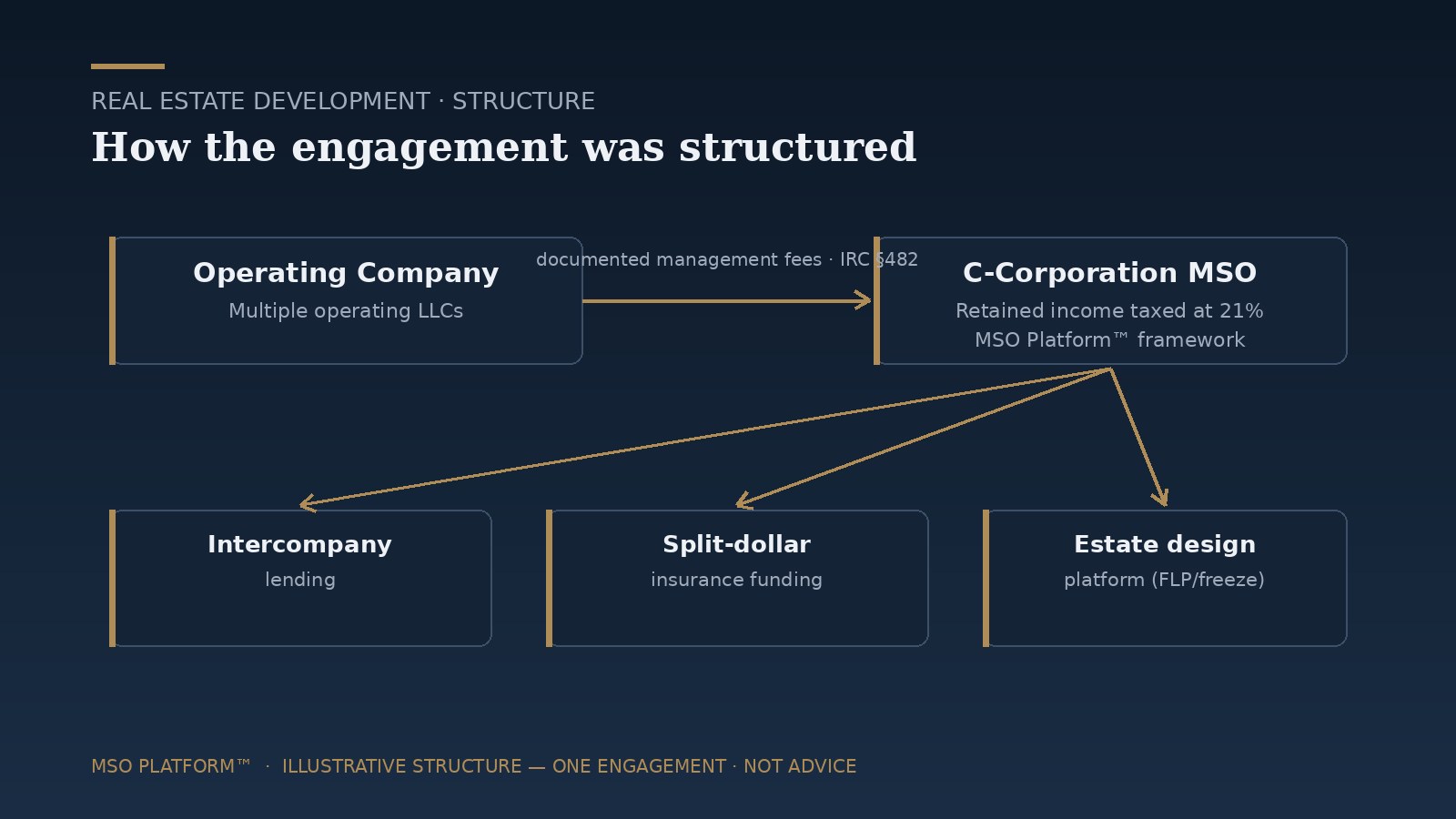
Guardian Tax Consultants® implemented a Management Services Organization under the MSO Platform™ framework. The MSO, taxed as a C corporation, performs documented management services for the operating companies and is compensated by management fees supported by a functional analysis of the services actually performed. Income retained in the MSO is taxed at the 21% corporate rate rather than the owner’s top personal rate — a deferral-driven form of capital formation, not a permanent savings — and the retained capital was deployed three ways:
- Lending capital back to the operating companies for equipment and development activity, reducing reliance on bank financing.
- Funding, through a loan-regime split-dollar arrangement, for life insurance designed to address the estate’s projected liquidity need, subject to policy performance, trust administration, and counsel review.
- The management platform within a broader estate design that included a family limited partnership and a proposed estate freeze to fix the value of the transferred interests.
Substantiation and Governance
The management fee is documented under the §482 arm’s-length standard, including the applicable Treasury regulations for controlled services transactions: services identified, functions and risks analyzed, and pricing benchmarked, with the file maintained contemporaneously. The arrangement is coordinated with the client’s CPA of record, who retains the compliance relationship, and with estate counsel responsible for the partnership and freeze documentation.
Record reviewed: management services agreement, fee workpapers, functional analysis, intercompany lending records, estate-planning coordination file, and CPA-of-record documentation.
Measured Outcomes
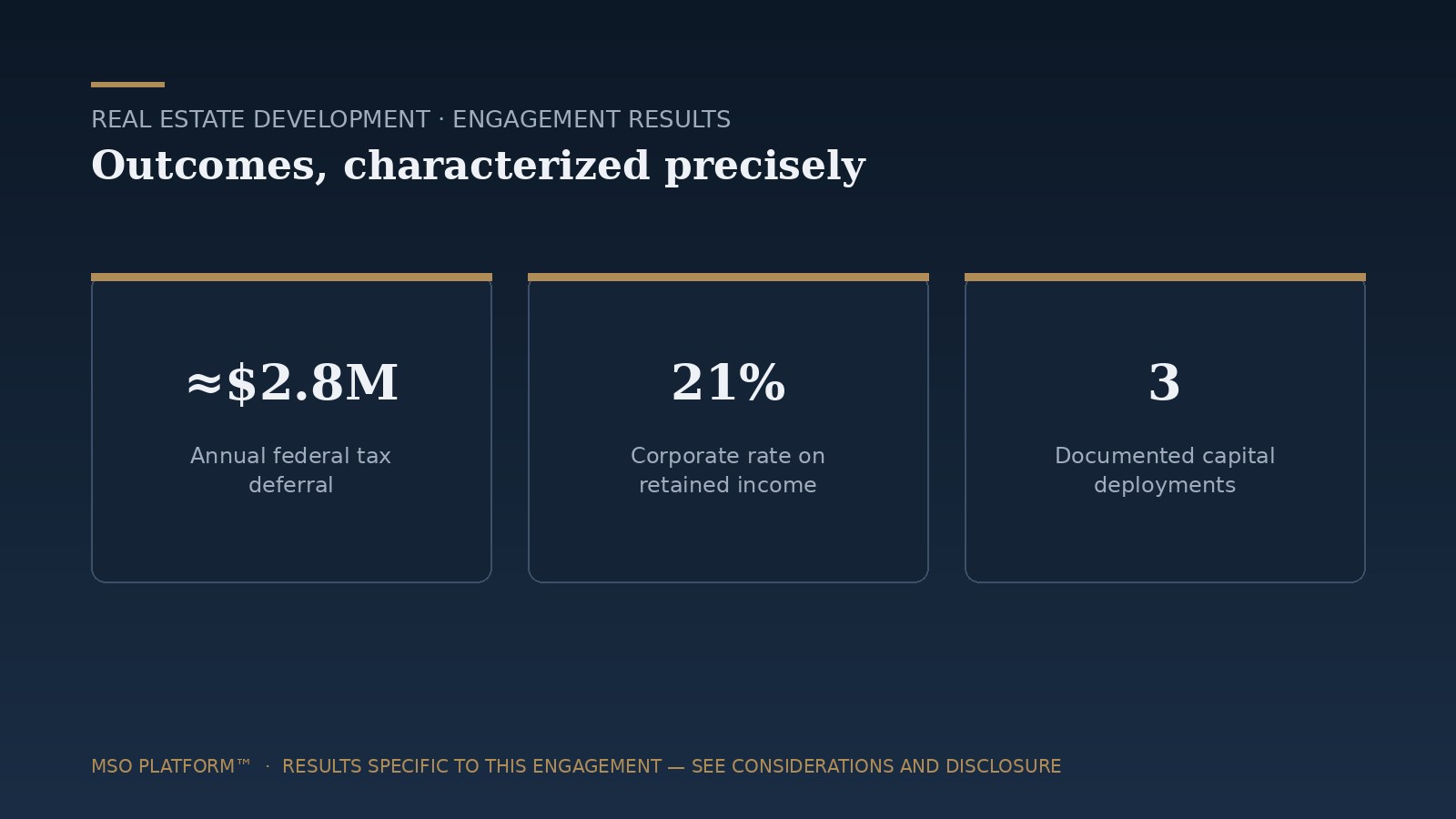
Results are specific to this engagement and depend on the facts, documentation, and implementation. The structure produced approximately $2.8 million in annual federal tax deferral on income retained in the MSO, improved liquidity through centralized capital management, reduced dependence on bank financing for equipment and development spending, and separated management assets from operating risk across the entity group. The split-dollar-funded policies were designed to establish a liquidity source for a projected estate tax liability that pass-through distributions alone could not efficiently fund.
A written feasibility review against your own facts is the first step of every engagement — a six-week deliverable with a no-cost initial review. Inquire about partnership.
Related Reading
- MSO Case Studies: the full library
- Real Estate MSOs: Property-Level Tax Benefits, Service Income, and Governance
- How MSO Management Fees Are Calculated
- MSO Cash Uses and §531 Accumulated Earnings
- Strategic Exit Paths for C-Corp MSOs
- The Dynasty Trust MSO: Estate Tax Planning After the Exemption Is Used Up
- Family Real Estate MSO Case Study: Transfer Pricing Discipline and an IDGT Sale
- Retail MSO Case Study: Inventory Velocity, Real Estate Optionality, and Estate Liquidity
Frequently Asked Questions
How can a real estate MSO centralize management functions across multiple entities?
A real estate MSO can centralize functions such as financing negotiation, asset management, administrative oversight, and capital planning, compensated by documented, arm’s-length management fees paid by the operating companies for services actually performed.
How are management fees documented in a real estate MSO?
Through a functional analysis of the services performed, benchmarking of the fee under the §482 arm’s-length standard, including the applicable Treasury regulations for controlled services transactions, and a contemporaneous file maintained to support the position taken by the CPA of record. The documentation identifies the services, analyzes the functions and risks each entity bears, and prices the fee against comparable arm’s-length arrangements — assembled when the fee is set, not reconstructed at examination.
Can MSO-retained capital support estate liquidity planning?
It may, as part of a broader design coordinated with estate counsel — in this engagement, through a loan-regime split-dollar arrangement funding life insurance intended to address a projected estate tax liability. Outcomes depend on documentation, policy performance, and counsel review.
What are the main risks in a real estate MSO structure?
Unsupported management fees, accumulated earnings without documented business purpose, and valuation or estate-freeze positions that lack independent appraisal support. The corporate rate differential is a deferral, not an elimination.
Assumptions and Methodology
Facts are sanitized and figures rounded to preserve client confidentiality. Deferral figures represent the rate differential on documented management fees retained in the MSO — the owners’ marginal rate less the 21% corporate rate, applied to the fee for the period stated — and are not permanent savings; amounts later distributed bear shareholder-level tax. Here, deferral of approximately $2.8 million per year ties to management fees of approximately $14 million annually (actual amounts are confidential and rounded) against an approximately 20-point spread — 37% federal plus the 3.8% net investment income tax on the rental income displaced, less 21% — with no state income tax assumed. Where the §199A deduction is available on the real estate activity, the spread narrows. A fee of that scale is supportable only where the MSO performs correspondingly substantial functions; the functional analysis, not the tax result, sets the fee.
Rate assumptions reflect federal law in effect during the engagement period; figures are rounded.
Considerations
The corporate rate differential is a deferral, not an elimination: amounts later distributed from the MSO bear tax at the shareholder level. The structure depends on the MSO performing real services at a defensible fee; accumulated earnings require ongoing business-purpose documentation. Estate freeze and valuation positions require independent appraisal and counsel review.
State income and franchise taxes vary by jurisdiction and can widen or narrow the modeled spread; figures tie to the assumptions stated above.
Intercompany credit must be respected as genuine debt — documented, interest-bearing, serviced, and reflected in the accounting records — to reduce recharacterization risk, including constructive-dividend, disguised-distribution, and circular-cash-flow arguments, and because interest income inside a C corporation can, where applicable, contribute to personal holding company exposure under §541; the structure manages these through documented operating functions and ongoing monitoring.
The retained-capital plan should be reviewed annually against documented working-capital, lending, acquisition, development, insurance, and estate-liquidity needs, rather than treated as open-ended accumulation.
This case study describes one engagement and is provided for educational purposes only. It is not tax, legal, or investment advice, and results are not representative of every engagement. Outcomes depend on each client’s facts, the services actually performed, documentation quality, and applicable law. Any strategy should be reviewed with the client’s own tax and legal advisors. Guardian Tax Consultants® does not prepare or sign client income tax returns; management fee arrangements are documented and benchmarked to support the position taken by the CPA of record.
Evaluate this structure against your own facts
Every engagement begins with a written feasibility report — a six-week deliverable with a no-cost initial review, coordinated with your CPA of record and counsel.