

At a glance
Situation: First-generation holder, age 76; $70M portfolio; projected $32M estate tax; exemption fully used.
Design: Son-owned MSO at a $1M benchmarked fee; IDGT sale positioned at an appraisal-supported discount.
Outcome: ≈$11.35M combined five-year projected effect (projections, not realized results).
Engagement Profile. First-generation wealth holder, age 76, widowed; one son active in the family real estate business. Real estate valued at $70 million held in a pass-through LLC; $10 million cash; unified credit fully utilized; no life insurance in place; projected estate tax liability of approximately $32 million at a 40% rate.
The Situation
The client’s income passed through to her at a 40% marginal rate, and every dollar of net rental income she did not consume compounded a taxable estate already projected to owe $32 million. The next generation was already running the portfolio in substance — but not in form, and the estate received no recognition for that reality.
The Structural Question
Could the son’s management of the portfolio be formalized and compensated at arm’s length, so that management income could be paid to the entity performing the documented work, while reducing income otherwise accumulating in the taxable estate — and could the portfolio itself then be positioned for transfer at its appraised, discounted value rather than its undiscounted gross value?
The Design
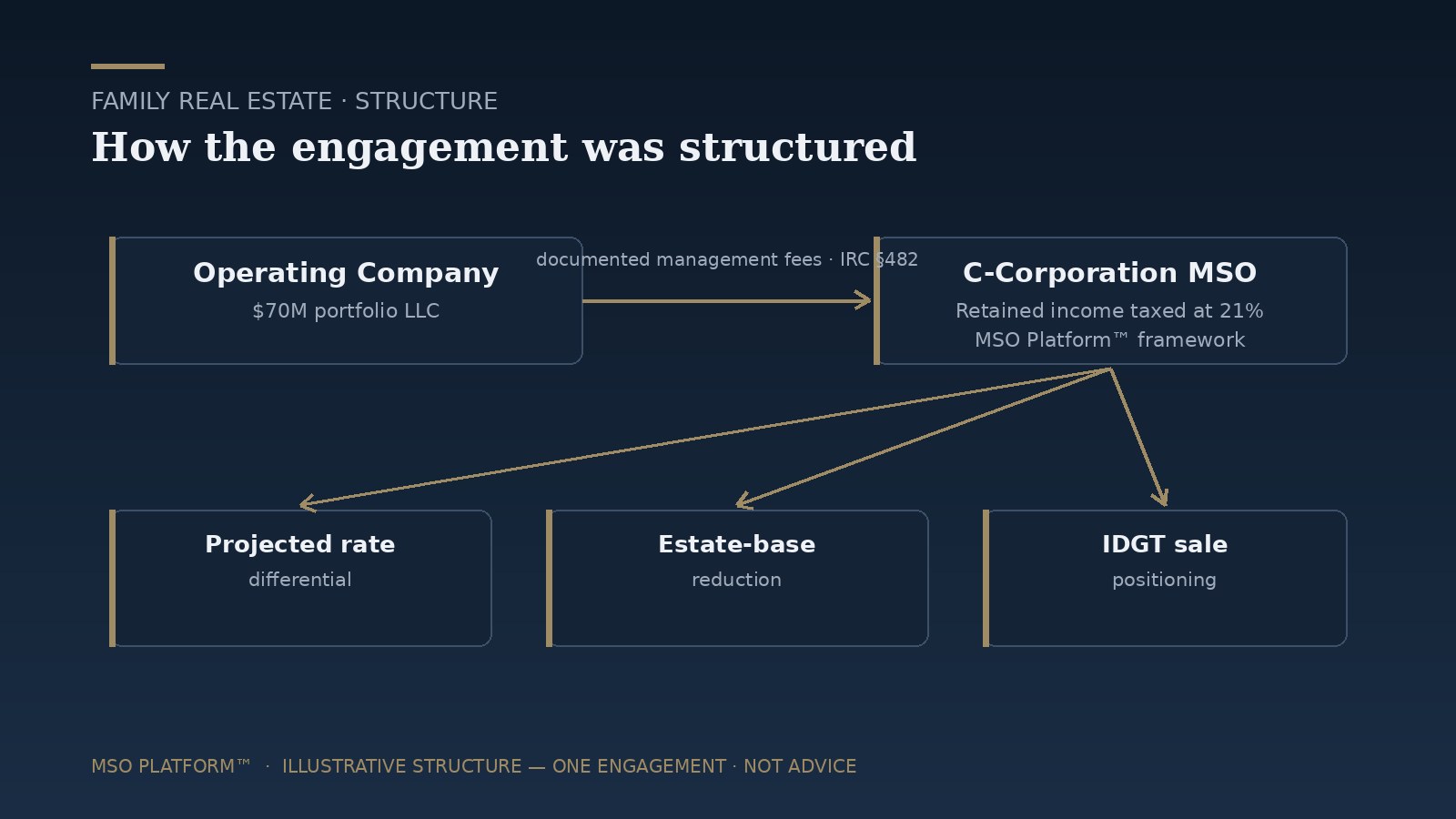
Guardian Tax Consultants® implemented a two-part design coordinated with estate counsel. First, a Management Service Organization owned by the son — structured as a C corporation under the MSO Platform™ framework — manages the $70 million portfolio for a documented annual fee of $1 million, benchmarked to the services performed. The fee is taxed at the MSO’s 21% corporate rate rather than the client’s 40% personal rate, and each properly supported fee payment also reduces the amount otherwise retained in the client’s taxable estate. Second, working with counsel, the real estate was positioned for sale to a dynasty trust structured as an intentionally defective grantor trust (IDGT), at a value reflecting a 30% appraisal-supported discount for lack of control and marketability.
Substantiation and Governance
The management fee is supported by contemporaneous functional analysis and transfer pricing benchmarking, documented for the trustee’s file and the CPA of record. The IDGT sale depends on a qualified independent appraisal supporting the discount, and on trust documents prepared and reviewed by estate counsel. The design is intended to be read comfortably by a trustee, an examiner, or successor counsel decades from now.
Record reviewed: management-fee benchmarking file, trustee documentation, appraisal file, IDGT sale documents, note documents, estate-counsel memoranda, and CPA-of-record file.
Projected Outcomes
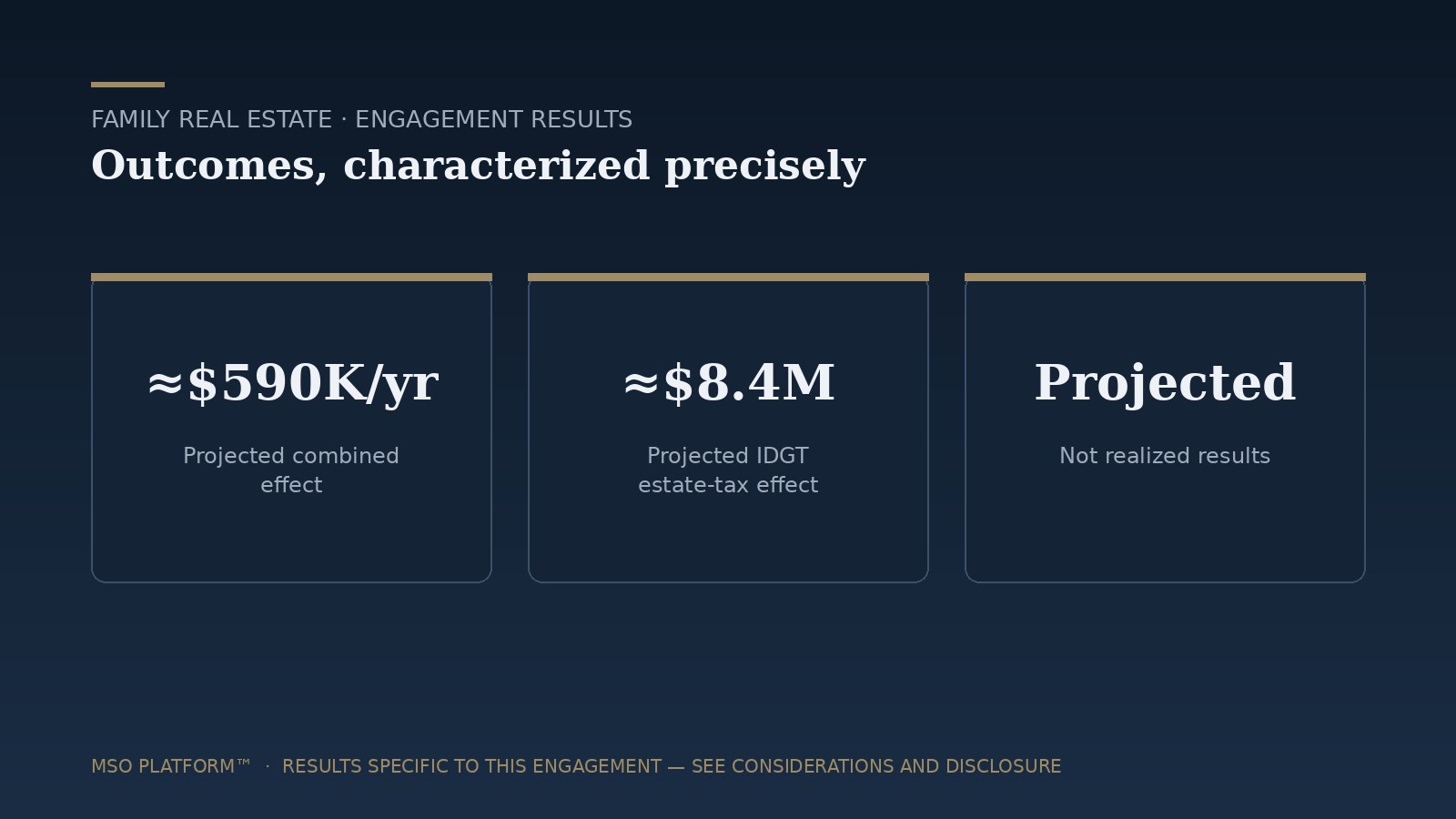
Projected figures are based on current assumptions and are not realized results; all are specific to this engagement.
Projected income-tax effect. The management fee arrangement is projected to produce approximately $190,000 per year of rate differential — the difference between tax on the fee at the client’s 40% rate and at the MSO’s 21% rate.
Projected estate-tax effect of the fee. Each properly supported $1 million fee reduces the amount otherwise retained by the senior generation, producing a modeled estate-tax effect of approximately $400,000 at a 40% rate — approximately $590,000 annually combined, or $2.95 million over five years — before considering survival period, future asset use, law changes, retained-control issues, and other estate-administration variables.
Projected IDGT effect. If sustained, a 30% appraisal-supported valuation discount on a $70 million portfolio would reduce the transfer value by approximately $21 million — before considering note economics, retained-control analysis, and examination risk — a projected estate-tax effect of approximately $8.4 million on the same modeled basis.
The combined five-year projected tax effect, based on current assumptions, was approximately $11.35 million before considering implementation cost, ongoing administration, appraisal risk, note economics, and counsel review. These components are different in kind — an annual rate differential, an annual estate-base reduction, and a one-time valuation position — and are presented separately for that reason.
A written feasibility review against your own facts is the first step of every engagement. The initial review is no-cost; the written analysis follows within six weeks of receiving the required materials. Inquire about partnership.
Related Reading
- MSO Case Studies: the full library
- The Dynasty Trust MSO: Estate Tax Planning After the Exemption Is Used Up
- Real Estate MSOs: Property-Level Tax Benefits, Service Income, and Governance
- How MSO Management Fees Are Calculated
- Handler Thayer MSO Tax Memorandum
- Real Estate Development MSO Case Study: Centralized Management and Estate Liquidity
Frequently Asked Questions
How can an MSO formalize next-generation management of family real estate?
By documenting the services, authority, and compensation of the family member already managing the portfolio in substance, with the fee benchmarked to the work performed and recorded for the trustee’s file.
How does transfer pricing apply to a family MSO?
Related-party management fees must reflect arm’s-length compensation for services actually performed, supported by functional analysis and benchmarking maintained contemporaneously. In a family context the discipline matters more, not less: the examiner’s first question is whether the fee reflects real work at a market price, and the answer should already be documented in the trustee’s file before it is asked.
What is an IDGT sale?
A sale of assets to an intentionally defective grantor trust, typically at an appraised value reflecting discounts for lack of control and marketability, moving future appreciation outside the taxable estate. It depends on qualified independent appraisal and counsel-drafted documents.
Why are the figures in this case study projections?
Because they depend on valuation outcomes, appraisal quality, continued fee support, grantor-trust status, and law in effect at death — none of which is realized until the events occur.
Assumptions and Methodology
Facts are sanitized and figures rounded to preserve client confidentiality. Deferral figures represent the rate differential on documented management fees retained in the MSO — the owners’ marginal rate less the 21% corporate rate, applied to the fee for the period stated — and are not permanent savings; amounts later distributed bear shareholder-level tax. Here, the rate differential is computed directly in the text — 40% versus 21% on a $1 million benchmarked fee — and every figure on this page is a projection under current assumptions.
Rate assumptions reflect federal law in effect during the engagement period; figures are rounded.
Considerations
These figures are projections, not realized results. Valuation discounts are examination-sensitive and stand or fall on appraisal quality. The management fee must track services actually performed by the MSO. Grantor trust status, basis consequences at death, and the interaction of the sale note with the estate all require ongoing counsel review. The client’s absence of insurance remains a liquidity consideration independent of these structures.
Two further considerations are named because counsel weighs them in every design of this kind: the installment note received on the IDGT sale remains an asset of the estate — the projected effect derives from the valuation discount and the shifting of post-sale appreciation, not from removing the full sale value — and assets sold to the trust forgo the basis adjustment at death that retained assets would receive. Retained-enjoyment exposure under §2036 requires that the senior generation’s use and control remain consistent with the transfer; the senior generation should not retain informal control, personal economic benefit, or use of transferred assets inconsistent with the sale and trust documents.
State income and franchise taxes vary by jurisdiction and can widen or narrow the modeled spread; figures tie to the assumptions stated above.
The fee must be paid only for services actually performed, at a rate supportable by third-party market evidence; excess compensation could be challenged as a gift, constructive transfer, or non-arm’s-length shifting of estate value — a further reason the benchmarking file, not the tax objective, sets the fee.
The fee, retained-earnings position, intercompany balances, insurance funding, and business-purpose file should be reviewed annually with the CPA of record and counsel.
This case study describes one engagement and is provided for educational purposes only. It is not tax, legal, or investment advice, and results are not representative of every engagement. Outcomes depend on each client’s facts, the services actually performed, documentation quality, and applicable law. Any strategy should be reviewed with the client’s own tax and legal advisors. Guardian Tax Consultants® does not prepare or sign client income tax returns; management fee arrangements are documented and benchmarked to support the position taken by the CPA of record.
Evaluate this structure against your own facts
Every engagement begins with a written feasibility report, coordinated with your CPA of record and counsel. The initial review is no-cost; the written analysis follows within six weeks of receiving the required materials.